Signer vs Signor difference helps English learners understand two similar words with different meanings and avoid confusion in daily writing. The Signer and Signor pair of words may appear almost the same, but their uses are different. Signer is an English noun for a person who signs a document, contract, agreement, or petition, while Signor is an Italian title used to address or refer to a man, similar to Mr. in English.
With my experience in language learning and editing, I find that clear definitions, practical examples, and simple memory tricks help writers choose the correct word with confidence. Signer commonly appears in legal, business, and official documents, including legal documents, bank authorizations, banking documents, business agreements, formal letters, and notarized documents, where a signature validates information.
Signor is mainly used in Italian names, greetings, literature, and cultural contexts, such as Signor Rossi and Signor Giovanni, where it acts as a respectful Italian honorific for men used politely. This guide explains the distinction through clear examples and real-world examples so people and professionals can use each term correctly, confidently, and accurately in everyday use, social media posts, emails, and professional writing situations while avoiding common errors, embarrassing mistakes, hesitation, and serious misunderstanding.
Quick Answer
Signer is the correct word when you mean a person who signs a document, agreement, form, or other written material.
Signor is an Italian title that means “Mr.” or “sir.” It is used before a man’s name, similar to how English speakers use “Mr.”
| Word | Meaning | Language Origin | Example |
| Signer | A person who signs something | English | The signer approved the contract. |
| Signor | A respectful title for a man | Italian | Signor Rossi owns the company. |
A simple way to remember the difference:
- Signer = someone who signs
- Signor = Italian title for a man
What Does Signer Mean?
The word signer is a noun that refers to someone who signs something. It comes directly from the verb sign, which means to write your name, mark, or approval on a document.
The suffix “-er” often creates a noun that describes a person who performs an action.
For example:
| Verb | Person Who Performs the Action |
| Teach | Teacher |
| Write | Writer |
| Drive | Driver |
| Sign | Signer |
So, a signer is simply a person who performs the action of signing.
For example:
- The signer must verify their identity before completing the agreement.
- Every signer received a copy of the contract.
- The document requires three authorized signers.
The word is common in legal, business, and administrative writing because many documents require one or more people to officially approve information.
Common Uses of the Word Signer
Signer in Legal Documents
In legal settings, a signer is the person who places their signature on an official document.
Contracts, agreements, and forms often identify individuals who have signing authority.
Examples include:
- Contract signer
- Authorized signer
- Primary signer
- Co-signer
For example:
The authorized signer has permission to approve financial transactions on behalf of the company.
Here, signer does not describe a job title. It simply identifies the person who has the authority to sign.
Read More: Bright vs Brite: Which Spelling Is Correct?
Signer in Business Communication
Businesses often use the word signer when discussing agreements, approvals, and responsibilities.
For example:
- The signer accepted the terms and conditions.
- Each signer must review the agreement carefully.
- The company requires an additional signer for large transactions.
In professional communication, using signer creates a clear connection between a person and a document.
Signer in Digital Documents
Modern technology has expanded the use of the word signer. Today, many documents are signed electronically through digital platforms.
A digital signer may approve:
- Online contracts
- Electronic forms
- Business agreements
- Government applications
For example:
The digital signer completed the verification process before submitting the online agreement.
The meaning remains the same. A signer is still the person who provides approval through a signature.
What Does Signor Mean?
The word signor is an Italian title used when addressing or referring to a man. It is similar to the English titles Mr. or sir.
The word comes from Italian signore, which has historical connections with words meaning “lord” or “master.”
In modern Italian, signore is the standard spelling. The English form signor is often used when writing about Italian culture, literature, music, history, or formal situations.
Examples:
- Signor Bianchi arrived at the meeting.
- The letter was addressed to Signor Marco Rossi.
- Signor Ferrari was known for his artistic work.
Unlike signer, the word signor has nothing to do with signing a document.
How Signor Is Used in English Writing
Although signor is borrowed from Italian, English writers sometimes use it when they want to maintain an Italian style or refer to Italian traditions.
Common situations include:
- Historical books
- Opera discussions
- Italian novels
- Cultural articles
- Formal references to Italian men
For example:
Signor Antonio presented his research at the international conference.
Here, Signor functions as a title, not as a description of an action.
Key Differences
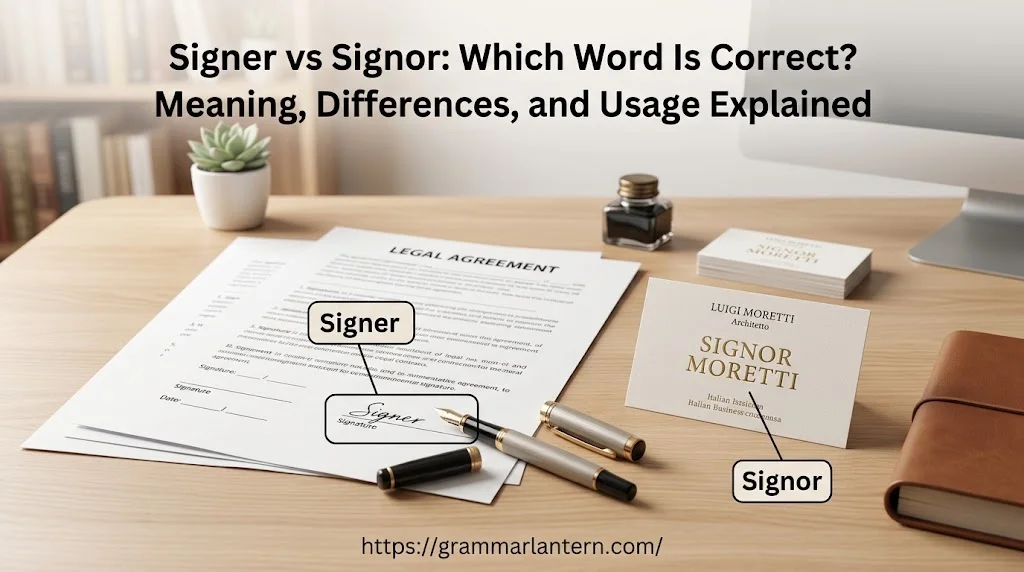
The biggest difference between signer and signor is their meaning.
A signer performs an action. A signor is a title.
| Feature | Signer | Signor |
| Meaning | Person who signs | Italian title for a man |
| Word Type | Noun | Title/noun |
| Origin | English | Italian |
| Related Word | Sign | Signore |
| Common Context | Contracts, documents, agreements | Italian names and culture |
| Example | The signer completed the form. | Signor Luca attended the event. |
The spelling similarity is accidental. These words developed from different linguistic backgrounds.
Pronunciation Difference
Pronunciation is another area where these words differ.
Signer
Signer is usually pronounced:
SY-ner
Example:
The signer completed the paperwork.
Signor
Signor is commonly pronounced:
seen-YOR
Example:
Signor Giovanni entered the room.
The different pronunciation reflects their different origins.
Why Do People Confuse?
Many learners confuse these words because they share several letters.
The first four letters are identical:
sign
However, similar spelling does not always mean similar meaning.
English has many examples of words that look related but are not:
- Flower vs flour
- Pair vs pear
- Right vs write
Signer and signor follow the same pattern.
Different Word Origins
The word signer comes from English grammar:
Sign + er = signer
It describes someone who does an action.
The word signor comes from Italian:
Signore = Mr./sir
It works as a respectful form of address.
Understanding word origins makes it easier to remember the difference.
Examples in Sentences
Seeing these words in real sentences makes their meanings clearer.
Correct Examples of Signer
- The signer agreed to all contract conditions.
- Each signer must provide identification.
- The signer added their signature at the bottom of the page.
- The legal document requires two authorized signers.
Correct Examples of Signor
- Signor Romano owns a traditional Italian restaurant.
- The museum displayed paintings created by Signor Bellini.
- Signor Marco visited the city during the summer.
Incorrect Examples and Corrections
| Incorrect Sentence | Correct Sentence | Explanation |
| The signor signed the agreement. | The signer signed the agreement. | A person who signs is a signer. |
| The signer Rossi arrived. | Signor Rossi arrived. | Signor is a title before a name. |
Signer vs Signatory: What Is the Difference?
Another common confusion is between signer and signatory.
Both words relate to signing, but they are not always interchangeable.
A signer is anyone who signs something.
A signatory is usually a person, organization, or country that officially signs an important agreement.
| Word | Meaning | Example |
| Signer | Person who signs a document | The signer completed the form. |
| Signatory | Official participant in an agreement | The countries became signatories of the treaty. |
For everyday documents, signer is usually the more natural choice.
Related Words Connected to Signer
Several English words connect to the idea of signing.
Signature
A signature is the written name or mark used to show approval.
Example:
Please add your signature at the bottom of the page.
Signatory
A signatory is an official signer of an agreement.
Example:
The organization became a signatory of the international agreement.
Co-signer
A co-signer is someone who signs an agreement together with another person.
Example:
The bank required a co-signer before approving the loan.
Related Words Connected to Signor
Because signor comes from Italian, it connects with other honorific words from Romance languages.
| Language | Word | Meaning |
| Italian | Signore | Mr./sir |
| Spanish | Señor | Mr./sir |
| French | Monsieur | Mr./sir |
These words show how many languages developed similar ways to respectfully address people.
How to Remember Easily
A simple memory trick can prevent confusion:
Signer has “-er,” which often means a person who does something.
Examples:
- Runner runs.
- Writer writes.
- Signer signs.
Signor sounds closer to “sir.”
So:
- The signer signs.
- The signor is addressed.
This small connection makes the difference easier to remember.
Read More: Plushie or Plushy: Which Spelling Is Correct?
FAQs
1. What is the main difference between Signer and Signor?
Signer refers to a person who signs a document, contract, agreement, or official paper. Signor is an Italian title used to respectfully address a man, similar to “Mr.” in English.
2. Is Signer a correct English word?
Yes, Signer is a correct English noun. It describes someone who signs a document, agreement, petition, or other written material requiring a signature.
3. Is Signor an English word?
Signor comes from Italian. Although it appears in English writing, especially in literature and cultural contexts, it is originally an Italian honorific used for men.
4. Why do people confuse Signer and Signor?
People often confuse these words because they have similar spelling and pronunciation. However, they have different origins, meanings, and uses.
5. When should I use Signer in a sentence?
Use Signer when talking about someone who officially signs something, such as a contract, legal document, bank authorization, or agreement.
6. When should I use Signor in a sentence?
Use Signor when referring to or addressing an Italian man politely, such as Signor Rossi or Signor Giovanni.
7. Are Signer and Signor pronounced the same way?
No, their pronunciation is different. Signer follows English pronunciation rules, while Signor follows Italian pronunciation patterns.
8. Can using Signer instead of Signor change the meaning?
Yes, using the wrong word can change the meaning completely. One refers to a person who signs documents, while the other is a respectful Italian title.
9. Where is Signer commonly used?
Signer is commonly used in legal, business, and official contexts, including contracts, formal letters, agreements, and notarized documents.
10. How can I remember the difference between Signer and Signor?
Remember that Signer contains “sign,” which relates to signing papers, while Signor is connected with Italian names and polite forms of address.
Conclusion
Understanding the difference between Signer vs Signor helps you avoid mistakes in professional writing, legal documents, and everyday communication. Although these words look similar, their meanings and purposes are completely different. Signer relates to a person who signs something, while Signor is an Italian title used for men.
Learning their definitions, contexts, and examples makes it easier to choose the correct term confidently. Whether you are writing an email, preparing a formal document, or reading Italian-related content, knowing when to use Signer and Signor improves your language accuracy and communication skills.