
When dealing with Series or Series’s or Series’, it helps to understand the noun individually rather than follow one standard rule for every noun. In this article, series can be used as a singular noun, and its correct singular possessive form is series’s. For example, “The series’s final episode was popular” clearly shows ownership or possession. Although some people use series’, series’s is the preferred form for singular possessive usage.
The plural possessive form is slightly different. When series refers to more than one, series’ can be used to show possession. However, series’s is not the correct form when the meaning is plural. These rules make the distinction between singular and plural clearer. The apostrophe in series’ and the apostrophe-s in series’s help show the intended possessive form.
In English grammar, context is important when choosing the right form. Good writing should make the meaning clear by considering the surrounding word, words, and sentence. This approach makes grammatical usage easier to understand and helps readers determine whether an expression refers to one series or several.
The Quick Answer
Before getting into the finer points, here’s the practical answer.
| Form | Use | Example |
| series | Singular noun | The series is popular. |
| series | Plural noun | Several series are popular. |
| series’s | Singular possessive | The series’s finale was excellent. |
| series’ | Plural possessive | The series’ finales were different. |
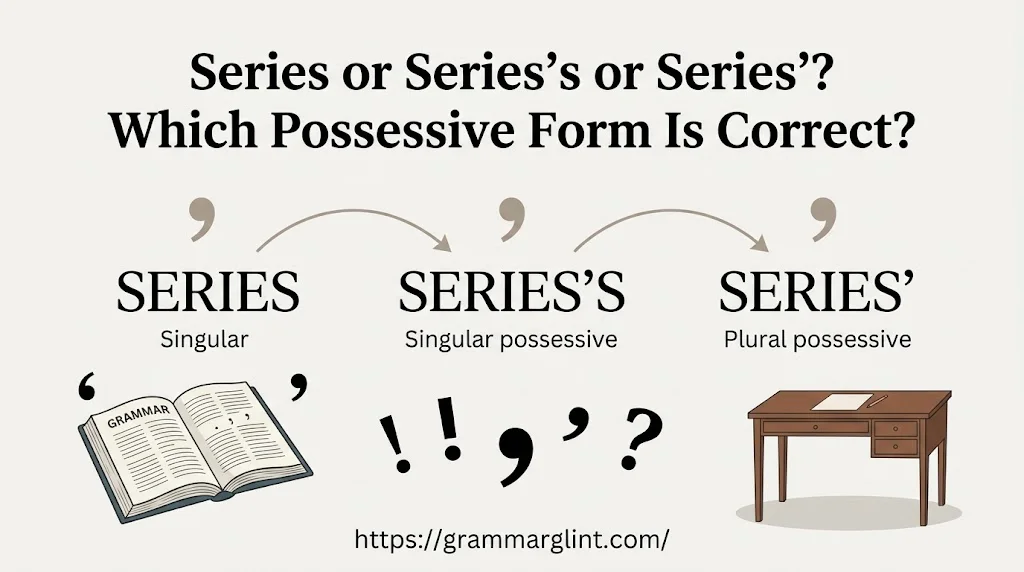
So, if you’re talking about one series and showing possession, use series’s under the standard singular possessive rule.
The series’s finale surprised everyone.
If you’re talking about multiple series, use series’.
The series’ finales aired in different months.
The tricky part is that series’ can also appear as a singular possessive in some style systems. That’s why you may see both the series’s finale and the series’ finale in edited English.
The important thing is to understand the grammatical distinction before worrying about stylistic preference.
What Does “Series” Mean?
The noun series refers to a group of related things arranged in sequence or connected by a common feature.
The word has many everyday uses. You might talk about:
- a television series
- a book series
- a lecture series
- a series of experiments
- a series of meetings
- a series of photographs
- a series of events
- a series of games
- a series of numbers
- a series of articles
That last point matters enormously.
Unlike book/books or episode/episodes, the word doesn’t change when you move from singular to plural.
Read More: As Well vs. Aswell: Complete Grammar Guide
Series as a Singular Noun
When you mean one series, series is singular.
For example:
- This series is excellent.
- The series has eight episodes.
- That series was released last year.
- The book series contains five novels.
- This lecture series begins Monday.
Notice the verbs:
- series is
- series has
- series was
- series contains
The singular meaning controls the verb.
The word itself doesn’t need a different spelling.
Series as a Plural Noun
When you mean two or more series, the spelling remains series.
For example:
- Several series are available.
- These series have different themes.
- Two series were canceled.
- The three series are unrelated.
- Several book series appeal to younger readers.
Here, series is plural even though nothing has changed in its spelling.
That gives us an unusual pattern:
| Number | Noun |
| One | series |
| Two | series |
| Ten | series |
| Several | series |
Context does the heavy lifting.
Why “Series” Causes So Much Confusion
Most English nouns give you a visual clue about number.
Consider these examples:
| Singular | Plural |
| book | books |
| show | shows |
| class | classes |
| episode | episodes |
| story | stories |
Now compare series:
| Singular | Plural |
| series | series |
There’s no spelling change.
That creates a problem when you want to make the noun possessive. You first have to determine whether series is singular or plural.
Consider these two sentences:
The series’s creator won an award.
The series’ creators won awards.
The apostrophe pattern looks different because the underlying nouns have different grammatical numbers.
The first sentence discusses one series.
The second discusses multiple series.
That’s the key distinction.
Is “Series’s” Correct?
Yes. Series’s is grammatically correct as a singular possessive form.
The standard rule for singular nouns generally says to add ’s to form the possessive.
That rule doesn’t disappear just because a singular noun already ends in s.
For example:
- class → class’s
- business → business’s
- witness → witness’s
- address → address’s
- series → series’s
So the formation is simple:
series + ’s = series’s
Examples of “Series’s”
Here are several natural examples:
- The series’s finale divided viewers.
- The series’s creator announced a sequel.
- The series’s popularity grew rapidly.
- The series’s storyline became more complex.
- The series’s main character changed dramatically.
- The series’s production schedule was demanding.
- The series’s first season received strong reviews.
- The series’s central theme became clearer later.
In every example, one particular series has a relationship with the noun that follows.
For instance:
The series’s finale
means:
the finale of the series
Likewise:
The series’s creator
means:
the creator of the series
This “of” test can help you understand what the possessive construction means.
Why Does “Series’s” Look So Strange?
Let’s be honest: series’s isn’t the prettiest word on the page.
The repeated s can make writers hesitate.
You might look at:
series’s
and think it must be wrong because it feels visually clumsy.
But grammar doesn’t work according to visual elegance.
English contains plenty of possessives with repeated or doubled sounds:
- class’s
- boss’s
- business’s
- witness’s
- actress’s
- princess’s
The spelling may look awkward, yet the construction can still follow the regular singular possessive rule.
So don’t reject series’s merely because your eyes don’t like it.
Grammar sometimes wears ugly shoes.
Is “Series’” Correct?
Yes, series’ is correct as the plural possessive form.
When series refers to multiple series, the noun is already plural. Since its plural form ends in s, you normally add only an apostrophe.
The pattern looks like this:
plural series + apostrophe = series’
For example:
The series’ finales were released months apart.
Here, you’re talking about more than one series.
Each series has a finale, so the possessive noun is plural.
Examples of Plural “Series’”
- The series’ creators attended the conference.
- The series’ endings were completely different.
- The series’ characters shared several traits.
- The series’ release dates overlapped.
- The series’ audiences varied considerably.
- The series’ storylines followed different directions.
- The series’ ratings improved during the second season.
The context tells you that series is plural.
Words such as several, many, these, those, and both can make that especially clear.
For example:
Both series’ creators attended the event.
The word both tells you that two series exist.
Therefore, series’ is the plural possessive form.
Series’s vs. Series’: What’s the Difference?
This is where the entire issue becomes much easier.
The difference is fundamentally about number.
One Series: Series’s
Use series’s when one series has or is associated with something.
The series’s finale was emotional.
There is one series.
There is one finale associated with it.
Multiple Series: Series’
Use series’ when multiple series have or are associated with something.
The series’ finales were emotional.
There are multiple series.
Each one has a finale.
The difference becomes clearer when you compare the sentences side by side.
| Meaning | Correct form | Example |
| One series | series’s | The series’s finale was delayed. |
| Multiple series | series’ | The series’ finales were delayed. |
| One series | series’s | The series’s creator spoke publicly. |
| Multiple series | series’ | The series’ creators spoke publicly. |
| One series | series’s | The series’s audience grew. |
| Multiple series | series’ | The series’ audiences grew. |
The noun after the possessive can also provide an important clue.
Compare:
The series’s finale
with:
The series’ finales
The singular finale fits one series.
The plural finales suggests multiple series.
However, don’t rely on the following noun alone. Always consider the entire sentence.
A Simple Trick for Choosing “Series’s” or “Series’”
When you’re unsure, ask one question:
How many series am I talking about?
If the answer is one, use the standard singular possessive:
series’s
If the answer is more than one, use the plural possessive:
series’
Here’s the shortcut:
One → series’s
Two or more → series’
For example:
The series’s ending shocked me.
One series has an ending.
Now:
The series’ endings shocked me.
Multiple series have endings.
That tiny distinction solves most cases.
How to Tell Whether “Series” Is Singular or Plural
Because series looks identical in both forms, you need to examine its context.
Fortunately, English gives you several clues.
Look at the Determiner
Words before series often reveal the number.
Singular:
- this series
- that series
- one series
- a series
- each series
Plural:
- these series
- those series
- several series
- many series
- two series
- both series
- multiple series
Compare:
This series is popular.
One series.
These series are popular.
Multiple series.
The spelling stays the same, but the surrounding words reveal the number.
Look at the Verb
The verb can also reveal whether series is singular or plural.
Singular:
1.The series is popular.
2.The series has six episodes.
3.The series was renewed.
Plural:
1.The series are popular.
2.The series have different formats.
3.The series were released separately.
The verb acts like a grammatical signpost.
When the noun itself refuses to change, that signpost becomes especially useful.
The Special Case of “A Series Of”
One construction deserves extra attention:
a series of
Writers sometimes see a plural noun after of and assume the entire phrase must be plural.
That’s not usually correct.
Consider:
A series of experiments is underway.
The noun experiments is plural.
However, a series is singular.
You’re talking about one series made up of multiple experiments.
The same pattern appears in:
- A series of meetings is scheduled.
- A series of tests was conducted.
- A series of articles has been published.
- A series of events is planned.
Compare Singular and Plural Constructions
| Construction | Number of series | Correct verb |
| A series of tests | One | is |
| One series of tests | One | is |
| Several series of tests | More than one | are |
| Two series of experiments | More than one | are |
| Multiple series of events | More than one | are |
This distinction becomes particularly useful when you’re deciding between series’s and series’.
For example:
A series’s results were published.
This refers to one series.
But:
Several series’ results were published.
This refers to multiple series.
Can “Series’” Be Singular Possessive?
Yes, depending on the style convention.
This is the part that often gets flattened into an overly simple grammar rule.
Some writers and style systems use series’ for singular possession because the noun already ends in s. Under that convention, you might see:
The series’ finale was excellent.
Here, series refers to one series.
Other style systems prefer:
The series’s finale was excellent.
So it would be misleading to say that series’ can never be singular possessive.
It can be, depending on the editorial system.
Why the Difference Exists
English punctuation has accumulated conventions over centuries. Different style traditions have made slightly different choices about nouns ending in s.
Some writers prioritize a straightforward visual form:
series’
Others prioritize a consistent grammatical pattern:
series’s
Neither spelling changes the underlying meaning when the context clearly identifies one series.
The important editorial rule is consistency.
If your publication uses series’ for singular possessives, don’t randomly switch to series’s elsewhere.
Series’s or Series’: Which One Should You Use?
If you’re writing without a specific style guide, series’s is the clearest choice for singular possession under the standard singular-noun rule.
For example:
The series’s final episode was excellent.
For plural possession:
The series’ final episodes were released separately.
If your employer, university, publisher, or publication follows a particular style guide, follow that guide instead.
A Practical Recommendation
| Situation | Recommended form |
| One series, no possession | series |
| Multiple series, no possession | series |
| One series, possessive | series’s |
| Multiple series, possessive | series’ |
| Style guide specifically prefers singular series’ | Follow that guide |
This approach gives you a reliable default without pretending that every English style manual makes identical choices.
Examples in Context
Rules become much easier to remember when you see them in realistic sentences.
Television
Singular:
The series’s finale attracted millions of viewers.
One television series has one finale.
Plural:
The series’ finales aired during the same week.
Multiple television series have separate finales.
Books
Singular:
The series’s first novel introduced the central conflict.
One book series is being discussed.
Plural:
The series’ first novels were published by different companies.
Multiple book series are involved.
Education
Singular:
The lecture series’s final session takes place Friday.
One lecture series has a final session.
Plural:
The lecture series’ schedules overlap this semester.
Multiple lecture series have separate schedules.
Research
Singular:
The research series’s methodology remained consistent.
One research series is being discussed.
Plural:
The research series’ methodologies differed significantly.
Multiple research series used different methodologies.
Sports
Singular:
The series’s deciding game attracted a huge audience.
One sports series has a deciding game.
Plural:
The series’ deciding games took place on different dates.
Multiple series had deciding games.
Common Mistakes With Series Possessives
The unusual spelling of series creates several recurring errors.
Mistake: Writing “Serieses”
A common assumption is that the plural of series should be serieses.
That’s not standard English.
The plural is simply:
series
For example:
- one series
- two series
- several series
- many series
Mistake: Using “Series’s” for Multiple Series
Consider:
❌ The series’s finales were different.
If you’re talking about several series, this construction doesn’t express the standard plural possessive.
Better:
✅ The series’ finales were different.
The plural noun is already series, so the possessive marker goes after the existing plural ending.
Mistake: Assuming Every “Series’” Is Plural
This assumption is too rigid.
For example:
The series’ finale was excellent.
Depending on the style convention, this can represent singular possession.
If the writer follows a system that uses ’s for singular nouns ending in s, the preferred version would be:
The series’s finale was excellent.
The surrounding context alone may not tell you which editorial convention the writer follows.
Mistake: Adding an Apostrophe to Make a Plural
Don’t write:
❌ I watched three series’.
The apostrophe isn’t needed.
Write:
✅ I watched three series.
The noun is already plural.
An apostrophe generally signals possession or contraction. It isn’t the ordinary way to create a plural.
Series’s vs. Series’: A Case Study
Consider this short passage:
The series’s creator praised the series’ creators.
At first, the sentence may look strange.
However, it can be grammatically meaningful.
The first phrase:
the series’s creator
refers to one series.
The second phrase:
the series’ creators
refers to multiple series.
You can make the contrast even clearer:
The series’s creator praised the creators of several other series.
The rewritten version removes the potentially ambiguous plural possessive.
This illustrates an important writing principle:
Grammar and clarity aren’t always the same thing.
A construction can be grammatical while still making readers pause.
Good editing considers both.
When Rewriting Is Better Than Using a Possessive
Sometimes series’s can look visually cumbersome, particularly when several possessive constructions appear close together.
For example:
The series’s creator’s comments caused controversy.
Technically, the sentence can work. But two possessives in a row make the structure harder to process.
A cleaner alternative is:
The comments from the series’s creator caused controversy.
Or:
Comments from the creator of the series caused controversy.
The goal isn’t to avoid series’s at all costs.
Instead, rewrite when the sentence becomes unnecessarily dense.
Useful Alternatives
You can sometimes replace a possessive with:
- the series’s → of the series
- the series’s creator → the creator of the series
- the series’s ending → the ending of the series
- the series’s popularity → the popularity of the series
For example:
The series’s ending surprised critics.
can become:
The ending of the series surprised critics.
Both are grammatical.
The second simply distributes the information more evenly.
Series Possessive Rules at a Glance
Here’s the entire system in one table.
| What you mean | Form | Example |
| One series | series | This series is excellent. |
| Multiple series | series | These series are excellent. |
| One series possessing something | series’s | The series’s finale was excellent. |
| Multiple series possessing something | series’ | The series’ finales were excellent. |
| Singular possessive under an apostrophe-only style | series’ | The series’ finale was excellent. |
The most important question isn’t “Does the word end in s?”
Instead, ask:
“Is the noun singular or plural?”
That question gets you much closer to the correct form.
A Quick Decision Guide for “Series,” “Series’s,” and “Series’”
Use this process whenever you hesitate.
First, ask whether you’re talking about one series
If yes:
- No possession → series
- Possession → series’s under the standard singular rule
Example:
The series is popular.
The series’s popularity is growing.
Next, ask whether you’re talking about multiple series
If yes:
- No possession → series
- Possession → series’
Example:
Several series are popular.
The series’ ratings are increasing.
Finally, check your style guide
If your publication follows a convention that uses series’ for singular possession, use that form consistently.
This three-step method is much safer than memorizing isolated examples.
How Other Nouns Help Explain the Rule
The grammar becomes clearer when you compare series with ordinary nouns.
Consider class.
One class:
class
Singular possessive:
class’s
Multiple classes:
classes
Plural possessive:
classes’
Now compare series:
One series:
series
Singular possessive:
series’s
Multiple series:
series
Plural possessive:
series’
The difference is that series doesn’t change its spelling in the plural.
That’s why the possessive question feels harder.
The underlying grammar hasn’t become radically different. The noun simply doesn’t give you the visual clue that ordinary nouns provide.
Why Context Matters More With “Series”
Consider this sentence:
The series are popular.
The plural verb are tells you that more than one series is being discussed.
Now consider:
The series is popular.
The singular verb is tells you that one series is being discussed.
The noun hasn’t changed.
That’s why English readers constantly use surrounding words to interpret series.
The same principle applies to possessives.
Compare:
The series’s ending
and:
The series’ endings
The first points toward one series.
The second points toward multiple series.
In ambiguous cases, additional context removes the uncertainty.
Read More: Incall vs Outcall: Understanding the Difference, Benefits and Costs
FAQs
1. Is “series’s” grammatically correct?
Yes. Series’s is the standard singular possessive form when series refers to one series.
2. Is “series’” also correct?
Yes. Series’ can be used as the plural possessive form when series refers to more than one series.
3. What is the singular possessive of “series”?
The singular possessive form is series’s.
4. What is the plural possessive of “series”?
The plural possessive form is series’.
5. Can “series’s” be plural possessive?
No. Series’s should not be used as the plural possessive form.
6. Why does “series” cause confusion?
The word series has the same spelling for both singular and plural forms, making its possessive usage confusing.
7. Is “series’s” or “series’” preferred for one series?
Series’s is preferred when referring to the possession of one series.
8. How do I know which possessive form to use?
Look at the context. If you mean one series, use series’s. If you mean multiple series, use series’.
9. Is “series” singular or plural?
Series can be either singular or plural. The surrounding sentence usually makes its meaning clear.
10. What is the easiest way to remember the rule?
Remember: series’s = possession belonging to one series, while series’ = possession belonging to multiple series.
Conclusion
Understanding Series or Series’s or Series’ becomes easier when you first decide whether series is singular or plural. For one series, series’s is the appropriate singular possessive form. For multiple series, series’ can be used as the plural possessive form.
The key is to pay attention to the context and meaning of the sentence. Although both forms may appear in everyday writing, knowing the difference helps you follow standard English grammar and make your writing clearer and more precise.

Muhammad Haroon is the voice behind many of the clear, practical grammar guides you’ll find on Grammar Lantern. With a strong background in content writing and a genuine love for the English language, Haroon specializes in breaking down intimidating grammar topics into simple, digestible lessons. His goal is simple: to empower readers to write with confidence and clarity. Whether he’s explaining tricky tenses or demystifying punctuation, Haroon approaches each topic with patience, precision, and a touch of warmth—because he knows that learning grammar is a journey, not a race.



[…] Read More: Series or Series’s or Series’? Which Possessive Form Is Correct? […]