“Otherwise” comma rules can seem tricky when the word connects ideas. As a conjunctive adverb, “otherwise” can show contrast, consequence, or an alternative. When it connects two independent clauses, a semicolon comes before it, while a comma follows it. However, punctuation depends on the sentence structure and how “otherwise” is used.
The same idea applies to “comma before or.” A comma does not always come before or. For example, “Would you like some tea or coffee?” does not need a comma because or connects two choices. In contrast, “You may phone me tonight, or you can write me an e-mail” uses a comma because or joins two independent clauses.
This guide explains the comma rules, common mistakes, and examples. It also compares British English and American English usage. With rules, you can understand when a comma is necessary, when it should be omitted, and how punctuation changes with sentence structure.
Quick Answer
Usually, yes after “otherwise” when it introduces a new clause, especially when it starts a sentence or follows a semicolon.
When otherwise connects two independent clauses, the traditional punctuation is:
Independent clause; otherwise, independent clause.
For example:
You should leave now; otherwise, you’ll miss the train.
You can also separate the thoughts into two sentences:
You should leave now. Otherwise, you’ll miss the train.
However, you don’t normally add a comma when otherwise directly modifies a word or phrase:
The restaurant was otherwise excellent.
She had an otherwise ordinary afternoon.
There’s also a real usage variation worth knowing. Because otherwise can mean “or else,” some writers use a comma before it when it links two clauses:
Hurry, otherwise you’ll miss the bus.
That construction appears in published English, especially in less formal prose. Still, the semicolon pattern remains the safest choice for formal and edited American writing.
Read More: Can You Start a Sentence With “Otherwise”? Complete Guide
What Does “Otherwise” Mean?
Before deciding where the comma belongs, look at what otherwise actually means.
The word has several related uses. Its punctuation changes because its grammatical job changes.
Otherwise Meaning “If Not” or “Or Else”
This is the most important use for comma questions.
Wear a coat; otherwise, you’ll get cold.
Here, otherwise means something close to “if you don’t wear a coat.”
The first clause presents an action. The second presents what happens if that action doesn’t occur.
You can think of the relationship like this:
Action → otherwise → alternative consequence
For example:
Save your document; otherwise, you could lose your work.
The implied meaning is:
Save your document. If you don’t, you could lose your work.
Otherwise Meaning “In Another Way”
Sometimes otherwise means differently.
I wouldn’t have done it otherwise.
Here, the word doesn’t connect two independent clauses. It simply describes another possible way of doing something.
No comma is needed.
Otherwise Meaning “In Other Respects”
In another common use, otherwise describes something that is acceptable or true except for one particular issue.
The apartment is small but otherwise comfortable.
The apartment has a problem with size. Apart from that, it’s comfortable.
Again, you don’t automatically put commas around otherwise.
Otherwise Meaning “Different From What Was Expected”
You may also see otherwise in phrases such as:
The evidence suggests otherwise.
The results proved otherwise.
In these sentences, otherwise means differently from what was assumed or expected.
It functions as part of the predicate rather than as a sentence connector. Therefore, no comma is normally needed.
When Do You Use a Comma After “Otherwise”?
A comma commonly follows otherwise when the word introduces a clause.
This happens particularly when otherwise appears at the beginning of a sentence or immediately after a semicolon.
Consider:
Finish the assignment today. Otherwise, you may forget about it.
The comma signals that otherwise serves as an introductory element before the main clause.
The same pattern works after a semicolon:
Finish the assignment today; otherwise, you may forget about it.
The punctuation gives the reader a clear visual break.
At the Beginning of a Sentence
When otherwise starts a sentence and means if not or in that case, a comma usually follows it.
Otherwise, the system will shut down.
Otherwise, you’ll have to wait until tomorrow.
Otherwise, the plan should work.
The comma helps separate the introductory word from the clause that follows.
After a Semicolon
When two independent clauses appear in the same sentence, the standard pattern is:
Clause 1; otherwise, Clause 2.
Examples:
- Check the address; otherwise, the package may go to the wrong location.
- Leave before rush hour; otherwise, traffic could delay you.
- Bring your identification; otherwise, you may not be allowed inside.
- Back up your files; otherwise, you could lose important data.
This is one of the most useful patterns to remember.
Do You Put a Comma Before “Otherwise”?
Here’s where the issue gets more interesting.
In traditional formal punctuation, don’t use a comma alone to join two independent clauses with otherwise.
For example:
You need to hurry, otherwise you’ll miss the train.
Many editors would replace the comma with a semicolon:
You need to hurry; otherwise, you’ll miss the train.
Or they would use two sentences:
You need to hurry. Otherwise, you’ll miss the train.
Why? Because a comma alone doesn’t provide enough separation between two independent clauses under the traditional rule.
The Comma-Before-Otherwise Variation
You may still encounter sentences like:
Hurry, otherwise you’ll be late.
This usage isn’t simply a random punctuation error. Otherwise can function with a meaning similar to “or else,” and that helps explain why some writers use a comma before it.
English dictionaries and usage references recognize this variation. However, formal copyediting generally favors the clearer semicolon construction when both sides are independent clauses.
For practical writing, the safest approach is simple:
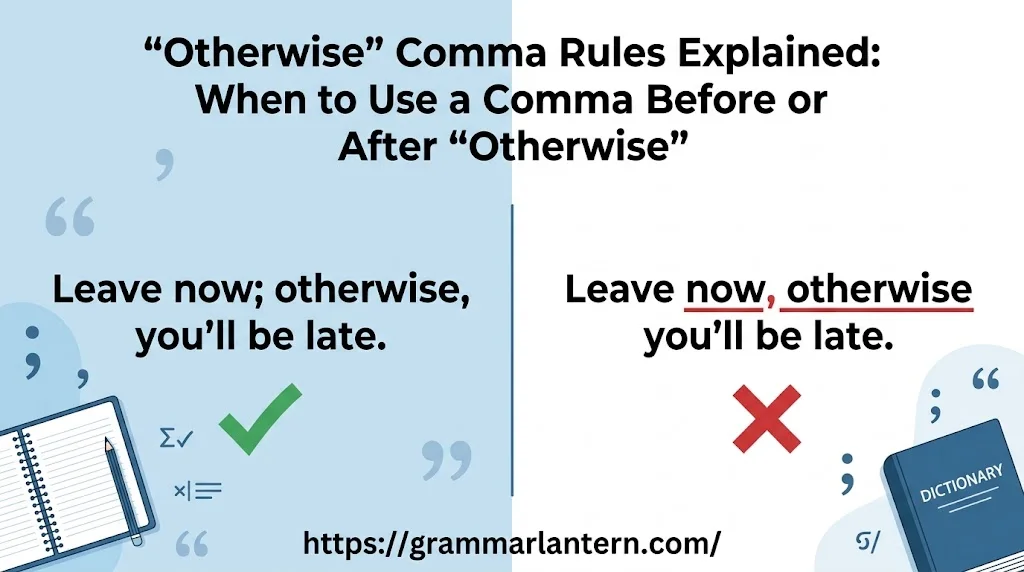
When both clauses can stand alone, use a semicolon before “otherwise.”
That choice avoids the comma-splice problem and works well in academic, professional, and formal writing.
When “Otherwise” Connects Two Independent Clauses
An independent clause can stand as a complete sentence.
Consider:
You must leave now.
That’s complete.
Now consider:
You’ll miss the train.
That’s also complete.
Put them together with otherwise:
You must leave now; otherwise, you’ll miss the train.
Both sides can stand independently. The semicolon separates them while otherwise explains their logical relationship.
The Basic Formula
Independent clause + semicolon + otherwise + comma + independent clause
Example:
Study tonight; otherwise, you may struggle on the test.
The first clause gives the recommended action. The second describes the consequence of not taking that action.
Why a Comma Alone Can Cause Trouble
This sentence uses only a comma:
You must leave now, otherwise you’ll miss the train.
Traditional formal grammar treats this as a comma splice because two independent clauses have been joined with only a comma.
A better formal version is:
You must leave now; otherwise, you’ll miss the train.
Or:
You must leave now. Otherwise, you’ll miss the train.
Both versions make the relationship clear.
When You Should Not Use a Comma After “Otherwise”
The biggest mistake is treating otherwise as if it always requires a comma.
It doesn’t.
When otherwise directly modifies an adjective or another element, a comma can create an unnecessary break.
Compare:
The room was otherwise comfortable.
with:
The room was otherwise, comfortable.
The first version is natural. The second interrupts the connection between otherwise and comfortable.
More examples include:
- The car is otherwise reliable.
- She is otherwise healthy.
- The plan seems otherwise reasonable.
- It was an otherwise ordinary day.
- The building remains otherwise intact.
In these examples, otherwise belongs closely with the word that follows or with the larger phrase.
A Useful Test
Remove otherwise from the sentence.
The room was otherwise comfortable.
becomes:
The room was comfortable.
The basic sentence remains intact. Otherwise simply adds the idea that the room was comfortable despite another condition.
Now compare:
Otherwise, the room will become uncomfortable.
Here, otherwise introduces a consequence. That’s a different grammatical job.
“Otherwise” Meaning “In Other Respects”
This use often causes unnecessary commas.
Consider:
The house is old but otherwise well maintained.
The word otherwise means “apart from that.”
The house is old. Aside from its age, it remains well maintained.
You don’t need commas around otherwise because the word fits naturally into the adjective phrase.
More examples:
The phone is expensive but otherwise excellent.
The procedure is complicated but otherwise safe.
The neighborhood is crowded but otherwise pleasant.
The instructions are long but otherwise easy to follow.
Notice the pattern. Otherwise helps qualify the description. It doesn’t introduce a new independent clause.
“Otherwise” Meaning “Differently”
When otherwise means differently, punctuation usually isn’t necessary.
These constructions are common:
- think otherwise
- believe otherwise
- assume otherwise
- suggest otherwise
- indicate otherwise
- prove otherwise
- say otherwise
Examples:
She thought otherwise.
The facts suggest otherwise.
His actions indicate otherwise.
The evidence proved otherwise.
Don’t assume otherwise.
A comma would usually be incorrect:
The facts suggest, otherwise.
The comma separates the verb from the word completing its meaning.
“Otherwise” in the Middle of a Sentence
Sometimes otherwise appears as an interrupting or parenthetical element.
In that situation, commas may set it off.
For example:
The proposal was, otherwise, difficult to defend.
Here, the writer treats otherwise as an interruption within the sentence.
However, this construction can feel formal or slightly stiff. Often, a clearer rewrite avoids the interruption altogether.
Compare:
The proposal was otherwise difficult to defend.
That version is cleaner if otherwise directly modifies the following description.
The lesson isn’t “always put commas around a middle-position otherwise.” Instead, ask whether the word acts as a genuine parenthetical interruption.
“Otherwise Known As” and Commas
The phrase otherwise known as has a specific structure.
When it introduces additional information about a person, place, or thing, commas often set the phrase apart.
For example:
Samuel Clemens, otherwise known as Mark Twain, wrote under a famous pen name.
The phrase provides an alternative name.
Another example:
The building, otherwise known as the Old Mill, has stood there for decades.
The commas show that the phrase adds extra information rather than restricting which building the sentence means.
When “Otherwise Known As” Is Part of a Larger Phrase
Context matters.
The artist otherwise known as Banksy remains widely discussed.
Here, the phrase identifies the artist through an alternative name. Removing it leaves a less specific sentence:
The artist remains widely discussed.
That distinction can affect whether the information functions as essential or nonessential.
For everyday writing, the main point is this: don’t treat every occurrence of “otherwise known as” as an automatic comma pair without considering the sentence structure.
“Otherwise” With “But,” “And,” and Other Conjunctions
You may see otherwise alongside a coordinating conjunction.
For example:
The meal was expensive but otherwise enjoyable.
Here, but already connects the relevant parts. Otherwise modifies the adjective enjoyable.
You don’t need a comma before otherwise:
The meal was expensive but otherwise enjoyable.
However, a parenthetical use can produce a different structure:
The meal was expensive but, otherwise, enjoyable.
That punctuation emphasizes otherwise as an interruption. It isn’t the normal choice for a straightforward sentence.
When the sentence reads smoothly without setting the word apart, leaving the commas out usually produces the cleaner result.
“Otherwise” vs. “Or Else”
These expressions often overlap in meaning, especially when describing consequences.
Take an umbrella; otherwise, you’ll get wet.
means roughly:
Take an umbrella, or else you’ll get wet.
However, the expressions aren’t interchangeable in every context.
Otherwise can also mean differently or in other respects. Or else doesn’t normally carry those meanings.
Compare:
The plan is otherwise sound.
You can’t naturally replace otherwise with or else here.
Likewise:
She thought otherwise.
doesn’t mean:
She thought or else.
The meaning determines the construction.
Common Mistakes
A handful of errors appear repeatedly.
Using a Comma Instead of a Semicolon
Less formal:
Finish the work, otherwise you’ll miss the deadline.
Safer formal version:
Finish the work; otherwise, you’ll miss the deadline.
Adding a Random Comma After “Otherwise”
Incorrect:
The plan is otherwise, practical.
Correct:
The plan is otherwise practical.
The comma breaks apart a phrase that doesn’t need interruption.
Assuming “Otherwise” Always Needs Commas
Incorrect:
She believed, otherwise.
Correct:
She believed otherwise.
Here, otherwise completes the meaning of the verb.
Forgetting the Comma After Sentence-Initial “Otherwise”
For formal writing, this is generally clearer:
Otherwise, the application may fail.
rather than:
Otherwise the application may fail.
The comma visually marks the introductory element.
Treating Every “Otherwise” as a Conjunctive Adverb
Otherwise has several grammatical uses. Its punctuation follows its function.
That’s why memorizing one rigid rule can actually make your writing less accurate.
A Simple Decision Process
When you’re unsure, walk through these steps.
Check the Meaning
Ask what otherwise means.
Does it mean:
- if not?
- or else?
- differently?
- in other respects?
- apart from that?
This is the first clue.
Check the Words Around It
Look at what comes before and after otherwise.
If it introduces a complete clause, stronger punctuation may be necessary.
If it directly modifies an adjective, noun phrase, or verb-related expression, you may not need a comma.
Test Both Clauses
Try turning each side into its own sentence.
You need to hurry.
You’ll miss the train.
Both are complete. Therefore:
You need to hurry; otherwise, you’ll miss the train.
The semicolon is a strong fit.
Look for a Parenthetical Interruption
If otherwise merely interrupts a sentence, commas may set it apart.
But don’t add commas just because the word appears in the middle.
At a Glance
| Use of “otherwise” | Typical punctuation | Example |
| Introduces a consequence at sentence beginning | Comma after | Otherwise, you’ll miss the train. |
| Connects two independent clauses | Semicolon before, comma after | Leave now; otherwise, you’ll be late. |
| Means “differently” | Usually no comma | She thought otherwise. |
| Means “in other respects” | Usually no comma | The plan is otherwise practical. |
| Directly modifies an adjective | No comma | It was an otherwise ordinary day. |
| Parenthetical use | Commas may surround it | The proposal was, otherwise, difficult to defend. |
| “Otherwise known as” | Often comma-set when parenthetical | John Smith, otherwise known as Jack, attended. |
Case Study: Choosing the Right Punctuation
Imagine a manager sending instructions to an employee.
The intended message is:
Submit the form today; otherwise, the request may be delayed.
Why does this work?
First, submit the form today can stand alone. Second, the request may be delayed can also stand alone. Finally, otherwise expresses the consequence of failing to follow the first instruction.
Now remove the semicolon:
Submit the form today, otherwise, the request may be delayed.
The sentence becomes awkward because the comma doesn’t adequately separate the two independent clauses in formal edited prose.
Now split the sentence:
Submit the form today. Otherwise, the request may be delayed.
That works perfectly too.
The practical lesson is simple: when two complete thoughts meet at “otherwise,” reach for a semicolon or a period.
Another Case Study: When No Comma Belongs
Consider:
The restaurant was expensive but otherwise excellent.
Here, the sentence doesn’t contain two independent clauses connected by otherwise.
Instead, otherwise excellent describes the restaurant. The meaning is essentially:
The restaurant was excellent except for its high price.
Adding a comma would interrupt that compact description:
The restaurant was expensive but otherwise, excellent.
That punctuation isn’t needed.
This example shows why the meaning and grammatical role matter more than the position of the word alone.
Examples
Warnings and Instructions
Lock the door; otherwise, anyone could enter.
Bring your ticket; otherwise, you may not get inside.
Leave early; otherwise, traffic will slow you down.
Check the figures; otherwise, the report may contain errors.
Everyday Conversation
We should call first; otherwise, they might be closed.
Take an umbrella. Otherwise, you’ll get soaked.
You’d better hurry; otherwise, we’ll miss dinner.
Formal and Professional Writing
The payment must arrive by Friday; otherwise, the order may be canceled.
Follow the stated procedure; otherwise, the results may become unreliable.
The document should remain unchanged; otherwise, the comparison may become inaccurate.
Without a Comma
The machine is otherwise reliable.
Her explanation was otherwise convincing.
The evidence suggests otherwise.
It was an otherwise normal afternoon.
The software performed well but otherwise offered few advantages.
These examples demonstrate the central point: punctuation follows function.
A Quick Rule You Can Remember
If otherwise means “if not” and connects two complete clauses, use:
Clause; otherwise, clause.
If otherwise begins a new sentence, use:
Otherwise, clause.
If otherwise means “differently” or “in other respects,” don’t automatically add a comma.
And if a comma-before-otherwise construction appears in published English, don’t assume it’s necessarily a typo. The conjunction-like use of otherwise has a recognized history in English usage. For formal writing, though, the semicolon construction offers the clearest and most conservative choice.
Read More: Stuck vs Stock: What’s the Difference?
FAQs
1. Do I need a comma before “otherwise”?
Not always. When “otherwise” connects two independent clauses, a semicolon usually comes before it and a comma follows it.
2. Should I put a comma after “otherwise”?
A comma often follows “otherwise” when it acts as a conjunctive adverb connecting ideas. However, the sentence structure determines whether the comma is necessary.
3. Can “otherwise” start a sentence?
Yes. When “otherwise” begins a sentence and introduces a contrasting result or alternative, a comma can follow it.
4. Is a semicolon needed before “otherwise”?
When “otherwise” connects two independent clauses, a semicolon is commonly used before it. For example: “Leave now; otherwise, you may miss the train.”
5. Is “otherwise” a conjunction?
No. “Otherwise” is commonly used as an adverb, including as a conjunctive adverb when it connects related ideas.
6. Does “or” always need a comma before it?
No. A comma is generally unnecessary when or connects simple words or phrases, such as “tea or coffee.”
7. When should I use a comma before “or”?
Use a comma before or when it joins two independent clauses: “You can call me, or you can send me an email.”
8. Can I use a comma before “otherwise”?
Yes, depending on its role. A comma may be appropriate when “otherwise” interrupts or modifies part of a sentence, but a semicolon is usually better when it connects two independent clauses.
9. Is comma usage different in British and American English?
The basic principles are largely the same in British English and American English. Differences can occur because of individual style guides and preferences.
10. What is the easiest way to remember the rule?
Look at what “otherwise” is connecting. If it links two complete sentences, use a semicolon before otherwise and a comma after it. If it modifies a single part of a sentence, the punctuation may be different.
Conclusion
Understanding otherwise comma rules becomes much easier when you first identify the word’s role in the sentence. When “otherwise” connects two independent clauses, the common pattern is semicolon + otherwise + comma. However, not every sentence with “otherwise” follows this exact pattern.
The same principle helps with comma before or. A comma depends on the structure and purpose of or, not simply on the word itself. By checking whether you are joining complete clauses, phrases, or individual choices, you can make better punctuation decisions and write more naturally.

Muhammad Haroon is the voice behind many of the clear, practical grammar guides you’ll find on Grammar Lantern. With a strong background in content writing and a genuine love for the English language, Haroon specializes in breaking down intimidating grammar topics into simple, digestible lessons. His goal is simple: to empower readers to write with confidence and clarity. Whether he’s explaining tricky tenses or demystifying punctuation, Haroon approaches each topic with patience, precision, and a touch of warmth—because he knows that learning grammar is a journey, not a race.
[…] Read More: “Otherwise” Comma Rules Explained: When to Use a Comma […]
[…] Read More: “Otherwise” Comma Rules Explained: When to Use a Comma […]