
Hide vs Hyde can confuse learners because these words look almost identical, yet one letter creates a clear visible difference. Hide is a commonly used English word, while Hyde is mainly a proper noun used as a surname, place name, or fictional character. Although they look similar, their meanings, spelling, and usage are different.
The difference becomes easier to understand when you consider the context and grammatical category. Hide can work as a verb or common noun, depending on how it appears in a sentence. As a verb, it describes an action, while as a noun, it can refer to an object or material. This makes hide a flexible word in everyday English language use.
Hyde, however, normally needs capitalization because it functions as a proper name. In Strange Case of Dr. Jekyll and Mr. Hyde, Hyde identifies a famous literary character. It can also appear as a surname or place name, so recognizing the role of the word helps prevent common mistakes when choosing between hide or Hyde.
In Modern English, hide is much more common in everyday communication, while Hyde has a more specific role in literature, names, and locations. The word Hyde may also appear in historical usage or seem old-fashioned in certain contexts. By paying attention to word choice, parts of speech, capitalization, and usage rules, you can easily choose the correct word and avoid incorrect usage.
Quick Answer
Hide is a verb or noun that means to conceal something, stay out of sight, or refer to animal skin. Hyde is a proper noun used for names, places, and fictional characters.
| Word | Meaning | Word Type | Example |
| Hide | To conceal, cover, or keep something unseen | Verb/Noun | “She tried to hide the surprise.” |
| Hyde | A name, place, or title | Proper noun | “Mr. Hyde is a character in a famous novel.” |
The easiest way to remember the difference:
If you are talking about an action, use hide. If you are talking about a name, use Hyde.
What Does Hide Mean?
The word hide has been part of the English language for centuries. It usually describes the action of keeping something away from view. It can apply to objects, people, emotions, information, and even animals.
Unlike many words with only one meaning, hide changes slightly depending on the context.
Hide as a Verb: To Keep Something Hidden
The most common use of hide is as a verb. It means to place something somewhere so others cannot see or find it.
People hide things for many reasons. Sometimes they want to protect something valuable. Other times, they want to create a surprise or maintain privacy.
Examples:
- “She hid her birthday gift inside the closet.”
- “The child hid behind the sofa during the game.”
- “He tried to hide his disappointment.”
In each sentence, hide describes something being kept away from view.
Common Uses of Hide as a Verb
Hiding Objects
People often use hide when they place objects somewhere secret.
Examples:
- “I hide my important documents in a safe place.”
- “The squirrel hides nuts for winter.”
- “He hid the keys under the table.”
This meaning appears frequently in everyday conversations because people regularly store or protect belongings.
Hiding Yourself
Hide can also describe a person or animal moving somewhere they cannot easily be seen.
Examples:
- “The children hid behind the curtains.”
- “The cat hid under the bed.”
- “The deer hid in the forest.”
This usage often appears in games, stories, and real-life situations.
Hiding Feelings or Information
The word hide does not only describe physical objects. It can also describe emotions, opinions, or facts.
Examples:
- “She couldn’t hide her excitement.”
- “He hid the truth from his family.”
- “The company tried to hide important information.”
Here, hide has a figurative meaning. Instead of covering something with a physical object, someone keeps something unknown or private.
Hide as a Noun
Although many people know hide as a verb, it can also work as a noun.
Hide Meaning Animal Skin
A hide refers to the skin of an animal, especially when it is used to make leather products.
Examples:
- “The craftsman used cowhide to create a leather bag.”
- “Animal hides have been used for clothing and tools throughout history.”
Before modern materials became common, animal hides played an important role in human survival. People used them for clothing, shelter, and protection.
Hide Meaning Wildlife Shelter
In British English, a hide can also mean a small shelter where people watch wildlife without disturbing animals.
Bird watchers often sit quietly inside a hide to observe birds in their natural environment.
Example:
- “The photographers waited inside the wildlife hide to capture pictures of rare birds.”
This meaning is especially common in nature reserves and bird-watching communities.
Read More: Some Is vs. Some Are: Is “Some” Singular or Plural?
Hide Verb Forms
One common mistake with hide involves using the wrong verb form.
The verb changes depending on tense:
| Verb Form | Word | Example |
| Base form | Hide | “I hide my wallet here.” |
| Past tense | Hid | “She hid the letter.” |
| Past participle | Hidden | “The treasure was hidden underground.” |
| Present participle | Hiding | “They are hiding behind the wall.” |
A frequent error is using hid when the sentence requires hidden.
Incorrect:
- “The documents have been hid.”
Correct:
- “The documents have been hidden.”
The word hidden must follow helping verbs like has, have, or had.
What Does Hyde Mean?
Unlike hide, the word Hyde is not a regular vocabulary word. It is mainly a proper noun, which means it identifies a specific person, place, or title.
Because it is a proper noun, it normally begins with a capital letter.
Examples:
- “Mr. Hyde appears in the story.”
- “Hyde Park attracts millions of visitors.”
- “Dr. Hyde was mentioned in the article.”
Using lowercase hyde for a name is incorrect.
Hyde in Literature: Mr. Hyde
The most famous use of Hyde comes from the classic novella Strange Case of Dr. Jekyll and Mr. Hyde written by Robert Louis Stevenson in 1886.
The story explores the conflict between two sides of human nature through the characters Dr. Jekyll and Mr. Hyde.
Mr. Hyde represents the darker, uncontrolled side of Dr. Jekyll’s personality. Because of this story, the phrase “Jekyll and Hyde” became a common expression.
People use it to describe someone who seems to have two very different personalities.
Example:
- “His behavior was like a Jekyll and Hyde transformation. He was friendly one day and angry the next.”
This expression does not mean someone is literally changing into another person. It describes a dramatic difference in behavior.
Hyde as a Place Name
The word Hyde also appears in many geographic names.
One well-known example is Hyde Park, one of the largest royal parks in London.
Other places around the world also use Hyde as part of their names, including streets, neighborhoods, and towns.
When Hyde appears in a location name, it always remains capitalized.
Examples:
- “We visited Hyde Park during our trip.”
- “Hyde Street is famous in several cities.”
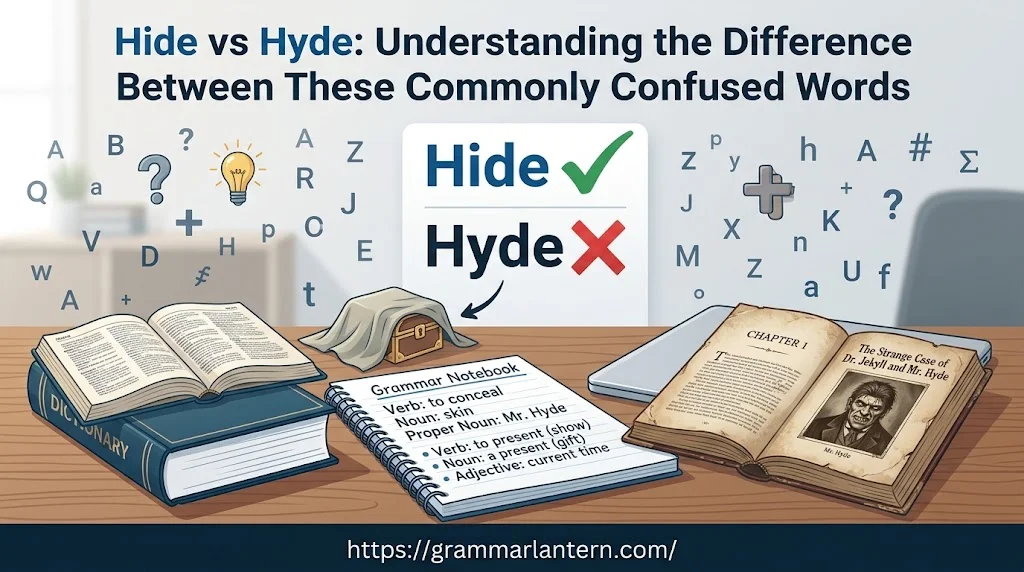
Key Differences
Although these words sound the same, their functions are completely different.
| Feature | Hide | Hyde |
| Pronunciation | Same sound | Same sound |
| Capitalization | Usually lowercase | Always capitalized |
| Type | Common word | Proper noun |
| Meaning | Conceal, cover, animal skin | Name, place, character |
| Usage | Everyday language | Specific references |
The biggest difference is meaning.
You can hide something, but you cannot Hyde something.
You can meet someone named Hyde, but you cannot use Hyde as a normal action.
Why Hide and Hyde Are Confusing
The main reason people confuse these words is that they are homophones.
Homophones are words that sound the same but have different spellings and meanings.
Other examples include:
- Two / To / Too
- Their / There / They’re
- See / Sea
- Right / Write
When speaking, you cannot see the spelling. Context helps listeners understand the meaning. However, writing requires the correct spelling.
For example:
“I will hide the book.”
The reader understands that this means conceal the book.
“I will Hyde the book.”
This sentence is incorrect because Hyde is not a verb.
Common Mistakes
Using Hyde as a Verb
Incorrect:
- “Please hyde the documents.”
Correct:
- “Please hide the documents.”
Why?
Because hide is the action word. Hyde is not.
Forgetting Capital Letters
Incorrect:
- “Mr. hyde is a famous character.”
Correct:
- “Mr. Hyde is a famous character.”
Names always begin with capital letters.
Confusing Hide, Hid, and Hidden
Incorrect:
- “The money was hide under the mattress.”
Correct:
- “The money was hidden under the mattress.”
Remember:
- Hide = present action
- Hid = past action
- Hidden = completed action
Examples in Sentences
| Sentence | Correct Word | Explanation |
| “I need to hide my password.” | Hide | Means keep secret |
| “Mr. Hyde appears in the novel.” | Hyde | Refers to a character |
| “The dog hid behind the fence.” | Hid | Past tense of hide |
| “The documents were hidden safely.” | Hidden | Past participle form |
| “The leather was made from animal hide.” | Hide | Refers to animal skin |
How to Remember the Difference
A simple memory trick can help:
Hide = Hidden things
Hyde = Human names and places
Think of it this way:
- You hide a secret.
- You meet Hyde in a story.
Another helpful reminder:
“Actions hide. Names Hyde.”
When you see a sentence, ask yourself:
Is this word describing an action or identifying something?
If it describes an action, choose hide.
If it identifies a person, place, or title, choose Hyde.
Related Words That Cause Confusion
Hide vs Conceal
Both words can mean keeping something unseen.
Examples:
- “She hid the gift.”
- “She concealed the gift.”
However, conceal sounds more formal, while hide is more common in everyday conversation.
Hide vs Hidden
These words are related but have different grammatical roles.
Examples:
- “I hide my keys.”
- “My keys are hidden.”
The first describes an action. The second describes a state.
Hyde vs Jekyll
These two names are often connected because of the famous novel.
While Hyde represents the darker personality in the story, Jekyll represents the respectable public identity.
Read More: 5 Ways to Describe the Sound of Rain: Onomatopoeia
FAQs
1. What is the difference between hide and Hyde?
Hide is a common English word that can function as a verb or noun. Hyde is usually a proper noun, such as a surname, place name, or fictional character.
2. Is hide a correct English word?
Yes. Hide is a standard and commonly used English word with several meanings depending on the context.
3. Is Hyde a word in English?
Yes, but Hyde is mainly used as a proper name. It is especially recognized as the name of the character in Strange Case of Dr. Jekyll and Mr. Hyde.
4. Should Hyde always be capitalized?
When Hyde is used as a proper name, it should be capitalized. Writing it as hyde would normally be incorrect in that context.
5. Is hide a noun or a verb?
Hide can be both a noun and a verb. As a verb, it means to keep something or someone out of sight. As a noun, it can refer to an animal’s skin or a place used for observing wildlife.
6. What does Hyde mean in Dr. Jekyll and Mr. Hyde?
In Strange Case of Dr. Jekyll and Mr. Hyde, Hyde is the surname of the fictional character Edward Hyde, who represents the darker side of Dr. Jekyll.
7. Is hide more common than Hyde?
Yes. Hide is much more common in everyday English because it has several meanings and grammatical uses. Hyde has a more specific use as a proper name.
8. How can I remember the difference between hide and Hyde?
A simple memory trick is to associate hide with the everyday verb or noun and Hyde with a name. If it identifies a person, character, or place, Hyde is usually the correct choice.
9. Can hide and Hyde be used interchangeably?
No. They are not interchangeable. Their meaning, grammatical function, and usage are different, so the correct choice depends on the context.
10. Which one should I use in a sentence?
Use hide for the ordinary English word and Hyde when referring to a proper name. Checking the context and capitalization will usually make the correct choice clear.
Conclusion
Understanding hide vs Hyde becomes simple once you focus on their meaning, usage, and context. Hide is a common English word that can work as a noun or verb, while Hyde is generally a proper noun used for names or places. Their similar spelling can cause confusion, but their different roles make them easy to distinguish.
When choosing between hide and Hyde, look at the sentence, capitalization, and intended meaning. Use hide for the ordinary English word and Hyde for a proper name. With regular practice and attention to context, you can avoid common mistakes and use both words correctly and confidently.




[…] Read More: Hide vs Hyde: Understanding the Difference […]
[…] Read More: Hide vs Hyde: Understanding the Difference […]