The Present vs Presant difference creates confusion among writers, students, and people working on an email, school assignments, business documents, or everyday writing. The truth is that spoken language and written rules do not always match. Some words may sound similar in speech but look completely different on the page. This is the case with present and presant. The incorrect form presant seems understandable because it echoes how people pronounce present quickly in everyday chatter.
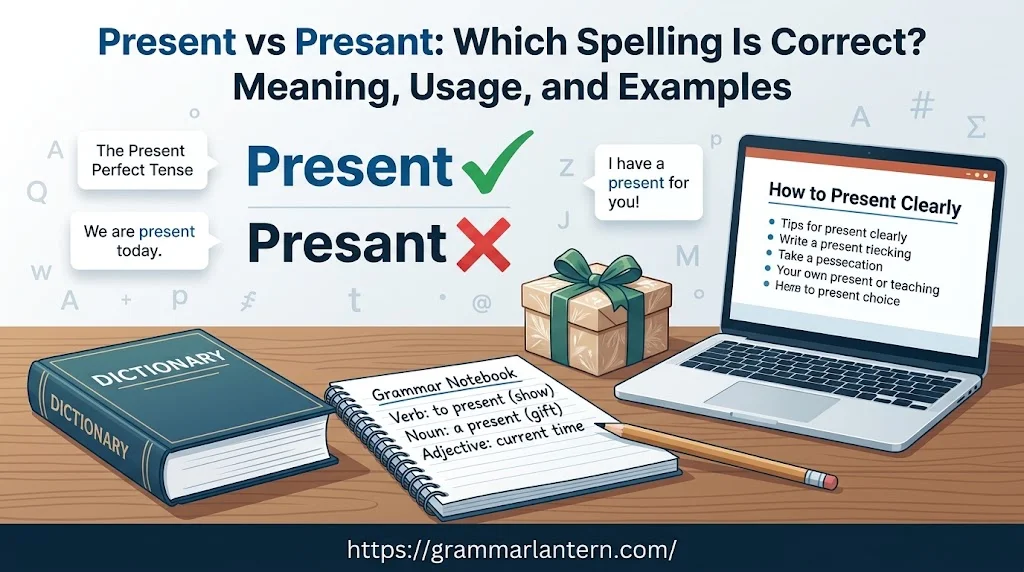
However, only Present is the recognized correct spelling in English. Many people make this mistake because of pronunciation, typing errors, autocorrect issues, or carelessness. The simple rule is that presant is a common misspelling without any official meaning in the English dictionary or official vocabulary.
Understanding the difference helps improve language skills, writing confidence, and the ability to communicate clearly. The word present has several meanings depending on context. As a noun, it can refer to a gift given with goodwill on a special occasion, or it can explain presence, the state of being in a particular place and the impression someone creates through demeanor and aura. As a verb, it means to give, show, or offer something, while presents can refer to offerings. It also appears in grammar as an adjective and across verb tenses. Learning correct usage, grammar accuracy, and proofreading techniques helps every student, teacher, content writer, and English learner avoid spelling mistakes, improve English fluency, strengthen vocabulary, and write with clarity, confidence, and precision.
Quick Answer
Present is the correct spelling.
Presant is incorrect and does not exist as a standard English word.
Examples:
✅ I bought a birthday present for my sister.
❌ I bought a birthday presant for my sister.
The word present has several meanings:
- A gift given to someone
- The current time or moment
- Something existing now
- To show, explain, or introduce something
The spelling presant should always be replaced with present.
Understanding the Difference
Although present and presant may look similar, they do not have the same status in English.
| Word | Correct or Incorrect | Meaning |
| Present | ✅ Correct | A gift, current time, something existing, or to show something |
| Presant | ❌ Incorrect | A spelling mistake, not a recognized English word |
The confusion usually happens because the second syllable in present can sound unclear. When people hear the word, they may incorrectly assume it contains the letter “a.”
However, correct spelling depends on the accepted written form, not only pronunciation.
For example:
- People often hear definitely and write “definately.”
- People hear separate and write “seperate.”
- People hear present and write “presant.”
These mistakes are common because English has many words where pronunciation and spelling do not perfectly match.
What Does Present Mean?
The word present is versatile because it can function as a noun, adjective, and verb. Its meaning changes depending on how you use it in a sentence.
Present as a Noun Meaning a Gift
One of the most common meanings of present is a gift.
A present is something you give to another person to celebrate an occasion, show appreciation, or express kindness.
Examples:
- My parents gave me a birthday present.
- She wrapped the present with colorful paper.
- The children were excited to open their Christmas presents.
In this meaning, present and gift are often interchangeable.
For example:
- I received a present from my friend.
- I received a gift from my friend.
Both sentences are correct.
However, the word present often feels more personal and is commonly used in casual conversations.
Present as a Noun Meaning Current Time
The word present can also describe the time happening now.
The present refers to the moment you are experiencing instead of the past or future.
Examples:
- Focus on the present instead of worrying about yesterday.
- The present is the only time we can control.
- She learned to appreciate the present moment.
This meaning appears frequently in discussions about personal growth, mindfulness, and decision-making.
A simple way to remember it:
Past = before now
Present = right now
Future = after now
Present as an Adjective Meaning Existing Now
When present works as an adjective, it describes something that currently exists or happens.
Examples:
- The present situation requires immediate attention.
- The present rules apply to all employees.
- Scientists are studying the present effects of climate change.
Here, present does not mean a gift. Instead, it describes something connected to the current time.
Read More: “Otherwise” Comma Rules Explained: When to Use a Comma
Present as a Verb Meaning to Show or Introduce
The word present can also be a verb. It means to show, explain, offer, or introduce something.
Examples:
- She will present her research tomorrow.
- The manager presented a new strategy.
- Students presented their projects in class.
This use is common in:
- Schools
- Businesses
- Conferences
- Meetings
- Public speaking
For example, a student may present a project, while a company manager may present a business plan.
Why Do People Spell Present as Presant?
The spelling mistake presant happens for several reasons.
Pronunciation Confusion
English pronunciation can be unpredictable. A person may hear the vowel sound in present and assume the spelling should include an “a.”
The pronunciation does not always reveal the exact spelling.
For example:
| Correct Word | Common Mistake |
| Present | Presant |
| Definitely | Definately |
| Separate | Seperate |
| Receive | Recieve |
Learning common spelling patterns helps prevent these errors.
Writing Words Based on Sound
Many beginners use a “write what you hear” approach. While this works for some words, it fails with many English words.
For example:
The word present sounds like it could be written as “presant,” but English spelling follows established rules.
The best approach is to learn:
- Correct spelling
- Word families
- Common usage patterns
Comparison Table
| Feature | Present | Presant |
| Spelling | Correct | Incorrect |
| Used in English | Yes | No |
| Meaning | Multiple meanings | No standard meaning |
| Example | She gave me a present. | Avoid this spelling. |
How to Remember the Correct Spelling
Remembering present becomes easier when you connect it with related words.
Learn the Word Family
The word family includes:
- Present
- Presentation
- Presenter
- Presenting
All these words keep the same spelling pattern.
Examples:
- She prepared a presentation for the meeting.
- The presenter explained the topic clearly.
- He is presenting his ideas today.
If you remember presentation, it becomes easier to remember present.
Use the “E” Pattern
The correct spelling contains e:
P-R-E-S-E-N-T
A useful memory trick:
A present is something you “send” or give to someone.
The spelling connection between present and sent can help you remember the correct form.
Present Pronunciation and Meaning Changes
One interesting feature of present is that its pronunciation changes depending on its use.
Present as a Noun or Adjective
Pronunciation:
PREZ-ent
Examples:
- birthday present
- present moment
- present condition
Present as a Verb
Pronunciation:
pri-ZENT
Examples:
- present a report
- present an idea
- present an argument
The spelling remains the same, but the stress changes.
This difference is called a stress shift, and English uses this pattern with several words.
Examples:
| Word | Noun Pronunciation | Verb Pronunciation |
| Present | PREZ-ent | pri-ZENT |
| Record | REK-ord | ri-CORD |
| Object | OB-ject | ob-JECT |
Common Mistakes
Mistake: Writing Presant for a Gift
Incorrect:
I bought a presant for my brother.
Correct:
I bought a present for my brother.
Mistake: Confusing Present With Presence
Many learners confuse these two words because they look similar.
| Word | Meaning | Example |
| Present | Gift, current, show something | She presented her idea. |
| Presence | Being somewhere | His presence made everyone happy. |
Example:
- The teacher was present in the classroom.
- The teacher’s presence helped students feel comfortable.
The first sentence means the teacher was there. The second sentence focuses on the teacher’s existence or attendance.
Using Present in Different Situations
Present in Education
Students often use present in school settings.
Examples:
- The teacher marked five students present.
- She will present her assignment tomorrow.
- The class discussed the present topic.
Present in Professional Communication
Correct spelling matters in workplace writing.
A misspelled word can affect how readers view your attention to detail.
Examples:
Professional:
I will present the report during tomorrow’s meeting.
Incorrect:
I will presant the report during tomorrow’s meeting.
Present in Daily Conversation
Native speakers use present frequently.
Examples:
- What is your present address?
- I want to enjoy the present moment.
- She gave me a beautiful present.
Is Presant Ever Correct?
No, presant is not a correct English word.
If you see this spelling, it is usually:
- A typing mistake
- A spelling error
- A learner’s mistake
The correct replacement is always present.
Present vs Gift: Are They the Same?
In many situations, present and gift have the same meaning.
Examples:
- She bought him a present.
- She bought him a gift.
Both are correct.
However, the word gift can sometimes have broader meanings.
For example:
- He has a gift for music.
Here, gift means a natural ability, not a physical item.
You cannot replace it with present.
Incorrect:
- He has a present for music.
Correct:
- He has a gift for music.
Read More: Signer vs Signor: Which Word Is Correct?
FAQs
1. Is Present or Presant the correct spelling?
Present is the correct spelling in English. Presant is a common spelling mistake and does not have any official meaning in English dictionaries.
2. Why do people write Presant instead of Present?
Many people write Presant because it sounds similar to Present when spoken quickly. Pronunciation can sometimes influence spelling, even when the written form is incorrect.
3. What does Present mean in English?
Present has multiple meanings. It can mean a gift, the current time, being available in a place, or the act of showing, introducing, or offering something.
4. Is Presant a real English word?
No, Presant is not a recognized English word. It is simply an incorrect spelling of Present caused by pronunciation confusion or typing mistakes.
5. How can I remember the correct spelling of Present?
A simple memory trick is to remember that Present contains “sent,” like something being presented or sent forward. Avoid changing the “e” to “a.”
6. Can Present be used as a noun and a verb?
Yes, Present can work as both a noun and a verb. As a noun, it can mean a gift. As a verb, it means to show, give, introduce, or offer something.
7. Why is correct spelling important in writing?
Correct spelling improves clarity, professionalism, and communication. Incorrect spellings can create confusion and affect the quality of emails, assignments, articles, and business documents.
8. Does Present have more than one meaning?
Yes, Present has several meanings depending on context. It may refer to a gift, current time, presence, or the action of presenting something.
9. Is Present commonly used in English?
Yes, Present is one of the most commonly used words in English. It appears frequently in daily conversations, academic writing, workplaces, and formal communication.
10. How can I avoid spelling mistakes like Presant?
You can avoid mistakes by improving vocabulary, practicing correct spelling, checking dictionaries, using proofreading techniques, and paying attention to common pronunciation-based errors.
Conclusion
The difference between Present vs Presant is simple once you understand the correct spelling rule. Present is the only accepted English spelling, while Presant is an incorrect form that often appears because the two words sound similar in speech.
Using the correct spelling helps you communicate with more accuracy and confidence. Whether you are writing emails, assignments, professional documents, or everyday messages, choosing Present shows strong language skills and attention to detail.

Muhammad Haroon is the voice behind many of the clear, practical grammar guides you’ll find on Grammar Lantern. With a strong background in content writing and a genuine love for the English language, Haroon specializes in breaking down intimidating grammar topics into simple, digestible lessons. His goal is simple: to empower readers to write with confidence and clarity. Whether he’s explaining tricky tenses or demystifying punctuation, Haroon approaches each topic with patience, precision, and a touch of warmth—because he knows that learning grammar is a journey, not a race.
[…] Read More: Present vs Presant: Which Spelling Is Correct? […]