
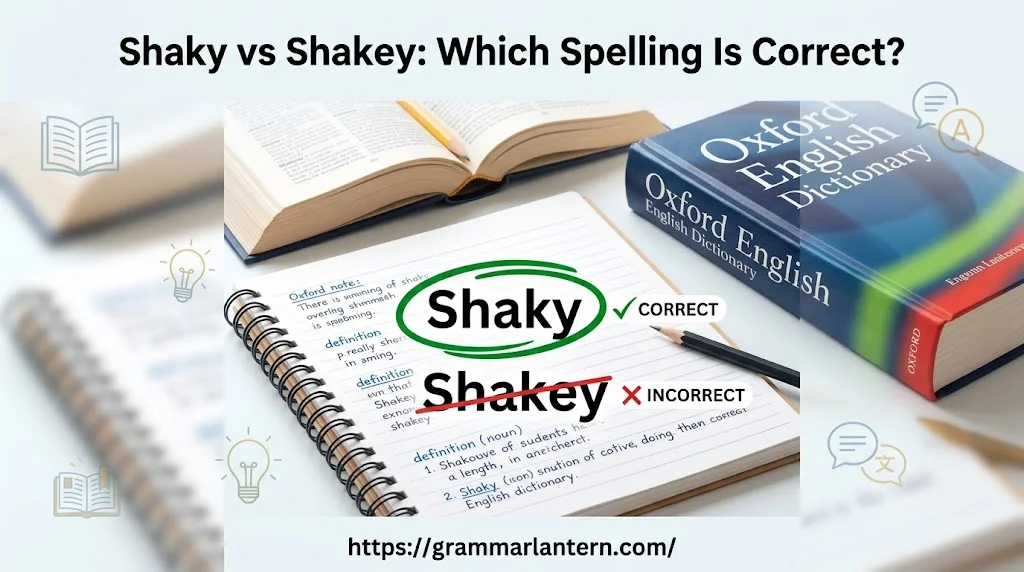
Shaky vs Shakey can confuse writers when they have typed shakey, paused, and looked at the word, but the correct spelling is shaky in standard English. Both forms sound the same when spoken, yet the extra “e” often sneaks into writing because shakey looks natural. This spelling dilemma affects students, professionals, writers, and even a grammar nerd, especially in text, messages, assignments, captions, and professional content. Once you understand the difference, you can avoid spelling confusion, second guessing, and spelling limbo, while improving your word choice, writing, and confidence.
The simple distinction is that shaky is an adjective and descriptive word that can mean shaking or trembling, while shakey is an alternative spelling, typo, or spelling variation. In clear grammar and word usage, shaky is the proper form for everyday English, professional writing, content writing, and written English. Using it supports accuracy, correctness, better writing skills, language, communication, and vocabulary, while making your professional presentation more polished and trustworthy.
Thousands of people may confuse these words, but you can clear up your doubts by remembering that shakey is the counterpart and less correct form, not a separate standard meaning. It is safe to say that these tricky spelling mistakes are familiar to strangers and experienced writers alike, so use the right guide to explain the real difference instead of assuming both spellings are equally acceptable.
Quick Answer
Shaky is the correct spelling.
The word shaky is an adjective that means:
- Trembling or shaking
- Weak or unstable
- Uncertain or unreliable
- Lacking confidence or security
The spelling shakey is generally a misspelling and should not be used in formal writing.
| Word | Correct Spelling | Meaning | Example |
| Shaky | ✅ Yes | Unsteady, trembling, uncertain, or weak | The old chair feels shaky. |
| Shakey | ❌ Usually no | Incorrect spelling of shaky | Avoid writing shakey in professional work. |
A simple way to remember it:
Shake + y = Shaky
The final e disappears before adding -y.
What Does Shaky Mean?
The word shaky comes from the verb shake. It describes a condition where something moves, lacks stability, or cannot be fully trusted.
Unlike some adjectives that have only one meaning, shaky has several uses depending on the situation.
For example:
- A person can have shaky hands.
- A building can have a shaky foundation.
- A student can have a shaky understanding of a subject.
- A business can experience a shaky financial period.
The central idea behind all these examples is the same: something is not completely steady.
Different Meanings of Shaky With Examples
Shaky Meaning: Physically Trembling
The most common meaning of shaky relates to physical movement. It describes something that shakes or cannot remain still.
This can happen because of:
- Fear
- Cold weather
- Stress
- Exhaustion
- Excitement
- Age
- Physical weakness
Examples:
- Her hands were shaky before the presentation.
- The injured player stood on shaky legs.
- His voice became shaky when he talked about the accident.
In these examples, shaky describes a visible or noticeable physical reaction.
Shaky Meaning: Weak or Unstable
Shaky can also describe objects, structures, or systems that are not strong or secure.
Examples:
- The old wooden bridge looked shaky after years of damage.
- The table has a shaky leg.
- The company’s financial situation is becoming shaky.
Here, shaky does not mean something is literally shaking. Instead, it suggests that something could fail, break, or collapse.
Read More: Safeness vs. Safetiness: Which Word Is Correct?
Shaky Meaning: Uncertain or Unreliable
People often use shaky to describe ideas, arguments, evidence, or information that are not convincing.
Examples:
- The lawyer presented a shaky argument.
- The report was based on shaky evidence.
- His memory of the event is a little shaky.
A shaky argument is not necessarily completely wrong. It simply lacks strength or reliability.
Shaky Meaning: Nervous or Lacking Confidence
The word can describe emotions, especially when someone feels unsure.
Examples:
- She gave a shaky performance during her first interview.
- His confidence was still shaky after the mistake.
- The team had a shaky start to the season.
In this context, shaky connects with feelings of uncertainty.
What Does Shakey Mean?
The spelling shakey is usually not accepted as standard English.
People often write shakey because English spelling can sometimes make the extra “e” seem natural. Many words keep an “e” before adding endings, so writers may assume the same rule applies here.
However, shaky does not follow that pattern.
The correct transformation is:
shake → shak + y → shaky
The final e is removed before adding -y.
Examples:
| Base Word | Correct Form |
| Shake | Shaky |
| Noise | Noisy |
| Ease | Easy |
| Grease | Greasy |
The spelling shakey may appear in:
- Brand names
- Usernames
- Character names
- Informal online writing
However, those uses do not make it the correct spelling for everyday English.
Why Do People Confuse?
The confusion happens because English pronunciation does not always reveal spelling.
When people hear shaky, they only hear two syllables:
SHAY-kee
The sound gives no clue whether the word contains an extra “e.”
This problem appears with many English words because pronunciation and spelling developed separately over centuries.
For example:
- Crazy not Crazee
- Lazy not Lazey
- Noisy not Noisey
The same pattern applies to:
Shake → Shaky
Key Differences
| Feature | Shaky | Shakey |
| Standard English spelling | Yes | No |
| Found in dictionaries | Yes | Usually no |
| Used in formal writing | Yes | Avoid |
| Pronunciation | Same | Same |
| Meaning | Trembling, unstable, uncertain | Usually intended to mean shaky |
The difference is not pronunciation or meaning. The difference is simply correct spelling.
Common Uses of Shaky in Everyday English
The word appears in many common expressions.
Shaky Hands
This describes hands that tremble.
Examples:
- He had shaky hands after lifting the heavy equipment.
- Her shaky hands made writing difficult.
Shaky Voice
This describes a voice affected by nervousness, fear, or emotion.
Examples:
- She answered with a shaky voice.
- His voice became shaky during the emotional speech.
Shaky Ground
The phrase “on shaky ground” means being in an uncertain or risky situation.
Examples:
- Their agreement was on shaky ground after the disagreement.
- The company is on shaky ground because of financial problems.
Shaky Start
This phrase describes a weak beginning.
Examples:
- The project had a shaky start but improved later.
- The team recovered after a shaky first half.
Shaky vs Similar Words
Many people replace shaky with similar words. However, each word has a slightly different meaning.
| Word | Meaning | Example |
| Shaky | Unstable, uncertain, trembling | His explanation was shaky. |
| Nervous | Worried or anxious | She felt nervous before the exam. |
| Weak | Lacking strength | The argument was weak. |
| Unstable | Likely to change or fail | The structure is unstable. |
| Uncertain | Not known or decided | The future remains uncertain. |
Understanding these differences helps you choose the most accurate word.
Shaky vs Shaking
Although they look similar, shaky and shaking have different grammatical roles.
Shaky is an adjective.
It describes a condition.
Example:
- My hands are shaky.
Shaking is usually a verb form.
It describes an action.
Example:
- My hands are shaking.
Compare:
- His voice was shaky.
(His voice sounded weak or nervous.) - His voice was shaking.
(His voice was physically trembling.)
Shaky vs Unstable
These words overlap, but they are not always interchangeable.
Shaky often suggests a temporary problem or weakness.
Example:
- The chair is shaky.
Unstable often sounds more serious.
Example:
- The building is structurally unstable.
A shaky chair may only need repair. An unstable building may create a safety risk.
Common Mistakes When Using Shaky
Writing Shakey Instead of Shaky
This is the biggest mistake.
Incorrect:
My hands were shakey before the interview.
Correct:
My hands were shaky before the interview.
Using Shaky When You Mean Nervous
Sometimes writers use shaky when they specifically mean emotional worry.
Incorrect:
I was shaky about meeting new people.
Better:
I was nervous about meeting new people.
However, if the nervousness causes physical effects, shaky works:
My voice became shaky during the conversation.
Using Shaky for Every Type of Weakness
Shaky does not always replace words like weak, poor, or bad.
Incorrect:
The food quality was shaky.
Better:
The food quality was poor.
Shaky works best when something feels unstable, uncertain, or unreliable.
Examples of Shaky in Professional Writing
The word shaky often appears in business, journalism, research, and academic writing.
Examples:
- The company recovered after a shaky financial year.
- The study relied on shaky assumptions.
- The proposal needs stronger evidence before approval.
- The organization faced a shaky transition period.
In professional contexts, shaky adds a specific meaning. It suggests uncertainty without saying something has completely failed.
Memory Trick to Remember Shaky
Remember this simple formula:
Shake loses the “e” before adding “y.”
Think of it like this:
SHAKE + Y = SHAKY
Not:
SHAKE + Y = SHAKEY
This small spelling rule can prevent a common writing mistake.
Read More: Symptomatology vs Symptomology: Which Word Is Correct?
FAQs
1. Is “shaky” or “shakey” correct?
Shaky is the correct standard spelling. Shakey is generally a misspelling or typo.
2. What does “shaky” mean?
Shaky is an adjective that means shaking, trembling, unsteady, or lacking stability.
3. Is “shakey” a word?
Shakey is not the standard spelling of the adjective. In most writing, you should use shaky instead.
4. Why do people spell “shaky” as “shakey”?
People often add the extra e because shakey may look more natural based on how the word sounds.
5. Do “shaky” and “shakey” sound the same?
Yes. In normal speech, shaky and shakey sound the same, which can make the spelling confusing.
6. Can I use “shakey” in formal writing?
It’s best to avoid shakey in formal writing. Use shaky in professional documents, assignments, emails, and other polished content.
7. What is the plural of “shaky”?
Shaky is an adjective, so it does not normally have a plural form. You simply use shaky with singular or plural nouns.
8. What is a synonym for “shaky”?
Depending on the context, synonyms include unsteady, unstable, trembling, weak, and uncertain.
9. Is “shaky” an adjective?
Yes. Shaky is an adjective used to describe something that shakes, trembles, feels unstable, or lacks confidence.
10. How can I remember the correct spelling?
A simple trick is to remember that the standard adjective is shaky, with no extra e. When you mean unsteady or trembling, choose shaky.
Conclusion
Shaky is the correct spelling, while shakey is usually an incorrect spelling or typo. Although both forms sound identical, the extra e does not belong in the standard adjective. Whether you are describing trembling hands, an unstable surface, or uncertain confidence, shaky is the form you should use.
Knowing this small spelling difference can make your writing clearer and more professional. If you ever hesitate between shaky vs shakey, remember the simple rule: shaky is correct. Once you learn it, you can avoid this common mistake in everyday and formal English.

For Shafiq ur Rehman, writing is an art form and grammar is the toolbox that makes it beautiful. As a dedicated content writer at Grammar Lantern, Shafiq approaches every topic like an architect carefully laying down strong foundations of understanding before adding the finer details. He loves diving into the trickiest grammar points and resurfacing with simple, bite-sized takeaways that anyone can grasp. When he’s not crafting articles, you’ll likely find him strategizing over a game of chess, exploring dusty local bookshops, or quietly jotting down poetic observations in his notebook.



[…] Read More: Shaky vs Shakey: Which Spelling Is Correct? […]
[…] Read More: Shaky vs Shakey: Which Spelling Is Correct? […]