Challenge vs Challange shows why correct spelling matters when writing emails, school papers, and professional documents with clear communication. Spelling mistakes can hurt how people view your writing, and many wonder which word is correct to use. Picking the wrong spelling can make your work look careless in official documents, emails, and school papers. Most people type fast without checking their text messages, social posts, and quick notes, which creates a common mistake.
Knowing the right form helps you write better, keeps readers trusting what you say, and improves your English grammar and vocabulary. Students, professionals, and everyday writers often confuse similar words, but Challenge is the accepted spelling found in dictionaries for formal writing, while Challange is a misspelling that should be avoided in academic, professional, and business communication.
This guide helps you discover the meaning, explore simple explanations, and follow practical tips to avoid confusion. By spotting patterns, following tricks, and giving deep attention while editing articles, essays, or conversations, you can recognize the standard, dictionary-approved, and widely accepted spelling. Careful checking of typos, misspelled words, tricky pitfalls, and mix-ups helps build a clear sentence, sharp message, and trustworthy impression in home tasks and work projects, while avoiding errors and improving your overall clarity.
Quick Answer
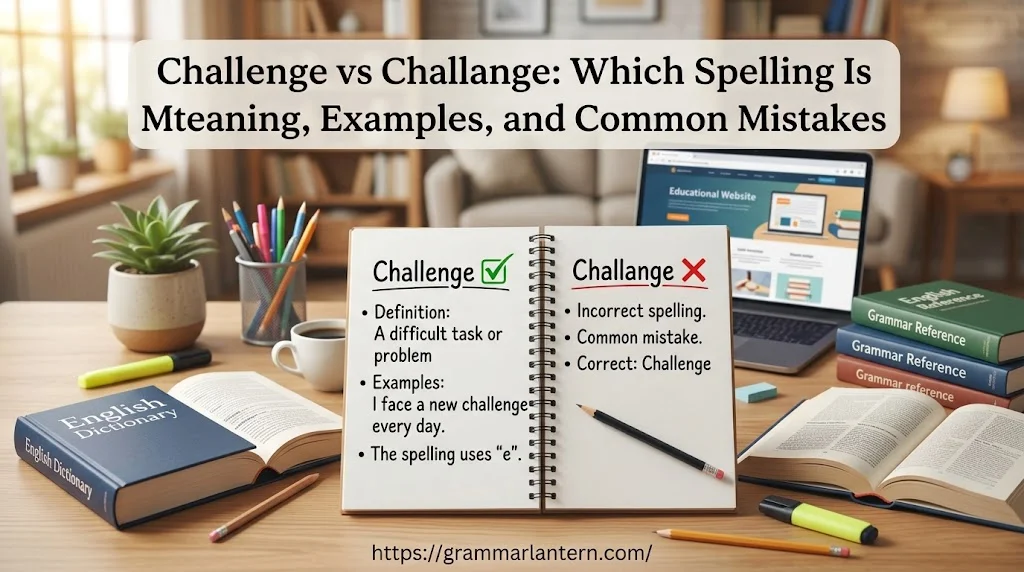
The correct spelling is challenge.
- ✅ Challenge — Correct spelling
- ❌ Challange — Incorrect spelling
The word challenge means a difficult task, a test of skill, an obstacle to overcome, or an invitation to compete.
Examples:
- Learning a new language can be a challenge.
- She accepted the challenge and completed the project successfully.
- The athlete issued a challenge to his opponent.
The word challange is simply a spelling error. It usually happens because people misunderstand the spelling pattern or add an unnecessary letter.
What Does Challenge Mean?
The word challenge has several meanings depending on the context. It can describe something difficult that requires effort, skill, courage, or determination.
In everyday English, people often use challenge when talking about situations that test their abilities.
For example:
“Starting a new career can be a challenge, but it can also create new opportunities.”
In this sentence, challenge does not only represent difficulty. It also suggests growth, learning, and improvement.
A challenge can push someone outside their comfort zone. It is often the first step toward developing new skills and achieving goals.
Challenge Meaning as a Noun
As a noun, challenge refers to a difficult task, situation, or test.
Examples:
- “The final exam was a major challenge.”
- “Finding affordable housing is a challenge in many cities.”
- “Climbing that mountain was an incredible challenge.”
A challenge usually requires:
- Time
- Effort
- Patience
- Knowledge
- Problem-solving skills
- Determination
For example, learning a new language may feel difficult at first. However, the challenge helps you improve your communication skills over time.
Challenge Meaning as a Verb
The word challenge can also work as a verb. In this form, it means to question, test, or invite someone to compete.
Examples:
- “The lawyer challenged the evidence.”
- “She challenged herself to run a marathon.”
- “He challenged his friend to a chess match.”
When used as a verb, challenge shows action. Someone is actively questioning, testing, or pushing limits.
What Does Challange Mean?
The word challange has no accepted meaning in standard English.
When comparing challange vs challenge, the difference is simple:
- Challenge is the correct English word.
- Challange is a spelling mistake.
Although many people write challange, dictionaries and standard writing guides recognize only challenge.
Read More: Can You Start a Sentence With “Otherwise”? Complete Guide
Why Do People Spell Challenge as Challange?
Several reasons explain why people make this mistake.
Confusion With Double-Letter Words
English includes many words with repeated letters, such as:
- Parallel
- Embarrass
- Successful
- Excellent
Because of these examples, some writers assume that challenge needs a different spelling pattern.
However, English spelling does not always follow simple rules. Each word has its own history and structure.
The correct spelling is:
Challenge
Not:
Challange
Pronunciation Does Not Clearly Show Spelling
When people pronounce the word challenge, they usually hear:
chal-lenge
The sound does not clearly reveal the exact spelling. Because of this, English learners may write the word based on how it sounds rather than how it is spelled.
This problem appears with many English words, including:
- Necessary
- Separate
- Embarrass
- Definitely
Fast Typing and Digital Communication
Modern communication also creates spelling mistakes.
People often type quickly on:
- Smartphones
- Social media platforms
- Messaging apps
- Online forums
A person may quickly write:
“This is a big challange.”
instead of:
“This is a big challenge.”
Spell-check tools can help, but understanding the correct spelling makes your writing stronger.
Key Difference Explained
The difference between challenge and challange is not about meaning. It is about correct spelling.
| Word | Correct Spelling | Meaning | Example |
| Challenge | ✅ Correct | A difficult task, test, or competition | “The project was a challenge.” |
| Challange | ❌ Incorrect | A spelling mistake | “Challange” should not be used. |
The correct spelling is:
C-H-A-L-L-E-N-G-E
The word already contains the correct letter pattern. Many people mistakenly change it and create an incorrect version.
Correct:
✅ Challenge
Incorrect:
❌ Challange
How to Remember the Correct Spelling
Remembering the spelling becomes easier when you connect the word with examples and patterns.
Use the Simple Memory Trick
Think:
“A challenge is already difficult enough. Don’t make the spelling harder.”
The correct spelling is:
CHALLENGE
Avoid adding unnecessary letters.
Incorrect examples:
- Challange
- Challlenge
- Challangee
Learn Related Words Together
Learning related forms helps you recognize the spelling more quickly.
| Word | Meaning | Example |
| Challenge | A difficult task or test | “This challenge requires patience.” |
| Challenged | Tested or questioned | “She challenged the decision.” |
| Challenging | Difficult or demanding | “The course was challenging.” |
| Challenger | A person who competes | “The challenger entered the competition.” |
When you remember the whole word family, the spelling becomes easier to identify.
Common Mistakes
Many English learners make small mistakes with this word. Understanding these errors improves writing accuracy.
Writing Challange Instead of Challenge
Incorrect:
“Learning English is a challange.”
Correct:
“Learning English is a challenge.”
The meaning is understandable, but the spelling mistake reduces writing quality.
Confusing Challenge and Challenging
These words are related but serve different purposes.
Challenge
Used as a noun or verb.
Examples:
- “The assignment was a challenge.”
- “I challenge you to complete the task.”
Challenging
Used as an adjective to describe something difficult.
Examples:
- “The assignment was challenging.”
- “She enjoys challenging tasks.”
A simple way to remember:
- Challenge = the thing
- Challenging = describes the thing
Examples in Different Situations
The word challenge appears in many areas of life.
Challenge in Education
Students face challenges while learning new subjects, preparing exams, and developing skills.
Examples:
- “Mathematics can be a challenge for some students.”
- “The research project was a challenging assignment.”
Educational challenges help students become better thinkers because they encourage practice and problem-solving.
Challenge in Work and Business
Professionals often use the word when discussing goals and obstacles.
Examples:
- “Managing a large team is a challenge.”
- “The company faces challenges in a competitive market.”
Businesses usually identify challenges before creating solutions.
Challenge in Personal Growth
Many personal achievements begin with challenges.
Examples:
- Learning a new skill.
- Improving fitness.
- Building confidence.
- Changing habits.
A challenge may feel uncomfortable at first, but overcoming it often creates progress.
Challenge vs Similar Words
Understanding similar words helps you use challenge more effectively.
Challenge vs Difficulty
These words are related but have slightly different meanings.
| Word | Meaning | Example |
| Challenge | A difficult situation that tests ability | “Starting a business is a challenge.” |
| Difficulty | The level of how hard something is | “The task has a high level of difficulty.” |
A challenge often suggests action and improvement. Difficulty focuses more on how hard something feels.
Challenge vs Problem
A problem usually needs a solution.
A challenge often requires effort and determination.
Examples:
Problem:
“The computer has a problem.”
Challenge:
“Learning new software is a challenge.”
A problem is something you fix. A challenge is something you overcome.
The History and Origin
The word challenge has an interesting background.
It comes from the Old French word chalenge, which originally referred to a claim, accusation, or dispute.
Over time, English speakers expanded its meaning. Today, challenge can describe:
- A difficult task
- A competition
- A disagreement
- A personal test
The word moved from a formal legal term into a common everyday expression.
Why Correct Spelling Matters
Correct spelling improves communication and creates a stronger impression.
Even when readers understand a misspelled word, mistakes can affect how they view your writing.
Correct spelling helps your writing appear:
- Professional
- Careful
- Reliable
- Clear
This matters in:
- Job applications
- Academic writing
- Business emails
- Online publishing
A small spelling mistake can distract readers from your message.
Real-Life Example
Consider this example:
“Starting a small business was a challenge. I faced financial pressure, learned new skills, and developed better strategies over time.”
Here, challenge describes a difficult experience that also creates opportunities for growth.
The word does not simply mean failure. It represents a situation that tests someone’s abilities.
Read More: Comming vs Coming: Correct Spelling, Meaning, and How to Use
FAQs
1. What is the correct spelling: Challenge or Challange?
The correct spelling is Challenge. It is the standard English word accepted by dictionaries and used in formal, academic, and professional writing. Challange is an incorrect spelling and should be avoided.
2. Why do people confuse Challenge and Challange?
People often confuse these words because Challenge is pronounced in a way that may make the incorrect spelling Challange seem natural. However, English spelling does not always match pronunciation.
3. Is Challange a real English word?
No, Challange is not a recognized English word. It is simply a common spelling mistake that happens when people write quickly without checking their work.
4. What does the word Challenge mean?
The word Challenge means a difficult task, problem, or situation that requires effort, skill, or determination to overcome. It can also refer to questioning or inviting someone to compete.
5. Can I use Challange in emails or professional documents?
No, you should not use Challange in emails, reports, essays, or professional documents. Using the wrong spelling can affect how readers view your writing quality and attention to detail.
6. How can I remember the correct spelling of Challenge?
You can remember that Challenge contains “lenge” after “chal” and does not include an extra “a.” Practicing correct usage and checking your writing can help prevent this mistake.
7. Is Challenge accepted in dictionaries?
Yes, Challenge is a dictionary-approved English word. It is widely accepted in everyday conversations, formal writing, academic work, and business communication.
8. Does pronunciation affect the spelling of Challenge?
Pronunciation can sometimes create confusion, but English spelling follows established rules rather than sound alone. This is why Challenge remains correct even if Challange appears similar.
9. How can spelling mistakes impact writing?
Spelling mistakes can reduce clarity, affect credibility, and make writing appear careless. Correct spelling helps create a professional impression and allows readers to understand your message easily.
10. Where is the word Challenge commonly used?
The word Challenge is commonly used in school assignments, workplace communication, social media posts, conversations, and everyday writing to describe difficulties or opportunities for growth.
Conclusion
The difference between Challenge vs Challange is simple: Challenge is the only correct spelling, while Challange is a common mistake. Although both words may look similar, only one follows standard English spelling rules and appears in dictionaries.
Learning the correct spelling improves your writing skills, confidence, and communication. By paying attention while typing, editing, and reviewing your work, you can avoid this mistake and create clearer, more professional writing.

Muhammad Haroon is the voice behind many of the clear, practical grammar guides you’ll find on Grammar Lantern. With a strong background in content writing and a genuine love for the English language, Haroon specializes in breaking down intimidating grammar topics into simple, digestible lessons. His goal is simple: to empower readers to write with confidence and clarity. Whether he’s explaining tricky tenses or demystifying punctuation, Haroon approaches each topic with patience, precision, and a touch of warmth—because he knows that learning grammar is a journey, not a race.
[…] Read More: Challenge vs Challange: Which Spelling Is Correct? […]