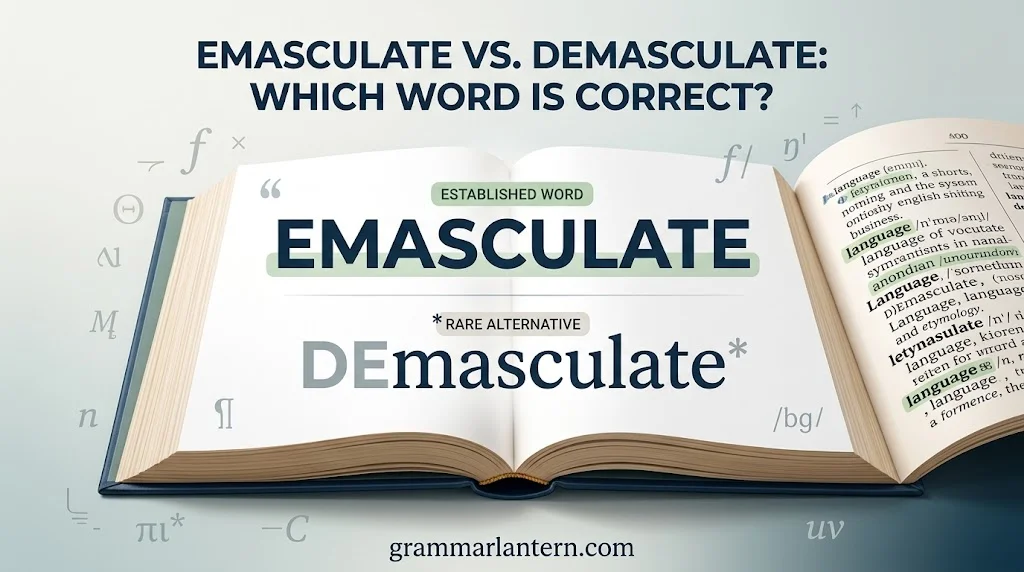
Emasculate vs. Demasculate can confuse English speakers, writers, and learners because the two terms have similar related meanings.In everyday writing and communication, the correct word choice is crucial. Emasculate is a recognized English word with an established definition, meaning, and usage, while demasculate is rarer, less common, and less formal.
Their distinction also connects with historical context, masculinity, power, and authority. The emasculate meaning can describe a practical removal of male qualities or a figurative loss of confidence, authority, or a person’s psychological state. In emasculate examples and sentences, the word can show psychological impact or a change in expression.
The demasculate meaning, definition of demasculate, and demasculate vs emasculate require attention to major dictionaries, standard usage, and formal recognition. Demasculate is a word that may appear in modern discussions and online usage, but its dictionary status differs from that of emasculate.
Checking dictionaries can improve clarity, especially in casual conversation, professional writing, and academic writing. Strong semantics, context, vocabulary, grammar, and language rules support effective expression. Applying proper usage, correct usage of emasculate, and the correct meaning of emasculate can improve expression clarity and English proficiency through useful examples and exercises, while recognizing whether a term is officially listed or widely recognised.
Quick Answer
Use “emasculate.”
| Word | Status | Meaning | Best choice? |
| Emasculate | Established standard English | To weaken, deprive of masculine strength, remove virility, or reduce effectiveness | Yes |
| Demasculate | Rare and uncommon | To remove masculinity from someone | Usually no |
| Emasculated | Standard past tense/adjective | Made less masculine, less powerful, or less effective | Yes |
| Demasculated | Rare form | Past form of demasculate | Usually avoid |
What Does Emasculate Mean?
Emasculate is a formal verb with several related meanings. The exact sense depends on what comes after the verb.
In its figurative use, it can mean to deprive someone of strength, confidence, authority, or a sense of masculine identity. It can also describe something that loses its power or effectiveness.
For example:
The public criticism left him feeling emasculated.
Here, emasculated doesn’t necessarily mean anything happened to the person’s body. Instead, the sentence describes a perceived loss of confidence, power, or masculine status.
Emasculate Can Mean “Weaken”
One of the most important meanings is broader than masculinity.
You can emasculate a law, institution, policy, organization, recommendation, or system when changes strip away much of its force or effectiveness.
For example:
- The amendments emasculated the original legislation.
- Budget cuts emasculated the agency.
- The revisions emasculated the report’s recommendations.
In these sentences, the subjects aren’t people. The word means weakened or deprived of effective power.
That broader sense is easy to miss if you associate the word only with masculinity.
Emasculate Can Have a Literal Biological Meaning
The word also has a literal biological meaning.
In medical or biological contexts, emasculate can mean to remove male reproductive organs or reproductive capacity.
The word also has a specialized botanical use. In plant breeding, researchers can emasculate a flower by removing its male reproductive structures before pollination. This helps prevent unwanted self-pollination during controlled crosses.
So the word has a wider range than everyday conversation might suggest.
What Does Demasculate Mean?
Demasculate is formed in a way that looks perfectly understandable.
Its intended meaning is essentially to remove masculinity from someone. Wiktionary records it as a transitive English verb with that definition and gives forms such as demasculates, demasculating, and demasculated.
However, there’s an important difference between being a recorded word and being the normal word choice in standard English.
Demasculate is uncommon. Most readers will be far more familiar with emasculate.
That difference matters when you’re choosing vocabulary for polished writing.
Is Demasculate a Real Word?
Yes, it is documented as an English word.
But that answer needs a second sentence: it isn’t the normal standard-English choice for this meaning.
This distinction prevents a common mistake. Saying demasculate “doesn’t exist” would be too absolute because the word is recorded in English sources. On the other hand, treating it as an equally common alternative to emasculate would also mislead readers.
Think of it this way:
Recorded word ≠ common word ≠ preferred word.
English contains many rare formations that readers can understand even though they aren’t the usual choices in edited prose.
For practical writing, emasculate wins.
Read More: Bachelor vs Batchelor: Which Spelling Is Correct?
Why Do People Confuse?
The confusion makes sense once you look at English word formation.
The prefix de- often signals removal, reversal, reduction, or separation.
Consider words such as:
- deactivate — make inactive
- devalue — reduce value
- deconstruct — take apart or analyze a structure
- demobilize — remove from military service or active mobilization
- decentralize — move away from a central authority
Because of these patterns, demasculate seems intuitive. Someone might reason:
de- + masculate = remove masculinity
The trouble is that English doesn’t build every word through neat mathematical formulas.
The History of Emasculate
The established word emasculate comes from Latin.
That history helps explain why emasculate became the conventional English form instead of demasculate.
The word has centuries of established usage behind it. Writers have long used it for literal castration, loss of masculine vigor, and figurative weakening.
English vocabulary isn’t always tidy. Sometimes the older form simply wins the race.
The Main Difference
The biggest difference isn’t really the basic idea. It’s established usage.
Both words can be understood as referring to the removal or loss of masculinity. However, emasculate has a much broader and firmly established range of meanings.
| Feature | Emasculate | Demasculate |
| Established English verb | Yes | Recorded but rare |
| Means to weaken | Yes | Not the usual sense |
| Can refer to masculine confidence | Yes | Intended meaning |
| Can describe weakened laws or institutions | Yes | Not normally used this way |
| Biological use | Yes | Not established in the same range |
| Botanical use | Yes | No comparable standard usage |
| Recommended in formal writing | Yes | Generally avoid |
| Familiar to general readers | Yes | Much less familiar |
This makes the choice straightforward in most situations.
If you want to describe loss of power, confidence, masculine identity, effectiveness, or reproductive capacity, emasculate has the established vocabulary behind it.
Examples
The easiest way to understand the difference is to see these words in context.
Examples of Emasculate
Loss of confidence or masculine identity:
- The constant criticism made him feel emasculated.
- He felt emasculated after losing control of the situation.
- The public humiliation was deeply emasculating.
Loss of authority or effectiveness:
- The amendments emasculated the bill.
- The budget cuts emasculated the department.
- The restrictions could emasculate the agency’s enforcement powers.
Botanical context:
- Researchers emasculated the flowers before controlled pollination.
The final example uses the technical biological sense rather than the social or figurative one.
Examples of Demasculate
Because demasculate is rare, it generally appears in contexts where the writer specifically means removing masculinity.
For example:
- The writer uses “demasculate” to describe the removal of masculine traits.
- The character believes the experience will demasculate him.
These sentences are understandable. Still, a more conventional writer would normally choose:
- The writer uses “emasculate” to describe the removal of masculine traits.
- The character believes the experience will emasculate him.
The second versions sound more natural to most English readers.
Emasculated vs. Demasculated
Another common search question is whether to use emasculated or demasculated.
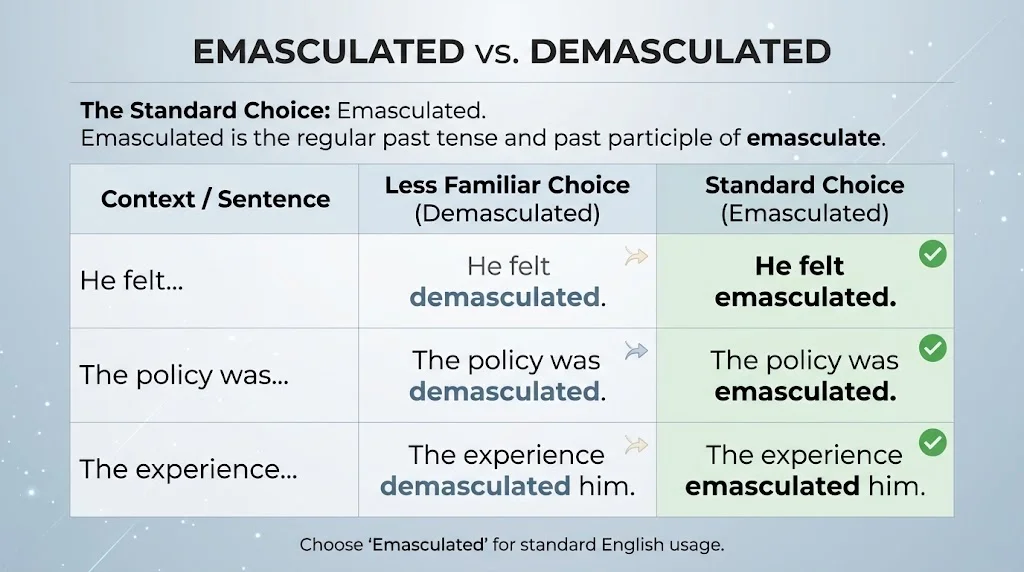
The standard choice is emasculated.
Emasculated is the regular past tense and past participle of emasculate.
Compare these sentences:
| Less familiar | Standard choice |
| He felt demasculated. | He felt emasculated. |
| The policy was demasculated. | The policy was emasculated. |
| The experience demasculated him. | The experience emasculated him. |
The standard forms are immediately recognizable.
When Should You Use Emasculated?
Use emasculated when you’re describing something that has already happened.
For example:
- He felt emasculated by the criticism.
- The organization was emasculated by funding cuts.
- The law had been emasculated by subsequent amendments.
Notice that the word can describe both people and abstract things.
That flexibility is one reason emasculate remains useful in formal English.
Emasculate vs. Castrate: Are They the Same?
Not exactly.
The words overlap in one literal sense, but castrate is more specific.
Castrate normally refers to removing the testes or rendering a male incapable of reproduction. Emasculate can describe that literal act, but it also has broader meanings involving strength, confidence, authority, and effectiveness.
Consider the difference:
- The veterinarian castrated the animal.
- The criticism emasculated him.
- The amendments emasculated the law.
Replacing emasculated with castrated in the second or third sentence would dramatically change the meaning and tone.
In other words, castrate is narrower while emasculate has a wider figurative range.
Emasculate vs. Weaken vs. Unman
Several English verbs overlap with emasculate, but they aren’t interchangeable in every sentence.
| Word | Main idea | Example |
| Emasculate | Remove masculine strength or weaken effectiveness | The changes emasculated the agency. |
| Weaken | Make something less strong | The changes weakened the agency. |
| Unman | Deprive someone of courage or composure | The attack unmanned him. |
| Castrate | Remove male reproductive capacity | The animal was castrated. |
| Enervate | Drain energy or vitality | The illness enervated him. |
Can You Use Emasculate for Laws and Organizations?
Yes.
This is one of the most useful figurative applications of the word.
A law can become emasculated if amendments remove the provisions that give it real force. An agency can become emasculated if budget cuts or restrictions prevent it from carrying out its core responsibilities.
For example:
The amendments effectively emasculated the legislation.
Here, nobody is talking about masculinity. The sentence means that the legislation lost much of its practical force.
A Simple Case Study
Imagine a regulatory agency has the authority to impose penalties on companies that violate safety rules.
A new amendment removes its enforcement powers. The agency still exists. Its name hasn’t changed. Its offices remain open.
Yet it can no longer do much of what it was created to do.
You could say:
“The amendment emasculated the agency.”
Here, emasculated means stripped of effective power.
That’s a useful distinction because simply saying weakened may not capture the sense of substantial loss of authority.
Read More: Title vs. Tittle: What’s the Difference?
Is Emasculate Always Negative?
Usually, yes.
When emasculate describes a person, it normally carries an unfavorable meaning. It suggests that someone has lost confidence, authority, masculine identity, vigor, or perceived power.
When it describes an institution or policy, the negative meaning becomes even clearer.
For example:
- The decision weakened the policy. — neutral
- The decision emasculated the policy. — stronger and more critical
The second sentence suggests that the policy lost an important amount of its original force.
That emotional weight makes emasculate more expressive than a basic synonym such as weaken.
Can Women or Organizations Be Emasculated?
The answer depends on the sense.
Historically and literally, emasculate relates to male reproductive capacity and masculinity. In its figurative human sense, dictionaries describe the word in terms of making a man feel less male by taking away power or confidence.
However, the broader figurative sense applies to nonhuman subjects as well.
You can say:
- The reforms emasculated the institution.
- The amendments emasculated the legislation.
- The cuts emasculated the department.
That doesn’t mean the institution has a gender. It means its power or effectiveness has been severely reduced.
When describing people, it’s best to preserve the specific context. If the intended meaning is simply embarrassment or loss of confidence, words such as humiliated, undermined, or discouraged may sometimes communicate the idea more precisely.
How to Pronounce Emasculate
In American English, emasculate is pronounced approximately:
ih-MASS-kyuh-late
The main stress falls on MASS.
Cambridge gives the US pronunciation as /ɪˈmæs.kjə.leɪt/.
The word also has an adjective form with a different final sound:
- Verb: emasculate — ih-MASS-kyuh-late
- Adjective: emasculate — ih-MASS-kyuh-lit
In everyday writing, however, you’re much more likely to see emasculated than the adjective emasculate.
Emasculate: Word Forms and Grammar
Knowing the related forms makes the word easier to use correctly.
| Form | Function | Example |
| emasculate | Verb | The criticism could emasculate him. |
| emasculated | Past tense/past participle | He felt emasculated. |
| emasculating | Present participle | The experience was emasculating. |
| emasculation | Noun | The emasculation of the institution caused concern. |
| emasculator | Noun | A person or thing that emasculates |
Common Sentence Patterns
The most natural construction often uses emasculate + object:
- The criticism emasculated him.
- The amendments emasculated the law.
- The experience emasculated the character.
You can also use the participle:
- He felt emasculated.
- The policy became increasingly emasculated.
- The experience was deeply emasculating.
The noun works when discussing the process or condition:
- The emasculation of the agency weakened public trust.
Common Mistakes
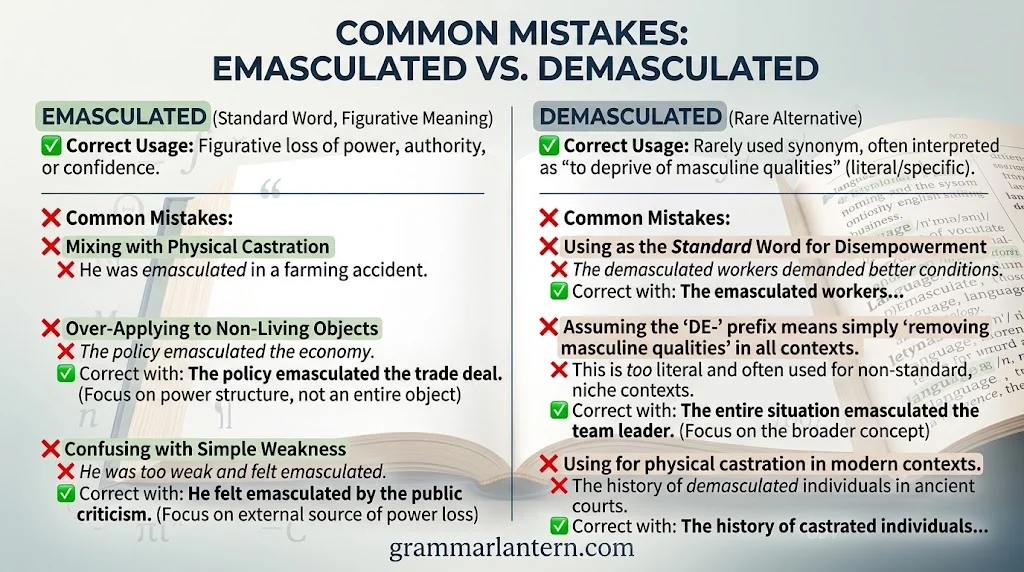
Assuming “Demasculate” Must Be Correct
The logic looks reasonable, but English isn’t always built like an equation.
De- + word = removal doesn’t guarantee that the resulting formation will become the established English term.
Saying “Demasculate Isn’t a Word”
That claim goes too far.
Wiktionary records demasculate as an English verb.
The more accurate statement is:
“Demasculate is a rare recorded word, but emasculate is the established standard choice.”
That’s both more precise and more useful.
Using Emasculate Only for Men
The word’s human figurative sense is closely tied to masculinity. However, emasculate also has a broader sense meaning to weaken or reduce effectiveness.
That’s why you can legitimately write:
The amendments emasculated the law.
No person is involved.
Using Castrate as a General Synonym
Castrate is much more literal and specific. If you’re talking about confidence, authority, or an institution’s power, emasculate usually fits better.
Assuming a Longer Word Sounds More Sophisticated
Sometimes writers reach for unusual words because they look more technical.
That’s a trap.
Clear vocabulary beats exotic vocabulary. If your readers immediately understand emasculate, there’s little reason to replace it with the much rarer demasculate.
Emasculate vs. Demasculate in Formal Writing
For formal writing, the recommendation is straightforward:
Use “emasculate.”
That applies to:
- academic essays
- research writing
- journalism
- business reports
- professional communication
- legal writing
- policy analysis
- educational content
- general web writing
The established word gives your sentence immediate clarity.
For example:
Preferred:
The amendment emasculated the commission by removing its enforcement authority.
Less natural:
The amendment demasculated the commission by removing its enforcement authority.
The first sentence uses an established figurative meaning. The second sounds unusual because demasculate isn’t normally used for institutional weakening.
Read More: United States’ or States’ or States’s? Correct Possessive
FAQs
1. Is emasculate a correct English word?
Yes. Emasculate is a recognized English word with established meanings and uses. It can refer to removing male characteristics or weakening someone’s sense of power, confidence, or authority.
2. Is demasculate a correct English word?
Demasculate is much less common than emasculate. Although you may encounter it in modern or online writing, it doesn’t have the same standard recognition and widespread use.
3. What does emasculate mean?
Emasculate can mean to deprive a man of male qualities. In figurative use, it can also mean to make someone feel less powerful, confident, or authoritative.
4. What does demasculate mean?
Demasculate is generally used to express an idea similar to emasculate. However, it is rare and isn’t the usual choice in standard English.
5. What is the difference between emasculate and demasculate?
The main difference is usage and recognition. Emasculate is established and widely used, while demasculate is uncommon and generally less suitable for formal writing.
6. Can I use emasculate in professional writing?
Yes, but you should consider the context. Because the word can carry a strong meaning related to masculinity, power, and confidence, choose it carefully.
7. Is emasculate only used in a literal sense?
No. It can have both literal and figurative meanings. In modern writing, the figurative sense often describes someone being deprived of confidence, authority, or power.
8. Why do people confuse emasculate and demasculate?
The words look and sound similar, and both appear connected to masculinity. This similarity can make writers assume that they are interchangeable.
9. Which word should I use: emasculate or demasculate?
In most situations, emasculate is the safer and more established choice. It is familiar to English readers and has recognized dictionary definitions.
10. How can I avoid confusing these two words?
Check the meaning, context, and level of formality before choosing a word. If you need the established standard term, emasculate is usually the better option.
Conclusion
Emasculate vs. Demasculate may look like a simple spelling comparison, but the difference mainly comes down to recognition, usage, and context. Emasculate is the established English word, while demasculate is considerably rarer. Understanding this distinction can help you make clearer and more confident choices in everyday and formal writing.
When you’re unsure, consider your audience and the meaning you want to express. For standard English, emasculate is generally the more appropriate choice. Paying attention to context, meaning, and established usage will help you avoid unnecessary confusion and improve your overall word choice.

For Shafiq ur Rehman, writing is an art form and grammar is the toolbox that makes it beautiful. As a dedicated content writer at Grammar Lantern, Shafiq approaches every topic like an architect carefully laying down strong foundations of understanding before adding the finer details. He loves diving into the trickiest grammar points and resurfacing with simple, bite-sized takeaways that anyone can grasp. When he’s not crafting articles, you’ll likely find him strategizing over a game of chess, exploring dusty local bookshops, or quietly jotting down poetic observations in his notebook.


[…] Read More: Emasculate vs. Demasculate: Which Word Is Correct? […]
[…] Read More: Emasculate vs. Demasculate: Which Word Is Correct? […]