
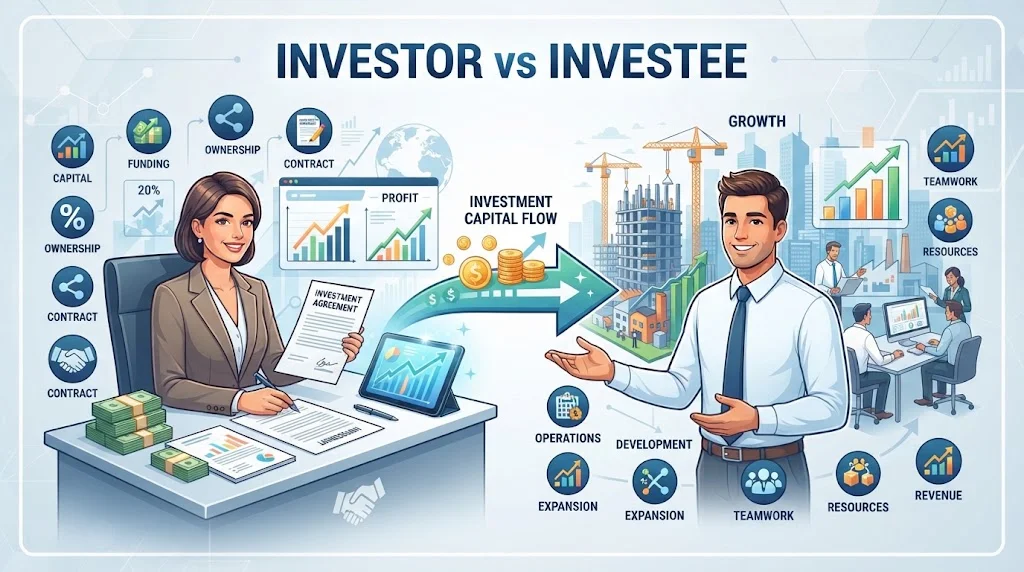
Have you ever wondered who gives the money and who receives it in an investment? The difference between investor vs investee is simple once you focus on each party’s role. An investor provides capital to a person, business, or project, usually with the expectation of earning a return. An investee is the person or entity that receives that capital. Although the terms look similar, they describe opposite sides of the same financial relationship.
You’ll commonly encounter these terms in business finance, accounting, startup funding, and investment agreements. For example, a company raising money from a venture capital firm is the investee, while the firm providing the funds is the investor. Understanding this distinction can make financial documents much easier to read. It also helps you avoid mistakes when discussing ownership, funding, or business transactions.
The key is to remember the direction of the investment. Money moves from the investor toward the investee, while the expected financial benefit generally moves back toward the investor. Once you connect each term with its role, the difference becomes much easier to remember. In this guide, you’ll learn how both terms work, see practical examples, and understand where they commonly appear in professional writing.
What Is an Investor?
An investor is a person, company, fund, or institution that commits capital to an asset, business, project, or financial instrument with the goal of earning a return or gaining another economic benefit.
Investors don’t all operate in the same way. Some buy shares in public companies and hold them for years. Others invest in startups, real estate, private companies, bonds, or entire portfolios of assets.
The common thread is the commitment of capital.
For example, imagine that a startup needs $1 million to expand. A venture capital firm contributes $1 million in exchange for an agreed ownership interest. The venture capital firm is the investor in that transaction.
An investor may expect returns through:
- Capital appreciation
- Dividends
- Interest
- Profit distributions
- Sale proceeds
- Other contractual financial benefits
However, an investor doesn’t automatically receive every type of return. The outcome depends on the investment structure.
Common Types of Investors
Investors can take many forms. Some of the most common include:
| Type of investor | Typical investment | Main objective |
| Individual investor | Stocks, bonds, funds, real estate | Wealth growth or income |
| Angel investor | Early-stage businesses | High-growth potential |
| Venture capital firm | Startups and emerging companies | Significant growth and eventual return |
| Private equity firm | Established private companies | Business growth and investment returns |
| Institutional investor | Stocks, bonds, funds, private assets | Portfolio returns |
| Corporate investor | Other businesses or strategic assets | Financial or strategic benefits |
| Fund | Multiple assets or companies | Portfolio-level returns |
An investor can also have different levels of involvement. One investor might simply own shares and monitor performance. Another might negotiate board representation or other governance rights.
What Is an Investee?
An investee is the person, company, or entity that receives an investment from an investor.
The word describes the recipient’s role within a particular investment relationship. It doesn’t necessarily describe the company’s legal structure, industry, size, or stage of development.
For example, if an investment fund buys shares in a technology company, the fund becomes the investor and the technology company becomes the investee.
The investee typically receives capital to achieve a specific business or financial objective. That could include:
- Expanding into new markets
- Hiring employees
- Developing products
- Purchasing equipment
- Building facilities
- Funding research
- Acquiring another company
- Supporting working capital
- Refinancing existing obligations
The investee’s obligations depend heavily on the type of investment.
An equity investee may issue ownership interests and provide shareholders with certain rights. A debt-financed investee generally has repayment obligations. That’s why calling every investee a “borrower” would be inaccurate.
The Key Difference
The fundamental difference is who provides the investment and who receives it.
| Factor | Investor | Investee |
| Basic role | Provides capital | Receives investment |
| Primary position | Capital provider | Capital recipient |
| Main objective | Earn a return or economic benefit | Obtain capital for a purpose |
| Money flow | Capital generally flows out | Capital generally flows in |
| Ownership | May receive ownership | May issue or transfer ownership |
| Risk | Takes investment risk | Takes business or financing risk |
| Control | May have influence or control depending on rights | May retain or share control |
| Returns | May receive dividends, interest, appreciation, or proceeds | May benefit from business growth or access to capital |
| Reporting | May analyze investment performance | May provide financial and operational information |
| Decision-making | May receive agreed governance rights | Usually manages the underlying business |
This table captures the basic relationship. Yet real-world investments can be considerably more complicated.
An investor doesn’t necessarily control an investee. Likewise, an investee doesn’t necessarily surrender ownership simply because it receives money.
How an Investor and Investee Relationship Works
An investor-investee relationship usually develops through several stages.
First, the investee needs capital or presents an investment opportunity. The investor then evaluates the opportunity. This evaluation can involve financial statements, market research, management assessment, legal review, competitive analysis, and other forms of due diligence.
If the investor decides to proceed, both sides negotiate the terms.
Those terms can determine:
- How much capital changes hands
- What the investor receives
- Whether ownership changes
- Whether interest applies
- How repayment works
- What voting rights exist
- Whether the investor gets board representation
- What information the investee must provide
- What happens if certain conditions aren’t met
- How either party can exit the arrangement
Once the agreement is completed, the investor provides the agreed capital. The investee then uses the funds according to the arrangement.
The relationship may continue for years or end much sooner. An investor could sell its ownership interest, receive repayment, collect distributions, or otherwise exit the investment.
Investment isn’t simply about money changing hands. It’s about the rights, obligations, risks, and expected outcomes attached to that money.
In Equity Investments
Equity investment creates one of the clearest examples of the investor vs investee relationship.
Suppose a company issues new shares to an investor. The company receives capital. The investor receives an ownership interest.
In this situation:
Investor:
- Provides capital.
- Receives shares or another ownership interest.
- May receive voting rights.
- May receive dividends if declared.
- May benefit if the value of the investment increases.
- Bears the risk that the investment could lose value.
Investee:
- Receives capital.
- Issues or transfers an ownership interest.
- Uses the capital to pursue business objectives.
- May have obligations to shareholders.
- May need to provide financial or operational information.
The percentage of ownership matters.
If an investor owns 5% of a company, that doesn’t mean the investor controls the company. A 5% shareholder may have certain rights without having enough voting power to direct major decisions.
A much larger ownership position can create greater influence. In some circumstances, an ownership interest can result in control.
Read More: As Of, As At, As From: Difference Explained With Examples
Does an Equity Investor Always Get Control?
No.
Investment and control aren’t synonyms.
An investor can own part of a company while the founders or another shareholder group retains control. The actual level of influence depends on factors such as:
- Voting rights
- Ownership percentage
- Share classes
- Board rights
- Shareholder agreements
- Contractual arrangements
- Distribution of voting power among other shareholders
This distinction becomes especially important in startup financing.
A founder might raise $2 million from an investor while retaining majority voting control. The investor still has an ownership stake but doesn’t necessarily run the company.
In Debt Financing
The distinction becomes slightly different when the capital comes through debt.
Suppose a business receives a $500,000 loan. The lender provides the money, while the business receives it.
The business generally has to repay the principal under the agreed terms. Interest may also apply.
This creates a relationship involving:
- Principal
- Interest
- Repayment dates
- Covenants
- Security or collateral where applicable
- Default provisions
- Other contractual obligations
Debt financing differs from equity financing because the recipient doesn’t normally give the lender an ownership stake simply for receiving the loan.
This is why the following comparison matters:
| Feature | Equity investment | Debt financing |
| Ownership | Usually involved | Usually not involved |
| Repayment | Not normally fixed | Usually required |
| Return | Dividends or appreciation | Interest and repayment |
| Investor risk | Can lose investment value | Faces credit/default risk |
| Control | May receive voting rights | Usually based on contractual rights |
| Relationship | Ownership-based | Creditor-based |
The term investee can still describe the recipient of an investment in the appropriate context. However, terminology surrounding debt often uses borrower and lender instead.
Risk Differences
Risk is another major difference between the two sides.
An investor commits capital before knowing exactly what return the investment will produce. The investment could perform well, perform poorly, or lose value entirely.
For example, someone who buys shares in a company faces market and business risks. If the company’s performance deteriorates, the shares may decline in value.
An investee faces a different set of risks.
A company receiving equity capital may gain resources for expansion without creating a fixed repayment obligation. However, it may dilute existing ownership.
A company receiving debt financing gains access to cash but takes on repayment obligations.
Common Investor Risks
Investors may face:
- Market risk
- Business risk
- Credit risk
- Liquidity risk
- Interest-rate risk
- Concentration risk
- Regulatory risk
- Operational risk
Common Investee Risks
Investees may face:
- Financial obligations
- Ownership dilution
- Investor expectations
- Governance restrictions
- Performance requirements
- Debt repayment pressure
- Reporting requirements
- Strategic disagreements
The exact risks depend on the transaction.
Responsibilities
An investor’s responsibilities aren’t identical to those of an investee.
What Does an Investor Typically Do?
An investor may:
- Conduct due diligence.
- Analyze financial statements.
- Assess potential returns.
- Evaluate business risks.
- Negotiate investment terms.
- Provide capital.
- Monitor performance.
- Exercise agreed shareholder or governance rights.
- Decide whether to maintain or exit the investment.
Investors often spend significant time evaluating opportunities before committing money. That’s because the investment decision can determine whether capital grows or disappears.
What Does an Investee Typically Do?
An investee may:
- Present a business plan or investment opportunity.
- Explain how it will use the capital.
- Provide required financial information.
- Meet contractual obligations.
- Manage the business or project.
- Use funds according to agreed terms.
- Communicate important developments.
- Protect the value of the underlying business.
The specific responsibilities come from the investment agreement, company documents, financing documents, and applicable rules.
Does an Investor Control an Investee?
Not necessarily.
This is one of the most important points to understand about the investor vs investee relationship.
Ownership, influence, and control can exist at different levels.
Consider three simplified situations:
Minority investment: An investor owns a small portion of a company and has limited influence.
Significant influence: An investor has enough rights or involvement to participate meaningfully in important decisions without necessarily controlling the company.
Control: An investor has sufficient rights to direct relevant activities and make key decisions under the applicable arrangement.
The exact definition of control can become technical in accounting and corporate law. Voting rights are important, but they aren’t always the only factor.
An investor could also gain contractual rights that affect decision-making.
So the statement “The investor owns the investee” isn’t automatically correct.
A better statement is:
An investor may own an interest in an investee and may or may not have significant influence or control.
Example: A Startup Case Study
Consider a fictional company called BrightTech.
BrightTech has developed a software platform and wants $1 million to expand into three new markets.
A venture capital firm agrees to invest $1 million in exchange for a 15% equity interest.
In this case:
- Venture capital firm = Investor
- BrightTech = Investee
- Investment = $1 million
- Investor ownership = 15%
- Purpose = Business expansion
BrightTech now has additional capital. The investor receives an ownership interest and expects that BrightTech will grow in value.
The investor might also negotiate certain rights. Those could include board representation, information rights, or approval rights over specific major decisions.
However, owning 15% doesn’t automatically mean the investor controls the company.
What Happens If BrightTech Succeeds?
Suppose the company grows significantly and its valuation increases.
The investor’s 15% interest could become substantially more valuable. The investor may eventually sell its stake or benefit from another liquidity event.
BrightTech benefits from the capital and potentially from the investor’s expertise, network, or strategic support.
What If BrightTech Struggles?
If the company’s value falls, the investor may lose part or all of its investment.
BrightTech also faces consequences. Expansion plans might fail, employees could be affected, and additional financing could become harder to obtain.
This example shows why both parties have something at stake.
Investor vs Investee vs Lender vs Borrower
These four terms often get mixed together.
They shouldn’t.
| Term | Meaning | Typical relationship |
| Investor | Provides capital expecting a return or economic benefit | Investment relationship |
| Investee | Receives an investment | Investment relationship |
| Lender | Provides money that generally must be repaid | Lending relationship |
| Borrower | Receives borrowed money and generally must repay it | Lending relationship |
The distinction becomes especially important when discussing financing.
An equity investor typically receives an ownership interest. A lender generally receives a contractual right to repayment and possibly interest.
A company can also have both relationships at once.
For example, a business might have:
- Equity investors
- Bank lenders
- Bondholders
- Founders
- Other financing providers
The same company can therefore be an investee in one relationship and a borrower in another.
Can an Investor Also Be an Investee?
Yes.
The roles aren’t permanent labels attached to a person or company.
Imagine Company A invests $5 million in Company B. Company A is the investor, while Company B is the investee.
Later, Company B invests $2 million in Company C.
Now:
- Company A → Investor in Company B
- Company B → Investee in relation to Company A
- Company B → Investor in Company C
- Company C → Investee in relation to Company B
The same entity can occupy both roles at different points in its investment activities.
This is particularly common among large corporations, investment funds, holding companies, and financial institutions.
What Does an Investor Expect From an Investee?
An investor generally expects the investee to protect and grow the value associated with the investment.
The exact expectations depend on the deal. Common expectations include:
- Strong financial management
- Sustainable growth
- Accurate reporting
- Responsible use of capital
- Compliance with agreements
- Effective leadership
- Risk management
- Progress toward agreed objectives
An investor doesn’t necessarily expect immediate profit.
A venture capital investor may accept years of losses from a startup if the business has substantial long-term growth potential.
That differs from an income-focused investment where regular distributions might matter more.
What Does an Investee Expect From an Investor?
The investee typically expects more than money.
Depending on the relationship, an investor may provide:
- Capital
- Industry expertise
- Strategic guidance
- Business connections
- Market knowledge
- Management experience
- Credibility
- Additional financing opportunities
However, not every investor provides these benefits.
A passive shareholder may simply provide capital. A strategic investor may become deeply involved in the business.
The investment agreement and relationship between the parties determine what each side can reasonably expect.
Common Mistakes
Several mistakes appear repeatedly when people use these terms.
Mistake 1: Calling the Recipient the Investor
If a company receives an investment, that company is generally the investee in that relationship.
The person or entity supplying the investment is the investor.
Mistake 2: Assuming Every Investment Creates Ownership
Not every financing arrangement involves equity.
Debt financing can provide capital without transferring ownership.
Mistake 3: Assuming Every Investor Controls the Company
An investor can hold a minority interest and have limited decision-making power.
Ownership percentage and control aren’t always the same thing.
Mistake 4: Treating Investee and Borrower as Identical
A borrower receives borrowed funds and generally must repay them. An investee can receive equity capital without having a fixed repayment obligation.
Mistake 5: Assuming the Investor Runs the Business
An investor may have governance rights without managing daily operations.
Founders and executives often continue running the company even after outside investment.
Why Difference Matters
Understanding investor vs investee isn’t just a vocabulary exercise.
The distinction helps you interpret:
- Investment agreements
- Financial reports
- Business plans
- Shareholder documents
- Corporate announcements
- Funding news
- Startup financing
- Investment analysis
- Accounting discussions
It also prevents a common misunderstanding: assuming that giving money automatically gives someone complete control.
The actual relationship depends on the type of investment and the rights attached to it.
For students, entrepreneurs, investors, and business professionals, this distinction provides a useful foundation for understanding more advanced financial concepts.
Quick Comparison
| Question | Investor | Investee |
| Who provides capital? | Investor | No |
| Who receives the investment? | No | Investee |
| Who expects an investment return? | Investor | Not necessarily |
| Who uses the capital? | Usually not the recipient | Investee |
| Can ownership change? | May receive ownership | May issue or transfer ownership |
| Can control exist? | Potentially | May retain or share control |
| Can either party face risk? | Yes | Yes |
| Can the same company occupy both roles? | Yes | Yes |
How to Remember Investor vs Investee
If the terminology feels confusing, use one simple mental shortcut:
Investor = invests.
Investee = receives the investment.
Think of the relationship as an arrow:
Investor → Capital → Investee
The arrow shows the basic flow of money.
In an equity transaction, another arrow may appear:
Investor ← Ownership Interest ← Investee
That second relationship explains why equity investing can create rights for the investor while giving the company access to capital.
Once you understand those two flows, the terminology becomes much easier.
Read More: Choosing vs. Chosing: Which Spelling Is Correct?
FAQs
1. What is an investor?
An investor is a person, company, or organization that provides money or capital to an investment with the goal of receiving a financial return.
2. What is an investee?
An investee is the person, company, or entity that receives an investment from an investor.
3. What is the main difference between an investor and an investee?
The main difference is their role in the transaction. The investor provides capital, while the investee receives the capital.
4. Can a company be an investor?
Yes. A company can act as an investor when it puts money into another business, project, or financial asset.
5. Can an individual be an investee?
Yes. An individual can be an investee if they receive investment funds, although the term is more commonly used for businesses and other entities.
6. Is the investee always a company?
No. An investee can be a company, partnership, organization, project, or another entity that receives investment capital.
7. Does an investor always own part of the investee?
No. Ownership depends on the type and terms of the investment. Some investments provide an ownership interest, while others involve loans or different financial arrangements.
8. Where are the terms investor and investee commonly used?
You’ll often see them in accounting, corporate finance, venture capital, private equity, investment agreements, and financial reporting.
9. How can I remember investor vs investee?
Think about the direction of the money. The investor invests, while the investee is invested in. This simple connection makes the distinction easier to remember.
10. Are investor and investee opposites?
In the context of an investment relationship, they represent two different sides of the same transaction. The investor supplies the capital, while the investee receives it.
Conclusion
Understanding investor vs investee becomes much easier when you focus on who provides the money and who receives it. An investor puts capital into a business, project, or other investment, while an investee receives that capital. Although the words look almost identical, their roles are clearly different. This distinction matters in accounting, finance, contracts, and everyday business communication.
When you come across these terms, remember one simple idea: the investor invests, and the investee is invested in. Once that connection becomes familiar, you’ll be able to recognize both terms quickly and use them accurately. Whether you’re reading a financial report or discussing a startup investment, knowing the difference can make complex financial language much easier to understand.

For Shafiq ur Rehman, writing is an art form and grammar is the toolbox that makes it beautiful. As a dedicated content writer at Grammar Lantern, Shafiq approaches every topic like an architect carefully laying down strong foundations of understanding before adding the finer details. He loves diving into the trickiest grammar points and resurfacing with simple, bite-sized takeaways that anyone can grasp. When he’s not crafting articles, you’ll likely find him strategizing over a game of chess, exploring dusty local bookshops, or quietly jotting down poetic observations in his notebook.