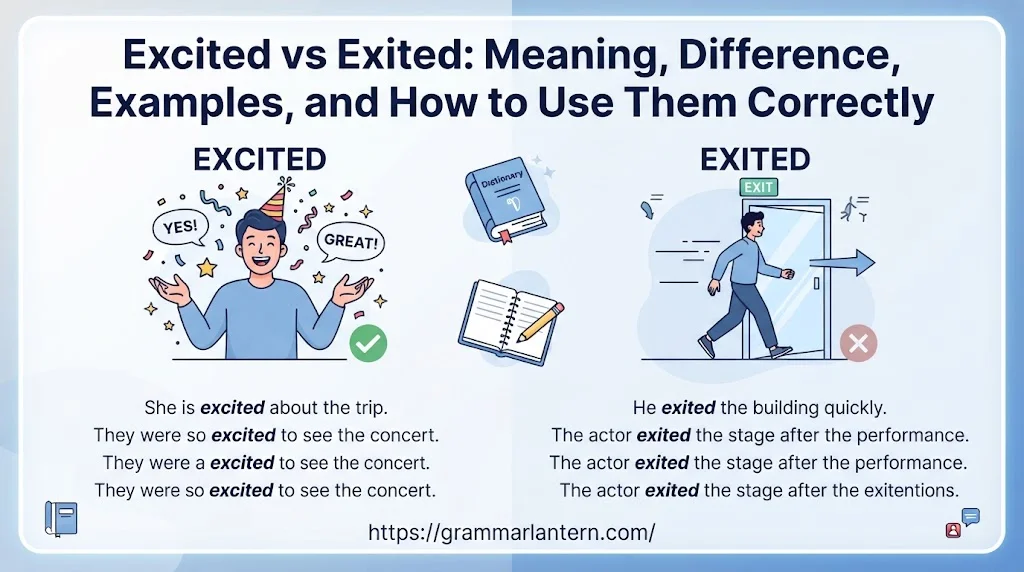
When you are writing a message or finishing an important email, you may pause and wonder whether excited vs exited is the correct choice. Although these words differ by only one letter, their meanings are completely different. Excited describes a feeling of happiness, enthusiasm, or eagerness, while exited means leaving a place, situation, or activity. Understanding this simple difference can help you avoid an embarrassing spelling mistake.
The confusion often happens because excited and exited look and sound quite similar, especially in fast speech or casual writing. The easiest way to remember them is to connect each word with its root. Excited comes from excite, while exited comes from exit. Once you recognize that connection, choosing the correct word becomes much easier.
In this guide, you will learn the meanings, grammar, pronunciation, spelling, origins, and everyday uses of excited vs exited. You will also see common mistakes, practical examples, and simple memory tricks that can help you remember the difference whenever you write or speak.
Quick Answer
Excited means enthusiastic, eager, or emotionally energized about something.
“I’m excited about my new job.”
Exited is the past tense of exit and means left.
“She exited the building after the meeting.”
The easiest way to remember the difference is this:
| Word | Meaning | Example |
| Excited | Enthusiastic or eager | “We’re excited about the vacation.” |
| Exited | Left a place or situation | “We exited the theater.” |
Think of excited as a feeling and exited as an action.
If someone feels thrilled about an upcoming event, use excited. If someone leaves somewhere, use exited.
What Does “Excited” Mean?
Excited describes a strong feeling of enthusiasm, eagerness, anticipation, or emotional energy.
You might feel excited before a vacation, a concert, a wedding, a job interview, a sports game, or an important announcement. The feeling can come from something you expect to happen soon or something enjoyable that has already happened.
For example:
- “I’m excited about the weekend.”
- “She’s excited to start college.”
- “They were excited about the results.”
- “He looked excited when he opened the package.”
- “We’re excited that you’re joining us.”
The word often describes a person’s emotional response to something.
Excited as an Adjective
In everyday English, excited commonly functions as an adjective.
It describes how someone feels rather than what someone does.
Compare these sentences:
“Maria is excited about the concert.”
Here, excited describes Maria’s emotional state.
“The concert excited Maria.”
Here, excited is the past-tense form of the verb excite.
This distinction becomes useful when you encounter related words such as excite, excited, and exciting.
Common Expressions With “Excited”
Certain grammatical patterns appear frequently with excited.
Excited about + noun
Use excited about when you feel enthusiastic about a person, thing, event, plan, or situation.
Examples:
- “I’m excited about the new project.”
- “She’s excited about her birthday.”
- “They’re excited about their vacation.”
- “He’s excited about the opportunity.”
Excited to + verb
Use excited to when you want to express enthusiasm about doing something.
Examples:
- “I’m excited to meet everyone.”
- “She’s excited to start her new job.”
- “We’re excited to announce the winner.”
- “He’s excited to visit New York.”
Excited that + clause
You can also use excited that before a complete idea.
Examples:
- “I’m excited that you’re coming.”
- “She’s excited that the project is finished.”
- “We’re excited that our team won.”
These patterns make excited especially common in personal, professional, and social communication.
Read More: Begun vs. Began: Which Is Correct? Helpful Examples
What Does “Exited” Mean?
Exited is the past tense and past participle of the verb exit.
It means left.
If someone exits a building, they leave the building. If a player exits a competition, the player leaves or is no longer involved in it and If someone exits an application, they close or leave the program.
For example:
- “He exited the restaurant.”
- “She exited the car.”
- “The audience exited the theater.”
- “The player exited the tournament.”
- “I accidentally exited the application.”
Notice something important: exited doesn’t describe enthusiasm.
A person can be excited and then exit a room. Those two words can even appear in the same sentence.
“She was excited about the event before she exited the building.”
The first word describes her feeling. The second describes her action.
Exited as a Verb
Unlike excited in common emotional expressions, exited functions as a verb.
The basic forms are:
| Verb form | Example |
| Exit | “Please exit through the rear door.” |
| Exits | “He exits the building at noon.” |
| Exited | “He exited the building earlier.” |
| Exiting | “She is exiting the building.” |
The form exited tells you that the leaving happened in the past.
The Main Difference
The central difference is simple:
Excited = enthusiastic or eager.
Exited = left.
Although the spelling differs by only one letter, the meaning changes dramatically.
| Feature | Excited | Exited |
| Root word | Excite | Exit |
| Main meaning | Enthusiastic or eager | Left |
| Common grammatical role | Adjective | Verb |
| Main idea | Feeling | Action |
| Related noun | Excitement | Exit |
| Example | “She is excited about college.” | “She exited the classroom.” |
A useful test is to replace the word with enthusiastic or left.
If enthusiastic works, choose excited.
“I’m enthusiastic about the trip.”
“I’m excited about the trip.”
If left works, choose exited.
“He left the room.”
“He exited the room.”
That substitution test catches the mistake surprisingly often.
Pronunciation
The two words also differ in pronunciation.
Excited typically has three syllables:
ex-cit-ed
Exited typically has three syllables as well:
ex-it-ed
The middle sounds differ. In excited, the pronunciation comes from excite, while exited comes from exit.
This difference becomes easier to hear when you say both words slowly.
Try this simple practice:
- “I’m excited about the trip.”
- “I exited the building.”
The first sentence describes an emotion. The second describes movement away from a location.
Fast speech can make the distinction less obvious to some learners. That’s why understanding the meaning matters just as much as recognizing the sound.
In Grammar
Grammar gives you another reliable way to distinguish these words.
How to Use “Excited”
Use excited when describing enthusiasm, anticipation, or eagerness.
Common structures include:
excited about + noun
“She’s excited about the new position.”
excited to + verb
“She’s excited to begin the new position.”
excited that + clause
“She’s excited that she got the position.”
You can also place excited after linking verbs such as be, feel, look, and seem.
Examples:
- “I feel excited about the trip.”
- “He looks excited.”
- “They seem excited about the announcement.”
- “She was excited to hear the news.”
How to Use “Exited”
Use exited when someone or something leaves.
Examples:
- “The customer exited the store.”
- “The driver exited the highway.”
- “The students exited the classroom.”
- “The user exited the application.”
The word can describe physical movement as well as leaving a situation or activity.
For instance:
“The company exited the market.”
Here, exited doesn’t mean physically walking out of a room. It means the company stopped operating or participating in that market.
That broader meaning is important in business and formal writing.
Common Mistakes
The most common mistake happens when writers leave out the c in excited.
Mistake: “I’m exited about the vacation.”
This sentence says that you left the vacation, which probably isn’t what you mean.
Correct: “I’m excited about the vacation.”
Now the sentence clearly communicates enthusiasm.
Another common error goes in the opposite direction.
Mistake: “We excited the building.”
This doesn’t correctly express the normal idea of leaving the building.
Correct: “We exited the building.”
Here, exited correctly functions as the past-tense verb.
Other common mistakes include:
- “I’m exited to see you.” ❌
- “I’m excited to see you.” ✅
- “She excited the room.” ❌
- “She exited the room.” ✅
- “They are exited about the results.” ❌
- “They are excited about the results.” ✅
The extra c isn’t decorative. It separates two different words.
Examples in Real Sentences
Context makes the distinction much easier.
Everyday Conversation
“I’m excited about dinner tonight.”
The speaker feels enthusiastic.
“We exited the restaurant at 10 p.m.”
The people left the restaurant.
Workplace Communication
“We’re excited to launch the new product.”
The team feels enthusiastic about the launch.
“The company exited the international market.”
The company stopped participating in that market.
School and Education
“The students were excited about the field trip.”
They felt enthusiastic.
“The students exited the classroom quietly.”
They left the classroom.
Travel
“I’m excited about my trip to California.”
The traveler feels eager.
“We exited the airport through the main entrance.”
The travelers left an area.
Technology
“I’m excited about the new software.”
The person feels enthusiastic.
“I accidentally exited the program.”
The person left or closed the program.
A Real-World Case Study
Imagine that an employee sends this message to a manager:
“I’m exited to join the team next Monday.”
The manager will probably understand the intended meaning from context. Still, the spelling creates an awkward impression.
Now compare it with:
“I’m excited to join the team next Monday.”
The second version immediately communicates enthusiasm and sounds polished.
Here’s another situation.
A security report might say:
“The visitor exited the building at 6:15 p.m.”
Changing exited to excited would produce a completely different and nonsensical meaning.
This illustrates an important writing lesson: context can rescue a typo, but precision prevents the typo in the first place.
Excited vs Exited vs Exciting
Another word often enters the same confusion: exciting.
These three words have different jobs.
| Word | Meaning | Example |
| Excited | Feeling enthusiasm | “I’m excited about the game.” |
| Exited | Left something | “I exited the stadium.” |
| Exciting | Causing enthusiasm | “The game was exciting.” |
The distinction between excited and exciting deserves special attention.
If you feel the emotion, you’re usually excited.
“I’m excited about the movie.”
If something causes the emotion, it can be exciting.
“The movie was exciting.”
Think of it this way:
The exciting event makes you excited.
That simple relationship helps you remember both forms.
Read More: Scoup vs. Scoop: Which Spelling Is Correct?
Excited vs Exited vs Exited From
You may encounter both exited the building and exited from the building.
The construction exited the building is direct and natural.
“The suspect exited the building.”
The construction exited from the building can also occur when the wording emphasizes the route or point of departure.
“The animal exited from a small opening.”
In everyday American English, left often sounds more natural than exited in casual conversation.
For example:
“She left the office.”
This sounds ordinary and conversational.
“She exited the office.”
This is grammatical, but it can sound more formal, technical, or report-like depending on context.
The word exited works especially well when precision matters or when the action itself needs emphasis.
Frequently Confused Sentences
Look closely at these pairs.
“I’m excited about the trip.”
This means you’re looking forward to the trip.
“I exited the airport.”
This means you left the airport.
1.“She was excited to meet them.”
She felt enthusiastic about meeting them.
2.“She exited the meeting.”
She left the meeting.
3.“We’re excited about the results.”
We feel enthusiastic or eager about the results.
4.“We exited the competition.”
We left or withdrew from the competition.
The surrounding words provide useful clues. Phrases such as about, to meet, and to start often accompany emotional excited. Words describing buildings, rooms, programs, markets, or competitions often appear with exited.
How to Choose
When you’re unsure, ask one question:
Is the sentence describing a feeling or an act of leaving?
If it’s a feeling, choose excited.
“She is excited about her promotion.”
If it’s an act of leaving, choose exited.
“She exited the office after the meeting.”
You can also use this three-step check:
- Replace the word with “enthusiastic.”
- If the sentence still makes sense, use excited.
- Replace the word with “left.”
- If that works, use exited.
- Check the surrounding grammar.
- Excited about/to usually signals emotion.
- Exited the/from usually signals departure.
This method works better than simply trying to remember the spelling.
Quick Comparison Table
| Point | Excited | Exited |
| Meaning | Enthusiastic, eager, or happy about something | Left a place, activity, or situation |
| Root | Excite | Exit |
| Typical role | Adjective | Past-tense verb |
| Emotion involved? | Yes | No |
| Describes leaving? | No | Yes |
| Common phrase | Excited about | Exited the building |
| Example | “I’m excited about college.” | “I exited the classroom.” |
| Memory clue | C helps distinguish it from exit | Comes directly from exit |
Practice: Excited or Exited?
Choose the correct word in each sentence.
- I’m ______ about my birthday party.
- The passengers ______ the plane.
- She was ______ to receive the award.
- We ______ the building through the rear door.
- They’re ______ about their new house.
- He ______ the competition after the first round.
- I’m ______ to start my new job.
- The customer ______ the store without buying anything.
Answers
- excited
- exited
- excited
- exited
- excited
- exited
- excited
- exited
The pattern becomes obvious once you focus on meaning rather than spelling.
Easy Memory Tricks
A small mental shortcut can prevent a surprisingly common spelling error.
Remember the C in “Excited”
Think of the c as standing for cheerful.
Excited = cheerful, eager, enthusiastic.
This isn’t the word’s actual etymology. It’s simply a memory device.
Remember the Exit Sign
Exited comes directly from exit.
Think of a familiar exit sign above a doorway.
Exit → exited → left.
That connection is much more reliable than trying to memorize the two spellings separately.
Use the Feeling-or-Leaving Test
Ask:
Is someone feeling something or leaving something?
Feeling enthusiasm?
Excited.
Leaving?
Exited.
It’s short, practical, and easy to apply while proofreading.
FAQs
1. What is the difference between excited and exited?
Excited describes a feeling of happiness, enthusiasm, or eagerness. Exited means that someone or something left a place, situation, or activity.
2. Is excited the correct word for being happy?
Yes. Excited is commonly used when someone feels very happy, enthusiastic, or eager about something.
3. What does exited mean?
Exited is the past tense and past participle of exit. It means left or went out of a place or situation.
4. Do excited and exited sound the same?
They can sound very similar, especially when spoken quickly. However, excited has an extra syllable and a different sound pattern.
5. Is “I am exited” correct?
Usually, no. If you mean that you feel happy or enthusiastic, the correct sentence is “I am excited.”
6. Is “She excited the building” correct?
No. The correct sentence is “She exited the building.” Here, exited means that she left the building.
7. How can I remember excited vs exited?
Connect each word to its root. Excited comes from excite, which relates to enthusiasm or strong feelings. Exited comes from exit, which means leaving.
8. Which one should I use in an email?
Use excited when expressing enthusiasm, such as “I’m excited to join the team.” Use exited when describing someone leaving, such as “The customer exited the office.”
9. Why do people confuse excited and exited?
The words have very similar spelling and pronunciation. Fast typing can make the confusion worse because dropping the c changes excited into exited.
10. What is an easy example of both words together?
A useful example is: “I was excited about the event, so I stayed until everyone else exited.” Here, excited describes a feeling, while exited means left.
Conclusion
Understanding excited vs exited becomes simple when you focus on their roots. Excited comes from excite and describes enthusiasm, happiness, or eagerness. Exited comes from exit and means that someone or something left.
When you are unsure, ask yourself what you mean. If you are talking about a feeling, choose excited. If you are talking about leaving, choose exited. Once you connect each spelling with its meaning, this common mix-up becomes much easier to avoid.