When writing about Illinois, choosing between Illinoises, Illinois’s, and Illinois’ can be confusing. Illinois is a proper noun and the name of a state. Illinoises is generally not used as its plural form, while Illinois’s and Illinois’ may appear as possessive forms. Knowing which form to use depends on the grammar rules and the style guide you are following.
The main question is how to form the possessive of a singular proper noun ending in s. Some grammar rules recommend adding ’s, making Illinois’s, while some style guides prefer only an apostrophe, producing Illinois’. Both forms can therefore appear in formal writing, professional documents, academic content, and everyday communication. Consistency is especially important when choosing between these possessive forms.
In practical sentence writing, look at the meaning and context before selecting a form. You might encounter Illinois’s economy or Illinois’ economy, depending on the preferred style. However, Illinoises is not normally used to show possession. Understanding these usage rules helps writers create clear, consistent, and polished sentences while avoiding common mistakes involving proper nouns and possessive nouns.
Quick Answer
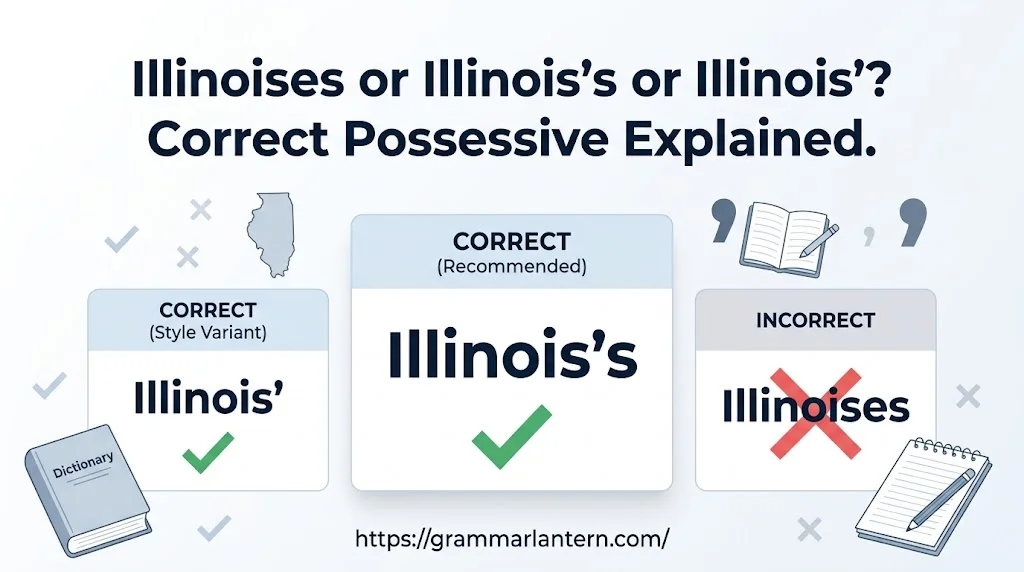
The standard singular possessive form is Illinois’s.
Illinois’ is also used in some writing styles as an alternative possessive form, especially where a publication prefers an apostrophe alone after names ending in s.
Illinoises is not the standard possessive form of Illinois.
| Form | Correct? | What it means |
| Illinois’s | Yes | Singular possessive |
| Illinois’ | Yes, in some styles | Alternative singular possessive |
| Illinoises | No, as a possessive | Not the standard possessive form |
| Illinois | Yes | The state name without possession |
So, if you need one safe choice for general American English, use Illinois’s.
For example:
Illinois’s economy has changed significantly over time.
You can also encounter:
Illinois’ economy has changed significantly over time.
The meaning is the same. The difference comes from editorial style.
What Is the Possessive Form of Illinois?
Before deciding where the apostrophe goes, identify what Illinois actually is grammatically.
Illinois is a singular proper noun. It names one U.S. state. The state became the 21st state admitted to the Union on December 3, 1818. Its capital is Springfield, and the state uses IL as its postal abbreviation.
The important point for grammar is that the final s in Illinois does not make the word plural.
That means you shouldn’t treat Illinois like a plural noun such as students or states.
Compare these forms:
- student → student’s
- students → students’
- Illinois → Illinois’s
The spelling looks unusual because Illinois already ends in s. However, its grammatical role remains singular.
Why Illinois’s Is a Singular Possessive
A possessive form shows a relationship between one noun and another noun.
Consider:
Illinois’s capital is Springfield.
The phrase Illinois’s capital means the capital associated with the state of Illinois.
Likewise:
1.Illinois’s government operates from Springfield.
2.Illinois’s constitution establishes the structure of state government.
3.Illinois’s history includes major developments in American politics and industry.
In each example, Illinois’s identifies a relationship between the state and the noun that follows it.
The same principle applies to many other singular nouns.
- business → business’s
- class → class’s
- address → address’s
- Illinois → Illinois’s
The ending may look crowded, but the grammar remains straightforward.
Why “Illinoises” Is Incorrect
This is where many writers take a wrong turn.
Illinoises adds an ordinary plural-looking s without an apostrophe. That doesn’t mark possession.
An apostrophe helps signal the possessive relationship:
Illinois’s history
Without the apostrophe, Illinoises doesn’t perform that grammatical job.
The difference is easier to see in a simple comparison:
| Form | Function |
| Illinois | Name of the state |
| Illinois’s | Possessive form of the state name |
| Illinois’ | Alternative possessive form |
| Illinoises | Not the standard possessive |
So this sentence is incorrect:
Illinoises economy is growing.
The corrected version is:
Illinois’s economy is growing.
The apostrophe tells the reader that economy relates to Illinois.
Why the Extra S Causes Confusion
The problem comes from seeing the word already ending in s.
A writer may think:
Illinois + s = Illinoises
That reasoning works for some plural forms. It doesn’t work here.
Possession and plurality are different grammatical jobs.
For example:
The students’ books
Here, students is plural, and the apostrophe marks possession.
But:
Illinois’s universities
Here, Illinois is singular, and ’s marks possession.
The apostrophe isn’t decorative. It changes the grammatical relationship.
Read More: Investor vs Investee: Meaning, Differences, and Examples
Is Illinois’s or Illinois’ Correct?
This is the more interesting question.
Both Illinois’s and Illinois’ can appear in edited English. The difference is mainly one of style convention rather than meaning.
Many modern grammar systems form the possessive of a singular noun ending in s with ’s.
Under that approach:
Illinois → Illinois’s
You can therefore write:
- Illinois’s government
- Illinois’s population
- Illinois’s history
- Illinois’s economy
- Illinois’s legislature
Another editorial convention allows or prefers an apostrophe alone:
Illinois → Illinois’
Under that convention, you might see:
- Illinois’ government
- Illinois’ population
- Illinois’ history
- Illinois’ economy
- Illinois’ legislature
The important thing is consistency.
If a publication uses Illinois’, switching randomly between Illinois’ and Illinois’s can make your writing look inconsistent.
Illinois’s: The Standard Singular Possessive Pattern
For general-purpose American English, Illinois’s is a clear and reliable choice.
The pattern is simple:
Singular noun + ’s = possessive
Consider:
The state’s economy
Now replace state with Illinois:
Illinois’s economy
The construction follows the same basic logic.
Examples of Illinois’s
1.Illinois’s capital is Springfield.
2.Illinois’s borders include five states and the Mississippi River.
3.Illinois’s public universities serve students throughout the state.
4.Illinois’s constitution dates from 1970.
5.Illinois’s agricultural industry remains important to its economy.
6.Illinois’s largest city is Chicago.
These sentences don’t need a complicated grammatical explanation. The possessive form simply connects Illinois with the noun that follows.
Illinois’: The Style-Dependent Alternative
You may still see Illinois’ frequently.
That’s not necessarily a spelling mistake.
Some style systems and editorial traditions use an apostrophe alone for singular proper names ending in s. Under that convention, the possessive looks like this:
Illinois’
So these sentences can appear in edited writing:
1.Illinois’ history is complex.
2.Illinois’ government is based in Springfield.
3.Illinois’ economy includes agriculture, manufacturing, finance, and services.
The key distinction is this:
Illinois’ is an accepted style choice, while Illinoises is not the standard possessive.
That distinction prevents a lot of unnecessary confusion.
Why Writers Disagree About Illinois’
English possessive rules have never been completely uniform across every style tradition.
Some writers focus on the written form and prefer ’s for singular nouns. Others follow a convention that drops the additional s after certain names ending in s.
That’s why you can open two professionally edited publications and find different forms.
It doesn’t mean one writer necessarily misunderstood the grammar.
It often means the publications follow different style rules.
Which Form Should You Use?
If you need a practical answer, use this rule:
Use Illinois’s unless a specific style guide tells you to use Illinois’.
That choice gives you a clear singular possessive form and avoids the appearance of a missing possessive marker.
If you’re writing for a school, university, employer, newspaper, website, or publisher, follow its established style.
The biggest mistake isn’t choosing between two accepted conventions.
The bigger mistake is using Illinoises as though it were the possessive.
Side-by-Side Comparison
| Form | Example | Explanation |
| Illinois | Illinois has many major cities. | Plain state name |
| Illinois’s | Illinois’s economy is diverse. | Singular possessive |
| Illinois’ | Illinois’ economy is diverse. | Alternative possessive style |
| Illinoises | Illinoises economy is diverse. | Incorrect possessive construction |
Here’s another useful way to remember it:
Illinois names the state.
Illinois’s shows possession.
Illinois’ can also show possession under a different style convention.
Illinoises does not function as the standard possessive.
How to Pronounce Illinois’s
Spelling and pronunciation create another layer of confusion.
The final s in Illinois is silent. The state name is pronounced approximately like ill-uh-NOY, not ill-uh-noise.
When you add the possessive ’s, however, the possessive ending is pronounced.
So:
Illinois → final s is silent
But:
Illinois’s → the possessive ending is pronounced
The result can sound unusual because the written form contains several letters that don’t correspond neatly to what you see.
This is a useful reminder that English spelling doesn’t always predict pronunciation.
The same issue appears in other words with silent letters. Written English preserves historical spellings even when spoken English has changed.
Examples of Illinois’s in Sentences
The easiest way to master the form is to see it in real contexts.
Government and Politics
1.Illinois’s government operates from the state capital in Springfield.
2.Illinois’s legislature consists of the Illinois House of Representatives and Illinois Senate.
3.Illinois’s constitution provides the framework for state government.
The possessive tells readers that the government, legislature, or constitution belongs to or is associated with Illinois.
Geography and History
1.Illinois’s geography ranges from major urban areas to agricultural regions.
2.Illinois’s history stretches from Native American settlement through statehood and modern development.
3.Illinois’s western boundary follows the Mississippi River for much of its length.
These constructions work naturally because the state name acts as a singular possessive noun.
Education
1.Illinois’s universities attract students from across the country.
2.Illinois’s education system includes public schools, community colleges, and universities.
3.Illinois’s public colleges serve students in urban and rural communities.
Economy and Business
1.Illinois’s economy includes manufacturing, agriculture, finance, transportation, and professional services.
2.Illinois’s location makes transportation an important part of its economic identity.
3.Illinois’s agricultural regions produce major crops such as corn and soybeans.
Examples of Illinois’ in Sentences
If you follow a style that uses the apostrophe alone, the same sentences can use Illinois’.
1.Illinois’ government operates from Springfield.
2.Illinois’ history includes major events in American development.
3.Illinois’ economy has strong connections to transportation and manufacturing.
4.Illinois’ universities serve students from many backgrounds.
5.Illinois’ agricultural sector remains important to the state.
Notice something important: the meaning doesn’t change.
The difference is in the punctuation convention.
That distinction matters when proofreading. You shouldn’t automatically mark every occurrence of Illinois’ as grammatically wrong.
Illinois or Illinois’s? Understanding the Apostrophe
Another common mistake involves adding a possessive apostrophe when you don’t need one.
Compare:
Illinois is a Midwestern state.
and:
Illinois’s population has changed over time.
The first sentence simply identifies the state.
The second connects Illinois with population.
Illinois Without an Apostrophe
Use Illinois when the word simply names the state.
Examples:
Illinois borders several other states.
She moved to Illinois last year.
Illinois became a state in 1818.
Chicago is located in Illinois.
No possession exists in these sentences.
Illinois’s With an Apostrophe and S
Use Illinois’s when the state name functions as a possessive.
Examples:
1.Illinois’s capital is Springfield.
2.Illinois’s laws cover many areas of state government.
3.Illinois’s history includes important developments in transportation.
4.Illinois’s population is concentrated heavily in the northeastern part of the state.
The apostrophe and s work together as the possessive marker.
Illinois’ With an Apostrophe Only
If your chosen style uses the apostrophe-only convention, write:
1.Illinois’ capital is Springfield.
2.Illinois’ laws cover many areas of state government.
3.Illinois’ history includes important developments in transportation.
Again, the meaning stays the same.
Common Mistakes
A few errors appear repeatedly.
Illinoises
Incorrect:
Illinoises economy is growing.
Correct:
Illinois’s economy is growing.
Or, under an apostrophe-only style:
Illinois’ economy is growing.
Illinois Is vs. Illinois’s
These two forms aren’t interchangeable.
Illinois is known for its diverse economy.
Here, is is the verb.
Illinois’s economy is diverse.
Here, ’s creates a possessive noun phrase.
A quick substitution test can help.
If you can replace ’s with is, you may be dealing with a contraction.
For example:
Illinois’s growing rapidly.
This is not a normal possessive construction. You likely mean:
Illinois is growing rapidly.
But:
Illinois’s economy is growing.
Here, Illinois’s clearly means the economy associated with Illinois.
Illinois’s vs. Illinois’s
These are usually the same grammatical construction written with different apostrophe characters.
The straight apostrophe is common on keyboards:
Illinois’s
The typographic or curly apostrophe looks like this:
Illinois’s
For polished publishing, typography generally favors the curly apostrophe.
The grammatical point doesn’t change.
How the Rule Works With Other Place Names Ending in S
Illinois isn’t the only geographical name that creates this question.
Consider:
- Kansas
- Texas
- Arkansas
- Massachusetts
These names end in s, yet each represents one state.
Under a singular ’s approach, you can form:
- Kansas’s
- Texas’s
- Arkansas’s
- Massachusetts’s
The principle is the same: the noun is singular even though its spelling ends in s.
That’s the key.
Don’t confuse the final letter with grammatical number.
A word ending in s isn’t automatically plural.
For example:
The business’s owner
Business is singular.
Likewise:
Illinois’s government
Illinois is singular.
The spelling may make the possessive look strange, but the underlying grammar remains stable.
A Simple Decision Guide
When you’re unsure, use this checklist.
- Need a standard singular possessive? Use Illinois’s.
- Following a style guide that prefers apostrophe-only forms? Use Illinois’.
- Writing for a publication? Follow its house style.
- Writing an academic paper? Follow the required academic style.
- Writing casually? Pick one accepted form and stay consistent.
- Considering Illinoises? Don’t use it as the standard possessive.
A simple memory trick works well:
Illinois is singular, so its possessive needs a possessive marker.
That marker can appear as ’s or, under some style conventions, ’.
It isn’t formed by simply adding another s.
Real-World Sentence Corrections
Let’s turn the rule into practical corrections.
| Incorrect or problematic sentence | Corrected sentence | Why |
| Illinoises economy is growing. | Illinois’s economy is growing. | Use a possessive marker |
| Illinois economy is growing. | Illinois’s economy is growing. | The relationship needs a possessive form |
| Illinois is capital is Springfield. | Illinois’s capital is Springfield. | Illinois’s shows possession |
| Illinois’ capital is Springfield. | Illinois’ capital is Springfield. | Correct under apostrophe-only style |
| Illinois’s history is fascinating. | Illinois’s history is fascinating. | Typographic apostrophe is preferred in polished text |
| Illinois has diverse economy. | Illinois has a diverse economy. | No possessive is needed |
| Illinois’s has many cities. | Illinois has many cities. | Here is isn’t being replaced by possessive ’s |
The final example is especially useful.
Illinois’s isn’t a replacement for Illinois is.
That’s a completely different grammatical structure.
Illinois Possessive vs. Plural: Don’t Confuse the Two
One of the most important lessons here is the difference between possession and plurality.
A plural tells you that there is more than one.
A possessive tells you about a relationship between nouns.
Compare:
states
This is plural.
states’ borders
This is plural possessive.
Now compare:
Illinois
This is singular.
Illinois’s borders
This is singular possessive.
The visual similarity can fool the eye, especially when the original noun already ends in s.
Here’s the pattern:
| Grammatical role | Example |
| Singular | Illinois |
| Singular possessive | Illinois’s |
| Alternative singular possessive | Illinois’ |
| Plural noun | Not normally Illinoises |
| Standard plural possessive of Illinois | Not generally needed |
There is rarely a practical reason to create a plural Illinoises in ordinary writing because Illinois functions as the proper name of one state.
In Formal and Academic Writing
Formal writing benefits from consistency more than clever punctuation.
Suppose an essay uses Illinois’s throughout the introduction and then suddenly switches to Illinois’ in the conclusion.
The reader may not misunderstand the sentence. However, the inconsistency can make the writing look less carefully edited.
For academic work, decide which style governs the document before you start.
For example, if your required style uses Illinois’s, keep that form throughout:
1.Illinois’s history influenced the region’s development.
2.Illinois’s transportation network supported economic growth.
3.Illinois’s universities expanded during the twentieth century.
Consistency makes small grammatical decisions disappear into the background. That’s exactly what good editing should do.
A Useful Alternative: Rewrite the Sentence
Sometimes you can avoid the entire debate.
Instead of:
Illinois’s economic development accelerated during the twentieth century.
You could write:
Economic development in Illinois accelerated during the twentieth century.
Or instead of:
Illinois’ history is fascinating.
You could write:
The history of Illinois is fascinating.
This doesn’t mean possessive forms are bad. Far from it. It simply gives you another option when a style requirement makes the punctuation inconvenient.
However, don’t rewrite every possessive sentence just to avoid Illinois’s. The possessive construction is perfectly natural.
Why the Silent S Matters
The pronunciation of Illinois explains part of the confusion.
The state name ends in written s, but speakers don’t pronounce that final letter in the basic state name.
That makes Illinois look different from a word such as Texas, where the final s has an audible sound.
Yet spelling rules don’t disappear because a letter is silent.
The written s remains part of the proper name. When you form a possessive, you work from the written noun:
Illinois → Illinois’s
This is one reason the form can look stranger than it sounds.
English has many words whose spelling and pronunciation don’t line up neatly. Silent letters are a normal part of the language’s history.
Read More: As Of, As At, As From: Difference Explained With Examples
FAQs
1. Is Illinoises a correct word?
Illinoises is generally not used as the plural or possessive form of Illinois. The name Illinois already refers to the state, so adding -es is unnecessary in normal English writing.
2. Is Illinois’s correct?
Yes. Illinois’s can be used as the possessive form of Illinois. For example, “Illinois’s economy has changed significantly.”
3. Is Illinois’ correct?
Yes. Illinois’ is also used as a possessive form, especially in styles that prefer an apostrophe alone after a proper noun ending in s.
4. Should I write Illinois’s or Illinois’?
Both forms can be acceptable. The choice usually depends on the style guide, publication, or organization you are following. The most important thing is to remain consistent.
5. Is Illinois a singular proper noun?
Yes. Illinois is a singular proper noun because it names one particular state. Its ending in s does not make it a regular plural noun.
6. Can I use Illinoises to show ownership?
No. Illinoises does not normally express possession. To show possession, use a possessive construction such as Illinois’s or Illinois’, depending on your preferred style.
7. Which is correct: Illinois’s economy or Illinois’ economy?
Both Illinois’s economy and Illinois’ economy can be found in standard writing. Choose the form required by your style preference and use it consistently throughout your work.
8. What is the possessive form of Illinois?
The possessive form can be written as Illinois’s or Illinois’. Different style guides handle singular proper nouns ending in s differently.
9. Is Illinois’s used in formal writing?
Yes. Illinois’s is acceptable in formal writing when it follows the style convention of adding ’s to a singular proper noun. It can appear in reports, essays, articles, and professional documents.
10. What is the easiest way to remember Illinois’s and Illinois’?
Remember that Illinois is a singular proper noun. When showing possession, either Illinois’s or Illinois’ may be appropriate. Illinoises is not the normal possessive form.
Conclusion
The choice between Illinoises, Illinois’s, and Illinois’ becomes easier once you understand the difference between a plural and a possessive. Illinoises is not normally used in standard English, while Illinois’s and Illinois’ can both function as possessive forms.
If your preferred style guide adds ’s to singular proper nouns ending in s, use Illinois’s. If it recommends an apostrophe alone, use Illinois’. Whichever form you choose, maintain consistency throughout your writing. That simple habit will make your sentences clearer and more polished.

For Shafiq ur Rehman, writing is an art form and grammar is the toolbox that makes it beautiful. As a dedicated content writer at Grammar Lantern, Shafiq approaches every topic like an architect carefully laying down strong foundations of understanding before adding the finer details. He loves diving into the trickiest grammar points and resurfacing with simple, bite-sized takeaways that anyone can grasp. When he’s not crafting articles, you’ll likely find him strategizing over a game of chess, exploring dusty local bookshops, or quietly jotting down poetic observations in his notebook.