
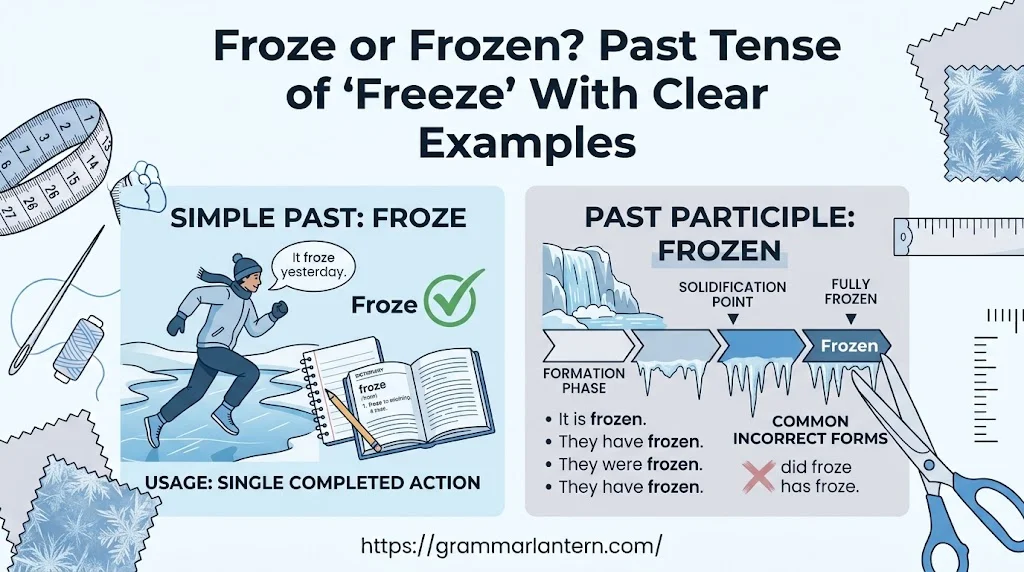
If you have ever wondered whether to say “the water froze” or “the water has frozen,” you are not alone. Froze and frozen come from the same verb, freeze, but they have different grammatical roles. Froze is the simple past tense, while frozen is the past participle. Knowing this basic difference makes it much easier to choose the correct form.
The word froze describes an action that happened in the past. For example, you can say, “The lake froze overnight.” On the other hand, frozen usually works with an auxiliary verb such as has, have, had, or be. For example, “The lake has frozen completely.” The sentence structure determines which form you need.
Understanding Froze vs Frozen can improve both everyday speaking and formal writing. Although these words share the same base verb, they cannot always replace each other. By learning their meanings, grammar rules, and common sentence patterns, you can avoid mistakes and use froze and frozen naturally and confidently.
Quick Answer
Froze is the simple past tense of freeze.
Frozen is the past participle of freeze. It commonly appears with helping verbs such as has, have, had, is, are, was, and were.
The three principal forms are:
| Verb form | Word | Example |
| Base form | freeze | Water can freeze. |
| Simple past | froze | The lake froze overnight. |
| Past participle | frozen | The lake has frozen. |
Here are the key rules:
- Use froze for a completed action in the simple past.
- Use frozen after has, have, or had.
- Use frozen in passive constructions with forms of be.
- Use freeze after did.
- Use freeze after modal verbs such as can, could, will, and might.
- Use frozen as an adjective when it describes a condition or state.
So, these sentences are correct:
1.“The water froze last night.”
2.“The water has frozen.”
3.“The water was frozen solid.”
But these aren’t correct in standard English:
1.“The water has froze.”
2.“The water frozen last night.”
3.“Did the water froze?”
The grammar around the helping verb determines which form you need.
Is “Froze” the Past Tense of “Freeze”?
Yes. Froze is the simple past tense of freeze.
The verb freeze is irregular, which means it doesn’t form its past tense by simply adding -ed. Instead, its vowel changes.
The pattern is:
freeze → froze → frozen
For example:
- “The pond froze overnight.”
- “My fingers froze in the cold.”
- “The pipes froze during the storm.”
- “The children froze when they heard the noise.”
Each sentence describes something that happened in the past.
Notice something important: froze doesn’t need a helping verb when you’re using the simple past.
You can simply say:
“The river froze.”
That’s complete.
You don’t need to say “The river has froze” or “The river did froze.” Those constructions require different forms.
Read More: Begun vs. Began: Which Is Correct? Helpful Examples
Is “Frozen” the Past Tense of “Freeze”?
Not exactly.
Frozen is the past participle of freeze, not its simple past form. This distinction sounds technical, but it becomes easy once you look at actual sentences.
A past participle generally works with another verb to create perfect or passive constructions.
For example:
- “The lake has frozen.”
- “The lake had frozen.”
- “The pipes were frozen.”
- “The food is frozen.”
In each sentence, frozen works differently from froze.
Compare these two sentences:
“The lake froze last night.”
“The lake has frozen.”
The first sentence uses the simple past. The second uses the present perfect.
That tiny difference explains why you can’t simply swap froze and frozen.
Freeze, Froze, and Frozen: The Three Main Forms
Understanding all three forms gives you a much stronger grasp of the verb.
| Form | Grammatical role | Example |
| freeze | Base form | “Water can freeze.” |
| froze | Simple past | “The water froze.” |
| frozen | Past participle | “The water has frozen.” |
| frozen | Adjective | “We bought frozen vegetables.” |
The base form appears in the present tense with certain subjects and after infinitives, modals, and auxiliaries such as did.
The simple past form froze stands on its own when you describe a completed past event.
The past participle frozen normally needs a grammatical partner when it functions as part of a verb phrase.
It can also function as an adjective. That’s where things become especially interesting.
How to Use “Froze” Correctly
Froze for a Completed Past Action
Use froze when you’re talking about something that happened and ended in the past.
For example:
- “The lake froze last winter.”
- “The water froze overnight.”
- “The pipes froze during the cold spell.”
- “My hands froze while I waited outside.”
You can often pair froze with a definite past-time expression.
Common examples include:
- yesterday
- last night
- last winter
- two hours ago
- during the storm
- when I was younger
- before sunrise
Consider this sentence:
“The windshield froze overnight.”
The action occurred during the previous night. You’re presenting it as a completed past event. Therefore, froze fits naturally.
Froze in Different Contexts
The verb freeze doesn’t only describe water becoming ice. English uses it in several related ways.
Physical freezing
“The pond froze after several days of below-freezing temperatures.”
Becoming extremely cold
“I froze while walking home without a jacket.”
Stopping suddenly
“The machine froze during the test.”
Becoming unable to move
“The rabbit froze when it noticed the dog.”
Becoming unable to speak or react
“I froze when the interviewer asked that question.”
A computer or application stopping
“My laptop froze while I was editing the document.”
The meaning changes with the context, but the grammatical form remains the same. If you’re using the simple past, froze is the correct form.
How to Use “Frozen” Correctly
Frozen With “Have,” “Has,” and “Had”
When freeze appears in a perfect construction, use frozen.
The basic patterns are:
has/have + frozen
had + frozen
Examples include:
- “The pipes have frozen.”
- “The lake has frozen completely.”
- “The vegetables have frozen together.”
- “The water had frozen before we arrived.”
- “The engine had frozen overnight.”
The helping verb carries the tense while frozen functions as the past participle.
That’s why this sentence is wrong:
“The water has froze.”
The correct version is:
“The water has frozen.”
Likewise:
“The pipes had froze.”
should become:
“The pipes had frozen.”
Frozen With “Be” in Passive Constructions
Frozen can also appear after forms of be in passive constructions.
For example:
- “The meat was frozen before delivery.”
- “The pipes were frozen overnight.”
- “The account was frozen.”
- “The vegetables are frozen.”
- “The lake was frozen solid.”
Here, frozen doesn’t work like the simple past froze.
Compare:
“The cold weather froze the pipes.”
The cold weather performed the action.
Now compare:
“The pipes were frozen by the cold weather.”
The pipes receive the action.
This distinction becomes particularly useful when you’re writing technical, business, scientific, or formal English.
Frozen as an Adjective
Here’s another twist: frozen can act as an adjective.
For example:
“We bought frozen berries.”
Here, frozen describes the berries.
It doesn’t necessarily mean you’re constructing a perfect tense. Instead, you’re describing their condition.
Other examples include:
- frozen food
- frozen water
- frozen ground
- frozen pipes
- frozen assets
- frozen account
- frozen expression
- frozen screen
You can also use frozen to describe an emotional state:
“He stood there with a frozen expression.”
In this case, frozen means stiff, motionless, or unable to react naturally.
Side-by-Side Comparison
The easiest way to see the distinction is to place the forms next to each other.
| Sentence | Correct? | Explanation |
| “The lake froze last night.” | Yes | Simple past |
| “The lake has frozen.” | Yes | Present perfect |
| “The lake had frozen.” | Yes | Past perfect |
| “The lake was frozen.” | Yes | Passive or state |
| “The lake frozen last night.” | No | The sentence needs a finite verb |
| “The lake froze before sunrise.” | Yes | Simple past |
| “The lake has froze.” | No | Use the past participle |
| “Did the lake freeze?” | Yes | Use the base form after did |
The biggest mistake involves treating froze and frozen as interchangeable.
They aren’t.
Think of froze as the independent past form. Think of frozen as a form that usually needs grammatical support.
Froze or Frozen After Helping Verbs?
Helping verbs provide one of the quickest clues.
After “Did” and “Didn’t”
After did or didn’t, use the base form freeze.
Correct:
“Did the water freeze?”
“The pipes didn’t freeze.”
Incorrect:
“Did the water froze?”
“The pipes didn’t froze.”
Why?
Because did already marks the sentence as past tense. Adding froze would effectively mark the past twice.
The same pattern appears with many irregular verbs:
- Did you go?
- Did she see it?
- Did they take the train?
- Did the water freeze?
Not:
- Did you went?
- Did she saw it?
- Did they took the train?
- Did the water froze?
After “Has,” “Have,” and “Had”
After has, have, or had, use frozen.
Examples:
- “The water has frozen.”
- “The pipes have frozen.”
- “The lake had frozen before dawn.”
This is the perfect-tense pattern.
After “Will,” “Can,” “Could,” and Other Modals
Modal verbs take the base form freeze.
Examples:
- “The water may freeze tonight.”
- “The pipes could freeze.”
- “The lake will freeze if temperatures drop.”
- “The machine might freeze again.”
- “Water can freeze at the right temperature.”
So don’t write:
“The water might froze.”
Write:
“The water might freeze.”
The modal already controls the grammatical structure.
Common Mistakes
“I Have Froze” vs. “I Have Frozen”
The correct sentence is:
“I have frozen.”
Why? Have requires the past participle.
The same rule applies to third-person singular:
“She has frozen.”
And to past perfect:
“She had frozen.”
“It Frozen Yesterday” vs. “It Froze Yesterday”
The correct sentence is:
“It froze yesterday.”
The word yesterday points to a completed past event. You’re using the simple past.
You could also say:
“It had frozen by yesterday.”
Now had changes the construction. The past participle frozen becomes necessary.
“Did It Froze?” vs. “Did It Freeze?”
The correct question is:
“Did it freeze?”
Remember the shortcut:
did + base verb
Therefore:
did + freeze
Not:
did + froze
“It Was Froze” vs. “It Was Frozen”
The correct construction is:
“It was frozen.”
Here, was combines with the past participle frozen.
However, you can also say:
“It froze.”
These sentences don’t mean exactly the same thing.
It froze emphasizes the event or change.
It was frozen emphasizes the resulting condition or the passive action.
“Freeze” in Different Tenses
The following table shows how freeze behaves across common tenses.
| Tense | Form | Example |
| Present simple | freeze/freezes | “Water freezes at low temperatures.” |
| Simple past | froze | “The water froze last night.” |
| Present perfect | has/have frozen | “The water has frozen.” |
| Past perfect | had frozen | “The water had frozen before dawn.” |
| Future | will freeze | “The water will freeze tonight.” |
| Present continuous | am/is/are freezing | “The water is freezing.” |
| Past continuous | was/were freezing | “The water was freezing quickly.” |
This table reveals an important pattern. Frozen doesn’t automatically mean past tense.
The tense comes from the complete verb construction.
For example:
“The water has frozen.”
That’s present perfect.
Meanwhile:
“The water had frozen.”
That’s past perfect.
The word frozen stays the same. The helping verb changes.
In Questions and Negative Sentences
Questions make these forms easier to understand because the helping verb becomes obvious.
1.Questions With “Did”
- “Did the lake freeze?”
- “When did the pipes freeze?”
- “Why did the computer freeze?”
2.Questions With “Has” or “Have”
- “Has the lake frozen?”
- “Have the pipes frozen?”
- “Has your screen frozen again?”
3.Questions With “Had”
- “Had the road frozen before the accident?”
- “Had the water frozen overnight?”
Negative sentences follow the same logic.
- “The water didn’t freeze.”
- “The pipes haven’t frozen.”
- “The lake hadn’t frozen yet.”
Once you identify the auxiliary verb, the correct form usually becomes obvious.
In Figurative English
English uses freeze far beyond weather and ice.
Freeze Meaning “Become Unable to React”
Imagine you’re giving a speech. Someone asks an unexpected question, and suddenly your mind goes blank.
You might say:
“I froze when they asked me that.”
That’s a perfectly natural use of froze.
Frozen Meaning “Unable to React”
You can describe the same state with frozen:
“I stood frozen in front of the audience.”
Here, frozen describes your condition.
The distinction is subtle but useful:
- I froze = the action or change happened.
- I was frozen = the condition is being described.
Frozen Meaning “Fixed or Unchanged”
Frozen can also mean something remains fixed.
For example:
- “The company kept prices frozen.”
- “The government announced a frozen budget.”
- “The account remained frozen.”
This meaning has nothing to do with ice. The word has developed a broader figurative sense of something being held in place.
“Freeze” in Passive Constructions
Passive sentences often cause trouble because writers see a past-time situation and instinctively choose froze.
The structure matters more than the time reference.
Consider:
“The bank froze the account.”
That’s active voice. The bank performed the action.
Now:
“The account was frozen by the bank.”
That’s passive voice. The account receives the action.
Both sentences can describe the same event.
| Active | Passive |
| “The bank froze the account.” | “The account was frozen by the bank.” |
| “The cold froze the pipes.” | “The pipes were frozen by the cold.” |
| “The technician froze the system.” | “The system was frozen.” |
This pattern explains why was froze is incorrect in standard English.
The correct passive construction uses was frozen.
“Freeze” in Perfect Constructions
Perfect constructions provide another clear contrast.
Compare these sentences:
1.“The pond froze.”
2.“The pond has frozen.”
3.“The pond had frozen.”
The first sentence uses simple past.
The second uses present perfect.
The third uses past perfect.
The timeline changes because the helping verb changes.
Simple Past
froze
Use it for a completed past event.
“The pond froze last night.”
Present Perfect
has/have frozen
Use it when the past event connects to the present.
“The pond has frozen.”
The frozen condition matters now.
Past Perfect
had frozen
Use it when one past event happened before another past event.
“The pond had frozen before the temperature rose.”
The order is clear: freezing happened first, then the temperature rose.
Freeze vs. Freeze Up
Another useful distinction involves freeze up.
The phrasal verb freeze up often describes suddenly becoming unable to speak, think, move, or respond.
For example:
“I froze up during the interview.”
This differs slightly from:
“The pipes froze.”
The first describes a psychological or behavioral reaction. The second describes physical freezing.
You can also use the past participle:
“She has frozen up under pressure before.”
And:
“He was frozen up with fear.”
However, freeze up doesn’t always imply fear. Nervousness, pressure, surprise, confusion, and stress can all trigger the expression.
Real-World Examples
The word appears in many everyday situations.
Weather and Nature
- “The lake froze overnight.”
- “The roads froze after the temperature dropped.”
- “The ground was frozen solid.”
- “Several ponds have frozen this week.”
Food and Storage
- “We froze the leftovers.”
- “The meat was frozen when it arrived.”
- “The vegetables have frozen together.”
- “Keep the berries frozen until you’re ready to use them.”
Technology
- “My phone froze during the call.”
- “The application has frozen again.”
- “The screen was frozen for several seconds.”
- “My computer might freeze if I open too many programs.”
People and Emotions
- “She froze when she heard the noise.”
- “He stood frozen in surprise.”
- “I froze up during the presentation.”
- “She has frozen under pressure before.”
Business and Finance
- “The bank froze the account.”
- “The account was frozen.”
- “The company has frozen hiring.”
- “The prices remained frozen for several months.”
These examples show why learning the grammar matters. Freeze has a surprisingly wide range of meanings.
Mini Case Studies
Case Study: A Lake in Winter
Suppose you’re describing something that happened last night.
“The lake froze last night.”
That’s simple past.
Now imagine you’re describing its current condition.
“The lake has frozen.”
The present result matters. That’s why the present perfect works.
Case Study: A Nervous Speaker
Imagine someone suddenly loses confidence during a presentation.
“She froze during the speech.”
You’re describing a completed event.
Now consider:
“She has frozen during presentations before.”
The present perfect connects past experiences with the present.
Case Study: A Bank Account
Consider an account that a bank stopped from being used.
“The bank froze the account.”
That’s active voice in the simple past.
Now shift the focus to the account:
“The account was frozen by the bank.”
That’s a passive construction.
The meaning remains closely connected, but the grammar changes.
A Simple Trick to Remember
Here’s the easiest memory pattern:
freeze → froze → frozen
Then attach each form to its main job.
Freeze = base form
“I might freeze.”
Froze = simple past
“I froze.”
Frozen = past participle
“I have frozen.”
You can also remember these four shortcuts:
- Completed past action: use froze.
- Has/have/had: use frozen.
- Forms of be + passive: use frozen.
- Did/modal + verb: use freeze.
Think of the helping verb as a traffic signal. It tells you which grammatical lane to enter.
Quick Grammar Checklist
Before choosing the form, ask yourself these questions:
- Am I describing a completed past action?
Use froze. - Does the sentence contain has, have, or had?
Use frozen. - Does a form of be introduce a passive construction?
Use frozen. - Does the sentence contain did or didn’t?
Use freeze. - Does a modal such as can, could, may, might, or will appear?
Use freeze. - Is the word describing a noun or condition?
Frozen may be functioning as an adjective.
This checklist handles most everyday situations involving froze vs. frozen.
Final Comparison
| Form | Main role | Example |
| freeze | Base form | “Water can freeze.” |
| froze | Simple past | “The water froze.” |
| frozen | Past participle | “The water has frozen.” |
| frozen | Adjective | “The water is frozen.” |
A useful way to think about the difference is through a timeline.
Freeze points to the basic action.
Froze tells you that the action happened in the past.
Frozen describes the participle form used with auxiliaries or a resulting condition.
For example:
“The cold weather froze the pipes.”
Then:
“The pipes have frozen.”
Finally:
“The pipes are frozen.”
Same basic verb. Different grammatical jobs.
Read More: Scoup vs. Scoop: Which Spelling Is Correct?
FAQs
1. Is “froze” the past tense of freeze?
Yes. Froze is the simple past tense of freeze. You use it when an action happened and was completed in the past. For example, “The water froze last night.”
2. Is “frozen” the past tense of freeze?
No. Frozen is the past participle of freeze. It is normally used with helping verbs such as has, have, had, or forms of be.
3. What is the difference between froze and frozen?
The main difference is grammatical. Froze is a simple past verb, while frozen is a past participle. For example, “The pond froze” uses the simple past, while “The pond has frozen” uses the past participle.
4. Can I say “I froze” in a sentence?
Yes. I froze is completely correct when describing something that happened in the past. For example, “I froze when I heard the loud noise.”
5. Can I say “I frozen” in a sentence?
No. Frozen normally needs a helping verb. You can say, “I have frozen the leftovers,” but not “I frozen the leftovers.”
6. Is “has froze” correct?
No, has froze is not standard English. After has, you should use the past participle frozen. The correct sentence is, “The water has frozen.”
7. Is “had froze” correct?
No. The correct form is had frozen because had is followed by the past participle. For example, “The lake had frozen before winter ended.”
8. What is the present form of froze and frozen?
The base or present form is freeze. Its main forms are freeze, froze, and frozen. For example: “I freeze,” “I froze,” and “I have frozen.”
9. Can “frozen” be used as an adjective?
Yes. Frozen can describe something that is solid because of very low temperature. For example, “We walked across the frozen lake.” It can also describe something that has stopped moving or changing.
10. Which should I use: “The water froze” or “The water has frozen”?
Both can be correct, depending on what you want to express. The water froze simply describes a completed past event. The water has frozen uses the present perfect and connects the past event with the present situation.
Conclusion
The difference between froze and frozen becomes much easier once you remember their grammatical roles. Froze is the simple past form of freeze, so it describes an action that happened in the past. Frozen is the past participle, so it generally appears with helping verbs such as has, have, had, or be.
A useful way to remember the pattern is freeze → froze → frozen. When you are talking about a completed past action, choose froze. When your sentence requires a past participle, choose frozen. With a little practice, this distinction will become natural in both your everyday conversations and your writing.

Muhammad Haroon is the voice behind many of the clear, practical grammar guides you’ll find on Grammar Lantern. With a strong background in content writing and a genuine love for the English language, Haroon specializes in breaking down intimidating grammar topics into simple, digestible lessons. His goal is simple: to empower readers to write with confidence and clarity. Whether he’s explaining tricky tenses or demystifying punctuation, Haroon approaches each topic with patience, precision, and a touch of warmth—because he knows that learning grammar is a journey, not a race.