Repast vs Repass can be confusing because the two words have similar spelling, but their meanings are completely different. Repass describes the action of passing something to someone a second time. For example, you might repass an item to another person or pass again through a place. In simple word usage, it is connected with movement or giving something another time.
Repast means a meal, but its use feels old and somewhat obsolete today. It is one of those uncommon words you are more likely to see in literature than in everyday vocabulary. Its definition is easy to understand once you notice the context. I have often found that older writing uses Repast when a writer wants a more formal or historical tone.
Both terms are correctly spelled, yet their modern usage is quite limited. Repass may still be used, although not often, while Repast is generally not used in regular modern communications. Understanding their semantics helps you choose the right word in ordinary communication and recognize both in older literary usage.
Quick Answer
The simplest way to remember repast vs repass is this:
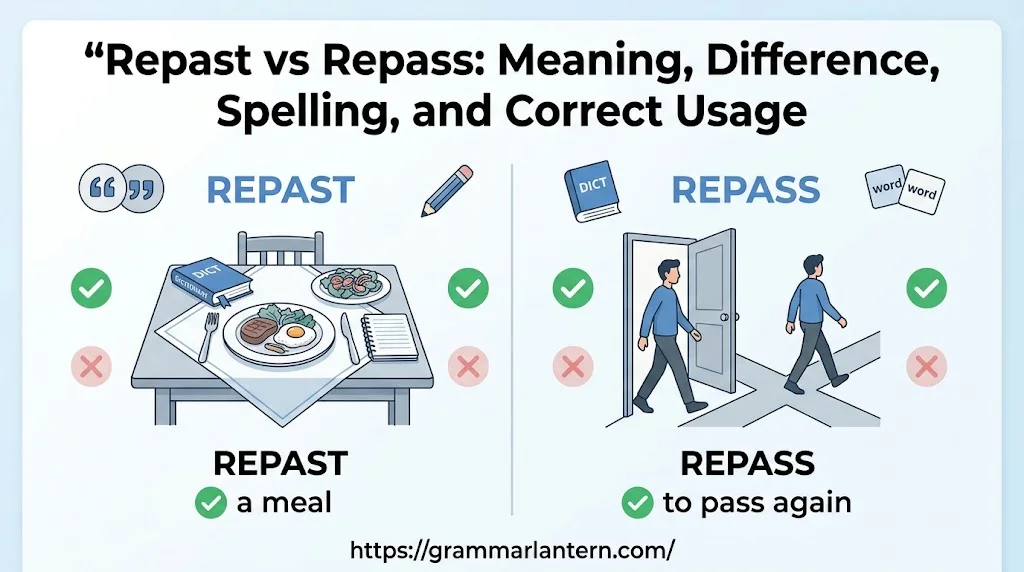
- Repast = a meal
- Repass = to pass again
- Repast is primarily a noun.
- Repass is a verb.
- Repast often sounds formal or literary.
- Repass describes repeated movement through or across something.
| Word | Part of Speech | Meaning | Example |
| Repast | Noun | A meal | We enjoyed a pleasant repast after the ceremony. |
| Repass | Verb | To pass again | We had to repass the same checkpoint. |
Here’s an easy memory trick:
Repast is about eating. Repass is about passing again.
Once you remember that distinction, choosing between the two becomes much easier.
What Does Repast Mean?
Repast means a meal or an occasion when people eat. It can refer to breakfast, lunch, dinner, or another meal.
The word isn’t usually the first choice in casual American conversation. Most people would simply say meal.
For example, you’d probably say:
We had a great meal after the wedding.
You could also write:
We had a pleasant repast after the wedding.
Both sentences communicate the basic idea of eating. However, repast gives the sentence a more formal, literary, or traditional flavor.
Repast Definition
As a noun, repast refers to food eaten as a meal or the meal itself.
Consider these examples:
- The family gathered for a hearty repast.
- Guests enjoyed a formal repast after the ceremony.
- The travelers stopped for a simple repast.
- The host prepared an elaborate repast for the visitors.
- After hours of work, everyone welcomed a warm repast.
In each sentence, the word refers to eating or a meal.
It doesn’t mean a particular food. A repast could consist of soup and bread, a full dinner, or an elaborate feast.
Repast as a Noun
One useful grammatical clue is that repast normally behaves like a noun.
You can use articles and adjectives before it:
- a repast
- the repast
- a simple repast
- an elaborate repast
- a satisfying repast
- a formal repast
You can also make it plural:
- several repasts
- daily repasts
- evening repasts
For example:
The travelers shared several modest repasts during their journey.
Here, repasts simply means meals.
Read More: Stub vs. Stab: Meaning, Difference, Pronunciation, and Usage
Repast in Formal and Literary Writing
The tone of repast is one reason learners may encounter it less often.
In everyday speech, meal is far more natural. In historical writing, literature, formal descriptions, and older texts, repast can sound perfectly at home.
Compare these sentences:
We stopped for a meal.
We stopped for a repast.
The first sounds ordinary and conversational. The second sounds more formal and descriptive.
That difference matters when you’re choosing words for an article, story, essay, or formal piece of writing.
Repast isn’t incorrect or outdated simply because it sounds formal. It can be a useful word when its tone fits the context.
What Does Repass Mean?
Repass is a verb meaning to pass again.
The word combines the idea of re-, meaning again, with pass. So the basic concept is straightforward: someone or something passes a place, point, route, or boundary again.
For example:
We had to repass the same gate on our way back.
The person passed the gate once and then passed it again.
Repass Definition
The verb repass describes repeated passage or movement.
It can involve:
- Passing through a doorway again
- Crossing a road again
- Moving through a checkpoint again
- Traveling along the same route again
- Passing a particular location again
- Going through a stage or point another time
For example:
The hikers had to repass the narrow bridge.
The hikers crossed the bridge before. They then crossed it again.
Repass as a Verb
Because repass is a verb, its form changes according to tense and grammatical context.
Common forms include:
| Form | Example |
| Repass | We may repass the same road. |
| Repasses | She repasses the gate every evening. |
| Repassed | They repassed the checkpoint yesterday. |
| Repassing | He is repassing the same location. |
The word therefore behaves like other regular verbs.
For example:
They repassed the old bridge before sunset.
Here, repassed tells us that the repeated passage happened in the past.
Examples of Repass
Consider these examples:
- We had to repass the border checkpoint.
- The runner repassed the starting point during training.
- She didn’t want to repass the dark alley.
- The travelers repassed the village on their return.
- The machine repeatedly repasses the same section.
- He was repassing the doorway when the lights went out.
Every example involves passing again.
That’s the key.
The Main Difference
The central difference between repast and repass is meaning.
Repast relates to food. Repass relates to movement.
That distinction is more useful than trying to memorize the spelling alone.
Meaning Difference
| Word | Core Meaning | Mental Image |
| Repast | A meal | A table with food |
| Repass | Pass again | Someone crossing a doorway twice |
If you picture a dining table, think repast.
If you picture someone walking through a gate for a second time, think repass.
Part-of-Speech Difference
The grammatical difference provides another strong clue.
Repast is primarily a noun:
The repast was delicious.
Repass is a verb:
We will repass the gate.
This distinction can help you spot an incorrect word even when you’re unsure about the definition.
Usage Difference
The words aren’t interchangeable.
Consider this sentence:
We enjoyed a delicious repass.
If the writer means a meal, the correct word is repast.
The corrected version is:
We enjoyed a delicious repast.
Now consider:
We had to repast the bridge.
If the intended meaning is “cross the bridge again,” the correct word is repass.
We had to repass the bridge.
The spelling changes by only one letter, yet the meaning changes completely.
In Sentences
Seeing the words in context makes their difference much clearer.
Sentences With Repast
Here are several natural examples:
The guests gathered for a formal repast after the ceremony.
Repast means the meal served after the ceremony.
The travelers stopped beside the river for a quick repast.
The travelers stopped to eat.
A generous repast awaited the family when they arrived.
The word refers to the meal waiting for them.
The old inn provided a warm repast on a cold evening.
Again, the meaning centers on food and eating.
Everyone enjoyed the evening repast.
The sentence describes an evening meal.
Sentences With Repass
Now compare examples using repass:
We had to repass the same street to reach the station.
The people passed along the street again.
The hikers repassed the trail they had taken earlier.
They traveled along the trail a second time.
She refused to repass the damaged bridge.
She didn’t want to cross it again.
The vehicle repassed the checkpoint before leaving the area.
The vehicle passed the checkpoint again.
The travelers repassed the village on their way home.
They passed through the village a second time.
Side-by-Side Sentence Comparison
| Repast | Repass |
| We enjoyed a hearty repast. | We had to repass the bridge. |
| The repast followed the ceremony. | They repassed the same road. |
| A simple repast was prepared. | She didn’t want to repass the checkpoint. |
| The travelers shared a repast. | The hikers repassed the trail. |
A useful rule emerges from these examples:
If you can replace the word with “meal,” use repast. If you can replace it with “pass again,” use repass.
Why Do People Confuse?
The confusion isn’t surprising.
Both words begin with rep-, contain similar letters, and have related-looking structures. When you’re reading quickly, the eye can easily skim over the difference.
Similar Spelling
Look closely:
repast
repass
Only a small spelling difference separates them.
The ending -ast in repast can visually disappear during fast reading. Meanwhile, repass resembles the familiar word pass, which can encourage readers to connect it with movement.
Similar Sound Patterns
Their pronunciations aren’t identical, but their overall sound pattern can still create confusion for people who haven’t encountered repast often.
This becomes especially noticeable when a speaker uses repast in a formal setting and the listener has mostly encountered the word pass.
Spelling confusion can then follow.
The Prefix Re- in Repass
The structure of repass offers a helpful memory clue.
The prefix re- often carries the meaning again.
Examples include:
- redo = do again
- reread = read again
- rebuild = build again
- replay = play again
- repass = pass again
This doesn’t mean every English word beginning with re- can be broken down so neatly. However, repass gives you a particularly useful example.
The Formality of Repast
Another reason for confusion is familiarity.
Most English speakers regularly hear meal. They encounter repast much less often.
When a word feels unfamiliar, the brain naturally searches for something that looks familiar. Repass happens to look like a recognizable word because of pass.
That’s where the mix-up can begin.
Pronunciation
Pronunciation can provide another clue, although meaning and grammar remain more reliable.
How to Pronounce Repast
In standard US English, repast is commonly pronounced with stress on the second syllable.
The word has two syllables.
The stressed part is the ending -past.
How to Pronounce Repass
Repass also has two syllables in common US pronunciation, with the second syllable receiving the main stress.
Its second part connects clearly with the verb pass.
Because the words have similar rhythmic patterns, pronunciation alone isn’t always enough to distinguish them quickly.
Context remains your best guide.
A Simple Pronunciation Tip
When you hear a word that sounds like one of these, ask yourself:
Is the speaker talking about food or movement?
If the subject is dinner, eating, or a meal, repast is probably intended.
If the subject is crossing, traveling, or moving through something again, repass fits.
Repast: Synonyms and Related Words
Because repast means a meal, several related words can sometimes replace it.
Common alternatives include:
- Meal
- Dinner
- Breakfast
- Lunch
- Feast
- Banquet
- Food
- Refreshment
However, these words aren’t perfect substitutes in every situation.
Meal is the broadest everyday alternative.
Feast usually suggests an abundant or special meal.
Banquet often refers to a large formal meal connected with an event or celebration.
Refreshment can refer to food or drink served to provide nourishment, especially between or around activities.
For example:
The guests enjoyed a lavish repast.
This emphasizes the meal itself.
The guests enjoyed a lavish banquet.
This suggests a large, formal meal or event.
The distinction is subtle but useful.
Repass: Synonyms and Related Expressions
Because repass means passing again, its closest everyday alternatives are phrases rather than single words.
These include:
- Pass again
- Go through again
- Cross again
- Travel through again
- Return through
- Go back through
For everyday American English, pass again may sound more natural than repass.
For example:
We had to pass the checkpoint again.
This sounds very natural in ordinary conversation.
You could also write:
We had to repass the checkpoint.
That version is grammatically possible, but its tone can feel more formal or specialized depending on the context.
Common Mistakes
These words cause several predictable errors.
Using Repass When You Mean Repast
Incorrect:
We prepared a large repass for the guests.
If you mean a meal, use repast:
We prepared a large repast for the guests.
Even better for ordinary conversation:
We prepared a large meal for the guests.
Using Repast When You Mean Repass
Incorrect:
The travelers repasted the bridge.
If you mean they crossed it again, use repassed:
The travelers repassed the bridge.
The meaning is movement, not eating.
Treating Repast as a Verb
Because repass is a verb, people sometimes assume repast works the same way.
That can lead to awkward constructions such as:
We repasted after the ceremony.
When the intended meaning is “we ate a meal,” this isn’t the normal use of repast.
A clearer sentence would be:
We had a repast after the ceremony.
Or simply:
We had a meal after the ceremony.
Assuming Repass Means a Second Meal
The spelling can create a false association with eating again.
However, repass doesn’t mean “eat again.”
If you want to describe eating another meal, use a phrase such as:
We ate again later.
Or:
We had another meal later that evening.
The prefix re- doesn’t magically turn pass into an eating word.
How to Remember
Memory tricks work best when they’re short.
Memory Trick for Repast
Connect repast with restaurant or meal.
Both ideas belong to the world of eating.
You can also remember:
Repast = a meal.
That’s the most reliable shortcut.
Memory Trick for Repass
Break repass into its obvious components:
re + pass = pass again
For example:
I passed the gate.
Then:
I repassed the gate.
The second sentence means I passed it again.
This little mental formula makes repass much easier to remember.
Which Word Should You Use?
Choose repast when your sentence refers to a meal.
Choose repass when your sentence describes passing something again.
Use this quick decision guide:
- Talking about food? → Repast
- Talking about a meal? → Repast
- Talking about dinner in a formal or literary way? → Repast
- Talking about passing again? → Repass
- Talking about crossing again? → Repass
- Talking about going through a place again? → Repass
When in doubt, substitute the simpler phrase.
If meal works, choose repast.
If pass again works, choose repass.
In Different Contexts
Context can make the distinction even easier.
Everyday Conversation
In everyday American English, meal is generally more natural than repast.
You might say:
We had a delicious meal.
Using repast isn’t wrong. It simply sounds more formal.
Likewise, pass again can sound more conversational than repass:
We had to pass the building again.
Both versions can work depending on the tone.
Formal Writing
Repast can fit naturally in formal prose.
For example:
The distinguished guests gathered for an evening repast.
The word gives the sentence a polished and somewhat traditional tone.
Repass can also appear in formal writing when repeated movement matters.
The expedition was forced to repass the same route.
The context makes the meaning clear.
Historical or Literary Contexts
Readers may encounter repast more often in historical or literary material.
Older styles of writing frequently use vocabulary that sounds more elevated than modern conversation.
For example, a narrative might describe:
a humble repast
rather than simply:
a simple meal
The meaning remains the same.
Travel and Movement
Repass is particularly useful when describing repeated movement.
Imagine a traveler who leaves a town and later returns through it.
You could write:
The traveler repassed the town before reaching the coast.
The verb efficiently communicates repeated passage.
Academic or Technical Writing
In specialized writing, repass may appear when describing repeated movement through a route, location, process, or physical point.
Still, clarity should come first.
If pass again makes the sentence easier to understand, there’s no prize for choosing the more unusual word.
Good writing isn’t about making every sentence sound complicated.
It’s about making every sentence work.
Read More: Labeler vs. Labeller: Which Spelling Is Correct?
A Practical Case Study: Choosing the Right Word
Imagine you’re writing this sentence:
After the wedding, everyone gathered for a formal ______.
Which word fits?
Repast fits because the blank refers to a meal.
Now consider:
After leaving the village, the travelers had to ______ the same road.
Here, repass fits because the travelers are moving along the road again.
The test is simple.
Ask what the sentence describes.
Food? Repast.
Repeated passage? Repass.
Quick Comparison Table
| Feature | Repast | Repass |
| Part of speech | Noun | Verb |
| Main meaning | A meal | To pass again |
| Related idea | Eating | Repeated movement |
| Everyday alternative | Meal | Pass again |
| Typical tone | Formal or literary | Formal or less common |
| Can be plural? | Yes, repasts | No noun plural because it is a verb |
| Example | We shared a pleasant repast. | We had to repass the gate. |
| Memory clue | Meal | Re + pass |
FAQs
1. What does Repass mean?
Repass means to pass something or move through a place again. It can describe the action of passing for a second time.
2. What does Repast mean?
Repast means a meal. It is an uncommon and somewhat old-fashioned word.
3. Are Repass and Repast synonyms?
No. Repass and Repast have different meanings and cannot normally replace each other.
4. Is Repass a commonly used word?
Not particularly. Repass is a valid word, but it is not frequently used in everyday modern communication.
5. Is Repast still used today?
Yes, but Repast is uncommon. You are more likely to encounter it in literature or formal writing.
6. How can I remember the difference?
Think of Repass as passing again and Repast as a meal. Their meanings become easier to remember when you connect each word with its use.
7. Is Repast an old-fashioned word?
Yes. Repast often has an old-fashioned, formal, or literary feeling.
8. Can Repass refer to passing an object?
Yes. Repass can describe passing an object to someone again, depending on the sentence and context.
9. Why do Repass and Repast look similar?
They share a similar spelling pattern, which can make them confusing. However, their meanings and uses are different.
10. Which word should I use in everyday writing?
Use Repass only when you need its specific meaning of passing again. For a meal, meal is usually more natural than the uncommon word Repast.
Conclusion
Repass and Repast may look almost identical, but they serve very different purposes. Repass relates to passing something or moving through a place again, while Repast refers to a meal and carries a more old-fashioned tone.
Knowing the difference helps you avoid simple spelling and word-choice mistakes. When you see either word in literature or formal writing, look at the surrounding context. That quick check usually makes the intended meaning clear.

For Shafiq ur Rehman, writing is an art form and grammar is the toolbox that makes it beautiful. As a dedicated content writer at Grammar Lantern, Shafiq approaches every topic like an architect carefully laying down strong foundations of understanding before adding the finer details. He loves diving into the trickiest grammar points and resurfacing with simple, bite-sized takeaways that anyone can grasp. When he’s not crafting articles, you’ll likely find him strategizing over a game of chess, exploring dusty local bookshops, or quietly jotting down poetic observations in his notebook.