
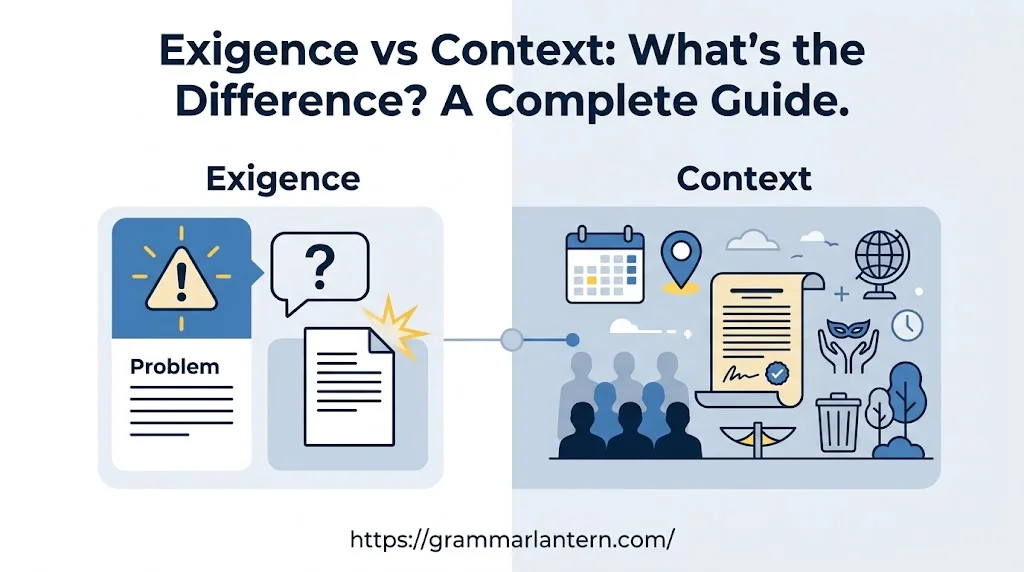
Exigence vs Context: What’s the Difference? becomes easier to understand when you look at what causes communication. Exigence is the immediate problem or urgent situation that pushes a writer or speaker to respond. It acts as a catalyst, spark, or prompt for communication. A sudden natural disaster or breaking news event, for example, can create a strong reason to communicate right away.
Context is the wider background surrounding that situation. It includes the time, place, culture, politics, history, and social conditions connected to an event. These factors help explain why a message appears in a particular setting. Think of a dry forest that is ready to burn. The match represents Exigence, while the forest represents Context.
When I explain this difference, I usually ask two simple questions: “Why now?” and “What surrounds this situation?” The first question points toward Exigence, while the second helps identify Context. Understanding both makes a rhetorical situation much easier to analyze because you can see both the immediate pressure and the larger environment behind the message.
Quick Answer
The simplest way to understand exigence vs context is this:
Exigence explains why communication is needed. Context explains the circumstances surrounding that communication.
Exigence is the problem, need, event, or situation that calls for a rhetorical response. It gives someone a reason to speak, write, argue, explain, persuade, or respond.
Context is the broader set of circumstances in which the communication occurs. It can include the time, place, audience, culture, historical period, social conditions, political environment, and situation.
| Feature | Exigence | Context |
| Basic meaning | The issue or need prompting communication | The circumstances surrounding communication |
| Main question | Why is a response needed? | What circumstances shape the response? |
| Main function | Creates a reason to communicate | Helps explain how communication works |
| Scope | Usually more specific | Usually broader |
| Example | A controversial policy creates a need for explanation | Workplace culture and economic conditions shape that explanation |
| Relationship to rhetoric | Motivates a rhetorical response | Influences the rhetorical response |
A useful shortcut is to ask two questions:
- Exigence: “What happened or needs attention?”
- Context: “What circumstances surround it?”
Those two questions can reveal a great deal about almost any rhetorical situation.
What Is Exigence?
Exigence is a situation, problem, need, or event that invites or requires a rhetorical response.
In rhetoric, the concept is more precise than simply saying that something is “important.” A situation becomes rhetorically significant when communication can address it in some meaningful way.
For example, a sudden increase in customer complaints could create an exigence for a company announcement. The company might need to explain what happened, reassure customers, and describe what it plans to change.
The complaints create the need for communication.
That is the exigence.
What Does Exigence Mean in Rhetoric?
In rhetorical analysis, exigence refers to the circumstance that gives communication its immediate reason for existing.
Imagine walking into a classroom and seeing students arguing about a new school rule. A teacher might write an explanation because students need clarification.
The new rule creates the situation.
The confusion creates the communication need.
The teacher’s explanation becomes the rhetorical response.
This is why exigence isn’t simply the subject of a text.
A speech might be about climate change. However, “climate change” alone doesn’t necessarily identify the exigence. The actual exigence could be a newly proposed environmental policy, a severe weather event, a public controversy, or a specific decision requiring public discussion.
Exigence Is More Than a Problem
Not every problem automatically becomes a rhetorical exigence.
Suppose a person loses their wallet while hiking alone. That’s certainly a problem. Yet the problem itself may not create a rhetorical situation.
Now imagine that the same person posts a warning about dangerous trail conditions after discovering that several hikers have experienced the same problem.
The situation has created a reason for communication.
That distinction is important.
A rhetorical exigence exists when communication can help address the situation.
This is one reason rhetorical analysis asks what prompted the text instead of merely asking what the text discusses.
Read More: 27 Best Replies to “I Don’t Care” Witty & Clever
Examples of Exigence
Here are several practical examples:
- A new law creates a need for a government agency to explain its effects.
- A product recall creates a need for a company to notify customers.
- A controversial school policy creates a need for students to argue for change.
- A natural disaster creates a need for public safety announcements.
- A workplace conflict creates a need for management communication.
- A social controversy creates a need for an editorial or public statement.
- A scientific discovery creates a need for researchers to explain its significance.
- A sudden change in prices creates a need for a business to communicate with customers.
In each case, something creates a reason to communicate.
That “something” is the starting point for identifying exigence.
What Is Context?
Context refers to the circumstances surrounding a piece of communication.
It gives you the background needed to understand why a message takes a particular form and how an audience might interpret it.
Context can include many factors:
- Time
- Place
- Historical circumstances
- Cultural expectations
- Social conditions
- Audience beliefs
- Political circumstances
- Economic conditions
- Institutional setting
- Technology
- Recent events
- Relationship between the speaker and audience
Context works like the backdrop of a movie. You can still see the characters without it, but the story makes much more sense when you understand where and when everything happens.
How Context Shapes Communication
Context can dramatically change the meaning and effectiveness of the same message.
Consider the sentence:
“We need to make changes.”
On its own, the statement tells you very little.
Now imagine it appearing in an email sent to employees after a company announces major financial losses. The sentence may sound serious and threatening.
Put the same sentence in a message about updating an outdated website, and the meaning changes completely.
The words remain the same.
The context changes.
That is why context matters so much in rhetorical analysis.
Examples of Context
Suppose a student writes an essay arguing that schools should teach financial literacy.
The context might include:
- The essay was written for a high school class.
- The intended readers are teachers and students.
- Many young people have limited experience managing money.
- The assignment requires persuasive writing.
- The student has a limited word count.
- The discussion takes place during a period of rising living costs.
These details don’t necessarily constitute the exigence.
Instead, they help explain the circumstances surrounding the argument.
The Key Difference
The clearest distinction is simple:
Exigence identifies the reason for communication. Context identifies the circumstances surrounding communication.
Suppose a university changes its tuition policy.
The change creates an exigence for communication because students need information about what the policy means.
The context might include rising operating costs, student concerns about affordability, the university’s financial situation, the academic calendar, and the relationship between administrators and students.
The exigence answers:
“Why does someone need to communicate about this?”
The context answers:
“What circumstances influence that communication?”
That difference may seem small at first. In practice, it can completely change the quality of a rhetorical analysis.
Simple Example
Imagine a city introduces stricter water-use restrictions during a prolonged drought.
The city publishes an announcement explaining the new rules.
Exigence
The exigence is the need to communicate about water restrictions during a serious shortage.
The announcement needs to explain the rules, encourage compliance, and help residents understand why changes are necessary.
Context
The context includes:
- The ongoing drought
- Local water availability
- Existing conservation rules
- Community attitudes toward restrictions
- Seasonal conditions
- Government responsibilities
- Residents’ daily water needs
The context influences how the city presents the message.
A technical report for engineers would probably use different language from a public announcement aimed at families.
The exigence remains connected to the water shortage and resulting restrictions. The context helps shape the response.
Exigence vs Audience vs Purpose
Another common mistake involves confusing exigence, audience, and purpose.
These concepts connect with one another, but they aren’t interchangeable.
Exigence vs Audience
The exigence is the situation prompting communication.
The audience consists of the people who receive or are intended to receive the message.
For example, suppose a school introduces a new attendance policy.
The policy change creates the exigence for an explanatory announcement.
Students and parents may form the primary audience.
The audience doesn’t create the exigence. It receives the response to that exigence.
Exigence vs Purpose
The purpose explains what the communicator wants to accomplish.
The exigence explains why communication is needed in the first place.
For example:
- Exigence: Employees are confused about a new scheduling system.
- Purpose: Explain how the new system works and reduce confusion.
- Audience: Employees.
- Context: The company recently changed its scheduling process.
Notice how each element performs a different job.
Exigence, Context, Audience, and Purpose Together
A strong rhetorical analysis often examines all four.
| Element | Question to Ask |
| Exigence | What situation created the need for communication? |
| Context | What circumstances surround the communication? |
| Audience | Who is supposed to receive it? |
| Purpose | What does the communicator want to accomplish? |
This framework prevents one concept from swallowing the others.
Exigence and the Rhetorical Situation
Exigence is one important part of a rhetorical situation.
A rhetorical situation generally involves an exigence, an audience, and constraints that shape the possible response.
Imagine a politician, business leader, teacher, or student responding to a public controversy. The person doesn’t communicate in a vacuum.
Several forces influence the response.
1.The speaker has an audience.
2.The speaker faces constraints.
3.The speaker has a reason for speaking.
The surrounding circumstances also affect the message.
Exigence provides the motivating situation. Context helps explain the environment in which that situation occurs.
How Constraints Affect Exigence
Constraints are factors that influence what a communicator can say and how effectively the message can work.
Common constraints include:
- Time limits
- Word limits
- Laws and regulations
- Audience expectations
- Available evidence
- Institutional rules
- Cultural norms
- Financial limitations
- Technology
- Existing beliefs
For example, a company responding to a product defect may want to provide complete information. Legal requirements, limited evidence, and concerns about customer reaction may restrict what the company can say.
The product problem creates the exigence.
The surrounding circumstances and constraints influence the response.
Real-World Case Study: A Workplace Policy Change
Consider a company that suddenly requires employees to return to the office three days per week.
The company publishes an internal announcement.
The Exigence
The policy change creates the immediate need for communication.
Employees need to understand what is changing, when it starts, and why management made the decision.
The Context
The context could include:
- The company’s existing remote-work culture
- Employee expectations
- Office capacity
- Business performance
- Team collaboration practices
- Employee commuting concerns
- Industry norms
- Previous workplace policies
The Audience
The primary audience consists of employees affected by the change.
Managers may also become a secondary audience because they must implement the policy.
The Purpose
The company may want to explain the decision, establish expectations, reduce confusion, and encourage compliance.
Why the Distinction Matters
Calling the return-to-office policy itself the “context” misses the larger situation.
Calling the entire workplace environment the “exigence” also misses the specific reason communication became necessary.
Breaking the situation into separate elements creates a much clearer analysis.
In a Student Essay
Student essays provide another useful example.
Imagine a student writes an argument supporting later school start times.
The topic is school start times.
But the topic isn’t automatically the exigence.
The exigence might be concerns about student schedules, academic performance, transportation, attendance, or student well-being.
The context might include the student’s school district, class assignment, audience, community expectations, school schedule, and current debate surrounding the issue.
The purpose might be persuading readers to support a later start time.
This distinction helps transform a shallow analysis into a meaningful one.
Instead of writing:
“The exigence is school start times.”
A stronger analysis might explain:
“The exigence is the concern that the current school schedule creates problems for students, which gives the writer a reason to argue for a change.”
That explanation identifies an actual rhetorical need.
How to Identify Exigence in a Text
Finding exigence becomes easier when you stop looking only at the topic.
Ask what happened immediately before the communication appeared.
Ask What Prompted the Message
Look for:
- A recent event
- A controversy
- A new decision
- A problem
- A change
- A public concern
- A disagreement
- A discovery
- An urgent need for clarification
These clues often reveal the exigence.
Ask What Needs a Response
Next, ask:
What situation does this writer or speaker appear to be responding to?
This question pushes you beyond the obvious subject.
A speech about education may actually respond to a proposed education bill.
An editorial about technology may respond to a specific privacy controversy.
A company announcement about safety may respond to a product defect.
The topic provides the surface.
The exigence reveals the reason underneath.
Ask Whether Rhetoric Can Address the Situation
This step matters.
A rhetorical exigence generally involves a situation that communication can influence, clarify, address, or shape.
If communication cannot meaningfully affect the situation, you’re probably dealing with a broader problem rather than a rhetorical exigence.
How to Identify Context in a Text
Context requires a wider lens.
Examine When the Text Was Created
Timing can influence meaning.
A statement written during a crisis will likely function differently from the same statement written during a calm period.
Ask:
- When was it written?
- What had recently happened?
- What events were unfolding?
- Was the issue new or longstanding?
Examine Where Communication Occurs
A formal speech, classroom discussion, social media post, legal document, and private email all operate in different contexts.
The setting affects language, expectations, tone, and audience response.
Examine the Social and Cultural Environment
Cultural expectations can shape how people interpret words and arguments.
A phrase that sounds ordinary in one community may sound offensive, humorous, formal, or confusing in another.
Context helps explain those differences.
Common Mistakes
Understanding the distinction also means knowing what not to do.
Mistaking the Topic for the Exigence
A topic describes what communication discusses.
An exigence explains why communication became necessary.
“Climate change” is a topic.
A newly proposed climate policy requiring public debate may create the exigence.
Mistaking the Audience for Context
The audience is an important part of the rhetorical situation.
However, saying “the audience is the context” doesn’t fully explain the circumstances surrounding the message.
The audience is one contextual factor among several.
Treating Every Background Detail as Important Context
Context should be relevant.
You don’t need to mention every historical fact connected to a text. Include details that actually influence the communication or its interpretation.
Good contextual analysis is selective.
More information doesn’t automatically mean better analysis.
Confusing Exigence With Purpose
Purpose concerns what the communicator wants to accomplish.
Exigence concerns the situation that prompted communication.
For example:
Exigence: Customers are confused about a new billing system.
Purpose: Explain the new system and reduce customer complaints.
Those ideas work together, but they aren’t the same.
Assuming Exigence Always Means an Emergency
The word “exigence” can sound dramatic because it resembles words associated with urgency.
However, rhetorical exigence doesn’t always involve a crisis.
A new policy, research finding, social debate, or organizational change can create an exigence without an emergency.
A Practical Method for Analyzing
When analyzing a speech, essay, article, or other rhetorical text, use this process.
- Identify the text: What are you analyzing?
- Find the trigger: What situation prompted the communication?
- Identify the exigence: What problem or need calls for a response?
- Identify the context: What surrounding circumstances shape the message?
- Identify the audience: Who receives or influences the message?
- Identify the purpose: What does the communicator want to accomplish?
- Identify constraints: What limits the communicator’s choices?
- Connect the elements: Explain how they influence one another.
This approach works because it moves from the immediate situation toward the broader environment.
Read More: Chose vs. Chosen: Which Is Correct? A Complete Guide
A Simple Rhetorical Analysis Example
Consider this hypothetical statement:
“Beginning next month, our library will remain open until midnight to give students more access to study space.”
Exigence
The exigence could be a demonstrated need for additional study access.
Perhaps students have complained that the library closes too early during exams.
Context
The context could include:
- Exam season
- Student demand for study space
- Existing library hours
- Campus schedules
- Staffing arrangements
- Available funding
- University expectations
Audience
Students are likely the primary audience.
Faculty and administrators may also have an interest in the announcement.
Purpose
The purpose is to inform students about the new hours and explain the benefit.
The distinction becomes obvious once each element receives its own label.
In Different Fields
The concepts aren’t limited to English classes.
English and Rhetoric
Students use exigence and context to analyze speeches, essays, editorials, advertisements, and persuasive arguments.
The distinction helps explain why a text exists and why the writer chose particular strategies.
Academic Writing
Academic writers often begin with a problem, gap, question, or debate that creates a reason for their work.
Understanding that need helps establish relevance.
A strong introduction doesn’t merely announce a topic. It shows why the topic deserves attention.
Journalism
A breaking event can create an immediate exigence for reporting.
The historical, social, economic, and political circumstances surrounding the event provide context.
Journalists need both.
Readers need to know what happened. They also need enough background to understand what it means.
Business Communication
A company may communicate because of a product issue, leadership change, policy update, customer complaint, or organizational decision.
That situation creates the exigence.
Company culture, market conditions, employee expectations, and institutional history form part of the context.
Public Relations
Public controversies often create strong rhetorical exigences.
A company may need to issue a statement because customers, employees, regulators, or the public expect a response.
The company’s reputation, previous statements, industry conditions, and public expectations form part of the surrounding context.
Why Exigence vs Context Matters
The difference isn’t merely academic terminology.
It helps you understand how communication actually works.
When you identify the exigence, you discover what demanded a response.
When you identify the context, you discover what shaped that response.
Together, they explain much more than the subject of a text.
For writers, this distinction can also improve arguments. If you understand the exigence, you can explain why your message matters. If you understand the context, you can adapt that message to the people and circumstances surrounding it.
That’s powerful rhetorical thinking.
Quick Comparison
| Question | Exigence | Context |
| What does it explain? | The reason communication is needed | The circumstances surrounding communication |
| What should you ask? | “What prompted this response?” | “What circumstances shape this response?” |
| Is it usually specific? | Yes | Often broader |
| Does it influence communication? | Yes | Yes |
| Is it the same as the topic? | No | No |
| Is it the same as purpose? | No | No |
| Is it the same as audience? | No | No |
| Can it involve urgency? | Often, but not always | It may include urgent circumstances |
| Example | A controversial decision prompts an explanation | The social and organizational environment shapes the explanation |
FAQs
1. What is Exigence?
Exigence is the immediate problem, need, or event that encourages someone to communicate.
2. What is Context?
Context is the broader background surrounding a situation, including its time, place, culture, history, and social conditions.
3. What is the main difference between Exigence and Context?
Exigence explains why communication happens, while Context explains the circumstances surrounding that communication.
4. Can an event create Exigence?
Yes. A sudden disaster, important announcement, or breaking news event can create an urgent reason to respond.
5. Is Context always related to history?
Not always. Context can include history, but it also covers current conditions, culture, politics, location, and social circumstances.
6. Why is Exigence important in writing?
It helps explain what motivated the writer to create a particular message at a specific time.
7. Why does Context matter?
Context helps readers understand the environment and circumstances that influenced the message.
8. Can one situation have both Exigence and Context?
Yes. Most rhetorical situations contain both an immediate reason for communication and a broader surrounding context.
9. What is an easy way to remember the difference?
Think of Exigence as the match that starts a fire and Context as the forest surrounding it.
10. Are Exigence and Context used in rhetorical analysis?
Yes. Looking at both helps you understand why a message was created and how its surrounding circumstances shaped it.
Conclusion
Exigence and Context work together, but they answer different questions. Exigence focuses on the immediate pressure that encourages communication, while Context looks at the larger environment surrounding that communication. One explains the reason for speaking or writing now, and the other explains the circumstances that give the message meaning.
A simple way to remember the difference is to picture a match and a forest. The match represents Exigence because it creates the immediate spark. The forest represents Context because it provides the larger setting. Once you understand this distinction, analyzing a rhetorical situation becomes much easier.

Muhammad Haroon is the voice behind many of the clear, practical grammar guides you’ll find on Grammar Lantern. With a strong background in content writing and a genuine love for the English language, Haroon specializes in breaking down intimidating grammar topics into simple, digestible lessons. His goal is simple: to empower readers to write with confidence and clarity. Whether he’s explaining tricky tenses or demystifying punctuation, Haroon approaches each topic with patience, precision, and a touch of warmth—because he knows that learning grammar is a journey, not a race.