
Have you ever heard someone say “For the Good of the Order” and wondered what it means? This expression often comes up in meetings, professional discussions, and organizational announcements when someone shares information that benefits the entire group. Although the wording may sound formal or old-fashioned, the phrase has a practical purpose. It helps people bring attention to shared concerns, important updates, or ideas that support everyone involved.
Understanding the meaning and origin of this expression can improve your English usage and strengthen your business communication. You might hear it during workplace discussions, team planning, or formal gatherings where members need to exchange information and make decisions. In these situations, the phrase emphasizes cooperation, shared responsibility, and organizational consistency rather than individual interests.
In this guide, you’ll discover what “For the Good of the Order” means, where it originated, and how people use it today. You’ll also explore practical examples, its role in formal writing, and its relevance to professional meetings and workplace culture. By the end, you’ll know when and how to use this expression naturally and confidently.
Quick Answer
“For the good of the order” means for the benefit, welfare, or best interests of a group or organization. It describes an action, decision, or discussion intended to help the group rather than serve only one person’s interests.
In meetings, the question “Anything for the good of the order?” often invites members to share announcements, concerns, suggestions, or final comments before the meeting ends.
For example:
- “We changed the meeting schedule for the good of the order.”
- “Does anyone have anything for the good of the order before we adjourn?”
- “She raised the safety issue because she believed it was for the good of the order.”
The expression is relatively formal and traditional. You may encounter it in organizational meetings more often than in everyday conversation.
What Is the Origin of “For the Good of the Order”?
The phrase “for the good of the order” has roots in the language of organized societies, fraternal groups, and formal associations. In these settings, an order is an organized body whose members share a purpose, traditions, rules, or responsibilities.
The word order has several meanings in English. It can refer to an arrangement, a system of rules, or an organization such as a fraternal society. In this expression, the organizational meaning is the most relevant.
Historically, members of these groups used the phrase to discuss matters affecting their organization and its members. It expressed the idea that a person’s actions should contribute to the group’s welfare.
How the Phrase Became Associated With Meetings
Over time, “the good of the order” became a familiar heading in some formal meeting agendas. It gave members an opportunity to comment on the organization’s work without necessarily introducing a specific item of business.
The phrase appears in historical fraternal proceedings. For example, a 1918 publication from the Independent Order of Odd Fellows discussed how the “good of the Order” portion of lodge meetings could make gatherings more educational, interesting, and useful to members.
That example shows that the meeting-specific use was established by the early twentieth century. It doesn’t establish the phrase’s exact first appearance, however.
The expression also fits within the broader tradition of parliamentary procedure, which provides methods for organizing meetings, recognizing speakers, discussing proposals, and making decisions.
What Role Does Parliamentary Procedure Play?
Parliamentary procedure helps groups conduct meetings fairly and efficiently. Robert’s Rules of Order, a widely used parliamentary authority, recognizes “Good of the Order,” “General Good and Welfare,” and “Open Forum” as optional agenda headings used by some organizations.
These headings generally allow members to offer observations about the group’s work, activities, or general welfare.
However, the phrase isn’t a mandatory part of every formal meeting. An organization may include it in its agenda, use a different label, or omit the discussion period entirely.
The important distinction: The phrase has a documented history in organized groups, but its precise origin and first use remain uncertain.
Read More: 22 Best Replies to “I Love You More” Read This Before Answering!
How Is “For the Good of the Order” Used Today?
Today, people use the expression in two main ways: to describe something that benefits a group and to name a discussion period during a meeting.
The intended meaning usually becomes clear from the surrounding conversation.
In Clubs and Fraternal Organizations
Fraternal organizations, service clubs, and membership societies are among the settings where this phrase remains recognizable.
A meeting chair might ask whether anyone has anything to share before the group adjourns. Members could offer updates about upcoming events, recognize another member’s work, or mention an issue affecting the organization.
For example:
“Before we close, does anyone have anything for the good of the order?”
The question invites relevant contributions. It doesn’t necessarily ask members to propose a formal motion or vote on a new policy.
In Board and Committee Meetings
A committee might use the expression to invite comments about its work. Someone could praise a successful project, suggest a better way to communicate, or identify a concern that deserves attention.
For example:
“The committee discussed the scheduling problem for the good of the order.”
Here, the expression emphasizes the shared benefit of addressing the issue. The goal is to improve the group’s work rather than simply satisfy one person’s preference.
In Workplaces
Although the expression sounds traditional, its underlying idea applies to modern workplaces.
Imagine a team that keeps missing deadlines because employees use different tracking systems. One employee suggests creating a shared project calendar.
A colleague might say, “Let’s make this change for the good of the order.”
The speaker means that the change could improve coordination for everyone involved.
In everyday workplace conversation, however, “for the good of the team” or “in the organization’s best interests” will usually sound more natural.
In Community Groups and Nonprofits
Community associations and nonprofit organizations often make decisions that affect volunteers, members, and the people they serve.
A neighborhood association might discuss a new waste collection schedule. A nonprofit might review its volunteer training process. A community club might suggest a more accessible meeting location.
In each case, a member could support the change because it benefits the organization or its wider community.
For example:
“She supported the new volunteer schedule because she believed it was for the good of the order.”
The expression highlights collective welfare rather than individual convenience.
In Everyday Conversation
You can also use the phrase outside formal organizations. It may describe a compromise, a shared responsibility, or a decision that benefits a larger group.
For example:
- “We need to resolve this disagreement for the good of the order.”
- “He accepted the compromise because it served the good of the order.”
- “She put aside her personal preference for the good of the order.”
These sentences are understandable, but the wording may sound formal or old-fashioned. In casual conversation, “for everyone’s benefit” often communicates the same idea more naturally.
Examples in Sentences
Examples make the difference between the general meaning and the meeting-specific meaning easier to understand.
Examples in Meetings
1. “Before we adjourn, does anyone have anything for the good of the order?”
The chair invites members to share relevant comments or announcements before the meeting ends.
2. “The president opened the floor for the good of the order.”
The president invited members to offer observations about the organization and its work.
3. “Maria mentioned the upcoming charity event during the good of the order.”
Maria used the discussion period to share information relevant to the group.
4. “We discussed the club’s communication problems for the good of the order.”
The members addressed a shared concern rather than focusing on one person’s complaint.
5. “No one had any further comments for the good of the order, so the chair moved toward adjournment.”
The discussion period ended because nobody had anything else to contribute.
Examples in the Workplace
1. “We adopted a shared calendar for the good of the order.”
The team made a change intended to improve coordination.
2. “He accepted the revised schedule for the good of the order.”
He supported the decision because he believed it would benefit the group.
3. “The manager encouraged honest feedback for the good of the order.”
The manager wanted employees to identify problems and suggest improvements.
4. “She reported the safety concern because addressing it was for the good of the order.”
She raised an issue that could affect the wider team.
Examples in Clubs and Community Organizations
1. “The treasurer announced the upcoming fundraiser during the good of the order.”
The treasurer shared information relevant to members.
2. “The association approved the new volunteer schedule for the good of the order.”
The schedule was intended to improve the organization’s operations.
3. “He thanked the volunteers for their efforts for the good of the order.”
He recognized their contribution to the group’s work.
4. “The members supported the proposal because it served the good of the order.”
They believed the proposal would benefit the organization.
Examples in Everyday Conversation
1. “Let’s put our differences aside for the good of the order.”
The speaker encourages cooperation for a shared purpose.
2. “She agreed to the compromise for the good of the order.”
She accepted an arrangement that she believed would benefit the group.
3. “We need to think about the good of the order before making this decision.”
The speaker asks everyone to consider the wider consequences.
4. “He chose not to pursue his personal preference for the good of the order.”
He placed the group’s interests above his own preference.
What Does “Anything for the Good of the Order?” Mean at a Meeting?
When a chairperson asks, “Anything for the good of the order?” they’re usually inviting members to share final comments or observations about the organization.
The question often appears near the end of a meeting, after the main agenda items have been addressed. It gives members a chance to raise something relevant that hasn’t already come up.
Think of it as a final opportunity to speak about the group’s welfare before everyone leaves.
What Can Members Discuss During the Good of the Order?
The exact rules depend on the organization. Common topics include:
- Announcements: Upcoming events, deadlines, meetings, or activities.
- Recognition: Thanking volunteers or acknowledging a member’s contribution.
- Constructive feedback: Suggesting ways to improve a program or activity.
- General concerns: Identifying issues that affect the membership.
- Member welfare: Sharing appropriate updates or information about members who may need support.
- Organizational observations: Commenting on the group’s progress, public reputation, or community work.
Not every organization permits every type of comment during this period. Some groups reserve formal proposals for the designated business portion of the meeting.
A Sample Meeting Conversation
Consider this short exchange at a neighborhood association meeting.
Chairperson: “We’ve completed the agenda items. Does anyone have anything for the good of the order?”
Member 1: “I’d like to thank the volunteers who organized Saturday’s cleanup.”
Chairperson: “Thank you. Does anyone else have a comment?”
Member 2: “The next meeting falls on a public holiday. We may want to review the date.”
Chairperson: “Thank you for raising that. We’ll determine how to handle the scheduling issue under our usual procedures.”
Chairperson: “If there are no further comments, we’ll proceed toward adjournment.”
This example illustrates the phrase’s practical purpose. Members can share relevant observations without automatically turning every comment into a formal proposal.
Does Every Comment Require a Vote?
No. A comment during the good of the order doesn’t automatically require a vote, formal motion, or immediate decision.
Someone might simply offer thanks, share an announcement, or point out an issue that deserves attention.
If a member wants the organization to take formal action, the chair may need to direct the matter into the appropriate procedure. The organization’s bylaws and adopted parliamentary rules determine how that happens.

“For the Good of the Order” vs. “For the Sake of Good Order”
These expressions look similar, but they don’t mean exactly the same thing. The difference comes down to collective benefit versus proper conduct and organization.
“For the good of the order” focuses on what benefits a group. “For the sake of good order” focuses on maintaining an orderly situation or following an appropriate process.
| Expression | Meaning | Example |
| For the good of the order | For the benefit of an organization or group | “We revised the policy for the good of the order.” |
| For the sake of good order | To maintain proper conduct or organization | “Please wait for the chair’s permission to speak, for the sake of good order.” |
| For the good of the group | For the benefit of everyone involved | “We changed the schedule for the good of the group.” |
| For the common good | For the benefit of a wider community | “The residents supported the project for the common good.” |
| In the best interests of the organization | To support the organization’s welfare or goals | “The board approved the plan in the best interests of the organization.” |
When Should You Use Each Expression?
Use “for the good of the order” when you want to emphasize the welfare of a particular organization or membership group.
For example, a club might revise its membership policy to make participation easier for everyone. A member could explain that the change serves the good of the order.
Use “for the sake of good order” when you want to emphasize procedure, discipline, or an orderly environment.
For instance, a meeting chair might ask participants to speak one at a time for the sake of good order.
In casual conversation, simpler alternatives often sound more natural. You can say “for everyone’s benefit,” “to keep things organized,” or “for the good of the team,” depending on your meaning.
Synonyms and Alternatives
The best alternative depends on what you want to communicate. Some expressions emphasize shared benefit, while others describe a meeting’s discussion period.
Alternatives Meaning “For the Benefit of Everyone”
Here are several natural alternatives:
- For the good of the group: Useful when discussing a team, club, or association.
- For the common good: Emphasizes the welfare of a community or a larger group.
- For everyone’s benefit: A straightforward option for everyday conversation.
- In the best interests of the organization: Suitable for business discussions, policies, and formal decisions.
- For the benefit of all: Emphasizes a shared advantage.
- For the good of the team: A natural workplace alternative.
- In everyone’s best interests: Works when a decision affects several people.
Examples:
- “We adopted the new policy for the good of the group.”
- “The residents supported the project for the common good.”
- “Let’s choose the schedule that’s for everyone’s benefit.”
- “The board approved the change in the best interests of the organization.”
These alternatives preserve the general idea without the traditional tone of the original phrase.
Alternatives Used During Meetings
If you’re referring to the meeting agenda item rather than a decision’s purpose, consider these expressions:
| Alternative | Typical use |
| Open forum | A period when participants can raise general topics |
| General discussion | An opportunity to discuss broader issues |
| Member comments | A period for members to offer observations |
| General announcements | A time to share reminders and upcoming events |
| Good and welfare | A traditional agenda heading used by some organizations |
| Closing comments | Final remarks before a meeting ends |
These terms aren’t perfect substitutes in every situation.
For example, an open forum may allow a wider range of discussion than a meeting’s good-of-the-order period. Meanwhile, general announcements usually focuses on sharing information rather than discussing organizational concerns.
Choose the term that matches the purpose of the discussion.
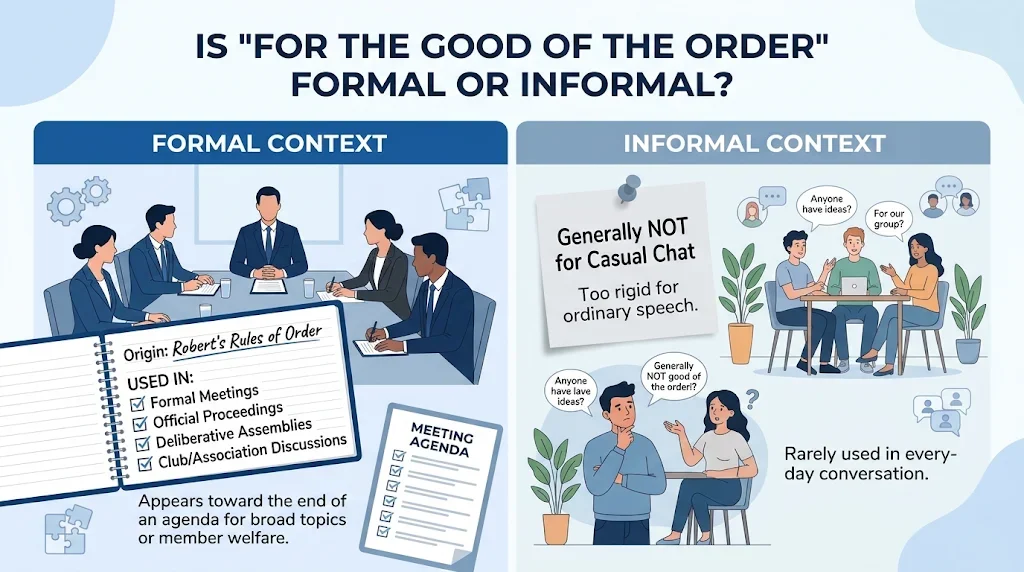
Is “For the Good of the Order” Formal or Informal?
“For the good of the order” is a relatively formal and traditional expression. It sounds especially natural in organizations that follow established meeting customs.
You may hear it at fraternal lodge meetings, association gatherings, committee meetings, or other organized events. In these settings, members usually understand the phrase without needing an explanation.
In ordinary conversation, however, it can sound old-fashioned. Most people would use simpler language to express the same idea.
Compare these examples:
Formal: “We should review the proposal for the good of the order.”
Conversational: “We should review the proposal to make sure it benefits everyone.”
Formal meeting question: “Does anyone have anything for the good of the order?”
Conversational meeting question: “Does anyone have any final comments or announcements?”
Both versions communicate a similar idea, but the formal version carries a traditional organizational tone.
Can You Use the Phrase in Professional Writing?
Yes. The phrase can work in professional writing when the audience recognizes its meaning.
For example, it may fit meeting minutes, an association’s agenda, or a description of a fraternal organization’s procedures.
However, if you’re writing for a general audience, a clearer alternative may help readers understand you immediately.
Instead of writing, “The committee discussed several matters for the good of the order,” you could write, “The committee discussed several issues affecting the organization’s welfare.”
The second sentence communicates the meaning directly without relying on specialized terminology.
Common Mistakes
Although the expression is straightforward, a few common misunderstandings can lead to awkward or inaccurate usage.
Confusing Collective Benefit With Maintaining Order
The phrase doesn’t simply mean keeping people quiet, following rules, or preventing disorder.
“For the good of the order” concerns the welfare of a group. “For the sake of good order” concerns proper conduct or organization.
A meeting chair might use the second expression when asking people to stop interrupting. The first is more appropriate when discussing a change intended to benefit the organization.
Assuming the Phrase Always Refers to Meetings
The expression often appears in meeting agendas, but its meaning isn’t limited to meetings.
You can use it to describe a decision, compromise, policy, or action that serves a group’s interests.
For example, “She accepted the compromise for the good of the order” describes a reason for her decision. It doesn’t refer to a meeting agenda item.
Treating It as a Demand for Obedience
The expression doesn’t automatically mean that members should obey leaders without question.
In fact, the meeting-specific use can give members an opportunity to offer constructive criticism. Someone might raise a concern precisely because they believe the organization needs to improve.
A healthy discussion considers whether a suggestion genuinely benefits the group. It doesn’t assume that every existing decision is automatically correct.
Assuming Every Organization Uses the Phrase
Not all clubs, companies, associations, or committees use this expression.
Some prefer “open forum,” “member comments,” “general discussion,” or “announcements.” Others don’t include a separate discussion period at all.
If you’re attending an unfamiliar meeting, check the agenda or ask the chair what the heading means in that organization.
Assuming Every Comment Requires Formal Action
A member may offer a compliment, announce an upcoming event, or share a general observation without asking the organization to make a decision.
Formal action may require a motion, a vote, or another procedure. The organization’s rules determine whether a matter raised during the discussion period can be handled immediately or must be placed on a future agenda.
Using It When a Simpler Expression Would Be Clearer
The phrase isn’t wrong in everyday conversation, but it can sound unnecessarily formal.
For example, “We should do this for the good of the order” may sound natural among members of a traditional organization. In a casual conversation with coworkers, “We should do this for the good of the team” may communicate the same idea more clearly.
The best wording depends on your audience and purpose.
Read More: In-Line vs. Inline vs. In Line: Meaning, Differences, and Examples
FAQs
1. What does “For the Good of the Order” mean?
“For the good of the order” means doing or sharing something that benefits an entire group, organization, or community. It often refers to raising important concerns, sharing useful information, or making decisions that serve everyone’s interests.
2. Where did the phrase “For the Good of the Order” originate?
The expression is associated with formal meetings and organized groups, including fraternal organizations, clubs, and military settings. It developed as a way to introduce matters relevant to the group’s shared interests and orderly operation.
3. How is “For the Good of the Order” used in meetings?
During a meeting, a member might use the phrase before sharing an announcement, raising a concern, or suggesting an improvement. It signals that the information may be relevant to the group as a whole.
Example: “For the good of the order, I’d like to remind everyone about the updated safety procedures.”
4. Is “For the Good of the Order” a formal expression?
Yes, it generally sounds formal and organizational. You may hear it in association meetings, official gatherings, military environments, and professional discussions. However, people can also use it informally when discussing what benefits a team.
5. Is “For the Good of the Order” a military phrase?
The expression is used in military contexts, but it isn’t exclusively military terminology. Clubs, fraternal organizations, committees, and other groups also use it to introduce information that concerns their members.
6. Can I use “For the Good of the Order” at work?
Yes. You can use it when sharing information that helps your colleagues or supports a team’s goals. However, in everyday workplace conversations, simpler alternatives such as “For everyone’s benefit” or “For the benefit of the team” may sound more natural.
7. What is an example of “For the Good of the Order” in a sentence?
Here’s a practical example: “For the good of the order, please report any scheduling conflicts before Friday’s meeting.”
In this sentence, the speaker encourages everyone to share information early so the group can plan effectively.
8. What does “the order” mean in this expression?
Here, “the order” refers to the organized group or body whose members share common responsibilities, rules, or goals. It doesn’t necessarily mean a command or instruction.
9. What are some alternatives to “For the Good of the Order”?
Depending on the context, you can use these alternatives:
- For everyone’s benefit
- For the good of the group
- In the interest of the organization
- For the benefit of the team
- For the common good
- To keep everyone informed
These expressions communicate a similar idea in language that may feel more familiar in everyday conversations.
10. Is “For the Good of the Order” still used today?
Yes. The expression remains relevant in certain formal meetings, clubs, associations, and organizational settings. Although it may sound traditional, people still use it to introduce announcements, concerns, or suggestions that affect the group.
Conclusion
The phrase “For the Good of the Order” refers to actions, information, or decisions that benefit a group as a whole. It’s commonly associated with formal meetings, military settings, clubs, and professional organizations where members need to communicate shared concerns. Understanding its meaning and context helps you recognize why someone might use it when making an announcement or raising an issue.
You can also use this expression when you want to emphasize teamwork, cooperation, and collective responsibility. In casual conversations, alternatives such as “for everyone’s benefit” may sound more natural, while the original phrase suits more formal settings. Once you understand its meaning and usage, you’ll be better prepared to recognize it and use it appropriately in both professional and organizational communication.

Muhammad Haroon is the voice behind many of the clear, practical grammar guides you’ll find on Grammar Lantern. With a strong background in content writing and a genuine love for the English language, Haroon specializes in breaking down intimidating grammar topics into simple, digestible lessons. His goal is simple: to empower readers to write with confidence and clarity. Whether he’s explaining tricky tenses or demystifying punctuation, Haroon approaches each topic with patience, precision, and a touch of warmth—because he knows that learning grammar is a journey, not a race.