Have you ever wondered whether you can start a sentence with “so”? You may have heard that doing so is grammatically incorrect, but that common misconception doesn’t reflect how modern English works. In fact, starting a sentence with so is perfectly acceptable when it helps express an idea clearly. You’ll often see this usage in everyday conversations, emails, articles, and other forms of writing.
Understanding the relevant grammar rules, sentence structure, and writing conventions can help you use this word confidently. For example, “It was raining, so we stayed home” connects a cause with its result. By contrast, “It was raining. So, we stayed home” expresses the same idea across two sentences. Both constructions can be correct when used appropriately.
In this guide, you’ll learn when to start a sentence with so, how to use it correctly, and which punctuation rules matter most. We’ll explore practical examples from formal writing, academic writing, and casual communication so you can make your writing clearer, smoother, and more natural.
Quick Answer
Yes, starting a sentence with “so” is grammatically acceptable in modern English. You can use it to connect ideas, introduce a result, ask a question, or move a conversation forward.
However, its suitability depends on the context.
- Everyday conversation: “So, what happened after the meeting?”
- Professional writing: “So we can meet the deadline, we need to finish the report today.”
- Explanatory writing: “The sample contained impurities. So the researchers repeated the experiment.”
- Formal academic writing: “The results differed significantly. Therefore, the researchers conducted another test.”
You don’t always need a comma after “so.” When it introduces a conversational question or acts as an introductory marker, a comma often improves readability. When it forms part of the main clause, the punctuation may be different.
The main rule is simple: Use “so” when it clearly expresses your intended meaning. Choose another transition when it communicates your idea more precisely.
What Does “So” Mean at the Beginning of a Sentence?
The meaning of “so” depends on the sentence around it. Sometimes it shows a result. At other times, it helps a speaker introduce a question or shift the discussion.
Recognizing these different uses will help you decide whether “so” is the right opening.
“So” to Show a Result or Consequence
One common use of “so” is to introduce an outcome that follows from an earlier fact or situation. In this role, it often connects two related thoughts.
For example:
- The store had closed early. So we bought groceries somewhere else.
- Maya missed the train. So she called a taxi.
- The computer wouldn’t turn on. So I checked the power cable.
In each example, the second sentence explains what happened because of the first situation.
Writers sometimes begin a new sentence with “so” instead of joining both thoughts with a comma and the word “so.” Both structures can work.
Combined sentence: The store had closed early, so we bought groceries somewhere else.
Two sentences: The store had closed early. So we bought groceries somewhere else.
The second version places more emphasis on the result. However, the relationship between the two sentences should remain clear.
“So” to Introduce a New Topic
People often use “so” when they want to move a conversation toward another subject. It creates a natural bridge between what they’ve discussed and what they want to discuss next.
For example:
- So, let’s talk about your upcoming interview.
- So, what are your plans for the weekend?
- So, we have covered the budget. Now let’s discuss the schedule.
This usage appears frequently in meetings, interviews, presentations, and everyday conversations.
However, repeating “so” at the start of every topic can make your speech or writing sound monotonous. Use it when it helps the discussion move forward, not simply because you need an opening word.
“So” to Begin a Question
Starting a question with “so” is perfectly acceptable. It often signals that the question follows from something already discussed.
Consider these examples:
- So, what happens next?
- So, are we meeting at the usual time?
- So, why did the results change?
- So, does that mean we need to start again?
In these sentences, “so” prepares the reader or listener for a question connected to the surrounding conversation.
It can also communicate curiosity, surprise, or a desire for clarification. The tone depends on the context and how the speaker delivers the question.
For example, “So, you knew about the problem?” might express surprise or ask someone to confirm information. The word itself doesn’t determine the speaker’s attitude; context does.
Read More: 8 Words for Someone Who Doesn’t Care About Others’ Feelings
“So” to Summarize or Draw a Conclusion
You can also begin a sentence with “so” when you want to summarize the point you’ve established or explain what follows logically.
For example:
- We have limited time and three tasks to complete. So we should handle the most urgent task first.
- Every participant completed the survey. So we can now analyze the responses.
- The repair would cost more than a replacement. So buying a new device made better financial sense.
Here, “so” signals a conclusion based on the preceding information.
In formal reports, you might choose “therefore,” “consequently,” or “as a result” when those expressions communicate the relationship more clearly. Still, “so” remains a valid choice when the tone and sentence structure suit it.
“So” to Emphasize a Point or Signal a Response
Sometimes “so” doesn’t introduce a direct consequence. Instead, it signals that a speaker is about to respond, make an observation, or address something important.
For example:
- So, that’s why the instructions seemed confusing.
- So, you’re saying the delivery will arrive tomorrow?
- So, here’s what we learned from the experience.
This use is especially common in spoken English. It helps people organize their thoughts and guide listeners through an explanation.
In writing, the same technique can make an explanation feel direct and approachable. Use it thoughtfully, though. Too many introductory markers can distract readers from the actual message.
Is It Grammatically Correct to Start a Sentence With “So”?
Yes. English grammar allows sentences to begin with “so,” and writers have used this construction for centuries.
The confusion often comes from traditional classroom advice about conjunctions. Students may learn to avoid starting sentences with words such as “and,” “but,” or “so.” That advice can help beginners avoid choppy writing, but it isn’t a universal rule of English grammar.
To understand why sentence-initial “so” works, you need to consider its grammatical function.
“So” as a Coordinating Conjunction
“So” can function as a coordinating conjunction that connects two independent clauses and indicates a result.
For example:
“Lena was feeling unwell, so she stayed home.”
Both parts express complete thoughts:
- Lena was feeling unwell.
- She stayed home.
The conjunction “so” connects these clauses and shows their logical relationship.
When you separate the clauses into two sentences, the second sentence can still begin with “so”:
“Lena was feeling unwell. So she stayed home.”
This structure is acceptable in modern English. The writer uses the period to create a stronger break between the thoughts.
“So” as a Discourse Marker
“So” can also function as a discourse marker, a word or expression that helps organize conversation and connect ideas.
For example:
“So, where would you like to begin?”
Here, “so” doesn’t simply join two grammatical clauses. It helps the speaker introduce a question and move the conversation forward.
Other examples include:
- So, let’s get started.
- So, what did you discover?
- So, here’s the situation.
This use explains why “so” appears so naturally at the beginning of spoken sentences.
Does Starting With “So” Create a Sentence Fragment?
No. Beginning a sentence with “so” doesn’t automatically make it a fragment.
A sentence fragment is a word group that doesn’t function as a complete sentence in the intended context.
Compare these examples:
Complete sentence: The roads were flooded. So we postponed the trip.
Incomplete thought: Because the roads were flooded.
The first example contains a complete statement followed by another complete statement. The second example leaves the reader waiting for the main clause.
A deliberate fragment may work in dialogue or creative writing, but formal prose generally benefits from complete sentences.
When Should You Start a Sentence With “So”?
The best time to use “so” is when it helps readers understand how your next thought relates to the previous one. However, the appropriate choice also depends on your audience and the type of writing you’re producing.
In Everyday Conversations
Everyday conversation is one of the most natural settings for sentence-initial “so.”
People use it to ask questions, introduce plans, explain decisions, and return to a topic after an interruption.
For example:
- So, are we still going to the movies?
- So I told him what had happened.
- So, what do you want to eat?
- So, that explains the missing keys!
These sentences sound natural because “so” helps organize the exchange. It doesn’t need to provide a formal logical connection every time.
In casual writing, such as text messages and personal notes, the same principle applies.
In Emails and Professional Communication
You can start a sentence with “so” in professional emails, especially when the message has a conversational tone.
For example:
“Hi Jordan,
So, we’re planning to launch the updated website on Thursday. Could you send the final images by Wednesday afternoon?”
This opening is understandable and friendly. However, depending on the relationship and the purpose of the email, a more direct version may sound better.
“Hi Jordan,
We’re planning to launch the updated website on Thursday. Could you send the final images by Wednesday afternoon?”
The second version removes an unnecessary introductory word without changing the meaning.
In professional communication, ask yourself whether “so” establishes a useful connection. If it does, keep it. If it merely delays the main point, remove it.
In Academic Writing
Academic writing requires careful reasoning, clear transitions, and an appropriate level of formality. Starting a sentence with “so” isn’t inherently wrong, but it may not always be the most precise choice.
Consider this example:
“The first trial produced inconsistent results. So the researchers repeated the experiment.”
The passage is clear, and the grammar is acceptable. However, a more formal version might read:
“The first trial produced inconsistent results. Therefore, the researchers repeated the experiment.”
Both versions express a consequence. The second may fit better in a formal research paper because “therefore” explicitly signals a logical conclusion.
That doesn’t mean you must remove every instance of “so” from academic writing. The best choice depends on the sentence, the discipline, and the style requirements.
In Formal Reports and Business Documents
Formal reports often benefit from transitions that identify the relationship between findings, recommendations, and conclusions.
For example:
Less formal: The supplier missed two deadlines. So we recommend reviewing the contract.
More formal: The supplier missed two deadlines. Consequently, we recommend reviewing the contract.
Both sentences are grammatical. The second makes the causal relationship explicit and adopts a more formal tone.
Choose your opening based on the purpose of the document. A project update may comfortably use “so,” while a technical report may call for a more specific transition.
When Should You Avoid Starting a Sentence With “So”?
Although starting with “so” is grammatically acceptable, not every sentence benefits from it. Sometimes removing the word produces clearer, tighter writing.
When “So” Adds No Meaning
Consider this example:
“So, I wanted to ask whether you received my email.”
The sentence isn’t grammatically incorrect. However, if the writer has no particular reason to use “so,” the word may be unnecessary.
A cleaner version would be:
“I wanted to ask whether you received my email.”
The revised sentence gets straight to the point.
Before keeping an introductory “so,” consider whether it connects ideas, signals a question, or serves another clear purpose. If it doesn’t, you can probably remove it.
When You Overuse “So”
Repeated sentence openings can make even good writing feel predictable.
Consider this paragraph:
“So I checked the report. So I found three mistakes. So I corrected them. So I sent the report to my manager.”
The reader can follow the sequence, but the repeated opening makes the paragraph sound mechanical.
A more natural version would be:
“I checked the report and found three mistakes. After correcting them, I sent the revised version to my manager.”
The revised paragraph preserves the sequence while varying its structure.
Practical tip: Read a paragraph aloud. If you keep hearing the same opening word, revise the sentences that don’t need it.
When the Connection Between Ideas Is Unclear
“So” often signals a relationship between ideas. If readers can’t identify that relationship, the transition may confuse them.
For example:
“The office bought new chairs. So the marketing team changed its slogan.”
The two statements may be related in some unusual situation, but the connection isn’t obvious.
You could clarify the relationship by adding context:
“The office bought new chairs to improve employee comfort. So the management team also reviewed other workplace improvements.”
Now the transition makes more sense because the second sentence follows from the broader idea.
When a More Precise Transition Works Better
Sometimes “so” is too general for the relationship you want to express.
For example:
“The first design was expensive. So the second design used fewer materials.”
If the second design changed specifically to reduce costs, you could write:
“The first design was expensive. Therefore, the second design used fewer materials to reduce production costs.”
The revision gives readers a clearer explanation of the reasoning.
Choose a more precise transition when it improves the meaning. Don’t replace “so” merely to make a sentence sound sophisticated.
How to Punctuate a Sentence That Begins With “So”
Correct punctuation depends on how “so” functions in your sentence. A comma may help the reader follow the thought, but you shouldn’t automatically place one after every sentence-initial “so.”
Should You Put a Comma After “So”?
Sometimes. When “so” acts as an introductory discourse marker, a comma often makes the sentence easier to read.
For example:
- So, what would you like to discuss?
- So, let’s look at the next example.
- So, how did the team solve the problem?
The comma separates the introductory marker from the main question or statement.
However, when “so” forms part of the sentence’s grammatical structure, you may not need a comma immediately after it.
For example:
- So we could finish on time, everyone agreed to arrive early.
- So far, the project has stayed within budget.
- So much depends on the final decision.
In the first example, “so” introduces a purpose clause. In the second, “so far” functions as an expression meaning “up to this point.” In the third, “so much” is a phrase that functions as the subject.
These examples show why punctuation depends on meaning and structure rather than the first word alone.
Can You Start a Sentence With “So” After a Period?
Yes. You can use a period before “so” when the preceding thought is complete.
For example:
“The team reviewed the proposal. So everyone understood the changes before the meeting.”
Both sentences are grammatically complete. The second sentence begins with “so” to emphasize the result of the review.
You could also combine the thoughts:
“The team reviewed the proposal, so everyone understood the changes before the meeting.”
The choice depends on the rhythm and emphasis you want. A period creates a stronger pause, while a comma keeps the two clauses closely connected.
Can You Start a Sentence With “So” After a Question Mark?
Yes. A question mark ends a question, but it doesn’t prevent the next sentence from beginning with “so.”
For example:
“Why did the delivery arrive late? So, what can we do to prevent the same problem?”
The second sentence introduces a follow-up question. The structure works particularly well in dialogue and explanatory writing.
You can also use “so” to introduce a statement after a question:
“Did everyone receive the instructions? So we can begin the workshop now.”
This example is possible, but the relationship between the question and the statement may be unclear without additional context. A clearer version might be:
“Did everyone receive the instructions? If so, we can begin the workshop now.”
The phrase “if so” explicitly connects the second sentence to the answer to the first question.
Can You Start a Paragraph With “So”?
Yes. A paragraph can begin with “so” when the word introduces a conclusion, continues an ongoing discussion, or signals a conversational shift.
For example:
“The trial revealed several weaknesses in the original design. The engineers then tested two alternatives.”
“So, which design should the company choose? The answer depends on cost, safety, and long-term performance.”
The new paragraph begins with a question that develops the previous discussion.
However, avoid starting every paragraph with “so.” A strong paragraph opening should tell readers what the paragraph contributes to the overall discussion.
In formal writing, you may prefer a direct topic sentence or a more precise transition. In a conversational article, “so” can provide a natural connection.
Examples
The following examples show how sentence-initial “so” works across different situations. Each one uses the word for a specific purpose.
Everyday Examples of Starting a Sentence With “So”
- So, what are we having for dinner?
- So we missed the bus and had to walk home.
- So, are you coming with us?
- So that’s where I left my phone.
- So, why didn’t you tell me earlier?
- So we decided to postpone the picnic until Sunday.
These examples demonstrate how “so” introduces questions, explains outcomes, and connects ideas in everyday conversation.
Professional Examples of Starting a Sentence With “So”
- So, let’s review the results before making a decision.
- So we can meet the deadline, we need to finalize the draft today.
- So, what are the next steps for this project?
- So far, the team has completed three of its five major tasks.
- So we can avoid further delays, please submit your feedback by noon.
These sentences suit different professional contexts. Some introduce a discussion, while others express a purpose or describe progress.
Academic and Explanatory Examples
- So the experiment produced different results under the new conditions.
- So, why does this distinction matter?
- So we can compare the findings accurately, we need consistent measurements.
- The initial hypothesis didn’t explain the observations. So the researchers developed a revised hypothesis.
- The first analysis revealed a possible error. Therefore, the researchers checked the calculations again.
The last example uses “therefore” to demonstrate a more formal alternative. Both words can introduce a result, but they may create different tones.
Narrative Examples of Starting a Sentence With “So”
- So I opened the door and found a package on the doorstep.
- So, after several delays, the team finally reached its destination.
- So began a journey none of them had expected.
- The lights suddenly went out. So we grabbed our phones and searched for a flashlight.
- So there I was, standing outside the wrong building with a meeting starting in five minutes.
Narrative writing often benefits from conversational openings because they help establish pace and voice. The right choice depends on the narrator and the scene.
Incorrect or Awkward Ways
The word “so” isn’t grammatically wrong at the beginning of a sentence. However, certain uses can make a sentence confusing, repetitive, or incomplete.
Using “So” Without a Clear Connection
Consider this example:
“The restaurant introduced a new menu. So the library extended its opening hours.”
Without more information, readers won’t understand why the two events belong together.
A clearer version might be:
“The restaurant introduced a new menu, attracting more visitors to the shopping district. So the nearby library extended its evening hours to accommodate increased demand for its study spaces.”
The added information explains the relationship between the events.
The lesson is simple: transitions work best when the connection between ideas is clear.
Overusing “So” at the Start of Sentences
Repeated openings can make writing sound monotonous, especially when every sentence describes the next event.
For example:
“So I opened the file. So I checked the figures. So I found an error. So I corrected the spreadsheet.”
A stronger version varies the sentence structure:
“I opened the file and checked the figures. When I spotted an error, I corrected the spreadsheet before sending it to the team.”
The revised version is shorter and easier to follow. It also avoids unnecessary repetition.
Using “So” in an Incomplete Sentence
Starting with “so” doesn’t excuse an incomplete thought.
Consider this example:
“So that everyone could understand the instructions.”
This is a dependent clause. It leaves the reader waiting for the main idea.
You can revise it in two ways:
- “So that everyone could understand the instructions, the trainer demonstrated each step.”
- “The trainer demonstrated each step so everyone could understand the instructions.”
Both versions communicate a complete thought.
However, fragments may be intentional in dialogue or creative writing. For example, “So much for our big plan!” is a complete exclamation in ordinary use, while “Because we ran out of time” may be a deliberate fragment in a conversation.
Using “So” When Another Transition Is More Precise
Consider these examples:
- “The deadline changed. So, we need to update the schedule.”
- “The deadline changed. However, we can still finish the project.”
- “The deadline changed. For example, the final report is now due Friday.”
Each transition communicates a different relationship.
“So” suggests a result or response. “However” signals contrast. “For example” introduces supporting evidence.
Choosing the right word helps readers follow your reasoning without having to guess what you mean.
Alternatives
Sometimes “so” is the best choice. In other cases, another word or phrase communicates your meaning more clearly.
The following table groups common alternatives by their purpose.
| Intended meaning | Alternative | Example |
| Result or conclusion | Therefore | Therefore, the team revised its plan. |
| Consequence | As a result | As a result, the delay affected delivery. |
| Logical conclusion | Thus | Thus, the findings support the hypothesis. |
| Contrast | However | However, the second test produced a different result. |
| Additional information | Furthermore | Furthermore, the report identifies two other risks. |
| Topic transition | Now | Now, let’s examine the next question. |
| Clarification | In other words | In other words, the process needs less time. |
| Purpose | To ensure that | To ensure that everyone understands, we’ll review the instructions. |
| Sequence | Next | Next, we’ll compare the two approaches. |
| Summary | In short | In short, the revised plan reduces unnecessary costs. |
These alternatives aren’t interchangeable in every situation. For example, “however” expresses contrast rather than consequence, while “furthermore” adds information instead of drawing a conclusion.
How to Choose the Right Alternative to “So”
Start by identifying the relationship between your ideas.
Ask yourself these questions:
- Does the second sentence describe a result? Consider “therefore” or “as a result.”
- Does it contradict the previous statement? Consider “however” or “nevertheless.”
- Does it add another point? Consider “furthermore” or “in addition.”
- Does it introduce a new step? Consider “next” or “now.”
- Does it explain an idea differently? Consider “in other words.”
For example:
Original: The supplier missed the delivery date. So we changed our production schedule.
Alternative: The supplier missed the delivery date. Consequently, we changed our production schedule.
Both versions are correct. The second sounds more formal, but it isn’t automatically better. Choose the wording that suits your audience and purpose.
Starting a Sentence With “So” vs. “Therefore”
“So” and “therefore” can both introduce a conclusion or result. However, they differ in tone and usage.
“So” is flexible and common in everyday English. It can also introduce questions, topic changes, and conversational responses.
“Therefore” more explicitly signals a logical conclusion. Writers often use it in formal explanations, reports, and academic arguments.
Compare these examples:
| With “so” | With “therefore” |
| The roads were icy. So we stayed home. | The roads were icy. Therefore, we stayed home. |
| So, what should we do next? | Therefore, what should we do next? |
| The figures didn’t match. So we checked them again. | The figures didn’t match. Therefore, we checked them again. |
The first and third pairs communicate similar results. However, the second pair illustrates an important difference: “so” naturally introduces a conversational question, while “therefore” usually sounds awkward in that role.
Use “so” for natural flow and “therefore” when you want to emphasize a logical conclusion. Neither word is universally superior.
Starting a Sentence With “So” vs. “And” or “But”
“So,” “and,” and “but” can all begin sentences, but each word serves a different purpose.
- So often introduces a result, response, or conversational transition.
- And adds information or continues a thought.
- But introduces a contrast or an unexpected difference.
Consider this short example:
“The team had only two days to finish the project. And several important details were still missing. But everyone agreed to focus on the most urgent tasks. So the team divided the remaining work.”
Each opening contributes something different to the passage. “And” adds information, “but” introduces contrast, and “so” signals a result.
Although all three can begin sentences, using them repeatedly without a clear purpose can weaken your writing. Focus on the relationship between ideas instead of choosing a transition simply to begin the next sentence.
Common Myths
Several common misconceptions make writers hesitant to use “so” at the beginning of a sentence. Understanding the facts will help you make better choices.
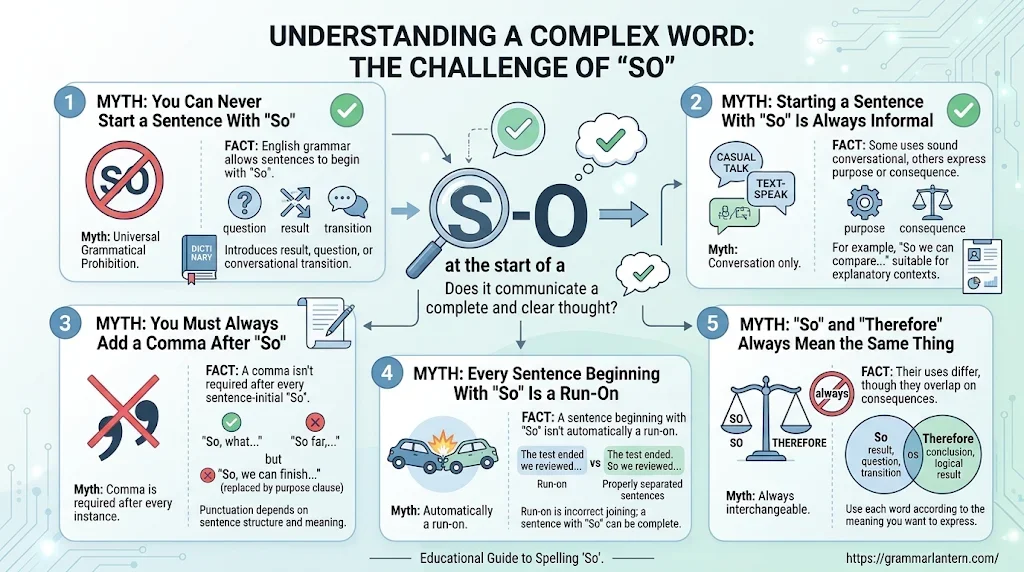
Myth: You Can Never Start a Sentence With “So”
Fact: English grammar allows sentences to begin with “so.” The word can introduce a result, a question, or a conversational transition.
The real concern is whether the sentence communicates a complete and clear thought.
Myth: Starting a Sentence With “So” Is Always Informal
Fact: Some uses of “so” sound conversational, but others express purpose or consequence.
For example, “So we can compare the results, we need consistent measurements” is suitable for many explanatory contexts.
In highly formal prose, a more specific construction may be preferable. However, that is a matter of style and precision rather than a universal grammatical prohibition.
Myth: You Must Always Add a Comma After “So”
Fact: A comma isn’t required after every sentence-initial “so.”
Compare these examples:
- “So, what do you think?” — The comma separates the introductory marker from the question.
- “So far, we’ve completed the first stage.” — The comma follows the introductory phrase “so far.”
- “So we can finish early, let’s begin now.” — No comma immediately follows “so” because it introduces a purpose clause.
Punctuation depends on the sentence’s structure and intended meaning.
Myth: Every Sentence Beginning With “So” Is a Run-On
Fact: A sentence beginning with “so” isn’t automatically a run-on.
A run-on occurs when independent clauses aren’t joined or separated correctly. For example, “The test ended we reviewed the results” is a run-on.
By contrast, “The test ended. So we reviewed the results” contains two properly separated sentences.
Myth: “So” and “Therefore” Always Mean the Same Thing
Fact: The words overlap when expressing consequences, but their uses differ.
“So” can introduce questions and conversational transitions. “Therefore” primarily signals a conclusion or logical result.
Use each word according to the meaning you want to express.
Read More: Wise vs. Wize: Which Spelling Is Correct?
FAQs
1. Can you start a sentence with “so”?
Yes, you can start a sentence with “so.” English grammar doesn’t prohibit this usage. Writers often use it to introduce a result, connect ideas, or begin a response. For example, “So, what should we do next?”
2. Is starting a sentence with “so” grammatically incorrect?
No, starting a sentence with “so” isn’t grammatically incorrect. The idea that you should never begin a sentence with a conjunction is an outdated misconception. What matters is whether the word fits the sentence and communicates your meaning clearly.
3. Should you put a comma after “so” at the beginning of a sentence?
It depends on how you use the word. When “so” introduces a transition or conversational opening, a comma often helps: “So, let’s get started.” When it directly introduces a result, a comma isn’t always necessary: “So we decided to leave.”
4. Can you start a formal sentence with “so”?
Yes, but consider your audience and purpose. In formal writing, “so” can introduce a logical result or conclusion. However, in highly formal or academic contexts, alternatives such as “therefore,” “consequently,” or “as a result” may communicate your point more precisely.
5. Can you start an academic essay with “so”?
You can, but it depends on the sentence and the essay’s tone. Beginning an academic paragraph with “So” may sound conversational. For a more formal style, you might write, “Therefore, the results support the original hypothesis.”
6. What does “so” mean at the beginning of a sentence?
At the beginning of a sentence, “so” can serve several purposes. It may introduce a result, signal a transition, summarize a previous point, or invite someone into a discussion.
Example: “So, the next step is to review the results.”
Here, “so” connects the discussion to the next action.
7. What is the difference between starting a sentence with “so” and using it in the middle?
When “so” appears in the middle of a sentence, it often connects a cause with its result. At the beginning, it can introduce a consequence or link the new sentence to an earlier idea.
- Middle: “I was tired, so I went to bed.”
- Beginning: “I was tired. So I went to bed.”
Both examples are acceptable, although the second gives the result its own sentence.
8. Can you start a sentence with “so” in an email?
Yes. Starting with “so” is common in casual and professional emails, especially when continuing an existing discussion.
Example: “So, I’ve attached the revised document for your review.”
For a more formal email, you might prefer “I’ve therefore attached the revised document for your review.”
9. What words can you use instead of “so” at the beginning of a sentence?
You can choose an alternative based on the meaning you want to express. Common options include:
- Therefore: Introduces a logical conclusion.
- Consequently: Highlights a result.
- As a result: Emphasizes an outcome.
- Thus: Expresses a conclusion, often in formal writing.
- In that case: Responds to a particular situation.
- Well: Introduces a conversational response.
Choose the word that best fits your sentence rather than replacing “so” automatically.
10. How can you avoid overusing “so” in your writing?
Use “so” when it improves the connection between your ideas. If several sentences begin with the same word, vary your sentence openings or remove unnecessary transitions. You can also use alternatives such as “therefore” or “as a result” when they express your meaning more accurately.
The goal isn’t to avoid “so” altogether. It’s to make every sentence clear, natural, and appropriate for your audience.
Conclusion
You can absolutely start a sentence with “so” without breaking English grammar rules. This common word introduces results, connects ideas, and helps conversations and written passages flow naturally. Whether you’re writing an email, explaining an outcome, or continuing a discussion, “so” can be an effective sentence starter when you use it appropriately.
The key is to pay attention to context, punctuation, and writing style. In casual writing, “So, what happens next?” sounds perfectly natural. In formal or academic writing, words such as “therefore” or “consequently” may sometimes be more suitable. Don’t let an outdated grammar myth limit your writing. Focus on clarity, choose words that fit your purpose, and use “so” whenever it helps you express your ideas effectively.

For Shafiq ur Rehman, writing is an art form and grammar is the toolbox that makes it beautiful. As a dedicated content writer at Grammar Lantern, Shafiq approaches every topic like an architect carefully laying down strong foundations of understanding before adding the finer details. He loves diving into the trickiest grammar points and resurfacing with simple, bite-sized takeaways that anyone can grasp. When he’s not crafting articles, you’ll likely find him strategizing over a game of chess, exploring dusty local bookshops, or quietly jotting down poetic observations in his notebook.