
Rules for Writing Out Numbers help you write clearly and avoid common grammar mistakes. The right choice depends on your style guide, audience, and purpose. In professional writing and academic writing, styles such as APA, MLA, and the Chicago Manual of Style follow different number rules. Some guides recommend spelling out one to nine and using numerals for 10 and above, while others spell out numbers up to ninety-nine.
When writing a sentence, spell out a number that appears at the beginning. For example, write “Twenty-five students attended the class” instead of starting with 25. Use a hyphen in compound numbers such as twenty-one, thirty-two, and eighty-eight. For large numbers, combine numerals and words when appropriate, such as 2.5 million people or 4 billion dollars. This approach improves readability and keeps information easy to understand.
For dates, times, and percentages, numerals usually provide better clarity. Write October 26, 2026, 8:54 p.m., and 4 percent. Use numerals for decimals, measurements, and specific monetary amounts, such as 0.75 inches, $4.50, and $2. However, simple fractions, such as two-thirds, are often spelled out. Always follow one consistent style throughout your writing.
Quick Answer
The general rule in everyday American English is to spell out numbers from zero through nine and use numerals for numbers 10 and above.
For example:
- Correct under the general convention: She bought five notebooks and 12 pens.
- Correct under the general convention: The library has eight computers and 25 desks.
- Less consistent: She bought 5 notebooks and twelve pens.
However, this guideline isn’t universal. Some style guides use different thresholds, and certain types of numbers follow special rules.
Use these general guidelines as a starting point:
| Type of number | Common writing convention | Example |
| Small numbers | Spell out zero through nine | seven books |
| Larger numbers | Use numerals for 10 and above | 14 books |
| Numbers beginning sentences | Usually spell out | Twenty students attended. |
| Dates and years | Use numerals | October 26, 2026 |
| Measurements | Usually use numerals in technical writing | 8 inches |
| Money | Often use numerals | $25 |
| Percentages | Follow the relevant style guide | 8% or eight percent |
| Fractions | Often spell out simple fractions in general prose | one-half |
| Phone numbers | Use numerals | 555-123-4567 |
The most important rule: Follow the style guide required by your publication, school, or workplace. If no guide applies, choose a consistent approach that makes your writing easy to understand.
The Basic Rules for Writing Out Numbers
Before exploring special cases, learn the general conventions that govern numbers in ordinary prose. These rules provide a practical foundation for most everyday writing.
Spell Out Numbers From Zero Through Nine
In general prose, writers commonly spell out single-digit numbers. This approach keeps sentences natural and prevents ordinary quantities from looking unnecessarily technical.
For example:
- I bought three apples at the grocery store.
- She invited seven friends to dinner.
- We need four volunteers for the event.
- He waited two hours for the bus.
- The recipe requires six eggs.
These examples show how number words fit smoothly into ordinary sentences.
However, the rule doesn’t mean you must always spell out every number below 10. Measurements, tables, statistics, and other specialized contexts may call for numerals.
For instance, The package weighs 5 pounds may be appropriate in a product description, depending on the applicable style guide. In scientific writing, numerals often help readers compare measurements quickly.
Use Numerals for Numbers 10 and Above
The general convention recommends numerals for numbers 10 and above. Numerals make quantities easier to scan, especially when readers encounter several numbers in the same paragraph.
Consider these examples:
- The school enrolled 125 new students.
- Our team completed 18 projects this month.
- The store received 42 orders yesterday.
- She has worked at the company for 15 years.
Spelling out a large number can make a sentence feel unnecessarily heavy. Compare The company hired one hundred and forty-seven employees with The company hired 147 employees. The second version is usually easier to scan in ordinary business writing.
Still, don’t treat the 10-and-above rule as absolute. Some style guides prefer spelling out certain numbers, while technical publications often use numerals for measurements and statistical values regardless of size.
Keep Number Formatting Consistent
Consistency matters because readers notice when similar information appears in different formats.
Imagine reading this sentence:
The office has 4 meeting rooms, twelve desks, and 8 printers.
The mixture of numerals and words looks uneven because the quantities serve the same purpose. Under the general convention, a more consistent version would be:
The office has four meeting rooms, 12 desks, and eight printers.
However, consistency doesn’t mean every number in a document must look identical. A sentence containing an age, a date, and a percentage may require different formats for each.
For example:
The 8-year-old company opened its second location on March 12 and increased sales by 15%.
Here, the different forms serve different grammatical and informational purposes.
Read More: “For the Good of the Order” Meaning, Origin, and Examples
Follow the Relevant Style Guide
Different style guides establish different rules for writing numbers. This explains why a form accepted in one publication might not fit another.
Three widely used American English references are:
- Associated Press (AP) Stylebook: Commonly used in journalism, news writing, and public relations.
- Chicago Manual of Style: Widely used in book publishing, editing, and many forms of general nonfiction.
- Publication Manual of the American Psychological Association (APA): Commonly used in psychology, education, and other social sciences.
These guides don’t handle every numerical expression in exactly the same way. APA, for example, has specific rules for numbers in statistical and scientific contexts. AP and Chicago also have their own conventions and exceptions.
If you’re writing for a university, newspaper, publisher, or company, check its required style guide before making final decisions.
When Should You Spell Out Numbers?
Certain situations commonly call for number words even when the basic rule might suggest numerals. Sentence openings are the most familiar example, but ordinary descriptions and simple fractions also deserve attention.
Numbers at the Beginning of a Sentence
Writers generally spell out a number that begins a sentence. Starting with a numeral can interrupt the flow of formal prose, particularly when the number is large.
For example:
- Incorrect under the usual convention: 25 employees attended the meeting.
- Better: Twenty-five employees attended the meeting.
The same principle applies to larger quantities:
- Awkward: 1,250 applications arrived during the first week.
- Better: More than 1,200 applications arrived during the first week.
- Also possible: The first week brought in 1,250 applications.
The final example avoids starting the sentence with a number altogether.
When a number contains several words, spelling it out can make the opening cumbersome. Rewriting the sentence often provides a cleaner solution.
For instance, instead of beginning with One hundred and eighty-seven customers complained, write A total of 187 customers complained. The revised sentence keeps the information clear without an awkward opening.
Numbers in Ordinary Descriptions
Number words often work best when you’re describing everyday experiences, people, and objects.
Consider these examples:
- We walked three blocks to reach the restaurant.
- She placed two candles on the table.
- He adopted four kittens from the shelter.
- The children played for six hours.
Spelling out small numbers gives ordinary prose a relaxed, readable rhythm. This approach works especially well in personal essays, stories, lifestyle articles, and conversational blog posts.
However, context still matters. A travel guide might use 3 miles when presenting a distance alongside other measurements. The format should help readers understand the information quickly.
Simple Fractions
In general prose, writers often spell out simple fractions when they function as ordinary descriptions.
Examples include:
- one-half of the cake
- two-thirds of the class
- three-quarters of the journey
- one-fourth of the total amount
Hyphenation depends on the fraction’s grammatical role and the applicable style guide. For example, a two-thirds majority commonly uses a hyphen because the fraction modifies a noun.
Technical writing often handles fractions differently. A mathematical explanation might use 1/2, 2/3, or a stacked fraction because these forms make calculations easier to follow.
Choose the format that suits the purpose of the text rather than applying one rule to every situation.
Numbers in Informal Writing
In personal letters, creative writing, and casual blog posts, spelling out small numbers can help the text sound natural.
For example:
I spent three days preparing for the interview, but the conversation lasted only 20 minutes.
The sentence combines a spelled-out small number with a larger numeral. Under the general convention, that choice feels natural and readable.
In dialogue, number formatting may also reflect the author’s preferred style. However, consistency remains useful even when the writing is informal.
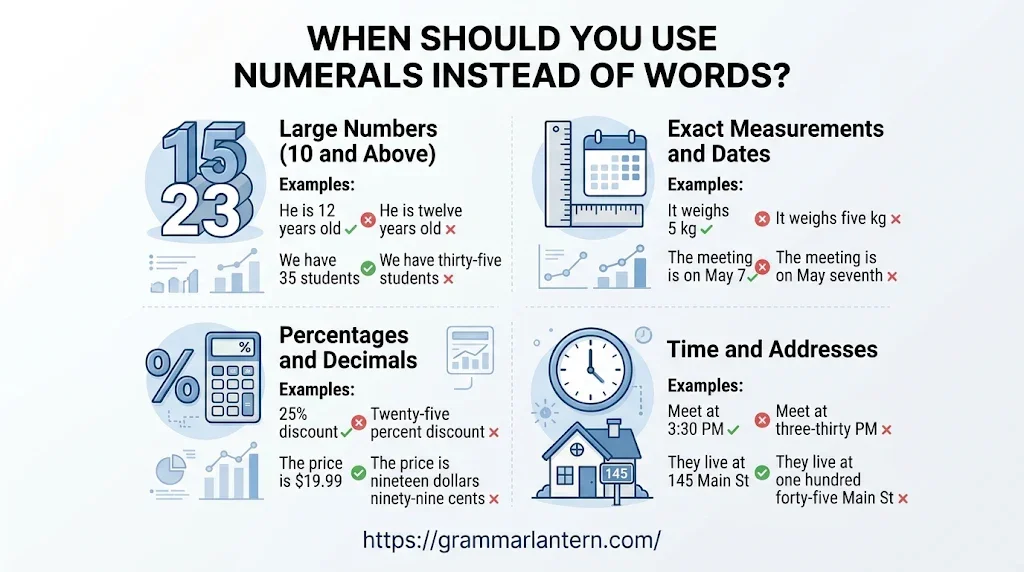
When Should You Use Numerals Instead of Words?
Numerals often work better when precision, quick comparison, or a standardized format matters. They’re especially useful for dates, measurements, money, percentages, and scientific results.
Large Numbers
Large numbers are generally easier to read as numerals than as fully spelled-out words. This becomes especially important when a sentence contains several quantities.
Compare these examples:
- Word form: The company earned two million five hundred thousand dollars.
- Numeral form: The company earned $2,500,000.
- Shortened form: The company earned $2.5 million.
Each form can be appropriate, depending on the context. A financial statement may require an exact figure, while a blog post might benefit from the shorter version.
Use the format that best serves your reader. If the exact amount matters, preserve the full value. If you’re communicating a general scale, a shortened expression may be clearer.
Dates and Years
Dates and years generally use numerals in American English. However, their punctuation and order depend on the format.
Examples include:
- October 26, 2026
- October 2026
- 2026
- The 1990s
- The 21st century
American English typically places the month before the day in full dates. It also uses a comma between the day and year when the day is included.
For decades, write the 1990s rather than the 1990’s. The apostrophe doesn’t belong in the plural form because you’re referring to a period of years, not indicating possession.
Century references require a little more attention. In ordinary prose, the twenty-first century may be preferred by a style guide that spells out certain numbers. Other contexts may use the 21st century. Follow the relevant publication’s rules.
Times and Clock Hours
Time expressions can appear as words or numerals, depending on the sentence and the document’s style.
| Written form | Example | Typical use |
| Words | seven o’clock | Narrative or conversational prose |
| Numerals with a colon | 7:00 a.m. | Schedules and formal time references |
| Numerals without minutes | 7 p.m. | Everyday writing and announcements |
| Twenty-four-hour time | 19:00 | Transportation, technical systems, and international schedules |
For example, you might write The meeting starts at seven o’clock in a story. A business invitation may instead say The meeting starts at 7:00 a.m.
Avoid combining incompatible formats. Expressions such as 7 a.m. in the morning repeat the same information because a.m. already identifies the morning period.
Ages
Age formatting depends on how the age appears in a sentence and which style guide you’re following.
Compare these examples:
- She has a six-year-old daughter.
- Her daughter is 6 years old.
- The child celebrated her ninth birthday.
- Participants aged 18 and older may register.
Under common American English conventions, ages written before nouns are hyphenated when they function as compound modifiers. The hyphens connect the words into one descriptive unit.
For example, a 10-year-old student uses hyphens because the entire expression describes the student. By contrast, the student is 10 years old doesn’t need them.
The spelling of the number itself depends on the style guide. Some publications spell out certain ages, while others favor numerals. When writing for a specific publication, check its rules.
Measurements and Units
Measurements usually favor numerals because readers need to identify exact quantities quickly. This is particularly important in recipes, product specifications, laboratory reports, and technical instructions.
Examples include:
- The table is 6 feet long.
- Add 250 milliliters of water.
- The temperature reached 32°F.
- The package weighs 4.5 kilograms.
- The trail extends for 12 miles.
Scientific and technical writing generally uses numerals with measurements, including values below 10. A report might state that a sample weighs 3 grams rather than three grams.
However, the appropriate format depends on the discipline and style guide. Scientific publications may also require specific unit symbols, spacing, or measurement conventions.
Never sacrifice precision merely to follow the general rule for spelling out small numbers.
Money and Prices
Money usually appears in numerical form because readers need to recognize amounts quickly.
For example:
- The notebook costs $5.
- The jacket costs $49.99.
- The business invested $250,000.
- The renovation cost approximately $1.2 million.
The dollar sign normally appears before the amount in American English. You don’t need to write $5 dollars because the symbol already identifies the currency.
In formal legal documents, contracts, and some financial instruments, writers may express monetary amounts in both words and numerals to reduce the risk of misreading. For example, a document might state $1,500 (one thousand five hundred dollars).
That extra wording serves a practical purpose. It helps readers verify the amount rather than relying on a single numerical representation.
Percentages and Decimal Numbers
Percentages and decimals often use numerals in business, scientific, and statistical writing. Their exact formatting depends on the publication’s requirements.
Examples include:
- Sales increased by 8%.
- The survey included 125 participants.
- The result was 3.75.
- The temperature dropped by 2.5 degrees.
Some general writing styles spell out percentages in certain contexts. For instance, a publication might prefer eight percent in ordinary prose but use 8% in tables.
APA style generally uses numerals for percentages, with the symbol in many contexts, while other style guides may differ.
When a document contains multiple percentages, consistency makes comparisons easier. If you’re reporting a series of results, avoid switching between 8%, eight percent, and 8 percent without a clear reason.
Statistics, Data, and Scientific Results
Statistical and scientific writing relies on numerical precision. Numerals help readers compare results, identify patterns, and interpret measurements without decoding long number words.
Consider this example:
A survey of 250 participants found that 42% preferred online appointments, while 31% preferred telephone appointments.
Writing those values as words would make the sentence longer without improving comprehension.
Statistical reports may also include:
- Sample sizes
- Means and medians
- Percentages and proportions
- Probability values
- Confidence intervals
- Test statistics
- Measurement results
These formats often follow discipline-specific rules. Researchers should check the required style guide rather than relying on general prose conventions.
For tables and graphs, numerical consistency is particularly important. Align decimal places where appropriate and label units clearly so readers can compare values accurately.
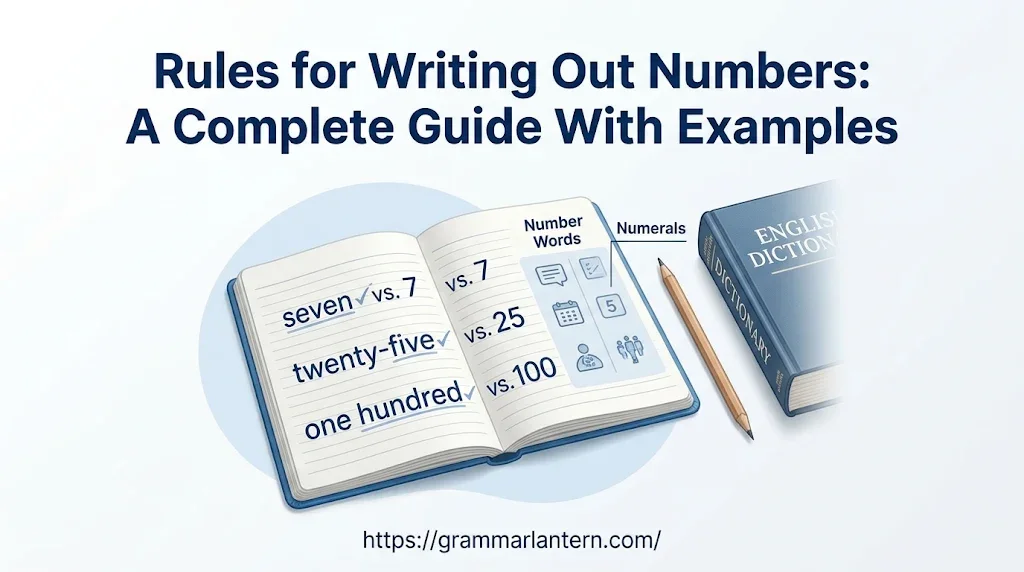
How to Write Large Numbers in Words
Sometimes you need to spell out a number completely. Understanding number names, hyphenation, and punctuation will help you write these expressions correctly.
Writing Numbers in the Hundreds
To write a number in the hundreds, combine the appropriate number word with hundred.
Examples:
- 100 = one hundred
- 125 = one hundred twenty-five
- 300 = three hundred
- 486 = four hundred eighty-six
- 900 = nine hundred
In standard American English, writers generally omit and between hundred and the remaining number in whole-number expressions. Therefore, one hundred twenty-five is the usual American form.
British English often includes and in comparable expressions. Because this article follows US English, the examples use the American convention.
Writing Numbers in the Thousands
For numbers in the thousands, combine the thousands group with the remaining hundreds, tens, or units.
Examples:
- 1,000 = one thousand
- 1,250 = one thousand two hundred fifty
- 4,600 = four thousand six hundred
- 7,325 = seven thousand three hundred twenty-five
- 25,000 = twenty-five thousand
Notice that twenty-five requires a hyphen. The same convention generally applies to compound numbers from twenty-one through ninety-nine.
In ordinary American English, use commas to separate groups of three digits in large numerals: 1,250, 25,000, and 350,000. Some technical or international contexts use different numerical conventions, so check the relevant requirements.
Writing Numbers in the Millions and Billions
Large numbers become cumbersome when fully spelled out. Use words when the context requires them, but consider shorter forms when readability matters.
| Numeral | Written form | Concise alternative |
| 1,000,000 | One million | 1 million |
| 2,500,000 | Two million five hundred thousand | 2.5 million |
| 125,000,000 | One hundred twenty-five million | 125 million |
| 1,000,000,000 | One billion | 1 billion |
| 3,400,000,000 | Three billion four hundred million | 3.4 billion |
These shorter expressions work well in reports, news articles, and blog posts. They also help readers grasp the scale of a figure without working through a long sequence of digits.
Be careful with rounding. The expression about 3.4 billion doesn’t necessarily communicate the same precision as an exact figure of 3,400,000,000. Match the level of detail to the evidence available.
Hyphenating Compound Numbers
In American English, compound numbers from twenty-one through ninety-nine generally take a hyphen when written as words.
Correct examples include:
- twenty-one
- thirty-four
- fifty-six
- seventy-eight
- ninety-nine
Incorrect forms include twenty one and fifty six when the standard hyphenated forms are required.
Numbers such as one hundred, three thousand, and five million don’t need hyphens between the scale word and the preceding number.
Hyphenation also matters when numbers modify nouns. For example, a twenty-five-page report uses a hyphen between the number and the noun within the compound modifier. A style guide may specify additional details for these constructions.
Rules for Special Number Formats
Some numbers have established formatting conventions that differ from ordinary quantities. These special cases appear frequently in professional and everyday writing.
Ordinal Numbers
Ordinal numbers describe position or sequence rather than quantity. Examples include first, second, third, and fourth.
You can write ordinals as words or numerals:
- She finished in third place.
- She finished in 3rd place.
- Read the fourth chapter.
- Read Chapter 4.
The appropriate choice depends on context. Formal prose often spells out ordinals in some situations, while rankings, addresses, dates, and numbered sections may use numerals.
Watch for irregular spellings. The first three ordinal words are first, second, and third, not oneth, twoth, and threeth.
Roman Numerals
Roman numerals use letters to represent values. They appear in monarchs’ names, outlines, book sections, and certain formal titles.
Common examples include:
- I = 1
- II = 2
- IV = 4
- V = 5
- IX = 9
- X = 10
- L = 50
- C = 100
For example, King Charles III uses a Roman numeral as part of a formal name. Roman numerals also appear in outline structures, such as Section IV.
Don’t replace Roman numerals with ordinary number words when an established name or format requires them. Their use follows specific conventions rather than the basic rule for spelling out numbers.
Ranges and Number Spans
Number ranges express a beginning and an ending value. You can write them using words or numerals, depending on the context.
Examples include:
- The course lasts five to seven weeks.
- The event welcomes children aged 5–10.
- The temperature should remain between 20 and 25 degrees.
- Chapters 3–6 cover the main topic.
Use an en dash for many numerical ranges when the style guide calls for it. In running text, from 5 to 10 and between 5 and 10 are also common forms.
Avoid mixing incompatible constructions. Write from 5 to 10, not from 5–10, when using the word from. Similarly, use between 5 and 10 rather than between 5–10.
Approximate Numbers
Approximate expressions communicate estimates rather than exact values. They can make prose more natural when precision isn’t necessary.
Examples include:
- About a dozen people attended.
- Roughly 100 customers responded.
- Several thousand tickets sold.
- Nearly 50 miles separate the towns.
The best choice depends on how precise the underlying information is. If you know the exact number and the reader needs it, provide the figure. If you’re describing a rough scale, an approximation may be sufficient.
Avoid presenting estimates as exact measurements. A report that says approximately 500 people attended makes a different claim from one that states 500 people attended without qualification.
Numbers in Lists and Tables
Numerals are often preferable in tables because readers scan them rather than read every entry as continuous prose.
For example:
| Product | Quantity | Price per item |
| Notebooks | 12 | $3.50 |
| Pens | 24 | $1.25 |
| Folders | 8 | $2.00 |
| Binders | 15 | $4.75 |
Spelling out every quantity and price would make the table harder to scan. Numerals allow readers to compare values quickly.
For numbered lists, use the format supported by the document’s design. In technical instructions, numbered steps also communicate sequence:
- Open the document.
- Check the number formatting.
- Apply the appropriate style.
- Proofread the final version.
Consistency is useful, but function comes first. A table containing measurements shouldn’t automatically follow the same format as a paragraph of descriptive prose.
Identifiers, Phone Numbers, and Addresses
Identifiers generally retain their established numerical forms. They’re not ordinary quantities that readers need to interpret as number words.
Examples include:
- Phone numbers: 555-123-4567
- Street addresses: 125 Main Street
- Product codes: AB-2048
- Order numbers: 105673
- Flight numbers: Flight 217
Writing these expressions entirely as words would make them harder to recognize and use. A customer searching for order number 105673, for instance, needs the exact identifier rather than a spelled-out version.
Use the format required by the organization or system associated with the identifier. Preserve leading zeros when they’re part of the official value.
AP Style vs. Chicago Style vs. APA Style
The general rule for writing out numbers is useful, but professional writing often requires more specific guidance. AP, Chicago, and APA each serve different audiences and purposes.
Number Rules in AP Style
AP style is widely used in newspapers, news websites, and public relations. It traditionally spells out numbers one through nine and uses numerals for 10 and above, with numerous exceptions.
For example, a general news sentence might read:
The city opened three libraries and renovated 12 schools.
However, measurements, ages, percentages, money, and other numerical expressions may follow different AP conventions. The current edition of the AP Stylebook should guide publication-specific decisions.
If you’re writing a news article, don’t assume the basic one-through-nine rule covers every case. Check the relevant entry when a number appears in a specialized context.
Number Rules in Chicago Style
The Chicago Manual of Style is widely used in book publishing, editing, and general nonfiction. Its traditional approach often spells out whole numbers from zero through one hundred in ordinary prose, although the appropriate treatment depends on the type of material.
For example, a Chicago-style narrative might spell out twenty-five guests where another style guide uses 25 guests.
Chicago also provides guidance for dates, measurements, percentages, fractions, and numbers that appear together. Different publications may adopt particular options or house-style rules.
If you’re preparing a manuscript for a publisher, follow its requirements rather than applying Chicago conventions selectively.
Number Rules in APA Style
APA style is common in psychology, education, and other social sciences. It distinguishes between numbers used for general quantities and those used in mathematical, statistical, and measurement contexts.
In general, APA spells out numbers below 10 in many ordinary situations and uses numerals for numbers 10 and above. However, it also specifies exceptions, including many measurements and statistical expressions.
For example:
- The experiment involved 12 participants.
- Each participant completed 3 trials.
- The mean score was 7.4.
- The results showed a 15% increase.
The precise treatment of each example depends on its function and the current APA guidance. Students should consult the required edition of the Publication Manual rather than relying on a simplified summary.
Which Number Style Should You Choose?
Choose your style guide according to the publication or institution you’re writing for.
| Writing situation | Recommended approach |
| Newspaper article | Follow AP style if required |
| Academic paper in psychology | Follow APA style if required |
| Book manuscript | Follow the publisher’s preferred style, often Chicago |
| Business report | Follow company style and relevant professional standards |
| Personal blog | Choose a clear convention and apply it consistently |
| Scientific report | Follow the discipline’s style guide and technical standards |
When no style guide applies, use the general rules in this article as a starting point. Then check special cases and keep similar expressions consistent.
Common Mistakes
Even experienced writers make mistakes when switching between words and numerals. Most errors occur because someone applies a general rule without considering context.
Mixing Words and Numerals Without a Reason
Inconsistent formatting can distract readers and make a document look unedited.
Inconsistent: The shop sold 5 shirts, twelve hats, and 8 jackets.
More consistent: The shop sold five shirts, 12 hats, and eight jackets.
The second version follows the general one-through-nine convention. However, a product inventory may use numerals for all three quantities because readers need to compare stock levels quickly.
The goal isn’t to force every number into one format. Instead, use the same approach for similar information within the same context.
Starting Sentences With Numerals
A sentence that begins with a numeral can look awkward in formal prose.
Less suitable: 18 applicants qualified for the next round.
Better: Eighteen applicants qualified for the next round.
For a larger number, rewriting the sentence may be more readable.
Less suitable: 1,875 people attended the conference.
Better: The conference attracted 1,875 people.
The revised version preserves the exact figure while avoiding a spelled-out number that would make the opening cumbersome.
Overusing Spelled-Out Large Numbers
Writing every number in words can slow readers down, especially in reports and data-heavy articles.
For example, The survey included two thousand four hundred and sixty participants is harder to scan than The survey included 2,460 participants.
In a narrative, the longer version may occasionally fit the tone. In a statistical report, the numeral is generally more practical.
Consider your reader’s needs. If the number communicates an exact quantity, make it easy to recognize.
Misusing Hyphens in Number Words
Compound numbers from twenty-one through ninety-nine generally require hyphens when written as words.
Correct: thirty-two, forty-seven, ninety-nine.
Incorrect under standard American conventions: thirty two, forty seven, ninety nine.
Compound modifiers also need attention. Write a 12-page report when the number and noun work together before another noun. In the report is 12 pages long, the construction changes, so the hyphen isn’t needed.
Confusing Number Words With Numerical Formatting
Spelling a number and formatting a numeral are two different tasks.
For example:
- Number words: one thousand two hundred
- Numerals: 1,200
- Currency: $1,200
- Percentage: 12%
- Decimal: 1.25
Each format communicates numerical information, but each follows its own conventions. Correct spelling doesn’t automatically guarantee correct formatting.
Ignoring Style Guide Exceptions
The rule to spell out numbers below 10 is only a starting point. Applying it mechanically can create errors in technical documents, financial statements, and other specialized writing.
For example, a measurement may use a numeral even when the value is below 10. A sentence beginning with a number may need restructuring. An identifier may require its exact original format.
The practical lesson: Identify the type of number before deciding how to write it.
Practical Examples of Numbers Written Correctly
The following table summarizes common number-writing situations. These examples reflect typical American English usage, but a required style guide may specify a different form.
| Context | Example | Why this format works |
| Small quantity | We bought four chairs. | Spells out a single-digit number |
| Larger quantity | The office has 18 desks. | Uses a numeral for a larger quantity |
| Sentence opening | Twenty people attended. | Avoids beginning with a numeral |
| Age before a noun | A 7-year-old student | Uses a hyphenated compound modifier |
| Age after a noun | The student is 7 years old. | Uses no compound-modifier hyphens |
| Date | October 26, 2026 | Uses a standard American date format |
| Time | The train leaves at 8:30 a.m. | Makes the scheduled time easy to identify |
| Measurement | The board is 6 feet long. | Communicates a specific measurement |
| Money | The ticket costs $45. | Presents the price clearly |
| Percentage | The rate increased by 12%. | Makes the proportion easy to scan |
| Simple fraction | She ate one-half of the sandwich. | Uses a common fraction word |
| Large number | The project cost $2.5 million. | Communicates scale concisely |
| Ordinal | He finished in third place. | Spells out an ordinal in prose |
| Number range | The course lasts 5–8 weeks. | Shows a numerical span compactly |
| Identifier | Order number 004821 | Preserves the exact identifier, including leading zeros |
A Practical Case Study: Editing a Business Report
Imagine you’re editing a report for a small company. The original paragraph reads:
The company hired 5 employees in March, received twenty-three applications in April, and increased revenue by 12 percent. Its new office measures 8 feet by 12 feet and opened on May 5, 2026.
The paragraph mixes number words and numerals. Some choices are reasonable because the quantities serve different purposes, but the formatting could be more consistent.
Under a general prose convention, you might revise it as follows:
The company hired five employees in March, received 23 applications in April, and increased revenue by 12%. Its new office measures 8 feet by 12 feet and opened on May 5, 2026.
This revision applies the general small-number convention to the employee count while retaining numerals for the application total, percentage, measurements, and date.
However, a company style guide might require numerals for every quantity in business reports. In that case, the editor should follow the company’s rule instead.
The lesson is simple: Good editing considers both consistency and context. Neither matters in isolation.
How to Choose Between Words and Numerals
When you’re unsure how to write a number, use this straightforward process.
- Identify the type of writing. A blog post, academic paper, news article, and scientific report may use different conventions.
- Check the required style guide. Follow the rules set by your publisher, school, or workplace.
- Identify the number’s purpose. Determine whether it represents an ordinary quantity, a date, a measurement, a percentage, or an identifier.
- Apply the relevant rule. Use the appropriate format for that context rather than relying on the basic threshold alone.
- Review sentence openings. Spell out a number that begins a sentence or rewrite the sentence when a long number would look awkward.
- Check consistency. Similar numbers should generally follow the same formatting approach within the same context.
- Proofread the final document. Look for missing hyphens, incorrect commas, inconsistent percentage formats, and altered identifiers.
For example, if you’re writing a recipe, measurements may need numerals for quick reference. If you’re writing a personal essay, spelling out small quantities may produce a smoother rhythm.
Think of number rules as a map rather than a rigid fence. They guide your choices, but the destination remains clear communication.
Read More: Sponser or Sponsor: Which Spelling Is Correct?
FAQs
1. What are the basic rules for writing out numbers?
The basic rules depend on your style guide. Some guides recommend spelling out numbers one through nine and using numerals for 10 and above.
2. Should I write numbers as words or numerals?
Use words for numbers when your style guide requires them. Numerals work well for measurements, dates, times, and specific amounts.
3. Can I start a sentence with a number?
Yes, but spell out the number instead of beginning with a numeral. You can also rewrite the sentence to make it sound more natural.
4. When should I use hyphens in written numbers?
Use hyphens in compound numbers from twenty-one through ninety-nine, such as twenty-five, thirty-two, and eighty-eight.
5. Should I spell out numbers in academic writing?
It depends on the required style. APA and MLA have specific number-formatting rules, so check the guidelines for your assignment.
6. How does Chicago style handle numbers?
Chicago style generally spells out whole numbers from zero through one hundred, with exceptions for certain contexts and types of numbers.
7. How should I write large numbers?
You can combine numerals and words to improve readability. For example, write 2.5 million people or 4 billion dollars.
8. Should dates and times be written as words or numerals?
Dates and exact times generally use numerals. For example, write October 26, 2026, and 8:54 p.m. However, you can write six o’clock.
9. How should I write percentages, decimals, and fractions?
Use numerals for decimals and follow your style guide for percentages. Simple fractions, such as two-thirds, are often spelled out in general writing.
10. Why is consistency important when writing numbers?
Consistency makes your writing easier to read and understand. Choose the appropriate style guide and apply its rules throughout your document.
Conclusion
Learning the rules for writing out numbers helps you communicate clearly in emails, essays, reports, and articles. Although different style guides have different requirements, the main goal remains the same: make your writing accurate, consistent, and easy to follow.
When you’re unsure whether to spell out a number or use numerals, consider the context and check your preferred style guide. With regular practice, you’ll find it easier to format numbers correctly and produce polished, professional writing.

For Shafiq ur Rehman, writing is an art form and grammar is the toolbox that makes it beautiful. As a dedicated content writer at Grammar Lantern, Shafiq approaches every topic like an architect carefully laying down strong foundations of understanding before adding the finer details. He loves diving into the trickiest grammar points and resurfacing with simple, bite-sized takeaways that anyone can grasp. When he’s not crafting articles, you’ll likely find him strategizing over a game of chess, exploring dusty local bookshops, or quietly jotting down poetic observations in his notebook.