Have you ever stopped while writing a sentence because you weren’t sure whether to use Jones’ or Jones’s? You’re not alone. Both possessive forms are accepted in English, but their use depends on grammar rules and writing styles. Understanding the difference helps you choose the correct apostrophe usage and avoid common punctuation mistakes. Although Jones’s follows the general rule for singular possessive nouns, Jones’ is also accepted by certain style guides.
When writing about names ending in S, such as Jones and Jesus, knowing where to place the possessive apostrophe makes your writing clearer. For example, you may write Jones’s house or Jones’ house, depending on your preferred style. The same principle applies to Jesus’s teachings and Jesus’ teachings. These possessive constructions show ownership, relationships, and association.
Whether you’re preparing business communication, writing academic papers, organizing professional documents, or creating digital content, consistent grammar guidelines matter. Understanding singular possessive nouns, proper nouns, and apostrophe placement helps you make confident writing decisions. In this guide, you’ll learn the meaning, rules, differences, and practical examples of both forms so you can use them correctly in everyday and formal writing.
Quick Answer
Both Jones’ and Jones’s are grammatically accepted possessive forms of the singular surname Jones. The correct choice depends on the writing convention or style guide you’re following.
- Jones’s: Adds apostrophe + s to the singular surname. Chicago style generally follows this convention.
- Jones’: Adds only an apostrophe after the existing s. AP style generally follows this convention for singular proper names ending in s.
Examples:
| Form | Example | Explanation |
| Jones’s | Jones’s house is beautiful. | Singular possessive |
| Jones’ | Jones’ house is beautiful. | Singular possessive |
| Joneses | The Joneses live nearby. | Plural surname |
| Joneses’ | The Joneses’ house is beautiful. | Plural possessive |
Remember these simple distinctions:
- Use Jones’s when following a style that adds ‘s to singular proper names ending in s.
- Use Jones’ when following a style that adds only an apostrophe.
- Use Joneses when referring to multiple people with the surname Jones.
- Use Joneses’ when showing possession by multiple people named Jones.
The important thing is to follow one convention consistently throughout your writing.
Understanding the Difference
The difference between Jones’ and Jones’s comes down to apostrophe placement and an additional letter. Both forms indicate that something belongs to one person named Jones.
Although they look slightly different, their grammatical function remains the same.
What Does Jones’s Mean?
Jones’s is the singular possessive form of the surname Jones. It follows the general rule of adding an apostrophe followed by s to a singular noun.
When you write Jones’s, you’re showing that a particular object, quality, responsibility, or relationship belongs to someone named Jones.
For example:
- Jones’s car needs new tires.
- I borrowed Jones’s notebook yesterday.
- Jones’s office is on the second floor.
- Everyone appreciated Jones’s presentation.
- The teacher reviewed Jones’s assignment.
In each sentence, the additional s appears after the apostrophe to create the possessive form.
This convention is common in Chicago-style writing and many general English publications.
What Does Jones’ Mean?
Jones’ is another accepted singular possessive form. Instead of adding another s, you place an apostrophe immediately after the existing final letter.
This approach avoids repeating the s in writing. Some editors also prefer it because they consider the apostrophe alone sufficient to indicate possession.
For example:
- Jones’ car needs new tires.
- I borrowed Jones’ notebook yesterday.
- Jones’ office is on the second floor.
- Everyone appreciated Jones’ presentation.
- The teacher reviewed Jones’ assignment.
Notice that these sentences communicate exactly the same ideas as their Jones’s counterparts.
The difference lies in the chosen punctuation convention rather than the meaning.
Do Jones’ and Jones’s Have Different Meanings?
No. In ordinary possessive constructions, Jones’ and Jones’s have the same meaning.
Both indicate that something belongs to one person with the surname Jones.
Consider these examples:
| Jones’s | Jones’ |
| Jones’s bicycle is outside. | Jones’ bicycle is outside. |
| Jones’s daughter is a doctor. | Jones’ daughter is a doctor. |
| Jones’s business is growing. | Jones’ business is growing. |
| Jones’s decision surprised us. | Jones’ decision surprised us. |
You don’t need to change the sentence’s meaning when switching between these forms.
However, you should consider your audience and the style requirements before choosing one.
What Is the Correct Grammar Rule for Names Ending in S?
To understand why both forms exist, you first need to understand how English forms possessive nouns.
English generally uses apostrophes to show ownership or a relationship between people, places, and things. The placement depends on whether the noun is singular or plural and which convention applies.
The General Rule for Singular Possessive Nouns
For most singular nouns, English forms the possessive by adding apostrophe + s (‘s).
This rule applies even when a singular proper name already ends in s under conventions such as Chicago style.
For example:
- James’s jacket is hanging outside.
- Charles’s office looks spacious.
- Lucas’s bicycle needs repair.
- Jones’s family owns the property.
- Chris’s presentation impressed everyone.
The additional s doesn’t mean the name has become plural. It simply marks possession.
This distinction matters because writers sometimes assume that a word ending in s cannot take another s. That’s not the general rule for singular possessives.
The Alternative Rule for Singular Names Ending in S
Some writing conventions use only an apostrophe after singular proper names ending in s.
Under this approach, you don’t add another s after the apostrophe.
Examples include:
- James’ jacket is hanging outside.
- Charles’ office looks spacious.
- Lucas’ bicycle needs repair.
- Jones’ family owns the property.
- Chris’ presentation impressed everyone.
This convention appears in AP-style journalism and other editorial settings.
Both approaches are established. The key is knowing which one your publication or assignment expects.
Read More: Ceil vs. Seal vs. Seel: Meaning, Differences, and Examples
Why Do Different Style Guides Use Different Forms?
English punctuation rules sometimes allow more than one accepted approach. Possessive names ending in s provide a good example.
Different editorial traditions have developed different preferences for readability, consistency, and house style.
Three considerations explain the variation:
- Readability: Some editors prefer avoiding an additional s after the apostrophe.
- Grammatical consistency: Others apply the usual singular possessive rule to every singular name.
- Editorial tradition: Publications follow established standards to keep their content consistent.
Neither convention changes the basic meaning of the sentence.
For example, a newspaper might use Jones’ home, while a book following Chicago style might use Jones’s home. Both communicate possession.
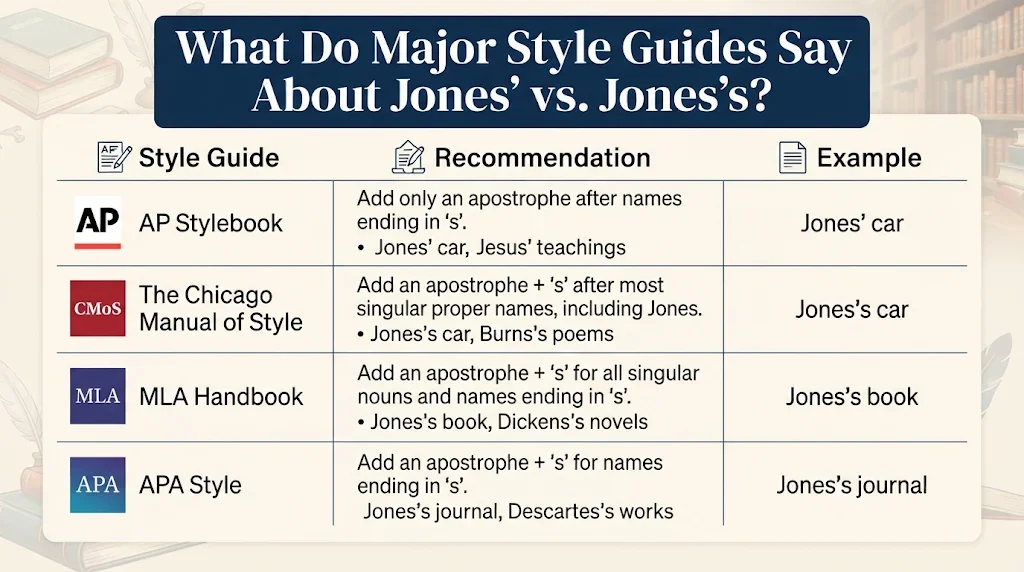
What Do Major Style Guides Say About Jones’ vs. Jones’s?
Style guides help writers maintain consistent punctuation across articles, books, academic papers, and professional documents. However, they don’t all recommend the same possessive form.
If you’re writing for a particular publication or institution, its preferred style should guide your decision.
The Chicago Manual of Style
The Chicago Manual of Style generally recommends adding apostrophe + s to singular proper names ending in s.
Therefore, Chicago style prefers Jones’s rather than Jones’.
Examples include:
- Jones’s house needs renovation.
- James’s book became popular.
- Charles’s business recently expanded.
- Harris’s appointment surprised everyone.
This approach follows the general singular possessive rule. It also makes the possessive construction consistent across many different names.
For writers following Chicago style, adding the extra s is the standard choice.
Associated Press (AP) Style
The Associated Press Stylebook generally uses only an apostrophe after singular proper names ending in s.
Therefore, AP style prefers Jones’.
Examples include:
- Jones’ home is near the station.
- James’ interview attracted attention.
- Charles’ company opened another office.
- Harris’ statement appeared in the newspaper.
This convention is especially relevant to journalists, news editors, and writers producing content for AP-style publications.
If your editor requires AP style, use Jones’ rather than Jones’s.
MLA Style
The MLA Handbook follows the general possessive approach of adding ‘s to singular proper nouns, including names ending in s.
Therefore, Jones’s is the appropriate form under the standard MLA possessive rule.
Examples:
- Jones’s argument supports the main point.
- James’s research provides useful evidence.
- Charles’s essay discusses the subject.
Students writing literature papers, research assignments, and other academic documents should apply the required MLA conventions consistently.
APA Style
The Publication Manual of the American Psychological Association also uses the singular possessive construction with ‘s, including for proper names ending in s.
Therefore, APA-style writing uses Jones’s.
Examples:
- Jones’s research examines workplace behavior.
- James’s findings support the hypothesis.
- Charles’s article discusses communication patterns.
This distinction is useful when preparing research papers, academic reports, and professional documents.
Which Style Should You Follow?
The right choice depends on where your writing will appear.
Use this practical guide:
| Writing situation | Recommended form |
| Chicago-style books and manuscripts | Jones’s |
| AP-style journalism | Jones’ |
| MLA academic writing | Jones’s |
| APA academic writing | Jones’s |
| General writing without a required style | Either accepted form |
| Publication with a house style | Follow its editorial rules |
Practical tip: Don’t switch between Jones’ and Jones’s halfway through an article. Pick one convention and apply it consistently.
How to Make Jones Possessive in Different Sentences
Possessive surnames appear in everyday conversations, academic assignments, business documents, and news articles. The punctuation rule stays the same, even when the writing situation changes.
Let’s examine how both forms work in different contexts.
Jones’s in Everyday Writing
In everyday writing, Jones’s can describe someone’s belongings, relationships, home, or personal achievements.
Examples:
- Jones’s phone is ringing in the kitchen.
- We visited Jones’s house last weekend.
- Jones’s brother works at the hospital.
- I accidentally took Jones’s umbrella.
- Jones’s dog enjoys playing in the garden.
These sentences show possession or a personal relationship.
You can use the same construction in text messages, personal letters, invitations, and informal stories.
Jones’s in Academic Writing
Academic writing often requires consistent grammar and punctuation. If your assignment follows Chicago, MLA, or APA conventions, Jones’s is generally the appropriate form.
Examples:
- Jones’s research explores the effects of education.
- The professor discussed Jones’s findings.
- Jones’s argument supports the central hypothesis.
- The article examines Jones’s contribution to the field.
In academic work, consistency matters because readers expect carefully edited language.
Always check your institution’s required style guide before submitting an assignment.
Jones’ in Journalism and Professional Writing
Journalists working under AP style generally use Jones’.
The same form can appear in business publications, news reports, and editorial content that follows an apostrophe-only house style.
Examples:
- Jones’ company announced a new partnership.
- The report examined Jones’ financial decisions.
- Jones’ statement appeared during the press conference.
- The committee reviewed Jones’ proposal.
However, not every newspaper or business publication follows AP style. Some organizations maintain their own editorial standards.
Jones’ and Jones’s Before Different Nouns
Another common question concerns the noun that follows the possessive surname.
Does the choice change when the following noun is singular, plural, or abstract?
No. The possessive construction depends on the name and the chosen style convention.
1.Before singular nouns:
- Jones’s car is expensive.
- Jones’ car is expensive.
- Jones’s office is closed.
- Jones’ office is closed.
2.Before plural nouns:
- Jones’s children attend the same school.
- Jones’ children attend the same school.
- Jones’s employees received bonuses.
- Jones’ employees received bonuses.
3.Before abstract nouns:
- Jones’s decision surprised everyone.
- Jones’ decision surprised everyone.
- Jones’s experience helped the team.
- Jones’ experience helped the team.
The noun following the possessive doesn’t determine whether you add another s. Your chosen style convention does.
Jones’ vs. Jones’s vs. Joneses: Understanding the Difference
Here’s where many writers get confused. Jones’, Jones’s, and Joneses look similar, but they don’t perform identical grammatical jobs.
The most important distinction is between singular possession and plural surnames.
What Does Joneses Mean?
Joneses is the regular plural form of the surname Jones.
Use it when referring to two or more people who share that last name.
Examples:
- The Joneses invited us to dinner.
- The Joneses live across the street.
- We met the Joneses at the wedding.
- The Joneses recently moved to California.
- Several Joneses attended the family reunion.
Notice that Joneses doesn’t contain an apostrophe.
That’s because you’re simply making the surname plural. You’re not showing ownership.
A common expression, “keeping up with the Joneses,” also uses this plural form. It refers to comparing your lifestyle, possessions, or social position with those of other people.
What Does Joneses’ Mean?
Joneses’ is the plural possessive form of Joneses.
Use it when something belongs to multiple people named Jones.
For example:
- The Joneses’ house has a beautiful garden.
- We attended the Joneses’ anniversary celebration.
- The Joneses’ children play soccer together.
- The Joneses’ car is parked outside.
- Everyone admired the Joneses’ new property.
The apostrophe appears after the final s because the plural surname already ends in s.
This follows the standard rule for plural possessive nouns ending in s.
What Does Jones’s Mean?
Jones’s indicates possession by one person named Jones.
For example:
- Mr. Jones’s office is upstairs.
- Jones’s bicycle needs repair.
- Jones’s daughter studies medicine.
The additional s follows the apostrophe because this convention adds ‘s to singular proper names.
What Does Jones’ Mean?
Jones’ can also indicate possession by one person named Jones.
For example:
- Mr. Jones’ office is upstairs.
- Jones’ bicycle needs repair.
- Jones’ daughter studies medicine.
This form follows the convention that adds only an apostrophe to singular proper names ending in s.
Comparison Table: Jones’ vs. Jones’s vs. Joneses vs. Joneses’
| Word | Grammatical form | Meaning | Example |
| Jones | Singular noun | One person | Mr. Jones arrived. |
| Jones’ | Singular possessive | Belonging to one Jones | Jones’ car |
| Jones’s | Singular possessive | Belonging to one Jones | Jones’s car |
| Joneses | Plural noun | Multiple people named Jones | The Joneses arrived. |
| Joneses’ | Plural possessive | Belonging to multiple Joneses | The Joneses’ car |
Remember that Jones’ and Jones’s express the same singular possessive relationship. However, Joneses and Joneses’ have different grammatical functions.
Common Mistakes to Avoid
Even experienced writers sometimes make mistakes with surnames ending in s. Most problems happen when people confuse plural forms, singular possession, and punctuation conventions.
Here are the mistakes worth avoiding.
Adding an Apostrophe Without Understanding Possession
An apostrophe doesn’t automatically belong after every surname ending in s.
If you’re simply referring to someone named Jones, don’t add an apostrophe.
Incorrect: I spoke with Jones’ yesterday.
Correct: I spoke with Jones yesterday.
The first sentence incorrectly uses a possessive form without a noun or another appropriate possessive construction.
However, the possessive forms work in sentences such as these:
- I borrowed Jones’s laptop.
- I borrowed Jones’ laptop.
Confusing Jones’ With Joneses
These forms don’t mean the same thing.
Jones’ indicates singular possession under the apostrophe-only convention. Joneses indicates multiple people with the surname Jones.
Compare:
- Jones’ house is large. (One person’s house.)
- The Joneses live nearby. (Multiple people.)
- The Joneses’ house is large. (A house belonging to multiple people.)
Adding or removing a single letter can change the grammatical meaning.
Writing Joneses’s
A common error is writing Joneses’s when trying to show plural possession.
That’s incorrect in standard usage.
The regular plural form is Joneses. Because it already ends in s, you add only an apostrophe to make it possessive.
Incorrect: The Joneses’s garden looks beautiful.
Correct: The Joneses’ garden looks beautiful.
The same rule applies to other regular plural nouns ending in s:
- The teachers’ lounge
- The students’ books
- The players’ uniforms
- The Joneses’ property
Switching Between Jones’ and Jones’s
Imagine reading an article that uses Jones’s in one paragraph and Jones’ in the next without a clear editorial reason.
That inconsistency can distract readers.
Although both forms are accepted, switching between them makes the writing look poorly edited.
Choose the convention that matches your style guide. Then apply it throughout the article.
Forgetting the Apostrophe in Plural Possessives
Another mistake involves writing Joneses without an apostrophe when showing ownership.
Compare these sentences:
- The Joneses bought a new house.
- The Joneses’ new house looks beautiful.
The first sentence identifies a family. The second identifies something belonging to that family.
That tiny apostrophe makes a meaningful grammatical difference.
How to Pronounce
One interesting detail about these possessive forms is that their written differences don’t normally change their pronunciation.
Both Jones’ and Jones’s are generally pronounced the same way as the surname Jones.
The additional written s in Jones’s doesn’t usually create another syllable. The possessive ending follows the existing pronunciation of the name.
For example:
- Jones: One syllable.
- Jones’: One syllable.
- Jones’s: One syllable.
You don’t need to pronounce an extra syllable when reading Jones’s aloud.
This is useful when proofreading because you might hear no difference between the two forms. The distinction appears in writing rather than ordinary speech.
Practical Examples in Sentences
Examples make grammar rules easier to understand. The following sentences show how each form works in everyday situations.
Examples Using Jones’s
Here are ten examples using the apostrophe + s convention:
- Jones’s new car is parked outside.
- I borrowed Jones’s laptop yesterday.
- Jones’s house needs a fresh coat of paint.
- Everyone praised Jones’s presentation.
- The teacher reviewed Jones’s assignment.
- Jones’s parents attended the graduation ceremony.
- We discussed Jones’s business proposal during the meeting.
- Jones’s garden looks beautiful in spring.
- The manager appreciated Jones’s contribution.
- Jones’s favorite restaurant serves excellent food.
Each example shows possession or a relationship involving one person named Jones.
Examples Using Jones’
Here are ten examples using the apostrophe-only convention:
- Jones’ new car is parked outside.
- I borrowed Jones’ laptop yesterday.
- Jones’ house needs a fresh coat of paint.
- Everyone praised Jones’ presentation.
- The teacher reviewed Jones’ assignment.
- Jones’ parents attended the graduation ceremony.
- We discussed Jones’ business proposal during the meeting.
- Jones’ garden looks beautiful in spring.
- The manager appreciated Jones’ contribution.
- Jones’ favorite restaurant serves excellent food.
These sentences have the same meanings as the previous examples. Only the punctuation changes.
Examples Using Joneses and Joneses’
The following examples demonstrate plural and plural possessive usage:
- The Joneses invited us to dinner.
- The Joneses’ garden looks beautiful.
- We visited the Joneses last weekend.
- The Joneses’ children attend the same school.
- The Joneses’ decision surprised everyone.
- Several Joneses participated in the event.
- The Joneses’ new home has a spacious kitchen.
- Our neighbors, the Joneses, adopted a puppy.
- The Joneses’ anniversary celebration was wonderful.
- Two Joneses work in the same department.
These examples highlight an important distinction: Joneses identifies multiple people, while Joneses’ shows ownership.
A Practical Case Study: Editing a Family Announcement
Imagine you’re preparing a family announcement about a person named Robert Jones.
Your original draft reads:
“Robert Jones’ daughter graduated last week. Jones’s family organized a celebration at their home.”
Both possessive forms are grammatically acceptable individually. However, the draft switches between two conventions.
If you’re following Chicago style, revise it as follows:
“Robert Jones’s daughter graduated last week. Jones’s family organized a celebration at their home.”
If you’re following AP style, use:
“Robert Jones’ daughter graduated last week. Jones’ family organized a celebration at their home.”
The sentences communicate the same information. The difference is editorial consistency.
The lesson: Good grammar isn’t just about choosing an accepted form. It’s also about applying your chosen convention throughout the document.
Quick Tips
If you still find the distinction confusing, these practical tips can help.
- Choose Jones’s when following Chicago, MLA, or APA conventions.
- Choose Jones’ when following AP style.
- Check your assignment requirements before writing academic papers.
- Use Joneses when referring to multiple people with the surname Jones.
- Use Joneses’ when showing possession by multiple people named Jones.
- Avoid Joneses’s because it incorrectly adds another possessive ending.
- Stay consistent throughout your article, essay, report, or email.
- Don’t add an apostrophe when using Jones as an ordinary singular surname.
A helpful way to remember the distinction is to identify the number of people first.
One Jones means Jones. Multiple Joneses means Joneses. After that, determine whether you’re showing possession and apply the appropriate punctuation.
Read More: Bosses vs. Boss’s vs. Boss’? The Correct Possessive Explained
FAQs
1. Is Jones’ or Jones’s correct?
Both Jones’ and Jones’s are grammatically accepted possessive forms of the singular name Jones. The choice depends on the writing style you follow. Many modern style guides prefer Jones’s, while some traditional styles use Jones’.
2. Should I use Jones’s or Jones’ in formal writing?
For formal writing, follow your preferred style guide. The Chicago Manual of Style generally recommends Jones’s, while AP style typically prefers Jones’. Consistency matters more than choosing one universally accepted form.
3. Is Jones’s grammatically correct?
Yes, Jones’s is grammatically correct. It follows the standard rule of adding apostrophe S to a singular noun to show possession, even when the name already ends in S.
4. Is Jones’ ever correct?
Yes, Jones’ is also correct in certain writing conventions. Some style guides omit the additional S when a singular proper name ends in S. This form is common in journalistic and traditional writing.
5. What is the possessive form of Jesus?
Both Jesus’s and Jesus’ appear in established English writing. Many general grammar conventions support Jesus’s, while some religious publications and traditional styles prefer Jesus’.
6. What is the difference between Jones’ and Jones’s?
The main difference is their spelling and style preference, not their meaning. Both forms indicate ownership or association with someone named Jones. For example, Jones’s car and Jones’ car express the same relationship.
7. Do all names ending in S need an apostrophe?
When forming the singular possessive of a name ending in S, you generally add apostrophe S. However, some style guides recommend using only an apostrophe. Always check the relevant style rules.
8. Is Jones’ plural or possessive?
Jones’ can represent the possessive form of the singular name Jones under certain style conventions. It can also represent the possessive form of the plural surname Joneses when the final E and S are written before the apostrophe. Context determines its meaning.
9. Should I use Jones’s in academic writing?
Jones’s is generally a suitable choice for academic writing, particularly when following Chicago-style conventions. However, some academic institutions require other style guides, such as APA or MLA. Check your institution’s requirements before choosing.
10. How can I remember the possessive rule for names ending in S?
A simple way is to remember the general rule: add apostrophe S to a singular name to show possession. For example, Jones’s book and James’s office follow this pattern. If your style guide recommends an apostrophe alone, use that convention consistently.
Conclusion
Choosing between Jones’ and Jones’s doesn’t have to be confusing. Both forms are accepted possessive variations, but different grammar rules and style guides determine which one you should use. The general rule for singular proper nouns supports Jones’s, while certain traditional and journalistic conventions prefer Jones’. The same distinction applies to names such as Jesus. Understanding these differences helps you use apostrophes, possessive nouns, and proper names correctly.
Ultimately, the best approach is to choose one recognized writing convention and follow it consistently. Whether you’re preparing academic assignments, professional reports, business documents, or everyday messages, correct apostrophe placement improves readability and clarity. Remember that good grammar isn’t just about following rules; it’s also about communicating your ideas clearly. Once you understand the difference, you’ll feel more confident using possessive forms in your writing.

For Shafiq ur Rehman, writing is an art form and grammar is the toolbox that makes it beautiful. As a dedicated content writer at Grammar Lantern, Shafiq approaches every topic like an architect carefully laying down strong foundations of understanding before adding the finer details. He loves diving into the trickiest grammar points and resurfacing with simple, bite-sized takeaways that anyone can grasp. When he’s not crafting articles, you’ll likely find him strategizing over a game of chess, exploring dusty local bookshops, or quietly jotting down poetic observations in his notebook.