Have you ever wondered whether woman’s, women’s, or womens’ is correct? When discussing Womans or Woman’s or Womens’, the answer depends on whether you’re talking about one woman or several women. Although woman changes to women in its plural form, both words follow simple possessive rules.
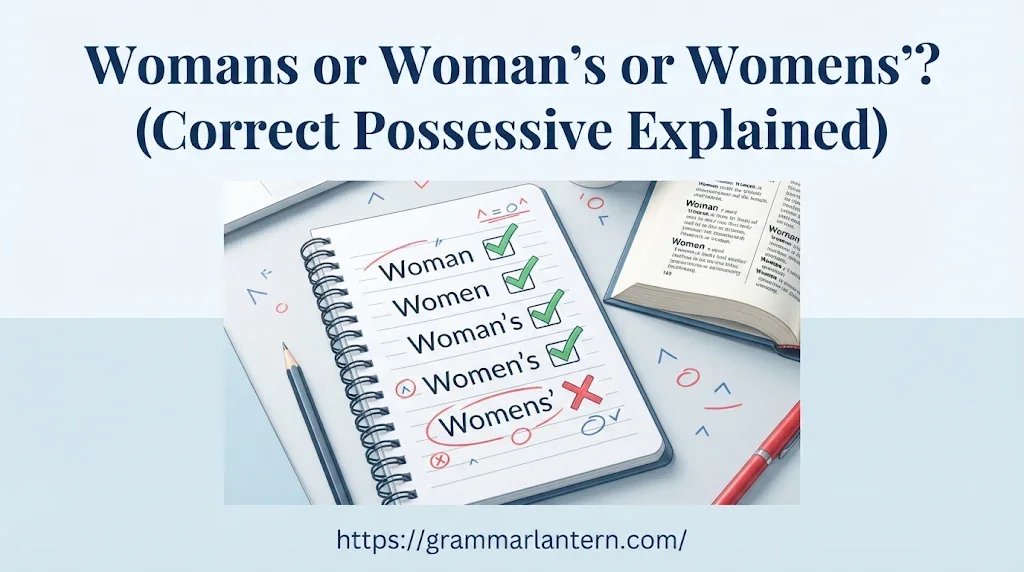
The correct singular possessive is woman’s, while the correct plural possessive is women’s. Both forms use an apostrophe followed by S because neither word ends in S. For example, you write woman’s bag when something belongs to one woman and women’s clothing when something belongs to several women. In contrast, regular plurals like students’ place the apostrophe after S.
Remember, womans, womens, and womens’ are incorrect forms. You can use either the curly apostrophe in women’s or the straight apostrophe in women’s. Both spellings are correct. Paying attention to apostrophe placement makes your writing clearer and helps you avoid common grammar mistakes.
Quick Answer
The correct spelling depends on the meaning you want to express. Here’s a quick comparison:
| Word | Correct or Incorrect? | Meaning |
| Woman | Correct | One adult female person |
| Women | Correct | More than one woman |
| Woman’s | Correct | Something belonging to or associated with one woman |
| Women’s | Correct | Something belonging to or associated with multiple women |
| Womans | Incorrect in standard English | Not the standard plural or possessive form |
| Womens’ | Incorrect in standard English | Incorrect apostrophe placement |
Remember these simple rules:
- Woman’s: Use it when something belongs to or relates to one woman.
- Women’s: Use it when something belongs to or relates to multiple women.
- Woman: Use it when referring to one person without showing possession.
- Women: Use it when referring to two or more women without showing possession.
- Womans: Avoid this spelling in standard English.
- Womens’: Avoid this spelling because the apostrophe is misplaced.
For example:
- The woman’s handbag is on the table.
- The women’s meeting starts at noon.
- The woman works at a hospital.
- The women work at a hospital.
The key is to identify whether you’re discussing one woman or several women before adding an apostrophe.
What Does Woman’s Mean?
Woman’s is the singular possessive form of the noun woman. It indicates that something belongs to, relates to, or is associated with one woman.
To form this possessive, add an apostrophe followed by the letter s to the singular noun.
Woman + ’s = Woman’s
For example, if one woman owns a handbag, you can describe it as the woman’s handbag. The apostrophe shows the relationship between the woman and the handbag.
However, possession doesn’t always mean physical ownership. The word can also describe personal experiences, responsibilities, opinions, relationships, and characteristics.
Examples of Woman’s in Sentences
Here are several examples showing how to use woman’s correctly:
- A woman’s handbag was left beside the reception desk.
- The woman’s decision surprised everyone in the meeting.
- Every woman’s experience deserves consideration.
- The woman’s voice sounded confident during the presentation.
- Her woman’s intuition helped her notice something unusual.
- The woman’s responsibilities increased after her promotion.
Notice that each example refers to one woman.
Read More: Ceil vs. Seal vs. Seel: Meaning, Differences, and Examples
Woman’s Can Express More Than Ownership
Although possessive nouns often indicate ownership, they can communicate other relationships too.
Consider these examples:
- A woman’s health: Health concerns or healthcare related to one woman.
- A woman’s perspective: A viewpoint expressed by one woman.
- A woman’s career: The professional life of one woman.
- A woman’s experience: Something one woman has experienced.
The apostrophe doesn’t necessarily mean someone legally owns something. It simply connects the noun to another person, idea, or concept.
What Does Womans Mean?
Womans is generally an incorrect spelling in standard English. Writers sometimes use it because they assume the plural of woman follows the regular rule of adding s.
However, English doesn’t form the plural of every noun this way.
The correct plural of woman is women, not womans. Similarly, the correct singular possessive is woman’s, not womans.
Why Is Womans Incorrect?
The confusion usually comes from applying a familiar spelling rule to an irregular noun.
For most regular singular nouns, adding s creates the plural:
- Book → Books
- Chair → Chairs
- Student → Students
- Teacher → Teachers
However, woman follows an irregular plural pattern:
- Woman → Women
- Man → Men
Therefore, writing womans as the plural form ignores the established spelling of this noun.
Incorrect and Correct Examples
| Incorrect Sentence | Correct Sentence |
| The womans bag is missing. | The woman’s bag is missing. |
| Several womans attended the event. | Several women attended the event. |
| I admire that womans confidence. | I admire that woman’s confidence. |
| The womans were waiting outside. | The women were waiting outside. |
Important: Don’t confuse an incorrect plural with a missing apostrophe. Sometimes the intended word is woman’s, while other times the writer actually needs women.
The surrounding sentence determines the correction.
What Does Womens’ Mean?
Womens’ is an incorrect spelling when used as the standard plural possessive form of woman.
The mistake happens because writers often place apostrophes after the final s whenever they want to show plural possession.
That rule works for regular plural nouns ending in s, but women doesn’t end in *s as a written word. Therefore, it follows a different possessive pattern.
Why Is Womens’ Incorrect?
The correct plural of woman is women. To make this irregular plural noun possessive, add an apostrophe followed by s.
The correct formation is:
Women + ’s = Women’s
Not:
Womens + ’ = Womens’
For example:
- Incorrect: Womens’ clothing is available here.
- Correct: Women’s clothing is available here.
- Incorrect: Womens’ opinions matter.
- Correct: Women’s opinions matter.
- Incorrect: Womens’ organization hosted the event.
- Correct: Women’s organization hosted the event.
The important point is that you must start with the correct plural noun before adding the possessive ending.
What Does Women’s Mean?
Women’s is the plural possessive form of woman. It indicates that something belongs to, concerns, or relates to two or more women.
The word women is already plural. To make it possessive, you add ’s at the end.
Women + ’s = Women’s
For example, women’s clothing refers to clothing designed for or associated with women. Similarly, women’s education refers to education involving or intended for women.
This form appears frequently in everyday English, journalism, academic writing, advertisements, and professional communication.
Examples of Women’s in Sentences
Here are some practical examples:
- Women’s clothing is available in several sizes.
- The organization supports women’s education in rural communities.
- Women’s rights deserve protection under the law.
- The university hosted a women’s leadership conference.
- The store introduced a new women’s footwear collection.
- The hospital provides specialized women’s healthcare services.
- The committee discussed women’s participation in the workplace.
Each example connects an idea, activity, or service with multiple women.
Does Women’s Always Show Ownership?
No. The possessive form can express several relationships beyond direct ownership.
For instance:
| Expression | Meaning |
| Women’s rights | Rights relating to women |
| Women’s health | Health concerns affecting women |
| Women’s clothing | Clothing designed for or associated with women |
| Women’s history | History involving women’s experiences and contributions |
| Women’s leadership | Leadership by or involving women |
| Women’s education | Education for or involving women |
In these expressions, the apostrophe indicates a relationship rather than necessarily showing physical ownership.
Key Differences
Understanding these four forms makes the entire topic much easier. Although their spellings look similar, each serves a different grammatical purpose.
The biggest difference involves number and possession. Woman and women identify people, while woman’s and women’s indicate possession or association.
Comparison Table of Woman and Women Forms
| Word | Grammatical Form | Number | Example |
| Woman | Singular noun | One | The woman is reading. |
| Women | Plural noun | More than one | The women are reading. |
| Woman’s | Singular possessive | One | The woman’s book is new. |
| Women’s | Plural possessive | More than one | The women’s books are new. |
Let’s examine how these forms work in actual sentences.
Woman: The woman works at a local school.
This sentence identifies one person without indicating possession.
Women: The women work at a local school.
Here, the noun refers to multiple people.
Woman’s: The woman’s office is on the second floor.
The apostrophe indicates that the office belongs to or is associated with one woman.
Women’s: The women’s office is on the second floor.
This sentence connects the office with multiple women.
Why Do Woman and Women Have Different Spellings?
English has several irregular plural nouns that change their internal spelling instead of simply adding s.
Woman becomes women, just as man becomes men. The change also affects pronunciation.
- Woman: commonly pronounced WUHM-uhn.
- Women: commonly pronounced WIH-min.
These words have different vowel sounds even though their spellings look closely related.
That distinction matters in speaking as well as writing. Knowing the correct spelling helps you recognize the correct form when reading sentences.
Why Is the Plural of Woman Women Instead of Womans?
English contains both regular and irregular plural nouns. Regular nouns usually form their plurals by adding s or es, while irregular nouns follow established patterns.
Woman belongs to the second group.
Its plural form is women, which has been part of English for centuries. The spelling developed through historical changes in the English language rather than through the modern regular plural rule.
The Historical Connection Between Woman and Women
The words woman and women share a historical relationship with man and men.
In Old English, the word mann referred to a person or human being. The word wīfmann referred to a female person. Over time, changes in pronunciation and spelling helped produce the modern forms woman and women.
The singular and plural forms eventually developed different vowel sounds and spellings.
This history explains why adding an ordinary s doesn’t produce the accepted plural form.
Other Examples of Irregular Plural Nouns
Here are several common English nouns that change their spelling when they become plural:
| Singular | Plural |
| Man | Men |
| Woman | Women |
| Child | Children |
| Foot | Feet |
| Tooth | Teeth |
| Mouse | Mice |
| Goose | Geese |
| Person | People |
These examples demonstrate why you shouldn’t assume that every English noun forms its plural by adding s.
A useful rule: Learn irregular plural forms individually because their spelling patterns aren’t always predictable.
Apostrophe Rules
Apostrophes play an important role in possessive nouns. They help readers understand who owns something or which person or group an idea relates to.
However, apostrophe placement changes depending on whether a noun is singular, regular plural, or irregular plural.
The Singular Possessive Rule
For most singular nouns, add ’s to form the possessive.
Examples include:
- Girl → Girl’s
- Teacher → Teacher’s
- Student → Student’s
- Mother → Mother’s
- Woman → Woman’s
For example:
- The teacher’s desk is near the window.
- The student’s assignment needs revision.
- The woman’s jacket is hanging by the door.
Because woman is singular, you add ’s to form its possessive.
The Irregular Plural Possessive Rule
Irregular plural nouns that don’t end in s generally form their possessive by adding ’s.
Examples include:
- Man → Men’s
- Woman → Women’s
- Child → Children’s
- Person → People’s
- Mouse → Mice’s
Consider these sentences:
- The men’s changing room is downstairs.
- The women’s conference begins tomorrow.
- The children’s playground needs repairs.
- The people’s concerns deserve attention.
Notice that the apostrophe appears before the final s.
What About Regular Plural Possessives?
Regular plural nouns that already end in s generally take an apostrophe after the final letter.
For example:
- Girls → Girls’
- Teachers → Teachers’
- Students → Students’
- Workers → Workers’
Compare these forms:
| Singular | Plural | Singular Possessive | Plural Possessive |
| Girl | Girls | Girl’s | Girls’ |
| Teacher | Teachers | Teacher’s | Teachers’ |
| Woman | Women | Woman’s | Women’s |
| Man | Men | Man’s | Men’s |
| Child | Children | Child’s | Children’s |
This comparison explains why women’s is correct rather than womens’.
Apostrophes Are Not Used to Form Ordinary Plurals
One common writing mistake is adding an apostrophe simply because a noun is plural.
Remember that apostrophes generally indicate possession or missing letters in contractions. They don’t normally make ordinary nouns plural.
For example:
- Incorrect: The woman’s attended the seminar.
- Correct: The women attended the seminar.
- Incorrect: Several girl’s joined the team.
- Correct: Several girls joined the team.
However, woman’s is correct when the sentence indicates possession.
Woman’s vs. Women’s: When Should You Use Each?
Choosing between woman’s and women’s becomes simple once you identify the number of people involved.
Use woman’s when you’re discussing one woman. Use women’s when you’re discussing multiple women.
The difference may seem small, but using the wrong form can change the meaning of a sentence.
Use Woman’s When Referring to One Woman
Choose woman’s when the noun refers to a single person.
Examples:
- A woman’s career can take many different paths.
- The woman’s passport was found at the airport.
- Her woman’s intuition helped her recognize the problem.
- The woman’s responsibilities include managing the department.
In each sentence, the possessive relationship involves one woman.
Use Women’s When Referring to Multiple Women
Choose women’s when the noun refers to more than one woman.
Examples:
- Women’s careers deserve equal opportunities.
- The women’s passports were checked at the airport.
- Women’s experiences can differ across cultures.
- The organization promotes women’s professional development.
Here, the possessive relationship involves a group rather than one individual.
Woman’s vs. Women’s: Practical Comparison
| Woman’s | Women’s |
| A woman’s handbag | Women’s handbags |
| A woman’s opinion | Women’s opinions |
| A woman’s career | Women’s careers |
| A woman’s health | Women’s health |
| A woman’s experience | Women’s experiences |
| A woman’s responsibility | Women’s responsibilities |
Some expressions, such as women’s health, remain plural possessive even when they describe a broad subject rather than physical ownership.
A Real-Life Writing Example
Imagine you’re writing a sentence about a professional development program.
If the program supports one particular woman, you might write:
“The organization funded a woman’s professional training.”
However, if the program supports several women, write:
“The organization funded women’s professional training.”
The change from woman’s to women’s tells readers whether the program concerns one individual or a group.
Common Mistakes
Even experienced writers sometimes confuse these forms. The unusual plural spelling makes apostrophe placement especially easy to get wrong.
Fortunately, a few simple corrections can prevent most mistakes.
Writing Womans Instead of Woman’s
This mistake usually happens when someone forgets the apostrophe in a singular possessive construction.
- Incorrect: The womans car is outside.
- Correct: The woman’s car is outside.
The corrected version identifies one woman as the person associated with the car.
Writing Womens’ Instead of Women’s
This error comes from applying the regular plural possessive rule to an irregular plural noun.
- Incorrect: Womens’ clothing is expensive.
- Correct: Women’s clothing is expensive.
Remember that women doesn’t end in s, so its possessive form takes ’s.
Confusing Woman With Women
The singular and plural forms have different meanings.
- Incorrect: Two woman attended the workshop.
- Correct: Two women attended the workshop.
The number of people determines whether you need woman or women.
Adding Apostrophes to Ordinary Plurals
Apostrophes aren’t necessary when you’re simply referring to multiple women.
- Incorrect: The woman’s are waiting.
- Correct: The women are waiting.
The sentence describes a group without showing ownership.
Using Woman’s for Multiple Women
When the subject involves several women, the singular possessive form doesn’t communicate the intended meaning.
- Incorrect: The woman’s achievements were celebrated at the event.
- Correct: The women’s achievements were celebrated at the event.
The second sentence clearly connects the achievements with multiple women.
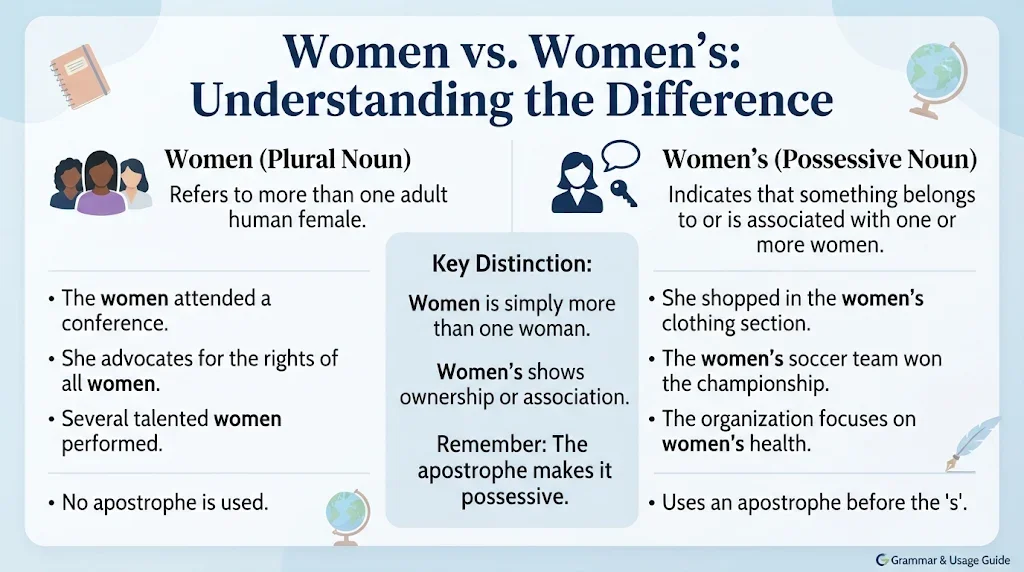
Women vs. Women’s: Understanding the Difference
Although women and women’s look almost identical, they perform different grammatical functions.
Women is a plural noun. Women’s is its possessive form.
The apostrophe and additional s make a grammatical difference.
When to Use Women
Use women when referring to multiple people without indicating possession.
Examples:
- Women work in many different industries.
- The women attended a professional conference.
- Several women participated in the research project.
- Women deserve equal opportunities in education.
None of these sentences requires an apostrophe because the noun doesn’t express possession.
When to Use Women’s
Use women’s when expressing ownership, association, or a relationship involving multiple women.
Examples:
- Women’s education remains an important topic.
- The women’s team won the championship.
- Women’s experiences shaped the discussion.
- The university introduced a women’s scholarship program.
Compare Women and Women’s in Context
Consider these two sentences:
Women deserve better healthcare services.
Here, women functions as the subject of the sentence.
Women’s healthcare services need continued improvement.
Here, women’s describes the type of healthcare services being discussed.
The apostrophe changes the grammatical relationship between the words.
In Everyday Writing
These possessive forms appear in many types of written communication. You’ll encounter them in academic papers, workplace documents, newspapers, product descriptions, and everyday conversations.
Using the correct form makes your writing clearer and more professional.
In Academic and Educational Writing
Academic writing frequently discusses women’s experiences, education, achievements, and contributions.
Examples include:
- Women’s participation in higher education.
- A woman’s role in community development.
- Women’s contributions to scientific research.
- A woman’s experience during the study.
Choose the form that accurately reflects whether you’re discussing an individual or a group.
In Business and Professional Communication
Businesses often use possessive expressions when describing products, services, or professional programs.
Examples include:
- Women’s leadership training.
- Women’s professional development.
- A woman’s business proposal.
- Women’s workplace experiences.
Correct apostrophe placement matters in reports, presentations, product descriptions, and marketing materials.
In Headlines and Advertisements
Headlines often use short possessive phrases to communicate their subject quickly.
For example:
- Women’s Fashion Trends for the New Season.
- A Woman’s Guide to Professional Success.
- Women’s Health: Important Topics to Understand.
- A Woman’s Journey Through Entrepreneurship.
These expressions follow the same grammatical rules as ordinary sentences.
In Organizations and Event Names
Many organizations and events use women’s to identify their audience or purpose.
Examples include:
- Women’s Leadership Conference.
- Women’s History Month.
- Women’s Basketball Tournament.
- Women’s Support Network.
These expressions refer to activities, programs, or subjects associated with women as a group.
Simple Tricks to Remember
If you frequently confuse these spellings, a few memory tricks can help.
You don’t need to memorize complicated grammatical explanations every time you write. Just follow these simple reminders.
Remember the Singular and Plural Forms
Start by learning the basic relationship:
- One person = Woman.
- Multiple people = Women.
- One person’s possession = Woman’s.
- Multiple people’s possession = Women’s.
Once you know the number, choosing the possessive form becomes easier.
Use the Man and Men Comparison
The words man and men follow the same pattern.
| Singular | Plural | Singular Possessive | Plural Possessive |
| Man | Men | Man’s | Men’s |
| Woman | Women | Woman’s | Women’s |
For example:
- The man’s wallet is missing.
- The men’s wallets are missing.
- The woman’s wallet is missing.
- The women’s wallets are missing.
If you remember men’s, remembering women’s becomes much easier.
Apply the Apostrophe Test
Ask yourself one question:
Does the plural noun already end in the letter s?
- If yes, a regular plural possessive generally takes an apostrophe after the s.
- If no, an irregular plural possessive generally takes ’s.
Since women doesn’t end in s, the correct possessive form is women’s.
Keep This Simple Memory Trick in Mind
One woman owns something: woman’s. Multiple women share or relate to something: women’s.
This short reminder can help you avoid the most common spelling mistakes.
Practice Exercises
Practice is one of the easiest ways to understand possessive nouns. The following exercises test whether you can distinguish singular nouns, plural nouns, and possessive forms.
Choose the correct word for each sentence.
Fill in the Blanks
- The ________ handbag was lying on the chair. (woman’s / women’s)
- The ________ team won the final match. (woman’s / women’s)
- Several ________ attended the conference. (woman / women)
- The ________ decision changed the company’s direction. (woman’s / women’s)
- The organization supports ________ education. (woman’s / women’s)
- One ________ applied for the position. (woman / women)
- The ________ opinions were included in the report. (woman’s / women’s)
- The ________ office is on the first floor. (woman’s / women’s)
Correct the Spelling Mistakes
Rewrite these sentences using the correct spelling.
- The womans purse was missing.
- Womens’ rights are important.
- Two woman joined the organization.
- The womens’ meeting starts tomorrow.
- Several womans attended the workshop.
Answer Key With Explanations
| Question | Correct Answer | Explanation |
| 1 | Woman’s | One woman owns the handbag. |
| 2 | Women’s | The team is associated with multiple women. |
| 3 | Women | The sentence refers to multiple people. |
| 4 | Woman’s | The decision relates to one woman. |
| 5 | Women’s | The education concerns multiple women. |
| 6 | Woman | The sentence refers to one person without possession. |
| 7 | Women’s | The opinions belong to or relate to multiple women. |
| 8 | Woman’s or Women’s | The correct choice depends on whether one woman or several women are associated with the office. |
Corrected sentences:
- The woman’s purse was missing.
- Women’s rights are important.
- Two women joined the organization.
- The women’s meeting starts tomorrow.
- Several women attended the workshop.
The final example in the answer key highlights an important point: grammar sometimes depends on context. Without knowing who uses or owns the office, either possessive form could be appropriate.
Read More: Bosses vs. Boss’s vs. Boss’? The Correct Possessive Explained
FAQs
1. Is it woman’s or womans?
Woman’s is correct when showing possession by one woman. Womans is incorrect because the possessive form requires an apostrophe and an S.
2. Is women’s or womens’ correct?
Women’s is the correct plural possessive form. Womens’ is incorrect because the word women doesn’t end in S.
3. What is the plural of woman?
The plural of woman is women. It is an irregular plural, so you don’t form it by simply adding S.
4. What is the singular possessive form of woman?
The singular possessive form is woman’s. For example, “The woman’s handbag is beautiful.”
5. What is the plural possessive form of women?
The plural possessive form is women’s. For example, “The women’s team won the competition.”
6. Why does women’s have an apostrophe before S?
Women is already a plural noun, but it doesn’t end in S. Therefore, you add apostrophe and S to make it possessive.
7. Is women’s with a curly apostrophe correct?
Yes. Women’s and women’s are both correct. The only difference is the apostrophe style.
8. When should I use women’s instead of woman’s?
Use woman’s when something belongs to one woman. Use women’s when something belongs to multiple women.
9. Is womens a real English word?
No. Womens is not the standard English plural of woman. The correct plural is women.
10. What is the difference between women’s and ladies’?
Both can show plural possession, but they use different apostrophe rules. Women’s takes apostrophe and S because women doesn’t end in S. Ladies’ takes an apostrophe after S because ladies already ends in S.
Conclusion
Choosing between woman’s, women’s, and womens’ becomes simple once you understand the difference between singular and plural possession. Remember that woman’s refers to something belonging to one woman, while women’s refers to something belonging to multiple women.
The easiest way to avoid mistakes is to check whether the noun already ends in S before placing the apostrophe. Keep this simple rule in mind, and you’ll have much more confidence when using these forms in everyday writing, emails, and professional communication.

Muhammad Haroon is the voice behind many of the clear, practical grammar guides you’ll find on Grammar Lantern. With a strong background in content writing and a genuine love for the English language, Haroon specializes in breaking down intimidating grammar topics into simple, digestible lessons. His goal is simple: to empower readers to write with confidence and clarity. Whether he’s explaining tricky tenses or demystifying punctuation, Haroon approaches each topic with patience, precision, and a touch of warmth—because he knows that learning grammar is a journey, not a race.