Have you ever stopped while writing and wondered whether to use witnesses, witness’s, or witness’? These three forms look similar, but each follows different grammar rules. Understanding their differences helps you express plurality and possession correctly. Whether you’re writing a legal document, preparing a report, or communicating professionally, choosing the right form makes your message clearer and more accurate.
The word witnesses is the plural form of witness, while witness’s shows singular possession. Meanwhile, witness’ is an alternative possessive form accepted by some writing styles. Although these apostrophe forms can seem confusing, learning when to use each one makes English grammar much easier. A few simple examples can help you recognize the correct form without second-guessing yourself.
In this guide, you’ll learn the essential plural rules, possessive forms, and apostrophe usage behind these words. We’ll explore common grammar mistakes, practical examples, and differences in formal writing. Whether you’re handling business communication, preparing meeting records, updating calendars, managing projects, or creating digital content, you’ll discover how to use each form with greater clarity, consistency, and confidence.
Quick Answer
The correct choice depends on whether you’re talking about one witness, multiple witnesses, or ownership.
- Witnesses: The regular plural of witness. Use it when referring to two or more people who see an event or provide information about something.
- Witness’s: The standard singular possessive form. Use it when something belongs to or relates to one witness.
- Witness’: An alternative singular possessive form accepted by certain style guides. Some writers use it instead of witness’s.
- Witnesses’: The plural possessive form. Use it when something belongs to or relates to multiple witnesses.
Here’s a quick comparison:
| Word | Grammatical function | Meaning | Example |
| Witness | Singular noun | One person who sees an event | The witness arrived. |
| Witnesses | Plural noun | More than one witness | The witnesses arrived. |
| Witness’s | Singular possessive | Something belonging to one witness | The witness’s statement was clear. |
| Witness’ | Alternative singular possessive | Something belonging to one witness | The witness’ statement was clear. |
| Witnesses’ | Plural possessive | Something belonging to multiple witnesses | The witnesses’ statements differed. |
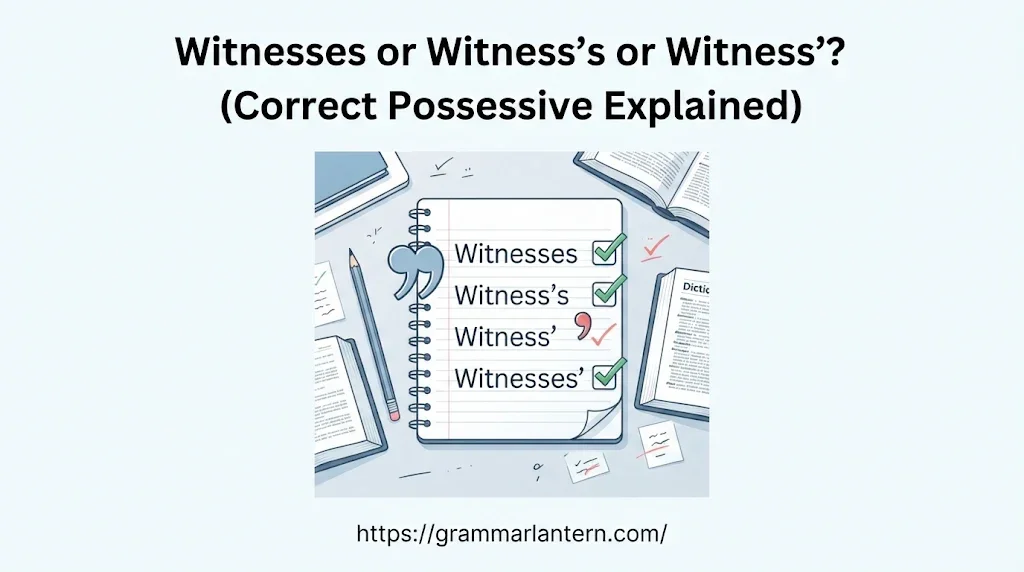
The easiest rule to remember: Use witnesses for the plural, witness’s for standard singular possession, and witnesses’ for plural possession.
What Does Witnesses Mean?
The word witnesses has two main grammatical uses. It can function as a plural noun or as a third-person singular verb. Understanding the sentence helps you identify which meaning applies.
Witnesses as the Plural Form of Witness
A witness is someone who sees an event, observes something happening, or provides information about an incident. When you refer to more than one such person, you use witnesses.
The word ends in -ss, so English spelling rules require -es to form its regular plural.
For example:
- One witness reported the accident.
- Two witnesses reported the accident.
- Several witnesses attended the court hearing.
- The police interviewed five witnesses.
Notice that the plural form doesn’t require an apostrophe. Adding an apostrophe would incorrectly turn a regular plural into a possessive construction.
Important: Witnesses means multiple people. It doesn’t automatically indicate ownership.
Witnesses as a Third-Person Singular Verb
The word witnesses can also describe an action. As a verb, it means seeing, observing, or experiencing something.
In this case, the word describes what one person does.
Consider these examples:
- She witnesses the ceremony every year.
- He witnesses the signing of the agreement.
- The journalist witnesses the demonstration firsthand.
- Maria witnesses the exchange between the two drivers.
In each sentence, witnesses describes an action performed by one person.
Compare these two sentences:
- The witnesses describe what happened.
- She witnesses what happened.
The first sentence uses witnesses as a plural noun. The second uses it as a verb.
Examples of Witnesses in Sentences
Here are additional examples showing how the plural noun works naturally:
- The witnesses provided detailed accounts of the incident.
- Several witnesses arrived before the trial began.
- Police officers questioned the witnesses separately.
- Three witnesses confirmed the driver’s identity.
- The investigation revealed that two witnesses had left the scene.
You can use witnesses whenever you’re referring to multiple people without expressing possession.
What Does Witness’s Mean?
Witness’s is the standard singular possessive form of witness. It indicates that something belongs to, concerns, or is associated with one person.
To form this possessive, keep the original word and add an apostrophe followed by another s.
Witness + ’s = Witness’s
This rule applies even though witness already ends in the letter s.
Witness’s as the Singular Possessive Form
English generally forms singular possessives by adding ’s to the noun.
For example:
- The teacher’s desk.
- The student’s notebook.
- The doctor’s appointment.
- The witness’s testimony.
The same rule applies to singular nouns ending in s, including witness.
For instance, imagine a courtroom with one person providing evidence. You want to refer specifically to that person’s statement.
You would write:
The witness’s statement helped investigators understand what happened.
The apostrophe followed by s shows that the statement belongs to or comes from one witness.
When Should You Use Witness’s?
Use witness’s when you’re discussing something connected to one particular witness.
Common examples include:
- Witness’s statement: A statement provided by one witness.
- Witness’s testimony: Testimony given by one witness.
- Witness’s signature: The signature of one witness.
- Witness’s account: One person’s description of an event.
- Witness’s identity: The identity of one person who witnessed something.
- Witness’s permission: Permission given by one witness.
Here are some complete sentences:
- The witness’s testimony helped establish the timeline.
- The lawyer reviewed the witness’s written statement.
- The witness’s signature appeared at the bottom of the document.
- Investigators questioned the witness’s account of the accident.
- The witness’s identity remained confidential during the investigation.
Each example refers to one witness.
Read More: 12 Best Replies to “Nice Meeting You” in Email Business Context
Is Witness’s Always Correct?
Witness’s is the standard singular possessive form in American English. However, some style guides allow writers to add only an apostrophe after singular nouns ending in s.
This alternative produces witness’.
Both forms can express singular possession, but you shouldn’t switch between them randomly. Follow your chosen style guide and maintain consistency throughout your document.
What Does Witness’ Mean?
Witness’ is an alternative singular possessive form. It indicates that something belongs to or relates to one witness.
Unlike witness’s, this version places the apostrophe after the existing final s without adding another one.
For example:
- The witness’ testimony was convincing.
- The witness’ statement contained important details.
- The lawyer examined the witness’ account.
These sentences communicate the same possessive meaning as their witness’s alternatives.
Witness’ as an Alternative Singular Possessive
Some writers prefer to avoid adding another s to singular nouns that already end in that letter.
Under this convention, they form the possessive by adding only an apostrophe.
For example:
| Singular noun | Alternative possessive |
| Witness | Witness’ |
| James | James’ |
| Charles | Charles’ |
| Lucas | Lucas’ |
However, this isn’t a universal rule. Many American English style guides prefer adding ’s to singular nouns ending in s.
Therefore, witness’s is generally the safer choice when you’re unsure which convention to follow.
When Should You Use Witness’?
Use witness’ when your publication, organization, or assigned writing style specifically follows the convention of adding only an apostrophe to singular nouns ending in s.
You might encounter this spelling in certain newspapers, publications, or documents that follow a particular editorial style.
For example:
- The witness’ statement contradicted the earlier report.
- The attorney questioned the witness’ credibility.
- The witness’ account provided additional evidence.
Remember that witness’ doesn’t mean multiple witnesses. It still expresses singular possession.
Is Witness’ Grammatically Correct?
Yes. Witness’ is an accepted alternative singular possessive spelling under certain style conventions.
However, acceptance depends on the writing standard you’re following.
The Chicago Manual of Style generally favors witness’s for singular possessives. Other editorial conventions may prefer an apostrophe alone in certain cases.
For ordinary American English writing, witness’s is the clearest default.
Key Differences
The biggest difference between these spellings involves number and possession.
- Witnesses indicates more than one person.
- Witness’s indicates possession by one person.
- Witness’ indicates the same singular possession under an alternative convention.
Apostrophes aren’t decorative punctuation. Their placement communicates grammatical relationships.
Consider these examples:
Witnesses: The witnesses arrived before the hearing.
This sentence refers to multiple people. Nobody necessarily owns anything.
Witness’s: The witness’s statement was recorded.
This sentence refers to a statement associated with one witness.
Witness’: The witness’ statement was recorded.
This sentence expresses the same singular possessive meaning using an alternative style.
Witnesses’: The witnesses’ statements were recorded.
This sentence refers to statements belonging to multiple witnesses.
Comparison Table: All Four Forms
| Form | Singular or plural? | Possessive? | Correct example |
| Witness | Singular | No | The witness spoke. |
| Witnesses | Plural | No | The witnesses spoke. |
| Witness’s | Singular | Yes | The witness’s account was detailed. |
| Witness’ | Singular | Yes | The witness’ account was detailed. |
| Witnesses’ | Plural | Yes | The witnesses’ accounts were detailed. |
The most important distinction is between witnesses and witnesses’. The first indicates plurality, while the second indicates plural possession.
How to Make Witness Possessive
Making witness possessive becomes simple once you identify whether the noun is singular or plural.
Let’s break down each construction.
Singular Possessive: Witness’s
When one witness owns or is associated with something, add ’s.
The construction looks like this:
Witness + ’s = Witness’s
Examples:
- The witness’s testimony was recorded.
- The witness’s phone contained useful evidence.
- The witness’s account matched the security footage.
- The witness’s address appeared on the official form.
Each sentence describes something associated with one witness.
Alternative Singular Possessive: Witness’
Some style conventions allow you to form the singular possessive by adding only an apostrophe.
The construction looks like this:
Witness + ’ = Witness’
Examples:
- The witness’ testimony was recorded.
- The witness’ phone contained useful evidence.
- The witness’ account matched the security footage.
Although this form is accepted under certain conventions, witness’s remains the standard American English preference.
Plural Possessive: Witnesses’
Now consider a situation involving multiple witnesses.
First, make the noun plural by adding -es. Then place an apostrophe after the final s.
Witness + es + ’ = Witnesses’
Examples:
- The witnesses’ statements supported the investigation.
- The witnesses’ names appeared on the report.
- The witnesses’ accounts provided different perspectives.
- The witnesses’ signatures were required on the document.
The apostrophe comes after the s because the plural noun already ends in that letter.
Witnesses vs. Witnesses’
This distinction causes plenty of confusion.
However, one simple question can help: Are you describing multiple people or something belonging to them?
Compare:
The witnesses arrived at the courthouse.
Here, witnesses simply means multiple people.
The witnesses’ statements were submitted to the court.
Here, witnesses’ indicates that the statements belong to or come from multiple witnesses.
The apostrophe changes the grammatical relationship.
Common Mistakes
Even experienced writers sometimes misuse apostrophes. Most errors happen when people confuse plural nouns with possessive nouns.
Here are the mistakes worth avoiding.
Using an Apostrophe to Form a Regular Plural
Apostrophes don’t normally create regular English plurals.
Incorrect: Three witness’s attended the hearing.
Correct: Three witnesses attended the hearing.
The sentence describes three people. It doesn’t express ownership, so no apostrophe belongs in the word.
Confusing Singular and Plural Possession
The number of owners determines where the apostrophe belongs.
Incorrect: The witnesses’s statements were different.
Correct: The witnesses’ statements were different.
The plural noun witnesses already ends in s. Add only an apostrophe to indicate plural possession.
Forgetting the Apostrophe in Possessive Constructions
A missing apostrophe can change the meaning of a sentence.
Compare:
- The witnesses statements were reviewed.
- The witnesses’ statements were reviewed.
The second sentence correctly identifies the statements as belonging to or coming from multiple witnesses.
Switching Between Possessive Styles
Using witness’s in one paragraph and witness’ in another can make your writing inconsistent.
Both forms can express singular possession. However, choose one convention and follow it throughout your document.
This matters particularly in academic writing, journalism, legal reports, and professional publications.
Misplacing Apostrophes in Legal and Professional Writing
Legal and professional documents often distinguish between individual and shared responsibilities.
For example:
- The witness’s signature was missing.
- The witnesses’ signatures were missing.
The first sentence refers to one person’s signature. The second refers to multiple people’s signatures.
A small punctuation difference can affect how readers interpret a document.
How to Choose the Correct Form of Witness
You don’t need to memorize complicated grammar explanations every time you write this word.
Instead, identify the meaning you want to communicate.
Use Witnesses When Referring to Multiple People
Choose witnesses when you’re talking about two or more people who observe an event or provide information.
Examples:
- The witnesses attended the trial.
- Several witnesses described the accident.
- Police interviewed the witnesses.
Quick test: Can you replace the word with “more than one witness”? If yes, witnesses is probably correct.
Use Witness’s for Singular Possession
Choose witness’s when one witness owns or is associated with something.
Examples:
- The witness’s testimony was important.
- The witness’s statement contained new information.
- The witness’s identification helped investigators.
Quick test: Are you talking about something belonging to one witness? Use witness’s in standard American English.
Use Witness’ When Following a Specific Style Guide
Choose witness’ when your required style guide prefers the apostrophe-only convention for singular nouns ending in s.
Examples:
- The witness’ statement was accurate.
- The witness’ testimony was valuable.
If you aren’t following a specific alternative convention, choose witness’s.
Use Witnesses’ for Plural Possession
Choose witnesses’ when something belongs to or is associated with multiple witnesses.
Examples:
- The witnesses’ statements were reviewed.
- The witnesses’ names appeared in the report.
- The witnesses’ accounts supported the investigation.
Quick test: Are multiple witnesses associated with the same item or several items? Use witnesses’.
Witness’s vs. Witnesses’: Singular vs. Plural Possessive
The difference between witness’s and witnesses’ is especially important because both forms express possession.
However, they identify different numbers of owners.
Witness’s refers to one witness.
Witnesses’ refers to two or more witnesses.
Consider these examples:
| Singular possession | Plural possession |
| One witness’s statement | Two witnesses’ statements |
| One witness’s account | Several witnesses’ accounts |
| One witness’s signature | Multiple witnesses’ signatures |
| One witness’s identity | Several witnesses’ identities |
| One witness’s experience | Multiple witnesses’ experiences |
One Witness’s Statement vs. Multiple Witnesses’ Statements
Imagine an investigation involving three people who saw the same accident.
If you’re discussing one person’s account, write:
The witness’s statement described the speeding vehicle.
If you’re discussing all three accounts, write:
The witnesses’ statements described the speeding vehicle.
The first sentence identifies one witness as the source of the statement. The second identifies multiple witnesses as the sources of their respective statements.
Shared Possession vs. Individual Possession
Plural possessives can also describe shared ownership.
For example:
The witnesses’ shared observation helped investigators reconstruct the incident.
Here, multiple witnesses contributed to one collective observation.
Now consider:
The witnesses’ individual statements contained different details.
Here, each witness provided a separate statement.
The apostrophe placement stays the same because multiple witnesses remain the owners or sources.
Witnesses in Different Contexts
Understanding these forms becomes easier when you see how writers use them in real situations.
The word witnesses appears frequently in legal, academic, everyday, and professional communication.
Witnesses in Legal Writing
Legal documents require precise language because readers must understand who provided evidence and which person a statement concerns.
For example:
- The witness’s testimony was entered into the court record.
- The witnesses’ statements were examined by the attorneys.
- Several witnesses attended the hearing.
- The witness’ account was included in the report.
The choice between singular and plural possession helps identify the source of evidence.
For legal documents, follow the applicable court, jurisdiction, or institutional style requirements.
Witnesses in Academic Writing
Researchers and students often discuss witnesses when examining historical events, interviews, observations, and documented experiences.
Examples:
- The witnesses’ accounts offered different perspectives on the historical event.
- The witness’s recollection supported the research findings.
- Several witnesses described similar circumstances.
- The researchers compared the witnesses’ statements.
In academic writing, consistency matters. If your institution requires a particular style guide, follow its possessive rules.
Witnesses in Everyday Communication
You don’t need to work in a courtroom to use these words correctly.
They appear in ordinary conversations about accidents, celebrations, public events, and personal experiences.
Examples:
- Two witnesses saw the car turn suddenly.
- The witness’s description helped locate the missing bag.
- The witnesses’ observations matched the security footage.
- Several witnesses confirmed what happened.
These sentences demonstrate how the same grammatical rules apply outside formal writing.
Witnesses in Business and Professional Communication
Businesses sometimes need witnesses for agreements, incident reports, workplace investigations, and official records.
Examples:
- The witness’s signature confirmed their presence.
- The witnesses’ statements were attached to the incident report.
- The company interviewed several witnesses.
- The witness’s account helped clarify the disagreement.
Correct apostrophe placement makes these documents easier to understand and helps avoid confusion about individual responsibilities.
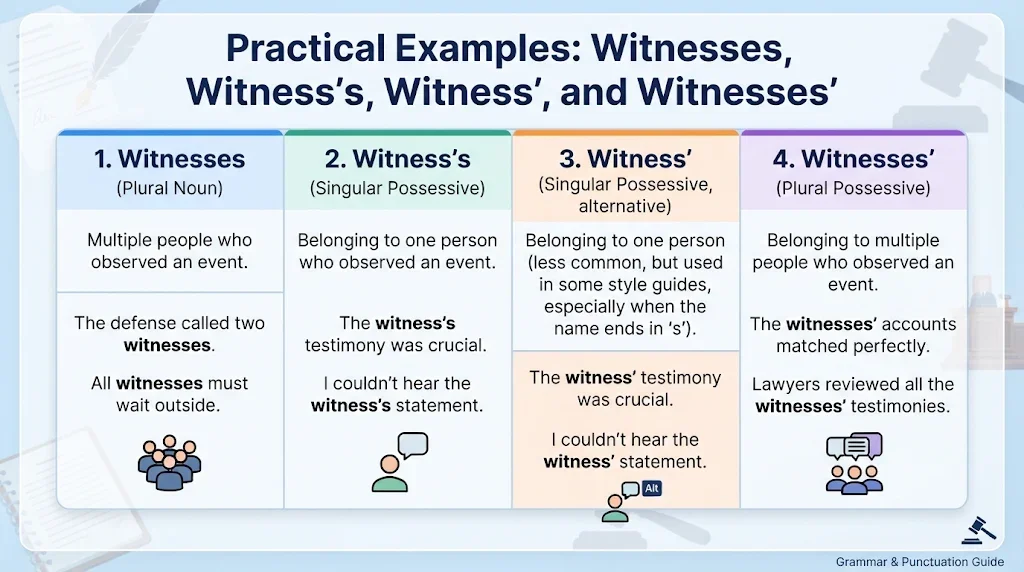
Practical Examples: Witnesses, Witness’s, Witness’, and Witnesses’
Let’s bring the rules together with additional examples.
Examples of Witnesses
Use this form when referring to multiple people or as a third-person singular verb.
- The witnesses arrived shortly before the hearing.
- Several witnesses provided additional information.
- Investigators interviewed four witnesses.
- The witnesses described the incident differently.
- She witnesses the ceremony every year.
Examples of Witness’s
Use this form for standard singular possession.
- The witness’s statement helped solve the case.
- The witness’s testimony supported the claim.
- The witness’s signature appeared on the agreement.
- The witness’s memory of the incident was clear.
- The witness’s account contradicted the initial report.
Examples of Witness’
Use this alternative singular possessive when following a style guide that permits it.
- The witness’ statement helped solve the case.
- The witness’ testimony supported the claim.
- The witness’ signature appeared on the agreement.
- The witness’ account contradicted the initial report.
Examples of Witnesses’
Use this form for plural possession.
- The witnesses’ statements were included in the investigation.
- The witnesses’ signatures appeared on the documents.
- The witnesses’ accounts provided additional evidence.
- The witnesses’ identities were protected.
- The witnesses’ observations helped establish the timeline.
Incorrect vs. Correct Examples
| Incorrect | Correct | Explanation |
| Three witness’s arrived. | Three witnesses arrived. | Regular plural needs no apostrophe. |
| The witnesses’s statements were reviewed. | The witnesses’ statements were reviewed. | Plural possessive takes an apostrophe after s. |
| The witness statement was recorded. | The witness’s statement was recorded. | Add the possessive marker when expressing ownership or association. |
| The witness’es account was clear. | The witness’s account was clear. | Use the correct apostrophe construction. |
| Two witnesses’s names appeared. | Two witnesses’ names appeared. | Multiple witnesses require plural possession. |
A Practical Case Study: Understanding Apostrophe Placement
Imagine a car accident involving three people who saw the collision.
An investigator collects statements from each person.
Now consider how the wording changes depending on the intended meaning.
Situation One: Describing the people
Three witnesses arrived at the police station.
The word witnesses simply identifies multiple people.
Situation Two: Describing one person’s statement
One witness’s statement included the vehicle’s registration number.
The possessive form indicates that the statement came from one witness.
Situation Three: Describing all three statements
The witnesses’ statements included different descriptions of the collision.
The plural possessive indicates that multiple witnesses provided the statements.
Situation Four: Following an alternative style
The witness’ statement included the vehicle’s registration number.
This construction expresses the same singular possession as Situation Two but follows an alternative style convention.
The lesson is simple: Identify the number of witnesses first. Then decide whether you’re expressing possession.
Read More: Jones’ or Jones’s? Here’s the Correct Possessive Form
FAQs
1. Is it witnesses or witness’s?
Both forms are correct, but they have different meanings. Witnesses is the plural form of witness, referring to two or more people. Witness’s shows possession by one witness. For example, “The witnesses arrived early” describes multiple people, while “The witness’s statement was recorded” shows ownership.
2. Is witness’ grammatically correct?
Yes, witness’ is an accepted possessive form in some style guides. However, witness’s is more common in modern American English. Both forms indicate that something belongs to one witness. Always follow your chosen style guide to maintain consistency.
3. What is the plural form of witness?
The correct plural form is witnesses. You add -es because the singular word ends in -ss. For example, “Three witnesses attended the hearing.” Remember that the plural form does not require an apostrophe.
4. What is the difference between witnesses and witness’s?
Witnesses refers to multiple people, while witness’s indicates something belonging to one person. For example, “The witnesses signed the document” refers to several individuals. In contrast, “The witness’s signature was missing” describes the signature of one individual.
5. Should I write witnesses’ or witness’s?
Use witnesses’ when showing possession by multiple witnesses. Use witness’s when showing possession by one witness. For example, “The witnesses’ statements were reviewed” refers to statements from several people. “The witness’s statement was reviewed” refers to one person’s statement.
6. Is witnesses’ the plural possessive form?
Yes, witnesses’ is the plural possessive form. First, change witness to its plural form, witnesses. Then add an apostrophe after the final s to show shared or individual possession by multiple witnesses.
7. Does witness’s need an apostrophe before or after the s?
The standard American English form is witness’s, with the apostrophe before the final s. This form shows singular possession. For example, “The witness’s testimony helped explain what happened.” Some style guides also accept witness’.
8. Can I use witness’s in formal writing?
Yes, witness’s is perfectly acceptable in formal writing. You can use it in legal documents, business reports, meeting records, and professional correspondence when showing singular possession. Just make sure your apostrophe usage follows the required style guide.
9. Why is witnesses’ different from witness’?
The difference comes from the number of people involved. Witnesses’ shows possession by multiple witnesses, while witness’ is an alternative way to show possession by one witness. The apostrophe placement helps readers understand whether you’re referring to one person or several.
10. What are the most common mistakes when using witnesses and witness’s?
Common mistakes include using witness’s as a plural form, writing witnesses with an unnecessary apostrophe, and confusing singular and plural possession. Remember these simple distinctions: witnesses means multiple people, witness’s means something belongs to one person, and witnesses’ means something belongs to multiple people.
Conclusion
Understanding the difference between witnesses, witness’s, and witness’ makes your writing more accurate and easier to understand. Remember that witnesses is the plural form, witness’s is the standard American English singular possessive form, and witnesses’ shows plural possession. Although witness’ is accepted by some style guides as a singular possessive alternative, consistency matters most. Once you recognize these basic apostrophe rules, choosing the correct form becomes much easier.
Whether you’re writing legal statements, preparing business documents, recording meeting details, or communicating online, proper grammar and punctuation help you deliver your message clearly. Keep these examples handy whenever you feel uncertain about witness-related terms. A small apostrophe might seem insignificant, but using it correctly can make a big difference in professional and everyday writing.

For Shafiq ur Rehman, writing is an art form and grammar is the toolbox that makes it beautiful. As a dedicated content writer at Grammar Lantern, Shafiq approaches every topic like an architect carefully laying down strong foundations of understanding before adding the finer details. He loves diving into the trickiest grammar points and resurfacing with simple, bite-sized takeaways that anyone can grasp. When he’s not crafting articles, you’ll likely find him strategizing over a game of chess, exploring dusty local bookshops, or quietly jotting down poetic observations in his notebook.