When choosing between Families or Family’s or Families’, the right spelling depends on what you want to express. Are you talking about one family, several families, or something that belongs to them? These three forms look similar, but each has a different purpose. Understanding their differences will help you avoid common grammar mistakes.
Family’s is the singular possessive form of family. You use it when something belongs to or relates to one family. For example, “Our family’s traditions have continued for generations.” The apostrophe and s show ownership or association. It’s a simple rule that makes the correct spelling easy to remember.
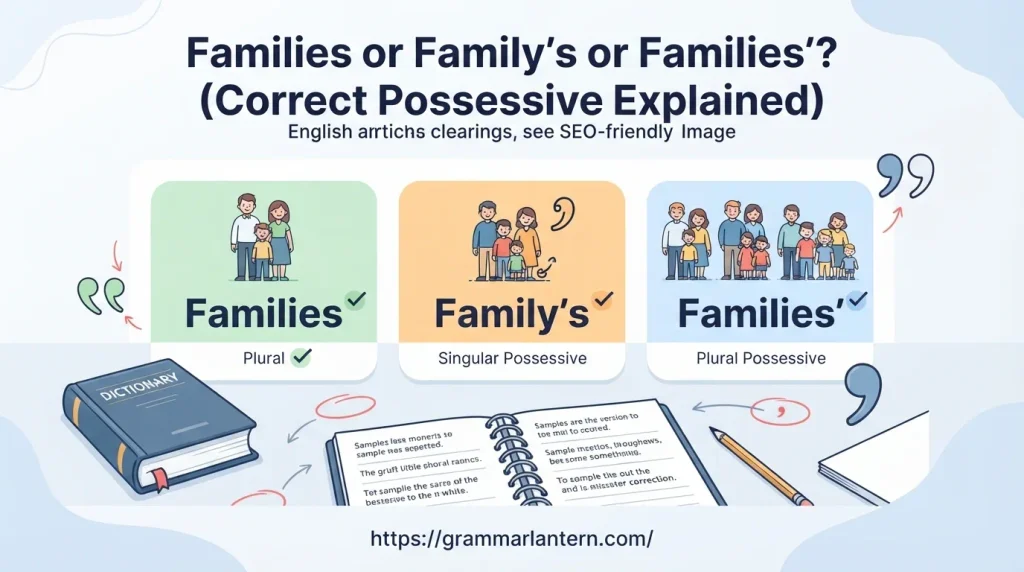
Families’ is the plural possessive form, showing ownership by multiple families. For example, “The neighborhood families’ cars lined the street.” Meanwhile, families is simply the plural form without possession, as in “Many families attended the school event.” Remember to drop the y, add ies, and place the apostrophe after s for plural possession. Avoid familys, which is incorrect.
Quick Answer
All three forms are correct, but you must use them in the right context.
- Families: The plural form of family, referring to two or more families. It doesn’t show ownership.
- Family’s: The singular possessive form showing something belongs to one family. It can also be a contraction of family is or family has.
- Families’: The plural possessive form showing something belongs to multiple families.
| Word | Grammatical form | Meaning | Example |
| Families | Plural noun | Two or more family units | Several families attended the festival. |
| Family’s | Singular possessive or contraction | Belonging to one family; family is/has | The family’s house needs repairs. |
| Families’ | Plural possessive | Belonging to multiple families | The families’ houses need repairs. |
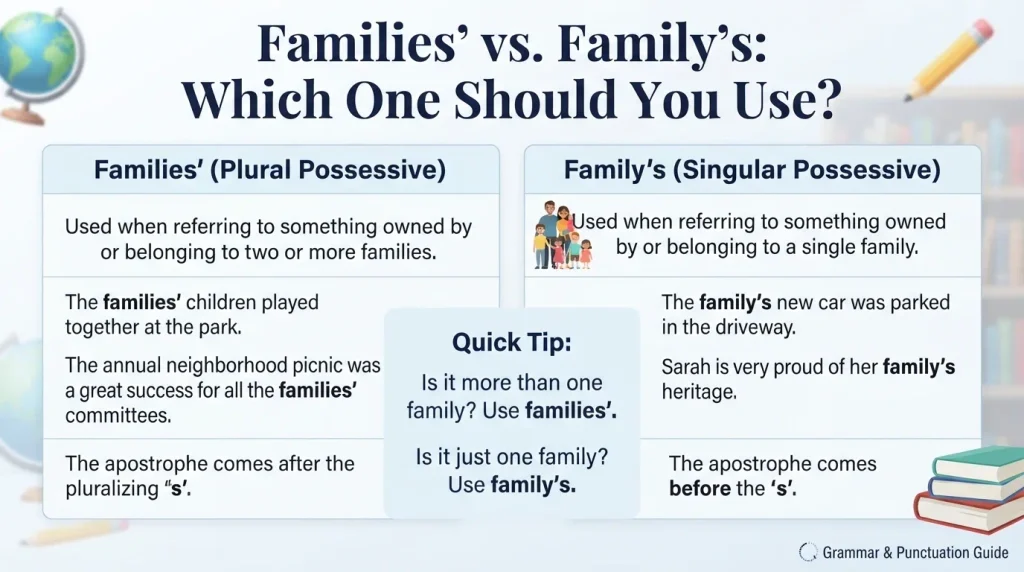
The easiest way to remember the difference is to identify the number of families and whether ownership is involved. If you’re talking about multiple families without showing ownership, use families. For something belonging to one family, use family’s. For ownership by multiple families, use families’.
Families: Meaning, Definition, and Usage
What Does Families Mean?
Families is the plural form of the noun family. It refers to two or more separate family units, households, or groups of related people.
A family may include parents, children, grandparents, siblings, spouses, or other relatives. When you talk about several such groups, you use families.
For example:
- Several families moved into the neighborhood.
- The school organized an event for local families.
- Many families enjoy spending weekends together.
- Families gathered at the community center.
- The charity provides meals to struggling families.
In each example, families refers to multiple groups. The word doesn’t indicate that something belongs to those groups.
When to Use Families Without an Apostrophe
Use families when you want to describe more than one family. You don’t need an apostrophe because you’re forming an ordinary plural noun rather than a possessive.
This rule applies whether you’re discussing family activities, housing, education, celebrations, relationships, or community life.
For example:
- Families need access to affordable healthcare.
- The neighborhood welcomes new families every year.
- Several families participated in the school fundraiser.
- Families often share meals during special occasions.
- The program supports low-income families.
Notice that none of these sentences expresses ownership. The word simply identifies multiple family groups.
Families in Everyday Writing
The plural form appears in countless situations. You might use it when discussing communities, school programs, social services, holiday events, or neighborhood activities.
| Context | Example |
| Education | Families attended the parent-teacher meeting. |
| Community | Families gathered at the park. |
| Housing | Several families rented apartments nearby. |
| Celebrations | Families celebrated the holiday together. |
| Healthcare | Families received information about preventive care. |
| Travel | Families visited the national park during summer. |
Because families is plural, it generally takes plural verbs in American English.
- Families are waiting outside.
- Families have different traditions.
- Families live in many types of homes.
Writing families is or families has usually creates a subject-verb agreement error when the word refers to multiple family units.
Why Families Is Not Possessive
A plural noun doesn’t automatically show ownership. The word families only tells readers that you’re referring to multiple family groups.
Compare these sentences:
- The families attended the meeting.
- The families’ concerns were discussed.
The first sentence simply identifies the people attending. The second shows that the concerns belong to those families.
Adding an apostrophe changes the grammatical relationship between the words. Therefore, don’t add one unless the sentence expresses possession or uses a contraction.
Family’s: Singular Possessive Form Explained
What Does Family’s Mean?
Family’s is the singular possessive form of family. It shows that something belongs to, relates to, or is associated with one family.
To form the singular possessive, add an apostrophe followed by s to the singular noun family.
- Family → Family’s
- The family → The family’s
- Our family → Our family’s
For example, the family’s car means the car belongs to one family. Similarly, the family’s decision refers to a decision made by that family.
The apostrophe helps readers understand the relationship between the family and the thing being described.
Read More: Witnesses or Witness’s or Witness’? Correct Possessive Explained
When to Use Family’s
Use family’s when you’re talking about something belonging to or associated with a single family. The possessed item might be a house, car, pet, tradition, opinion, decision, responsibility, or characteristic.
Here are some common examples:
- The family’s car broke down yesterday.
- Our family’s traditions have changed over time.
- The family’s decision surprised everyone.
- The family’s garden looks beautiful.
- My family’s history includes several generations of teachers.
- The family’s responsibilities increased after the move.
In each sentence, family’s connects one family to something that belongs to it or relates to it.
Examples of Family’s in Sentences
Understanding the singular possessive becomes easier when you see it in different situations.
| Sentence | What Family’s Shows |
| The family’s house is large. | Ownership of a house |
| The family’s dog is friendly. | Ownership of a pet |
| My family’s recipe is delicious. | A recipe associated with one family |
| The family’s decision was final. | A decision made by one family |
| Her family’s history is fascinating. | History associated with her family |
| The family’s vacation begins tomorrow. | A vacation planned by one family |
The apostrophe appears before the s because family is singular. This follows the standard rule for most singular nouns in English.
Family’s as a Contraction
One tricky detail makes family’s more interesting. It can also represent a contraction of family is or family has.
A contraction combines words and replaces omitted letters with an apostrophe. In this case, the apostrophe doesn’t indicate possession. It marks shortened wording.
Family’s Meaning Family Is
When family’s means family is, the sentence usually describes a condition, situation, or action happening now.
Examples:
– The family’s coming over tonight.
(The family is coming over tonight.)
– The family’s excited about the trip.
(The family is excited about the trip.)
– The family’s waiting outside.
(The family is waiting outside.)
These sentences use family’s as a contraction rather than a possessive noun.
Family’s Meaning Family Has
Family’s can also represent family has when has functions as an auxiliary verb.
Examples:
– The family’s lived here for decades.
(The family has lived here for decades.)
– The family’s already finished dinner.
(The family has already finished dinner.)
– The family’s visited several countries.
(The family has visited several countries.)
The contraction is common in casual conversation and informal writing. In formal writing, spelling out family is or family has may provide greater clarity.
How to Identify the Correct Meaning of Family’s
If you’re unsure whether family’s expresses possession or a contraction, try replacing it with family is or family has.
Consider these examples:
| Sentence | Replacement Test | Meaning |
| The family’s house is old. | The family is house is old. | Possessive |
| The family’s arriving soon. | The family is arriving soon. | Contraction |
| The family’s lived here for years. | The family has lived here for years. | Contraction |
| The family’s traditions are important. | The family is traditions are important. | Possessive |
If neither replacement makes sense, family’s probably indicates possession.
This test works well in everyday writing. However, always read the entire sentence because context can affect the meaning.
Families’: Plural Possessive Form Explained
What Does Families’ Mean?
Families’ is the plural possessive form of family. It shows that something belongs to, relates to, or is shared by two or more families.
First, you form the plural families. Then you add an apostrophe after the final s.
- Family → Families → Families’
- One family → Family’s
- Multiple families → Families’
For example, the families’ homes means the homes belonging to multiple families. The apostrophe comes after the s because the noun is already plural.
This small punctuation difference tells readers how many families are involved.
When to Use Families’
Use families’ when you want to show possession or association involving multiple families.
You might use it to describe:
- Homes belonging to multiple families
- Traditions shared by several families
- Opinions expressed by multiple families
- Responsibilities assigned to several families
- Children belonging to different families
- Needs or concerns raised by multiple families
For example, the families’ concerns were addressed during the meeting means several families expressed concerns.
The word doesn’t refer to just one family. It connects something to multiple family units.
Examples of Families’ in Sentences
| Sentence | What Families’ Shows |
| The families’ homes were decorated. | Homes belonging to multiple families |
| The families’ concerns were addressed. | Concerns raised by several families |
| We collected the families’ opinions. | Opinions expressed by multiple families |
| The families’ children attend the same school. | Children belonging to different families |
| The families’ responsibilities increased. | Responsibilities shared or assigned to multiple families |
| The families’ traditions differ significantly. | Traditions associated with several families |
Each sentence shows plural ownership or association. The apostrophe comes after the final s because families already contains the plural ending.
Why the Apostrophe Comes After the S
English generally forms possessives differently depending on whether the noun is singular or plural.
For a singular noun, add apostrophe + s. For a regular plural noun ending in s, add only an apostrophe after the existing s.
| Noun | Plural | Possessive |
| Family | Families | Families’ |
| Student | Students | Students’ |
| Teacher | Teachers | Teachers’ |
| Neighbor | Neighbors | Neighbors’ |
| Employee | Employees | Employees’ |
The rule prevents unnecessary letters from appearing in possessive forms. You don’t write families’s because the plural noun already ends in s.
The correct spelling is families’, not families’s.
Key Differences
Comparison of Meaning and Grammar
These three forms have different grammatical roles. Knowing those roles helps you choose the correct word without guessing.
| Form | Singular or Plural? | Possessive? | Main Use |
| Family | Singular | No | Refers to one family |
| Families | Plural | No | Refers to multiple families |
| Family’s | Singular possessive or contraction | Sometimes | Ownership by one family; family is/has |
| Families’ | Plural possessive | Yes | Ownership by multiple families |
Consider these three sentences:
- Families attended the school event.
- The family’s car was parked outside.
- The families’ cars were parked outside.
The first sentence describes multiple families attending. The second describes a car belonging to one family. The third describes cars belonging to several families.
The meanings become clear when you pay attention to the apostrophe.
Apostrophe Placement Rules
Apostrophe placement follows a straightforward pattern.
Singular Possessive
Add an apostrophe and s to the singular noun.
- Family → Family’s
- Student → Student’s
- Teacher → Teacher’s
Examples:
- The family’s home is nearby.
- The student’s notebook is missing.
- The teacher’s desk is clean.
Regular Plural Possessive
If the plural noun ends in s, add an apostrophe after the final s.
- Families → Families’
- Students → Students’
- Teachers → Teachers’
Examples:
- The families’ homes are nearby.
- The students’ notebooks are missing.
- The teachers’ desks are clean.
Ordinary Plural
When you simply want to make the noun plural, don’t add an apostrophe.
- Family → Families
- Student → Students
- Teacher → Teachers
Examples:
- Families attended the event.
- Students completed their assignments.
- Teachers prepared their lessons.
How to Tell Them Apart Quickly
Use this simple decision process:
- Are you referring to more than one family without showing ownership? Use families.
- Does something belong to one family? Use family’s.
- Does something belong to multiple families? Use families’.
- Does family’s mean family is or family has? Use it as a contraction.
The key is to identify the meaning before choosing the spelling. Apostrophes aren’t decorative marks. They communicate relationships between words.
Family vs. Families: Understanding Singular and Plural Forms
Why Family Changes to Families
The word family ends in a consonant followed by y. English follows a common spelling rule when forming the plural of nouns with this ending.
When a noun ends in a consonant + y, change the y to i and add es.
Family → Families
The same rule applies to several other common words:
| Singular | Plural |
| Family | Families |
| City | Cities |
| Baby | Babies |
| Story | Stories |
| Party | Parties |
| Country | Countries |
However, when a noun ends in a vowel + y, you usually add s without changing the y.
| Singular | Plural |
| Boy | Boys |
| Toy | Toys |
| Day | Days |
| Key | Keys |
| Journey | Journeys |
This distinction explains why families is correct while familys is incorrect in standard English.
Family and Families in Everyday Sentences
The singular and plural forms also affect verb agreement.
When family acts as a singular collective noun in American English, it generally takes a singular verb. When families refers to multiple family units, it takes a plural verb.
| Singular | Plural |
| The family lives nearby. | The families live nearby. |
| The family has two children. | The families have two children. |
| The family is waiting. | The families are waiting. |
| The family enjoys traveling. | The families enjoy traveling. |
American English usually treats a family as one unit when the sentence focuses on the group as a whole. Therefore, the family is and the family has are common standard forms.
The plural families refers to multiple groups. It therefore takes plural verbs such as are, have, and live.
Is Families Singular or Plural?
Families is always plural when used as the ordinary plural noun of family. It refers to more than one family group.
For example:
- The families are waiting outside.
- Families have different needs.
- Several families live in this building.
- The families were invited to dinner.
The word families doesn’t become singular simply because each family contains multiple people. Grammatically, it represents multiple family units.
This distinction matters in subject-verb agreement, pronoun selection, and possessive construction.
How to Form the Possessive of Family Correctly
Singular Family Possessive Rule
To form the singular possessive of family, add apostrophe + s.
Family + ’s = Family’s
Use this form when one family owns or is associated with something.
Examples:
- The family’s name is Williams.
- The family’s property is valuable.
- The family’s business has grown.
- The family’s children attend the same school.
- The family’s experience helped us make a decision.
The singular possessive remains family’s even when the family includes many relatives. The grammatical owner is one family unit.
Plural Families Possessive Rule
To form the plural possessive, start with the plural families and add an apostrophe after the final s.
Families + ’ = Families’
Examples:
- The families’ homes were damaged.
- The families’ children played together.
- The families’ opinions mattered.
- The families’ schedules were different.
- The families’ businesses operated in the same area.
This rule applies to regular plural nouns that already end in s. The apostrophe shows possession without adding another letter.
Why Families’ Does Not Need Another S
One common mistake is writing families’s. This spelling adds an unnecessary s after the apostrophe.
The word families already ends in s. Therefore, you only need an apostrophe to make it possessive.
| Incorrect | Correct |
| Families’s homes | Families’ homes |
| Families’s opinions | Families’ opinions |
| Families’s children | Families’ children |
| Families’s traditions | Families’ traditions |
Remember the pattern: singular possessive gets apostrophe + s, while regular plural possessive gets an apostrophe after the existing s.
In Real-Life Contexts
Family Ownership and Property
Ownership is one of the easiest ways to understand the difference between family’s and families’.
When one family owns a house, use family’s house. When multiple families own separate houses, use families’ houses.
- The family’s house needs a new roof.
- The families’ houses need new roofs.
- Our family’s apartment is on the third floor.
- The families’ apartments are located in the same building.
Notice how the number of owners changes the apostrophe placement. The first example refers to one family. The second refers to several families.
Case study: One owner versus multiple owners
Imagine a neighborhood with one family living in a house. You would write:
The family’s house has a beautiful garden.
Now imagine five families live in five different houses. You would write:
The families’ houses have beautiful gardens.
The apostrophe tells readers whether the property belongs to one family or several. This difference is especially important in housing reports, property descriptions, and community announcements.
Family Traditions and Celebrations
Traditions often involve ownership or association. However, the number of families determines the possessive form.
- Our family’s tradition is to eat dinner together.
- The families’ traditions vary from region to region.
- The family’s holiday celebration begins on Friday.
- The families’ celebrations include music and food.
If you’re discussing one family’s customs, use family’s. If you’re comparing customs belonging to several families, use families’.
For example, a school newsletter might say:
The families’ cultural traditions enriched the annual celebration.
This sentence describes traditions associated with several participating families.
Family Needs and Responsibilities
The same distinction appears when discussing needs, concerns, and responsibilities.
- The family’s needs are important.
- The families’ needs vary by location.
- The family’s responsibilities increased after the move.
- The families’ concerns were discussed during the meeting.
These examples are particularly useful in reports, community programs, social services, education, and healthcare.
If a program serves one household, family’s needs may be appropriate. If it serves several households, families’ needs is generally the correct possessive form.
Family Names and Relationships
Family names can also create confusion because possessive forms may appear in formal documents, invitations, or personal writing.
Examples:
- The family’s last name is Johnson.
- The families’ last names are different.
- Our family’s history goes back several generations.
- The families’ histories were recorded in the archive.
The first and third sentences refer to one family. The second and fourth refer to multiple families.
Be careful when writing family names on invitations or holiday cards. Apostrophes generally indicate possession rather than forming a plural surname.
For example, if you’re greeting a household named Smith, The Smiths is the plural family name. The Smiths’ home indicates possession by the Smith family.
Common Mistakes
Apostrophes are small marks, but they can create big spelling mistakes. The following errors commonly appear in school assignments, emails, signs, and online writing.
Using an Apostrophe to Make Families Plural
Apostrophes don’t usually form ordinary plurals in English.
Incorrect: Two family’s attended the wedding.
Correct: Two families attended the wedding.
The incorrect version suggests singular possession or a contraction rather than multiple families. Since the sentence refers to more than one family, the plural families is correct.
More examples:
- Incorrect: Many family’s moved here.
- Correct: Many families moved here.
- Incorrect: Several family’s joined the program.
- Correct: Several families joined the program.
Confusing Family’s With Families’
These forms differ in the number of families involved.
Incorrect: The families’s cars were parked outside.
Correct: The families’ cars were parked outside.
The incorrect form contains an extra s. The plural families already ends in s, so you only need an apostrophe to indicate possession.
Compare:
- The family’s car is parked outside. (One family)
- The families’ cars are parked outside. (Multiple families)
Writing Familys Instead of Families
The word familys is a common spelling mistake. English changes the y to i and adds es when forming the plural of a noun ending in consonant + y.
Incorrect: Several familys joined the celebration.
Correct: Several families joined the celebration.
Other examples of the same spelling rule include babies, cities, stories, and parties.
Using the Wrong Verb With Families
Plural nouns generally take plural verbs.
Incorrect: The families is waiting.
Correct: The families are waiting.
Incorrect: The families has different traditions.
Correct: The families have different traditions.
This mistake often happens when writers focus on the people inside each family rather than the grammatical number of the word families.
Misunderstanding Family’s as Possessive Every Time
The apostrophe in family’s doesn’t always indicate ownership. Sometimes it represents a contraction.
Compare these sentences:
- The family’s house is beautiful. (Possession)
- The family’s visiting today. (Family is)
- The family’s lived here for ten years. (Family has)
The sentence structure helps you identify the meaning. If family’s appears before a noun such as house, car, or tradition, it’s often possessive. If it appears before a verb or participle, it may be a contraction.
However, don’t rely on that pattern alone. Use the replacement test to confirm the meaning.
Side-by-Side Examples
Sometimes the best way to learn a grammar rule is to compare incorrect and correct sentences. The following examples show how apostrophe placement, spelling, and verb agreement affect meaning.
| Incorrect Sentence | Correct Sentence | Explanation |
| The familys are visiting. | The families are visiting. | Use families for the plural. |
| The family house is beautiful. | The family’s house is beautiful. | Add apostrophe + s to show ownership. |
| The families’s cars are new. | The families’ cars are new. | Place the apostrophe after the plural s. |
| Many family’s attended. | Many families attended. | Don’t use an apostrophe for ordinary plurals. |
| The families is happy. | The families are happy. | Plural subjects take plural verbs. |
| The familys’ traditions are unique. | The families’ traditions are unique. | The correct plural spelling is families. |
| The families’ is arriving. | The families are arriving. | Use a plural verb with families. |
| The family’s are waiting. | The families are waiting. | Use families when referring to multiple family groups. |
More Examples in Context
Families
- Families attended the graduation ceremony.
- Families are welcome at the community event.
- Several families moved to the city.
Family’s
- The family’s business is successful.
- Our family’s favorite destination is the beach.
- The family’s coming home tomorrow.
Families’
- The families’ children attend the same school.
- The families’ homes are located nearby.
- The families’ experiences were shared during the workshop.
Reading these examples aloud can help you notice how each form works. Once you understand the meaning, the spelling becomes easier to remember.
A Simple Trick to Remember the Difference
The One-Family and Multiple-Families Test
Ask yourself how many families the sentence refers to.
- One family: Use family’s when showing possession.
- Multiple families: Use families’ when showing possession.
- Multiple families without ownership: Use families.
For example:
| Meaning | Correct Form | Example |
| One family | Family’s | The family’s garden is beautiful. |
| Multiple families | Families’ | The families’ gardens are beautiful. |
| Multiple families without possession | Families | Families enjoy gardening. |
This simple test works in most everyday writing situations.
The Apostrophe Position Trick
The apostrophe’s position depends on whether the noun is singular or plural.
- Singular owner: Apostrophe before s → family’s
- Plural owner ending in s: Apostrophe after s → families’
- Ordinary plural: No apostrophe → families
Think of the apostrophe as a small ownership marker. Its position helps readers understand who owns something.
The Replacement Test for Family’s
If you’re uncertain about family’s, try replacing it with family is or family has.
| Original Sentence | Replacement | Result |
| The family’s waiting outside. | The family is waiting outside. | Contraction |
| The family’s lived here for years. | The family has lived here for years. | Contraction |
| The family’s car is missing. | The family is car is missing. | Possessive |
| The family’s traditions are important. | The family is traditions are important. | Possessive |
If the replacement works naturally, family’s may be a contraction, If it doesn’t, the word is probably possessive.
Families’ vs. Family’s: Which One Should You Use?
When Family’s Is Correct
Use family’s when one family owns or is associated with something. You can also use it as a contraction for family is or family has.
Examples:
- The family’s house is near the school.
- The family’s decision changed everything.
- The family’s arriving soon.
- The family’s lived here since 2015.
The first two examples show possession. The last two use contractions.
When Families’ Is Correct
Use families’ when something belongs to or relates to multiple families.
Examples:
- The families’ houses are nearby.
- The families’ concerns deserve attention.
- The families’ children play together.
- The families’ experiences were different.
The word families’ doesn’t work as a contraction. It always functions as a plural possessive form in standard English.
Quick Decision Guide
Use these steps whenever you hesitate between families, family’s, and families’.
- Step one: Identify whether the sentence refers to one family or multiple families.
- Step two: Determine whether the sentence expresses ownership or association.
- Step three: If you’re using one family possessively, write family’s.
- Step four: If you’re using multiple families possessively, write families’.
- Step five: If you’re simply referring to multiple families, write families without an apostrophe.
- Step six: If you see family’s, check whether it can mean family is or family has.
These steps will help you avoid most apostrophe mistakes without memorizing complicated grammar terminology.
Read More: Jones’ or Jones’s? Here’s the Correct Possessive Form
FAQs
1. Is Family’s or Families’ correct?
Both family’s and families’ are correct. However, family’s shows possession by one family, while families’ shows possession by multiple families.
2. What is the plural of Family?
The plural of family is families. You replace the ending y with ies to form the plural.
3. What does Family’s mean?
Family’s is the singular possessive form. It shows that something belongs to or relates to one family.
4. What does Families’ mean?
Families’ is the plural possessive form. It indicates that something belongs to or relates to two or more families.
5. Is Familys a correct spelling?
No, familys is incorrect. The correct plural spelling is families, while the possessive forms are family’s and families’.
6. Where does the apostrophe go in Families’?
The apostrophe goes after the final s in families’. This placement indicates possession by multiple families.
7. Should I use Family’s traditions or Families’ traditions?
Use family’s traditions when discussing one family’s traditions. Use families’ traditions when referring to traditions belonging to several families.
8. Is Families’ singular or plural possessive?
Families’ is plural possessive. It refers to ownership or association involving more than one family.
9. How do you make Family possessive?
Add an apostrophe and s to form family’s. For example, “My family’s home is nearby.”
10. How can I remember the difference between Family’s and Families’?
Remember that family’s refers to one family, while families’ refers to multiple families. The apostrophe placement makes the difference easy to recognize.
Conclusion
Understanding the difference between family’s, families, and families’ makes your writing clearer and more accurate. Each form serves a different purpose. Family’s indicates singular possession, families represents the ordinary plural, and families’ expresses plural possession.
The easiest way to remember these spellings is to identify whether you’re discussing one family, several families, or something they own. Pay attention to the apostrophe placement, and you’ll avoid common mistakes. With a little practice, choosing the correct form will become second nature.

For Shafiq ur Rehman, writing is an art form and grammar is the toolbox that makes it beautiful. As a dedicated content writer at Grammar Lantern, Shafiq approaches every topic like an architect carefully laying down strong foundations of understanding before adding the finer details. He loves diving into the trickiest grammar points and resurfacing with simple, bite-sized takeaways that anyone can grasp. When he’s not crafting articles, you’ll likely find him strategizing over a game of chess, exploring dusty local bookshops, or quietly jotting down poetic observations in his notebook.