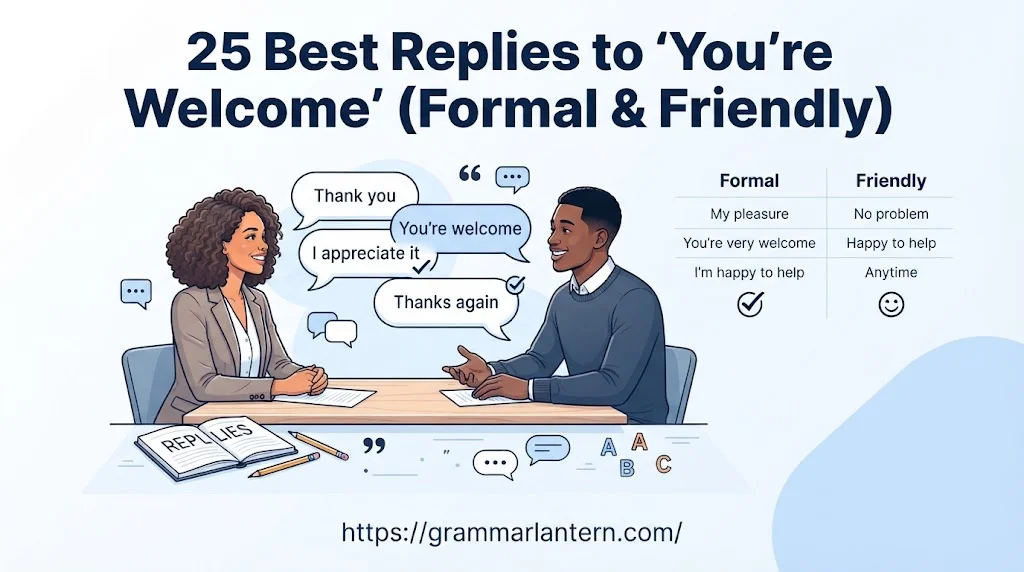
“You’re Welcome” is polite, but repeating the same phrase can sometimes make a conversation feel predictable. In everyday communication, having a few natural alternatives can help you sound more confident and genuine. Whether you’re speaking with a friend, coworker, client, or someone you have just met, the right response can make a small interaction feel warmer.
In my experience, phrases such as “My pleasure” work especially well in professional communication because they sound polished without feeling cold. For a relaxed workplace exchange, “Happy to help” can feel more natural. Even “Of course” is a simple option when you want to keep the conversation friendly and effortless.
The best reply depends on the situation, relationship, and tone. Knowing other ways to say you’re welcome gives you more flexibility when responding after a big favor, small task, or everyday assistance. These alternatives can show kindness, sincerity, and appreciation while helping you avoid the same typical response every time.
Quick Answer
The best reply to “you’re welcome” depends on what you want to communicate.
Here are some of the most useful choices:
| Situation | Natural Reply | Tone |
| Everyday conversation | “Thanks again.” | Friendly |
| Professional setting | “I really appreciate your help.” | Professional |
| A meaningful favor | “That means a lot.” | Sincere |
| Advice or guidance | “I’ll keep that in mind.” | Appreciative |
| Close friend | “I owe you one!” | Casual |
| Helpful coworker | “You’ve been a huge help.” | Warm |
| Important assistance | “I couldn’t have done it without you.” | Grateful |
| Ending a conversation | “Thanks again. Have a great day!” | Polite |
| Future contact | “Thanks! Talk to you soon.” | Friendly |
| Short text exchange | “Appreciate it!” | Casual |
You don’t always need to reply to “you’re welcome.” If the conversation has naturally ended, another thank-you can sometimes make the exchange feel repetitive.
When you do respond, keep your words proportional to the situation. A small favor usually needs a small response. A major act of kindness deserves something more personal.
What Does “You’re Welcome” Mean in Conversation?
“You’re welcome” usually acknowledges someone’s thanks. It tells the other person that their gratitude is accepted and that the speaker was willing to help.
The phrase can sound formal, friendly, warm, or even distant depending on delivery. Consider these two situations:
“You’re welcome. Glad I could help.”
“You’re welcome.”
The words remain almost identical. The emotional effect can differ considerably.
Context matters just as much. A cashier might say “you’re welcome” after helping a customer. A colleague might use it after sending you an important file. A friend might say it after driving across town to help you.
Because the situations differ, your response should change too.
You also don’t need to create an endless gratitude loop:
“Thank you.”
“You’re welcome.”
“Thanks again.”
“Of course.”
At that point, the conversation may have reached its natural stopping point. There’s no prize for keeping the thank-you marathon alive.
25 Best Replies to “You’re Welcome”
“Thanks Again.”
“Thanks again” is one of the safest and most versatile replies.
It works because it acknowledges the person’s response while reinforcing your original gratitude. You can use it with friends, coworkers, neighbors, acquaintances, and service professionals.
Example:
“Thanks again for helping me move that table.”
“You’re welcome.”
“Thanks again. I really appreciate it.”
It feels warm without becoming overly emotional.
“I Appreciate It.”
When you want something slightly more polished, “I appreciate it” works extremely well.
This phrase fits professional and casual conversations. It also sounds more personal than a plain “thanks.”
Example:
“I sent the revised document to your email.”
“You’re welcome.”
“I appreciate it.”
It’s especially useful when someone has done something practical for you.
“I Really Appreciate Your Help.”
This version adds more weight to your gratitude.
Use it when someone has genuinely invested time or effort into helping you. The phrase works particularly well with coworkers, managers, mentors, clients, and friends.
Example:
“I walked you through the reporting system.”
“You’re welcome.”
“I really appreciate your help. It saved me a lot of time.”
The final sentence explains why you’re grateful, which makes the response feel more sincere.
“Of Course.”
“Of course” has a relaxed and friendly quality.
It works particularly well when someone has helped you voluntarily and you want to keep the conversation casual.
Example:
“Thanks for picking me up.”
“You’re welcome.”
“Of course.”
This response doesn’t add much information. That’s actually its strength. Sometimes simple sounds better.
“Absolutely.”
“Absolutely” gives the conversation an upbeat tone.
It’s useful when you want to acknowledge someone’s willingness to help or show that you value their support.
Example:
“Thanks for staying late to help.”
“You’re welcome.”
“Absolutely. I appreciate you being there.”
It’s friendly, confident, and conversational.
“Glad to Hear It.”
This response works best when the surrounding conversation involves reassurance, assistance, or a positive outcome.
However, context matters. It isn’t a universal replacement for “thanks.”
For example:
“Your advice really helped me.”
“You’re welcome.”
“Glad to hear it.”
The response keeps the tone relaxed and positive.
Read More: Investor vs Investee: Meaning, Differences, and Examples
“I’m Glad You Could Help.”
This phrase works when you want to recognize the person’s assistance without sounding overly formal.
It can fit workplace conversations, group projects, and everyday interactions.
Example:
“Thanks for helping me understand the spreadsheet.”
“You’re welcome.”
“I’m glad you could help.”
It focuses on the successful outcome rather than simply repeating your thanks.
“That Means a Lot.”
When someone’s help mattered emotionally, “that means a lot” carries more warmth.
You might use it after someone supports you during a difficult situation, gives you valuable advice, or makes a thoughtful gesture.
Example:
“I brought the documents over because I knew you needed them.”
“You’re welcome.”
“That means a lot. Thank you.”
This response feels personal, so it works best when the relationship allows genuine emotion.
“I’m Grateful for Your Help.”
“I’m grateful for your help” sounds sincere and slightly more formal.
It works especially well when the assistance was important rather than routine.
For instance, you might say this to someone who helped you prepare for an important presentation or guided you through a difficult task.
It communicates more than simple politeness. It tells the other person that their contribution mattered.
“I’m Glad You Were Able to Help.”
This phrase has a professional, measured tone.
It works well in workplace conversations where you want to remain appreciative without becoming too casual.
Example:
“Thanks for helping me resolve that issue.”
“You’re welcome.”
“I’m glad you were able to help.”
It’s a good choice when you’re speaking to someone you know professionally but aren’t particularly close to.
“Thank You for Being So Helpful.”
This response recognizes the person’s attitude as well as their action.
Instead of simply saying that you appreciated one specific favor, you’re acknowledging their overall willingness to assist.
It works well with customer-service representatives, colleagues, teachers, assistants, and people who have gone out of their way to help.
“I Appreciate You Taking the Time.”
Time is often more valuable than the actual favor.
If someone spent an hour explaining something, reviewing your work, meeting with you, or solving a problem, this response recognizes that effort.
Example:
“I reviewed the entire proposal and marked the sections that needed changes.”
“You’re welcome.”
“I appreciate you taking the time to look through it.”
That sounds thoughtful because it identifies what you genuinely valued.
“Thanks, I Owe You One.”
Now we’re firmly in friendly territory.
“I owe you one” suggests that you intend to return the favor someday. It’s casual, warm, and common among friends and familiar coworkers.
Example:
“I covered your shift this afternoon.”
“You’re welcome.”
“Thanks. I owe you one!”
Avoid it in highly formal situations. Telling a client or senior executive that you “owe them one” may sound unnecessarily casual.
“You’ve Been a Huge Help.”
This is a strong option when someone’s assistance made a noticeable difference.
It can work with friends, coworkers, classmates, and family members.
Example:
“You’ve been a huge help. I would’ve been stuck without you.”
The phrase sounds natural because it focuses on the person’s actual contribution.
“I Couldn’t Have Done It Without You.”
Use this when someone’s contribution was genuinely important.
It can express strong appreciation after completing a complicated project, organizing an event, solving a problem, or reaching an important goal.
However, don’t use it for every tiny favor. Saying it after someone hands you a pen may sound theatrical.
Save it for situations where the person’s help truly mattered.
“Thanks, That Was Really Kind of You.”
This response works especially well after a thoughtful gesture.
Maybe someone stayed late, checked on you, brought something you needed, or helped you during a stressful moment.
Example:
“I dropped off the notes from today’s meeting.”
“You’re welcome.”
“Thanks. That was really kind of you.”
It recognizes the person’s kindness rather than treating the action like a routine transaction.
“I’m Glad You Helped Me With That.”
This phrase feels personal and conversational.
It’s useful when you want to keep the exchange relaxed while making it clear that the assistance mattered.
For example:
“Thanks for fixing that formatting problem.”
“You’re welcome.”
“I’m glad you helped me with that. I couldn’t figure it out.”
The added explanation gives the conversation a natural human rhythm.
“I’ll Keep That in Mind.”
This response works particularly well when the other person provided advice, guidance, or a recommendation.
For example:
“Thanks for explaining which approach works better.”
“You’re welcome.”
“I’ll keep that in mind.”
It doesn’t simply repeat gratitude. Instead, it shows that you intend to use what the person told you.
“I Appreciate That.”
“I appreciate that” is short, flexible, and useful in many situations.
You can use it when someone accommodates you, understands your situation, offers support, or makes an effort on your behalf.
The tone depends heavily on delivery. A warm voice makes it sound sincere. A flat tone can make it sound distant.
“Thanks for Understanding.”
This response fits situations involving patience, flexibility, or emotional understanding.
For example, if someone accommodates a scheduling problem, listens to your explanation, or accepts a difficult circumstance, this phrase can acknowledge that specific kindness.
It works best when the person has actually demonstrated understanding.
“Thanks, I’m Glad We Got It Sorted.”
This is particularly useful at work.
When two people solve a problem together, the goal isn’t necessarily to keep thanking each other. Instead, you can recognize the successful outcome.
Example:
“I corrected the figures and sent the updated report.”
“You’re welcome.”
“Thanks. I’m glad we got it sorted.”
It sounds cooperative rather than overly formal.
“Thank You. I’ll Let You Know How It Goes.”
Use this when someone has given you advice, guidance, or practical assistance related to something you’ll do later.
Example:
“Try contacting the department directly. They should be able to fix it.”
“You’re welcome.”
“Thank you. I’ll let you know how it goes.”
This response also gives the conversation somewhere to go later.
“Thanks Again. Have a Great Day!”
When you want to close the conversation politely, this is an excellent option.
It’s particularly useful with customer-service interactions, professional contacts, receptionists, and people you may not speak with again soon.
The phrase expresses gratitude while clearly signaling that the conversation can end.
“Thanks! Talk to You Soon.”
This response works when you expect another conversation with the person.
It’s warmer than a formal closing and works naturally in texts, phone calls, and casual workplace chats.
Example:
“I’ll send you the details tonight.”
“You’re welcome.”
“Thanks! Talk to you soon.”
There’s no need to add anything else.
“Thanks, I Appreciate You.”
This is a warm and personal expression.
It’s best reserved for people with whom you have some emotional familiarity. Friends, family members, close coworkers, and trusted colleagues may respond naturally to it.
In a highly formal setting, however, “I appreciate your help” is usually safer.
Best Replies in Formal Situations
Professional communication requires a little more awareness of tone.
You don’t need to sound robotic. In fact, overly formal language can create unnecessary distance. The goal is polite, clear, and natural.
Good formal replies include:
- “I really appreciate your assistance.”
- “Thank you again for your help.”
- “I appreciate you taking the time.”
- “Thank you for your support.”
- “That was very helpful.”
- “I’m grateful for your assistance.”
- “Thank you. I appreciate it.”
Workplace Example
Imagine a colleague spends thirty minutes helping you troubleshoot a spreadsheet.
A natural exchange might look like this:
You: “Thanks for helping me with those formulas.”
Coworker: “You’re welcome.”
You: “I really appreciate your help.”
That’s professional without sounding like it came from a legal document.
For a manager or client, you could choose something slightly more polished:
“Thank you again. I appreciate you taking the time.”
The wording respects the professional relationship while still sounding human.
Best Friendly Replies
Friends don’t usually need polished corporate language.
Try responses such as:
- “Thanks again!”
- “I appreciate it!”
- “You’re the best.”
- “I owe you one!”
- “That means a lot.”
- “You’ve been a huge help.”
- “Thanks! I really needed that.”
- “Seriously, thank you.”
The closer the relationship, the more room you have for humor and personality.
For example:
“Thanks for helping me move.”
“You’re welcome.”
“I owe you pizza!”
That’s more natural between friends than saying, “I sincerely appreciate your assistance.”
Unless you’re joking, of course. Then anything goes.
Best Replies to “You’re Welcome” Over Text or Chat
Text conversations reward brevity.
A long response to a short “you’re welcome” can feel strangely formal. Most of the time, one short sentence is enough.
Good options include:
- “Thanks again!”
- “Appreciate it!”
- “Thanks 😊”
- “You’re awesome!”
- “I really appreciate it.”
- “Thanks! Talk soon.”
- “That means a lot.”
- “Thanks again. Seriously.”
Use emojis carefully in professional messages. A simple smile or thumbs-up may work with a familiar coworker, but a formal client email usually needs cleaner wording.
Best Replies When Someone Helped You With Something Important
When the favor was significant, your response should show that you recognize its value.
Compare these:
“Thanks.”
and:
“I really appreciate everything you did. That made a huge difference.”
The second response communicates specific appreciation.
If someone helped you through a stressful project, supported you during a difficult period, or invested substantial time in your success, consider saying:
- “That means a lot to me.”
- “I’m really grateful for your help.”
- “You’ve been a huge help.”
- “I couldn’t have done it without you.”
- “I really appreciate everything you did.”
Case Study: A Major Favor
Imagine a coworker stays late to help you finish an important presentation.
You say:
“Thanks for staying late.”
They respond:
“You’re welcome.”
A weak follow-up would be:
“Okay, thanks.”
A stronger response would be:
“I really appreciate it. You saved me a lot of time tonight.”
The difference is specificity. You aren’t simply repeating gratitude. You’re explaining why the help mattered.
Best Replies When You Want to End the Conversation
Sometimes your goal isn’t to continue talking. You simply want to close the exchange gracefully.
Try:
- “Thanks again. Have a great day!”
- “I appreciate it. Take care.”
- “Thanks! Talk to you soon.”
- “Thanks again. I’ll see you later.”
These responses work because they combine appreciation with a natural closing.
You don’t need to invent another topic just because someone said “you’re welcome.”
Do You Need to Reply to “You’re Welcome”?
No, not always.
This is one of the most useful things to understand about conversational etiquette.
If someone says “you’re welcome” after you thank them, the exchange may already be complete. A smile, nod, or change of subject can be perfectly natural.
For example:
“Thanks for holding the door.”
“You’re welcome.”
That’s a complete interaction.
Adding “thank you again” isn’t wrong. It simply isn’t necessary.
You should especially avoid turning every small courtesy into a long exchange. Natural conversation has rhythm. Sometimes the best response is to let the moment pass.
“You’re Welcome” vs. Other Responses to “Thank You”
People often confuse responses to “thank you” with responses to “you’re welcome.”
These phrases generally respond to gratitude:
| Expression | Usually responds to | Tone |
| You’re welcome | Thank you | Neutral/polite |
| No problem | Thank you | Casual |
| No worries | Thank you | Casual |
| My pleasure | Thank you | Polite/warm |
| Of course | Thank you | Friendly |
| Anytime | Thank you | Friendly |
| Glad to help | Thank you | Warm/professional |
If someone has already said “you’re welcome,” repeating one of these phrases can create an unnecessary loop.
For example:
“Thank you.”
“You’re welcome.”
“No problem.”
That third line doesn’t usually add much. Instead, you could say:
“Thanks again.”
Or simply move forward with the conversation.
How Tone Changes the Meaning of Your Reply
Words don’t operate in a vacuum.
Tone, timing, facial expression, punctuation, and relationship all influence how a response feels.
Consider “I appreciate it.”
It can sound:
- Warm and sincere
- Professional
- Brief and efficient
- Slightly distant
- Sarcastic in a particular context
Text messages create another problem because readers can’t hear your voice.
Compare:
“Thanks.”
with:
“Thanks!”
The exclamation mark can make the second version feel more enthusiastic. However, punctuation alone doesn’t determine meaning.
The relationship matters too.
A close friend might write:
“Thanks, you’re a lifesaver!”
A client might receive:
“Thank you. I really appreciate your assistance.”
Both express gratitude. The social setting changes the language.
Read More: As Of, As At, As From: Difference Explained With Examples
Common Mistakes
Overthinking a Simple Exchange
Not every conversation requires the perfect sentence.
If someone says “you’re welcome,” “thanks again” is often more than enough.
Sounding Too Formal
Saying:
“I remain sincerely appreciative of your gracious assistance.”
would sound strange in most everyday conversations.
Professional doesn’t mean stiff.
Using Slang in Formal Situations
Expressions such as “I owe you one” or “You’re a lifesaver” can be excellent with friends. They may not fit a formal client interaction.
Repeating Thanks Too Many Times
Gratitude becomes less natural when you keep repeating the same message.
If you’ve already thanked someone several times, a simple transition may work better.
Using a Phrase That Doesn’t Match the Situation
Don’t say “that means a lot” when someone simply passed you a document.
Likewise, don’t respond with a casual “I owe you one” after a formal professional favor.
Match the emotional weight of the response to the actual situation.
How to Choose the Right Reply
A simple five-question test can help:
- Who are you talking to?
- How formal is the situation?
- How important was their help?
- Do you want to continue the conversation?
- Do you want to sound warm, professional, casual, or sincere?
Then choose the simplest phrase that fits.
If It’s Professional
Choose:
“I really appreciate your help.”
If It’s Friendly
Choose:
“Thanks again!”
If It’s a Major Favor
Choose:
“That means a lot.”
If They Gave You Advice
Choose:
“I’ll keep that in mind.”
If You’re Closing the Conversation
Choose:
“Thanks again. Have a great day!”
If They’re a Close Friend
Choose:
“I owe you one!”
This approach keeps your response natural instead of scripted.
Quick Comparison of Formal and Friendly Replies
| Reply | Formality | Warmth | Best Use |
| I appreciate your help. | High | High | Workplace |
| Thank you for your assistance. | High | Moderate | Formal situations |
| I appreciate you taking the time. | High | High | Professional help |
| Thanks again. | Medium | High | General use |
| I appreciate it. | Medium | High | Most situations |
| That means a lot. | Low-Medium | Very high | Meaningful help |
| You’ve been a huge help. | Medium | High | Significant assistance |
| Of course. | Low | High | Friendly conversations |
| I owe you one! | Low | High | Friends |
| Talk to you soon. | Low | High | Closing a conversation |
FAQs
1. What can I say instead of “You’re welcome”?
You can say “My pleasure,” “Happy to help,” “Of course,” “Anytime,” or “No problem.” The best choice depends on the situation, relationship, and level of formality.
2. What is a formal response to “Thank you”?
“My pleasure” is a polished and professional option. You can also use “You’re most welcome” or “It was my pleasure.” These phrases work well with clients, customers, and colleagues.
3. Is “My pleasure” professional?
Yes. “My pleasure” sounds warm, respectful, and professional. It shows that you were happy to provide assistance without making the exchange sound overly formal.
4. What is a friendly way to say “You’re welcome”?
For casual conversations, try “Of course,” “Anytime,” “No worries,” or “Happy to help.” These responses sound relaxed and work well with friends and familiar coworkers.
5. Can I say “No problem” instead of “You’re welcome”?
Yes, “No problem” is common in everyday conversation. It suggests that helping was easy and that the other person does not need to feel obligated. In very formal settings, however, a phrase like “My pleasure” may sound more polished.
6. What is the best workplace response to “Thank you”?
“Happy to help” is an excellent workplace response because it sounds professional while remaining friendly. “Of course” and “My pleasure” are also useful depending on the situation.
7. What should I say when someone thanks me for a big favor?
For a meaningful favor, you can say “It was my pleasure,” “I was happy to help,” or “Anytime.” These responses show that you genuinely wanted to assist rather than simply completing an obligation.
8. Is “You’re most welcome” too formal?
Not necessarily. “You’re most welcome” is polite and warm, although it can sound slightly more formal than “You’re welcome.” It works nicely when you want to emphasize sincerity.
9. How can I avoid repeating “You’re welcome”?
Build a small collection of alternatives that fit different situations. Use “My pleasure” for professional conversations, “Happy to help” at work, and “Of course” or “Anytime” with friends.
10. What is the nicest way to respond after someone says thanks?
A warm response such as “My pleasure” or “I’m glad I could help” can sound especially genuine. The nicest phrase is usually the one that matches your natural tone and the relationship you have with the other person.
Conclusion
Knowing other ways to say you’re welcome can make everyday conversations feel less repetitive and more natural. A simple phrase like “My pleasure” can sound polished, while “Happy to help” feels relaxed and professional. With friends, “Of course” or “Anytime” can create a warmer, more casual exchange.
Ultimately, the best reply depends on the person, situation, and tone of the conversation. You do not need complicated words to sound thoughtful. Choosing a phrase that feels natural can show kindness, confidence, and sincerity while making even a short exchange feel more genuine.

For Shafiq ur Rehman, writing is an art form and grammar is the toolbox that makes it beautiful. As a dedicated content writer at Grammar Lantern, Shafiq approaches every topic like an architect carefully laying down strong foundations of understanding before adding the finer details. He loves diving into the trickiest grammar points and resurfacing with simple, bite-sized takeaways that anyone can grasp. When he’s not crafting articles, you’ll likely find him strategizing over a game of chess, exploring dusty local bookshops, or quietly jotting down poetic observations in his notebook.