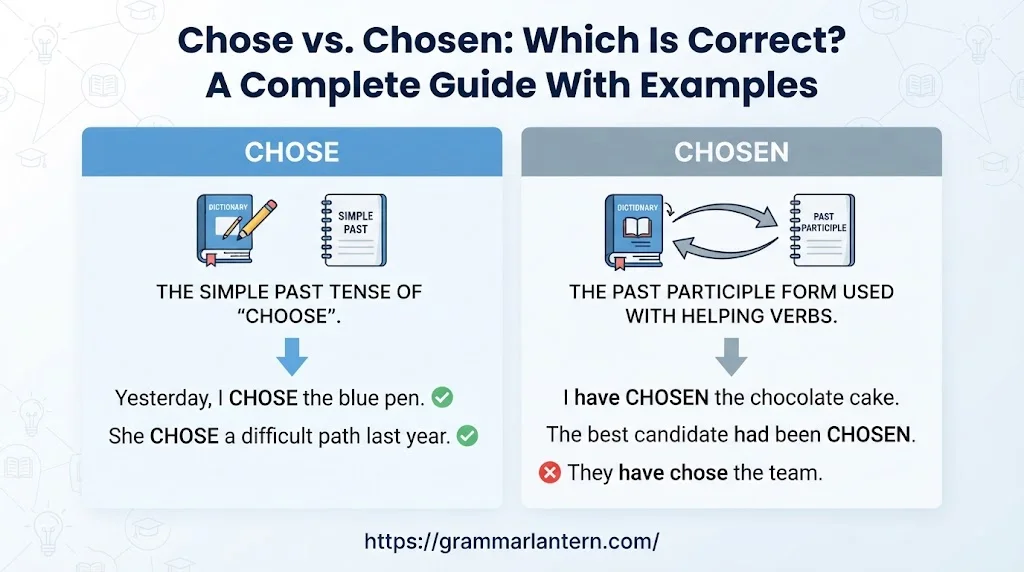
If you’re confused about chose vs. chosen, you’re not alone. These two forms of choose often cause confusion because they look similar, yet they serve different grammatical purposes. The easiest way to remember the difference is to focus on tense and helping verbs. Chose is the simple past tense, while chosen is the past participle. For example, you can say, “I chose the red dress yesterday,” but you would say, “I have chosen the red dress.”
The difference becomes clearer when you consider when an action happened. Chose describes a completed action that happened at a specific time in the past. It can stand alone as the main verb. Chosen, however, normally needs a helping verb such as have, has, had, or be. Saying “She has chosen a new career” is correct, while “She chosen a new career” is not.
Learning chose vs. chosen doesn’t have to be difficult. Once you recognize the grammatical pattern, you can quickly decide which word belongs in a sentence. Think of chose as the past-tense form and chosen as the form that usually needs a helping verb. With a few examples, the distinction becomes much easier to remember and use correctly.
Quick Answer
Chose and chosen are both correct forms of the irregular verb choose, but they have different grammatical functions.
- Choose = present or base form
- Chose = simple past form
- Chosen = past participle
Here’s the easiest comparison:
| Word | Verb Form | Example |
| choose | Present/base form | I usually choose coffee. |
| chose | Simple past | I chose coffee yesterday. |
| chosen | Past participle | I have chosen coffee. |
The key rule is simple:
Use “chose” for a completed past action. Use “chosen” with an auxiliary verb in perfect or passive constructions.
So:
- I chose this book yesterday. ✅
- I have chosen this book. ✅
- I have chose this book. ❌
- I chosen this book. ❌
Once you recognize the verb form, the choice becomes much less confusing.
The Main Difference
The easiest way to understand chose vs. chosen is to look at the three forms of the verb.
Choose is the base form. You use it for the present tense and after certain auxiliary verbs.
Chose is the simple past form. It describes something that happened and finished in the past.
Chosen is the past participle. It usually needs another verb, such as has, have, had, is, was, or were, depending on the construction.
Consider these sentences:
- I choose my clothes every morning.
- I chose my clothes last night.
- I have chosen my clothes already.
- My clothes were chosen last night.
Notice how the surrounding verbs change the structure. The word chosen doesn’t normally stand alone as the main past-tense verb.
The Basic Verb Pattern
The verb choose is irregular. It doesn’t form its past tense by simply adding -ed.
Its principal forms are:
| Form | Word | Example |
| Base form | choose | We choose carefully. |
| Simple past | chose | We chose carefully. |
| Past participle | chosen | We have chosen carefully. |
| Present participle | choosing | We are choosing carefully. |
This pattern resembles other irregular verbs:
- speak → spoke → spoken
- write → wrote → written
- break → broke → broken
- choose → chose → chosen
A useful memory trick is to think of chose as the middle form. Chosen belongs to the third position.
What Does “Chose” Mean?
Chose is the simple past tense of choose. It describes a decision or selection that happened in the past.
You can use it when someone selected something, preferred one option, or made a decision at an earlier point.
For example:
- She chose the blue apartment.
- We chose the cheaper option.
- He chose to stay home.
- They chose a different route.
- I chose chocolate instead of vanilla.
In each sentence, the decision occurred in the past.
You don’t need an auxiliary verb before chose in a normal affirmative simple-past sentence.
Examples of Chose in Sentences
Here are several everyday examples:
- Maria chose the window seat.
- James chose a career in engineering.
- The customer chose the larger package.
- We chose the restaurant near the station.
- She chose to study abroad.
- They chose the safest route.
- I chose the first option.
- He chose not to participate.
The word can describe tiny decisions or major life choices. The grammatical rule remains the same.
Chose With Specific Past Time
Chose works especially naturally with completed past-time expressions.
Common examples include:
- yesterday
- last night
- last week
- last month
- last year
- two hours ago
- three days ago
- when I was younger
- earlier this morning
For example:
She chose her wedding dress last Saturday.
The phrase last Saturday identifies a completed point in the past. Therefore, the simple past chose fits naturally.
Another example:
We chose a new supplier two months ago.
The decision happened at a definite earlier time. Again, chose is the appropriate form.
Read More: Begun vs. Began: Which Is Correct? Helpful Examples
What Does “Chosen” Mean?
Chosen is the past participle of choose. Unlike chose, it usually doesn’t express simple past tense by itself.
Instead, chosen appears in several grammatical structures, particularly perfect tenses and the passive voice.
For example:
- I have chosen a new laptop.
- She has chosen her favorite song.
- They had chosen a different strategy.
- The winner was chosen by the judges.
- Three candidates were chosen for the program.
The surrounding verb provides important grammatical information.
Chosen With Has, Have, and Had
The perfect tenses use a form of have followed by a past participle.
Since chosen is the past participle of choose, these combinations are correct:
- has chosen
- have chosen
- had chosen
Examples:
She has chosen a new apartment.
They have chosen their team captain.
We had chosen the venue before the meeting started.
Compare the incorrect versions:
- She has chose a new apartment. ❌
- They have chose their team captain. ❌
- We had chose the venue. ❌
The auxiliary verb has, have, or had requires the past participle here.
Chosen in Passive Constructions
Chosen also appears in passive sentences.
For example:
Sarah was chosen for the position.
The sentence doesn’t say that Sarah selected something. Instead, someone selected Sarah.
Compare:
The committee chose Sarah.
Sarah was chosen by the committee.
The first sentence uses chose because the committee performed the action.
The second uses chosen because Sarah receives the action.
This distinction is extremely useful when learning chose vs. chosen.
Choose vs. Chose vs. Chosen
Understanding chose vs. chosen becomes easier when you include choose in the comparison.
| Word | Meaning/Function | Typical Construction | Example |
| choose | Base or present form | choose, do choose, will choose | I choose tea. |
| chose | Simple past | chose | I chose tea yesterday. |
| chosen | Past participle | have chosen, was chosen | I have chosen tea. |
Think of these forms as different tools. They come from the same verb, but each tool has a particular job.
A Simple Timeline
You can also visualize the difference:
Present:
I choose a book.
Past:
I chose a book yesterday.
Past connected to the present:
I have chosen a book.
The timeline helps because chose directly places the action in the past. Chosen needs another verb to establish its grammatical relationship with time or voice.
When to Use “Chose”
Use chose when you describe a completed action in the simple past.
For example:
He chose the blue shirt.
The decision happened in the past. There’s no need for has, have, or had.
Another example:
We chose the hotel after comparing five options.
The sentence describes a finished decision.
Chose With Past-Time Expressions
These expressions commonly work with chose:
| Expression | Example |
| yesterday | She chose yesterday. |
| last week | They chose last week. |
| two days ago | He chose two days ago. |
| last year | We chose that company last year. |
| earlier | I chose the first option earlier. |
| when I was younger | I chose differently when I was younger. |
The important idea isn’t the presence of a particular time word. The real issue is whether the sentence presents the choice as a completed past event.
When to Use “Chosen”
Use chosen when the sentence requires a past participle.
Two major situations are especially important: perfect constructions and passive constructions.
Perfect Constructions
Examples include:
- She has chosen a dress.
- We have chosen a location.
- He had chosen the wrong path.
- They will have chosen a winner by Friday.
In each case, chosen follows a form of have.
Passive Constructions
Examples include:
- She was chosen as captain.
- They were chosen for the project.
- He has been chosen for the role.
- The finalists will be chosen tomorrow.
Here, chosen follows a form of be within a passive construction.
“Has Chosen” vs. “Was Chosen”
These two expressions can look similar, but their meanings differ significantly.
Has chosen means the subject made the choice.
Daniel has chosen a new car.
Daniel performed the choosing.
Was chosen means someone or something selected the subject.
Daniel was chosen as team captain.
Someone else selected Daniel.
That difference matters in professional writing, academic work, reports, and everyday communication.
Compare the Direction of the Action
| Sentence | Who made the choice? |
| Maya has chosen the design. | Maya |
| Maya was chosen for the project. | Someone else |
| The panel chose Maya. | The panel |
| Maya has been chosen by the panel. | The panel |
A quick question can help: Who is doing the choosing?
If the subject performs the action, an active construction may use chose or chosen, depending on tense.
If the subject receives the selection, a passive construction uses chosen with the appropriate form of be.
In Different Tenses
Different tense structures make the distinction even clearer.
| Tense or Construction | Correct Form | Example |
| Present | choose | I choose carefully. |
| Simple past | chose | I chose carefully. |
| Present perfect | have chosen | I have chosen carefully. |
| Past perfect | had chosen | I had chosen carefully. |
| Future perfect | will have chosen | I will have chosen by then. |
| Simple passive past | was chosen | I was chosen yesterday. |
| Present perfect passive | has been chosen | I have been chosen for the role. |
The pattern is consistent.
Chose belongs to the simple past.
Chosen belongs to participial constructions.
Common Mistakes
Many mistakes happen because learners remember that both words describe a past choice. However, meaning alone doesn’t determine the correct form. Grammar does.
“I Have Chose” vs. “I Have Chosen”
Incorrect:
I have chose the blue one.
Correct:
I have chosen the blue one.
Why? Have requires the past participle in this perfect construction. The past participle is chosen.
“I Chosen” vs. “I Chose”
Incorrect:
I chosen the blue one.
Correct:
I chose the blue one.
Without an appropriate auxiliary verb, the simple past form chose works here.
“I Was Chose” vs. “I Was Chosen”
Incorrect:
I was chose for the position.
Correct:
I was chosen for the position.
The passive construction requires the past participle chosen.
“Did You Chose?” vs. “Did You Choose?”
Incorrect:
Did you chose this one?
Correct:
Did you choose this one?
This mistake deserves special attention.
After did, use the base form of the verb.
Therefore:
- Did you choose?
- Did she choose?
- Did they choose?
- Did he choose?
Not:
- Did you chose? ❌
- Did she chosen? ❌
The word did already carries the past-tense marker. The main verb returns to its base form.
In Questions
Questions provide another useful test.
When did forms the question, use choose:
What did you choose?
Why did she choose that option?
Which color did they choose?
When a perfect construction forms the question, use chosen:
Have you chosen a date?
Has she chosen a restaurant?
Had they chosen a replacement?
The auxiliary tells you which verb form follows.
In Negative Sentences
Negative sentences follow the same principles.
With did not, use the base form:
I did not choose that option.
She didn’t choose the red dress.
They didn’t choose the cheaper plan.
Don’t write:
I didn’t chose that option. ❌
With perfect constructions, use chosen:
I haven’t chosen yet.
She hasn’t chosen a color.
They hadn’t chosen a replacement.
This gives you another practical rule:
Did + choose
Have/has/had + chosen
Chose vs. Chosen in Passive Voice
Passive voice makes chosen particularly common.
Consider this active sentence:
The judges chose three finalists.
Now change it to passive voice:
Three finalists were chosen by the judges.
The object of the active sentence becomes the subject of the passive sentence. The verb changes from chose to were chosen.
More examples include:
- The manager chose the employee.
- The employee was chosen by the manager.
- The committee chose two proposals.
- Two proposals were chosen by the committee.
- The voters chose a representative.
- A representative was chosen by the voters.
The passive structure normally follows this pattern:
Subject + form of be + chosen
For example:
The winner was chosen yesterday.
The winners were chosen yesterday.
Chosen as an Adjective
Chosen can also function as an adjective.
For example:
She was the chosen representative.
He became the team’s chosen leader.
The chosen method worked well.
Here, chosen describes a noun.
The word can suggest that someone or something has been selected for a particular purpose.
You’ll also encounter the chosen in certain contexts where the word refers collectively to people who have been selected.
For example:
The story describes a group known as the chosen.
The exact meaning depends on context, but the underlying idea remains selection.
Read More: Scoup vs. Scoop: Which Spelling Is Correct?
Chose vs. Chosen With “To”
The verb choose often appears before to + verb.
The same pattern works with its different forms.
1.She chooses to stay.
2.She chose to stay.
3.She has chosen to stay.
Notice that the second verb remains in its base form after to.
So you write:
- chose to leave
- chose to study
- chose to wait
- chosen to leave
- chosen to study
- chosen to wait
Not:
She chose to left. ❌
The first verb carries the tense. The verb after to stays in its base form.
In Everyday and Formal Writing
There isn’t a formal version and an informal version of these words. Both chose and chosen are standard English.
The difference is grammatical, not stylistic.
You can use chose in a casual conversation:
I chose pizza last night.
You can also use it in formal writing:
The research team chose three variables for further analysis.
Likewise, chosen works in both settings:
I’ve chosen the movie.
The committee has chosen the final proposal.
What matters is sentence structure.
Case Study: Choosing the Correct Form
Imagine that a student writes these sentences:
I have chose a major.
Last year, I chosen biology.
I chose to study biology because I enjoyed science.
I was chose for a research project.
Only the third sentence is correct.
Let’s repair the others:
I have chosen a major.
Have + past participle requires chosen.
Last year, I chose biology.
Last year describes a completed past event, so chose works.
I chose to study biology because I enjoyed science.
Chose is the simple past form. To study remains in the base form.
I was chosen for a research project.
The passive construction requires chosen.
This small case study demonstrates how context determines the correct form.
How to Remember
You don’t need to memorize dozens of complicated rules. A few practical checks can solve most problems.
Remember the Three Forms
Think:
choose → chose → chosen
The middle form is chose.
The final principal form is chosen.
Use the Auxiliary-Verb Test
Look at the word before the verb.
If you see:
- has
- have
- had
you’ll generally need chosen in a perfect construction.
If you see a passive form of be, such as:
- is
- are
- was
- were
- been
you may need chosen in a passive construction.
For example:
- has chosen
- had chosen
- was chosen
- were chosen
Use the “Yesterday” Test
If you can naturally say yesterday and you’re describing a completed past decision, chose will often be the right form.
I chose the blue shirt yesterday.
This isn’t a universal test, but it works well for simple past sentences.
Remember “Did + Base Form”
After did, return to choose:
Did you choose?
Not:
Did you chose?
This rule prevents one of the most common mistakes involving this verb.
Quick Comparison
| Feature | Chose | Chosen |
| Base verb | choose | choose |
| Verb form | Simple past | Past participle |
| Works alone as simple past | Yes | No |
| Used with have/has/had | No | Yes |
| Used in passive voice | No | Yes |
| Example | She chose carefully. | She has chosen carefully. |
| Example with passive | — | She was chosen. |
The simplest distinction is this:
Chose tells you that someone made a choice in the simple past.
Chosen works as a past participle in constructions such as “has chosen” and “was chosen.”
Practice: Choose the Correct Word
Try filling in each blank with choose, chose, or chosen.
- She ___ the red jacket yesterday.
- Have you ___ a restaurant?
- Did they ___ the larger apartment?
- He has ___ a new career path.
- We ___ the second option last week.
- The captain was ___ by the players.
- I usually ___ tea in the morning.
- They had ___ a different strategy before the meeting.
- Why did she ___ that option?
- The committee has ___ three finalists.
Answer Key
| Sentence | Answer | Reason |
| She ___ the red jacket yesterday. | chose | Simple past |
| Have you ___ a restaurant? | chosen | Present perfect |
| Did they ___ the larger apartment? | choose | Base form after did |
| He has ___ a new career path. | chosen | Present perfect |
| We ___ the second option last week. | chose | Simple past |
| The captain was ___ by the players. | chosen | Passive construction |
| I usually ___ tea in the morning. | choose | Present tense |
| They had ___ a different strategy. | chosen | Past perfect |
| Why did she ___ that option? | choose | Base form after did |
| The committee has ___ three finalists. | chosen | Present perfect |
FAQs
1. What is the difference between chose and chosen?
Chose is the simple past tense of choose, while chosen is the past participle. For example, “I chose the black shoes yesterday” uses the simple past. “I have chosen the black shoes” uses the past participle.
2. Is chose past tense or past participle?
Chose is the simple past tense of choose. It describes an action that happened in the past. The past participle form is chosen.
3. Is chosen a past tense word?
Chosen is not the simple past tense. It is the past participle of choose. It usually appears with a helping verb, such as has, have, or had.
4. Should I say “I chose” or “I chosen”?
You should say “I chose” when using the simple past tense. For example, “I chose the blue jacket.” You can use chosen when a helping verb comes before it, as in “I have chosen the blue jacket.”
5. Is “I have chose” correct?
No. The correct sentence is “I have chosen.” After have, has, or had, you generally need the past participle chosen, not the simple past chose.
6. Is “She has chose” correct?
No. The correct form is “She has chosen.” The helping verb has requires the past participle chosen in this construction.
7. What is the correct form: “He chose me” or “He chosen me”?
The correct sentence is “He chose me.” Because there is no helping verb before the main verb, the simple past form chose is needed.
8. Can chosen be used without a helping verb?
In most ordinary sentences, chosen needs a helping verb. For example, “They have chosen a leader” is correct. However, chosen can also appear as a participial adjective in certain constructions, such as “the chosen candidate.”
9. What is the easiest way to remember chose vs. chosen?
Remember this simple pattern: chose = past, while chosen = past participle. If you see have, has, or had, chosen is usually the form you need.
10. What are the three forms of choose?
The three main forms are choose – chose – chosen. Choose is the base form, chose is the simple past, and chosen is the past participle. For example: “I choose carefully,” “I chose yesterday,” and “I have chosen already.”
Conclusion
Understanding chose vs. chosen becomes much easier when you remember their grammatical roles. Chose is the simple past form of choose, so you use it for a completed action in the past. Chosen is the past participle, so it commonly appears with helping verbs such as have, has, and had. This small distinction can prevent a surprisingly common English grammar mistake.
When you’re unsure which form to use, look at the sentence structure. If you’re describing a past action directly, chose is usually correct. If the sentence uses have, has, or had, you’ll generally need chosen. Once this pattern becomes familiar, choosing between these two forms will feel almost automatic.

For Shafiq ur Rehman, writing is an art form and grammar is the toolbox that makes it beautiful. As a dedicated content writer at Grammar Lantern, Shafiq approaches every topic like an architect carefully laying down strong foundations of understanding before adding the finer details. He loves diving into the trickiest grammar points and resurfacing with simple, bite-sized takeaways that anyone can grasp. When he’s not crafting articles, you’ll likely find him strategizing over a game of chess, exploring dusty local bookshops, or quietly jotting down poetic observations in his notebook.