Have you ever stopped while writing and wondered whether Coaches, Coach’s, or Coaches’ is the correct form? You’re not alone. These three forms look almost identical, yet each one has a different grammatical job. A misplaced apostrophe can change the meaning of a sentence completely. If you’re writing about sports, education, or team management, knowing the difference can save you from awkward mistakes.
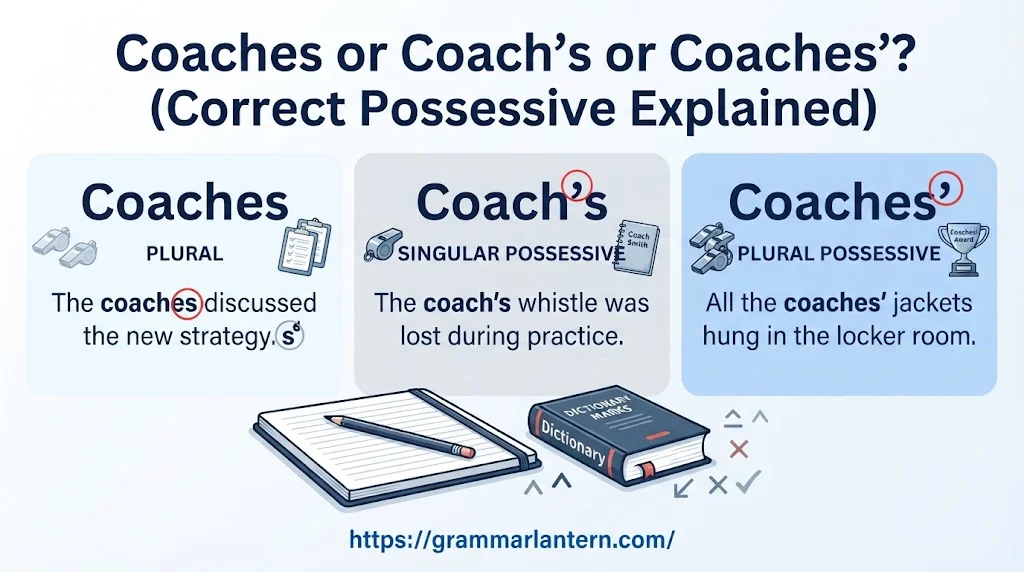
The word coaches is normally the plural form of coach, meaning more than one person who trains or instructs others. It can also function as a verb, as in “She coaches the soccer team.” By contrast, coach’s is the singular possessive form, showing that something belongs to one coach. For example, “The coach’s office is upstairs” refers to the office of a single person.
Things become slightly more interesting with coaches’, which is the plural possessive form. It shows that something belongs to multiple coaches. For example, “The coaches’ meeting starts at noon” means the meeting belongs to or involves several coaches. Once you understand how plural and possessive forms work, choosing the right spelling becomes much easier.
Quick Answer
The correct form depends on what you mean.
| Form | What it means | Grammatical function | Example |
| Coaches | More than one coach | Plural noun | The coaches arrived early. |
| Coach’s | Belonging to or associated with one coach | Singular possessive | The coach’s office is nearby. |
| Coaches’ | Belonging to or associated with multiple coaches | Plural possessive | The coaches’ meeting starts at noon. |
Here’s the simplest rule:
- Coaches = two or more coaches
- Coach’s = something belonging to one coach
- Coaches’ = something belonging to two or more coaches
So, if you’re asking about coaches or coach’s or coaches’, first determine whether you’re talking about number or possession.
Coaches: The Plural Form of Coach
Coaches is the plural form of coach. You use it when you mean more than one coach and aren’t showing possession.
The noun coach ends in -ch, so English normally forms its plural by adding -es rather than simply adding -s.
Coach → coaches
For example:
- The coaches met after practice.
- Several coaches attended the conference.
- The school hired three new coaches.
- The coaches discussed the team’s schedule.
- Two coaches stayed late to supervise training.
Notice something important: none of these examples needs an apostrophe.
The word coaches simply tells you that there is more than one coach. An apostrophe would serve no grammatical purpose.
When to Use Coaches
Use coaches when the word functions as an ordinary plural noun.
You can usually test it by replacing coaches with two coaches, several coaches, or many coaches.
For example:
The coaches discussed the game.
You could say:
The two coaches discussed the game.
The meaning remains grammatically sound. That tells you coaches is functioning as a plural noun.
Examples of Coaches
Here are several common uses:
- The coaches prepared the players for the tournament.
- Three coaches attended the workshop.
- The coaches arrived before the athletes.
- Several coaches disagreed about the schedule.
- The university employs experienced coaches.
- The coaches worked together during practice.
In every case, coaches means more than one coach. No possession appears.
Coach’s: The Singular Possessive Form
Coach’s is the singular possessive form of coach.
Use it when something belongs to, relates to, or is associated with one coach.
The basic pattern is:
coach + ’s = coach’s
For example:
The coach’s office is locked.
The office belongs to or is associated with one coach.
Other examples include:
- The coach’s strategy was effective.
- I followed the coach’s advice.
- The coach’s whistle fell on the field.
- The coach’s decision surprised the players.
- We discussed the coach’s training plan.
The apostrophe comes before the s because the noun is singular.
How to Recognize Coach’s
Ask yourself:
Does the thing belong to or relate to one coach?
If the answer is yes, coach’s is usually the form you need.
For example:
The coach’s car is outside.
The sentence refers to one coach and one car associated with that coach.
Now compare:
The coaches’ cars are outside.
Here, more than one coach is involved. The apostrophe moves after the s.
That small punctuation change carries important information.
Read More: Affend or Offend: Which Spelling Is Correct?
Coach’s Can Show More Than Physical Ownership
Possession doesn’t always mean literal ownership.
English uses possessive forms to express many kinds of relationships. Coach’s can indicate responsibility, authorship, association, opinion, direction, or connection.
Consider these examples:
- The coach’s advice helped the players.
- The coach’s decision changed the lineup.
- The coach’s strategy worked well.
- The coach’s opinion influenced the discussion.
- The coach’s instructions were clear.
A coach doesn’t necessarily “own” advice or a strategy in a physical sense. The possessive simply connects the coach with the advice, strategy, decision, or instructions.
Coaches’: The Plural Possessive Form
Coaches’ is the plural possessive form of coach.
Use it when something belongs to, relates to, or is associated with more than one coach.
The construction works like this:
coaches + ’ = coaches’
The plural coaches already ends in s, so you add only an apostrophe.
For example:
The coaches’ meeting starts at three.
The meeting involves multiple coaches.
Other examples include:
- The coaches’ decisions affected the team.
- The coaches’ offices are on the second floor.
- The players followed the coaches’ instructions.
- The coaches’ schedules were published yesterday.
- The coaches’ recommendations differed.
Why Does the Apostrophe Come After the S?
This is one of the most useful possessive rules to remember.
For a singular noun, add ’s:
coach → coach’s
For a regular plural noun ending in s, add only an apostrophe:
coaches → coaches’
This creates the contrast:
- one coach’s plan
- two coaches’ plan
The first form identifies one coach. The second identifies multiple coaches.
The Difference at a Glance
The easiest way to understand the three forms is to place them side by side.
| Form | Number | Possessive? | Example | Meaning |
| coaches | More than one | No | The coaches left. | Multiple coaches |
| coach’s | One | Yes | The coach’s office is open. | Office of one coach |
| coaches’ | More than one | Yes | The coaches’ offices are open. | Offices of multiple coaches |
Think of the apostrophe as a small grammatical signpost.
No apostrophe means you’re simply naming multiple coaches. An apostrophe before s signals one coach’s relationship to something. An apostrophe after s signals that several coaches have that relationship.
How to Know Which Form You Need
When you face the question “coaches or coach’s or coaches’?”, don’t guess based on appearance. Instead, ask two simple questions.
Are You Talking About One Coach or More Than One?
If you mean one person, start with coach.
If you mean multiple people, use coaches.
For example:
- One coach → coach
- Two coaches → coaches
- Several coaches → coaches
Are You Showing Possession or Association?
If you aren’t showing possession, use coach or coaches based on number.
If you are showing possession or association, use the appropriate possessive form.
That gives you this simple decision process:
One coach + possession → coach’s
Multiple coaches + no possession → coaches
Multiple coaches + possession → coaches’
This method works far better than trying to memorize isolated examples.
A Simple Substitution Test
A substitution test can quickly expose the correct form.
Test for Coaches
Replace coaches with several coaches.
The coaches gathered outside.
Becomes:
Several coaches gathered outside.
The meaning still works. Therefore, coaches is simply plural.
Test for Coach’s
Replace coach’s with of the coach.
The coach’s strategy was effective.
Becomes:
The strategy of the coach was effective.
The sentence may sound less natural, but the relationship remains clear. Therefore, coach’s expresses singular possession or association.
Test for Coaches’
Replace coaches’ with of the coaches.
The coaches’ strategy was effective.
Becomes:
The strategy of the coaches was effective.
Again, the relationship is clear. Therefore, coaches’ expresses plural possession or association.
Coaches vs. Coach’s: What’s the Difference?
The difference between coaches and coach’s comes down to plural versus singular possessive.
Coaches means more than one coach.
Coach’s means something associated with one coach.
Compare these sentences:
The coaches arrived early.
This sentence simply identifies multiple people.
The coach’s office was unlocked.
This sentence identifies something associated with one coach.
Another pair makes the distinction even clearer:
The coaches discussed the schedule.
The coach’s schedule changed unexpectedly.
In the first sentence, coaches is the subject. In the second, coach’s modifies schedule and shows a relationship between one coach and the schedule.
Coach’s or Coaches’: What’s the Difference?
The difference between coach’s and coaches’ is the number of coaches involved.
Coach’s = one coach.
Coaches’ = multiple coaches.
Compare:
The coach’s office is upstairs.
One coach has an office.
Now consider:
The coaches’ offices are upstairs.
Multiple coaches have offices.
The apostrophe tells you something about possession. The position of the apostrophe tells you how many coaches are involved.
Compare These Examples
| Singular possessive | Plural possessive |
| the coach’s plan | the coaches’ plan |
| the coach’s office | the coaches’ offices |
| the coach’s advice | the coaches’ advice |
| the coach’s decision | the coaches’ decisions |
| the coach’s instructions | the coaches’ instructions |
The context can determine whether one coach or several coaches are connected to the noun that follows.
Coaches or Coaches’: What’s the Difference?
These two forms can look especially confusing because both begin with coaches.
The key is the apostrophe.
Coaches is simply plural.
Coaches’ is plural possessive.
Consider:
The coaches met in the conference room.
Here, coaches acts as a noun. It identifies the people who met.
Now:
The coaches’ meeting lasted two hours.
Here, coaches’ modifies meeting. It indicates that the meeting relates to the coaches.
The apostrophe changes the grammatical role.
Common Mistakes
Apostrophes cause trouble because writers sometimes treat them as marks for making words plural. They aren’t.
Mistake: Using Coach’s for Multiple Coaches
Incorrect:
The coach’s met after practice.
If you mean multiple coaches, use:
The coaches met after practice.
The apostrophe isn’t needed because you’re simply forming a plural.
Mistake: Using Coaches When You Mean Possession
Incorrect:
The coaches office is closed.
If the office belongs to multiple coaches, write:
The coaches’ office is closed.
The apostrophe shows the relationship between the coaches and the office.
Mistake: Writing Coaches’s
A common error is:
The coaches’s meeting
This construction isn’t the standard plural possessive form.
Because coaches already ends in s, the standard plural possessive is:
The coaches’ meeting
Only an apostrophe is added.
Mistake: Adding an Apostrophe to Every Plural
Incorrect:
Several coach’s attended the event.
Correct:
Several coaches attended the event.
Pluralization and possession are separate grammatical ideas.
That’s the central point. An apostrophe doesn’t make a noun plural.
Special Case: Shared and Separate Possession
When multiple coaches are involved, the surrounding noun can affect the meaning.
Consider:
The coaches’ office was renovated.
This can refer to an office shared by multiple coaches.
Now consider:
The coaches’ offices were renovated.
The plural offices indicates multiple offices. Each coach may have an individual office or the group may have several offices.
The apostrophe tells you that the offices relate to the coaches. The noun that follows tells you whether you’re talking about one office or several.
Shared Possession
For a shared item:
The coaches’ locker room was renovated.
Multiple coaches use the same locker room.
Separate Possession
For separate items:
The coaches’ lockers were replaced.
Multiple lockers belong to or are assigned to the coaches.
This distinction matters because possessive grammar doesn’t always tell you exactly how ownership is divided. Context completes the picture.
Coaches’ in Professional and Educational Writing
The plural possessive form appears frequently in workplaces, schools, sports organizations, and training programs.
For example:
- The coaches’ conference begins Friday.
- The coaches’ handbook contains updated policies.
- The coaches’ responsibilities include player development.
- The coaches’ training session starts at 9 a.m.
- The coaches’ feedback helped improve the program.
In each example, multiple coaches are connected to the following noun.
The same principle applies outside sports.
For professional coaching:
The coaches’ recommendations varied according to each client.
For an educational setting:
The coaches’ workshop focused on classroom leadership.
For a youth program:
The coaches’ schedules were sent to parents.
The grammatical rule doesn’t change just because the context changes.
Case Study: Changing One Apostrophe
Consider this sentence:
The coach’s plans were approved.
This tells you that one coach is associated with the plans.
Now change the sentence:
The coaches’ plans were approved.
The meaning shifts. Multiple coaches are associated with the plans.
Now remove the apostrophe entirely:
The coaches planned the event.
The word coaches is no longer possessive. It simply identifies the people performing the action.
Three small changes create three distinct grammatical structures:
| Sentence | Meaning |
| The coach’s plans were approved. | Plans associated with one coach |
| The coaches’ plans were approved. | Plans associated with multiple coaches |
| The coaches planned the event. | Multiple coaches performed the action |
This is why apostrophe placement deserves attention. It isn’t decorative punctuation. It can change meaning.
Facts to Remember
A few practical facts make this distinction easier to remember:
- Coach is singular.
- Coaches is the standard plural form.
- Coach’s is the singular possessive form.
- Coaches’ is the plural possessive form.
- Coaches doesn’t need an apostrophe simply because it ends in s.
- Coaches’ uses an apostrophe after the final s.
- Coach’s uses ’s because coach is singular.
- Possession can indicate association rather than literal ownership.
- The noun following a possessive can be singular or plural depending on meaning.
- Apostrophes don’t normally create ordinary English plurals.
A Quick Memory Trick
Here’s a simple way to keep all three forms straight:
Coaches → several coaches
Coach’s → one coach’s something
Coaches’ → several coaches’ something
Look at the apostrophe position:
- coach’s → apostrophe before s
- coaches’ → apostrophe after s
You can think of the apostrophe as following the plural s when several coaches are involved.
That tiny visual cue can save you from a surprisingly common grammar mistake.
More Examples
1. Examples With Coaches
- The coaches arrived before the players.
- Several coaches joined the program.
- The coaches discussed the tournament.
- Two coaches led the training session.
2. Examples With Coach’s
- The coach’s office is open.
- The coach’s advice proved useful.
- The coach’s strategy changed during halftime.
- The coach’s instructions were easy to follow.
3. Examples With Coaches’
- The coaches’ offices are nearby.
- The coaches’ advice differed.
- The coaches’ strategies produced different results.
- The coaches’ instructions were distributed before practice.
Read More: Emasculate vs. Demasculate: Which Word Is Correct?
FAQs
1. Is “coaches” the plural of “coach”?
Yes. Coaches is the standard plural form of coach. For example, “The coaches discussed the players’ performance.”
2. Is “coach’s” grammatically correct?
Yes. Coach’s is the singular possessive form. It indicates that something belongs to one coach, such as “The coach’s office is locked.”
3. What does “coaches’” mean?
Coaches’ is the plural possessive form. It shows possession or association with more than one coach. For example, “The coaches’ opinions differed.”
4. Is “coachs” a correct spelling?
No. Coachs is not the correct plural form of coach. The correct spelling is coaches.
5. What is the difference between “coach’s” and “coaches’”?
Coach’s refers to one coach, while coaches’ refers to multiple coaches. For example, “The coach’s strategy” means one coach’s strategy, while “the coaches’ strategies” means strategies belonging to several coaches.
6. Does an apostrophe make “coach” plural?
No. An apostrophe generally does not make a noun plural. The plural of coach is coaches, without an apostrophe.
7. Is “coaches” ever used as a verb?
Yes. Coaches can be the third-person singular present form of the verb coach. For example, “Maria coaches the school team.”
8. Which is correct: “the coaches strategy” or “the coaches’ strategy”?
The coaches’ strategy is correct when the strategy belongs to multiple coaches. The apostrophe comes after the s because coaches is already plural.
9. Which is correct: “the coach’s team” or “the coaches’ team”?
Both can be correct, depending on your meaning. The coach’s team refers to one coach, while the coaches’ team refers to multiple coaches.
10. How can I remember the difference between these forms?
Think about the number of coaches first. Use coaches for more than one coach, coach’s for something belonging to one coach, and coaches’ for something belonging to several coaches.
Conclusion
Understanding coaches, coach’s, and coaches’ becomes much easier when you focus on meaning rather than the apostrophe itself. Coaches is usually the plural noun, while coach’s shows possession by one person. Coaches’ indicates possession by multiple people. Each form has a specific purpose, so the surrounding sentence usually tells you which one you need.
The easiest trick is to ask yourself two questions: How many coaches are there? and Does the word show possession? If you mean several coaches, use coaches. If one coach owns or is connected to something, use coach’s and If several coaches share ownership or involvement, use coaches’. Once that pattern becomes familiar, these apostrophe questions stop being tricky.

Muhammad Haroon is the voice behind many of the clear, practical grammar guides you’ll find on Grammar Lantern. With a strong background in content writing and a genuine love for the English language, Haroon specializes in breaking down intimidating grammar topics into simple, digestible lessons. His goal is simple: to empower readers to write with confidence and clarity. Whether he’s explaining tricky tenses or demystifying punctuation, Haroon approaches each topic with patience, precision, and a touch of warmth—because he knows that learning grammar is a journey, not a race.