
For English learners, Shown vs. Showed can feel tricky, but the difference becomes easier when you understand how the verb Show behaves in different forms. Showed is the past tense, while Shown is usually the past participle. These words may look similar, but they are not always interchangeable.
Both words relate to displaying, presenting, or letting someone see something. In simple English, you can learn the pattern step-by-step. For example, “I Showed you a photo yesterday,” but “I have shown you this before.” This helps reduce confusion when learners speak or write and avoid second-guess mistakes.
This guide uses examples, clear examples, tables, memory tricks, and quick comparisons to make the grammar rules easier to remember. Practice helps the easy rules stick, so you can choose the right form more confidently in books, conversations, school assignments, and everyday writing.
The Basic Difference
The simplest way to understand showed vs. shown is to look at the three principal forms of show:
| Verb form | Grammatical role | Example |
| show | Base form | I want to show you something. |
| showed | Simple past | I showed you the document yesterday. |
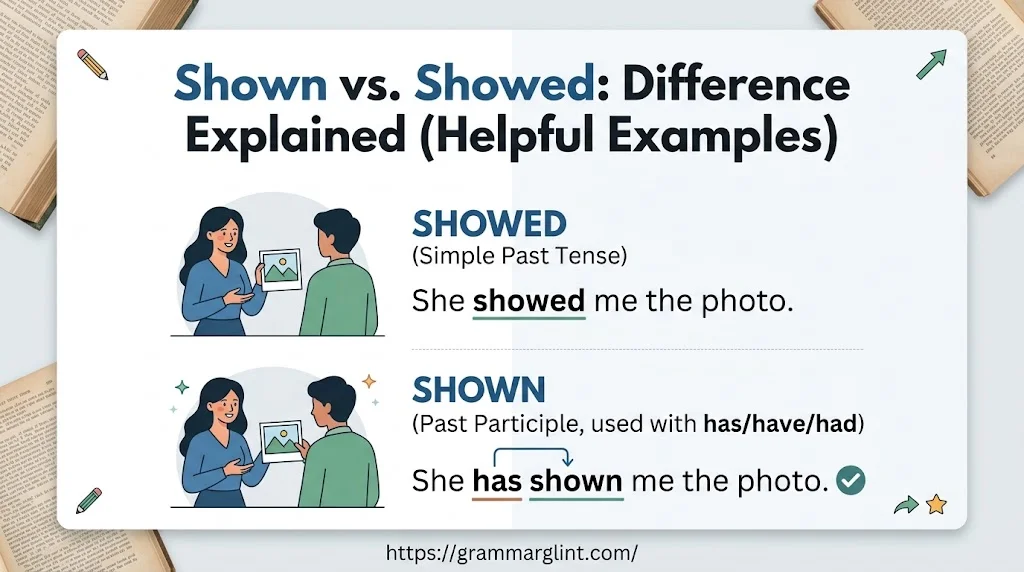
| shown | Past participle | I have shown you the document before. |
Showed works as the simple past tense. You can normally use it as the main verb without another auxiliary verb.
Shown, however, is a past participle. It generally appears with an auxiliary verb such as have, has, had, is, are, was, or were, depending on the construction.
A useful rule is:
Use “showed” for the simple past. Use “shown” when the sentence requires a past participle.
For example:
- The teacher showed us the experiment.
- The teacher has shown us the experiment before.
- The experiment was shown to the class.
The action remains essentially the same. The grammatical construction changes.
Show, Showed, and Shown: Understanding the Verb Forms
The verb show is an irregular verb in its past forms. Unlike a regular verb such as walk, it doesn’t form its past tense by simply adding -ed to create every form.
Its principal forms are:
show → showed → shown
The first form, show, is the base form. You use it after modal verbs and auxiliary do forms, among other structures.
Examples include:
- I want to show you my new project.
- You should show them the results.
- Did she show you the email?
- They don’t show their emotions easily.
The second form, showed, is the simple past.
Examples:
- She showed me her new apartment.
- The graph showed a sharp increase.
- He showed us how the machine worked.
The third form, shown, is the past participle.
Examples:
- She has shown remarkable patience.
- The results have shown a clear pattern.
- The video was shown during the meeting.
This three-form pattern is worth memorizing because it solves many common errors.
Read More: Emersion vs. Immersion: Meaning, Differences, and Usage
When to Use “Showed”
Showed is the correct choice when you need the simple past form of show.
The simple past describes an action or situation that occurred in the past. The action may have happened once, repeatedly, or over a particular period.
For example:
- I showed him the photograph.
- She showed us her new car.
- The manager showed the employees the new procedure.
- The results showed a significant difference.
In each sentence, showed acts as the main past-tense verb.
You don’t need has, have, had, was, or were to make showed work as a simple past verb.
“Showed” for a Completed Past Action
Use showed when you’re describing a completed event in the past.
For example:
Marcus showed me the report after lunch.
The sentence presents showed as a finished action. The phrase after lunch also places the action in a past context.
Other examples include:
- The teacher showed us a historical photograph.
- I showed my friend the message.
- She showed the doctor her test results.
- The presenter showed the audience a short video.
- The employee showed his manager the completed design.
Notice how naturally showed functions as the main verb.
“Showed” With Specific Past Time
Specific past-time expressions often work naturally with showed.
Common examples include:
- yesterday
- last night
- last week
- earlier today
- two days ago
- in 2024
- during the meeting
- after the class
- before dinner
For example:
- She showed me the document yesterday.
- We showed the client the design last week.
- The report showed unexpected results in 2024.
- He showed us the photographs during dinner.
However, don’t assume that every sentence mentioning a past time must use showed. Grammar depends on the complete construction.
Common Sentence Patterns With “Showed”
Here are several useful structures:
1. Subject + showed + object
- The teacher showed the class a diagram.
2. Subject + showed + person + object
- Sarah showed her brother the photograph.
3. Subject + showed + that-clause
- The evidence showed that the system had failed.
4. Subject + showed + how/why/what
- The technician showed us how to fix the problem.
The word showed can therefore introduce much more than a physical object. It can introduce information, evidence, results, methods, emotions, behavior, or relationships.
When to Use “Shown”
Shown is the past participle of show. It normally appears as part of a larger verb construction.
You most often encounter it in perfect tenses and passive constructions.
For example:
- She has shown great determination.
- They had shown the results earlier.
- The results were shown to the committee.
- The documentary was shown on television.
Using shown by itself as a simple past verb is generally incorrect in standard English.
You wouldn’t normally write:
- ❌ She shown me the picture yesterday.
Instead, write:
- ✓ She showed me the picture yesterday.
The distinction comes from the grammatical role of the verb.
“Shown” With Has, Have, and Had
One of the most important rules for shown vs. showed involves has, have, and had.
These auxiliary verbs can form perfect constructions. When show follows them as the main verb, you need its past participle: shown.
Has Shown
Use has shown with a singular third-person subject such as he, she, it, or a singular noun.
Examples:
- She has shown excellent leadership.
- The study has shown promising results.
- The company has shown steady growth.
- His performance has shown considerable improvement.
The present perfect connects a past action or development with the present in some way.
Compare:
The study showed a problem.
This presents the finding as a past event.
The study has shown a problem.
This emphasizes the relevance or consequence of the finding now.
Neither construction is automatically better. The intended meaning determines the appropriate tense.
Have Shown
Use have shown with I, you, we, they, and plural nouns.
Examples:
- We have shown the results to the team.
- They have shown strong interest in the proposal.
- Researchers have shown that the method can work.
- You have shown considerable patience.
The same past-participle rule applies.
Had Shown
Use had shown when you need the past perfect.
The past perfect places one past event before another past event.
For example:
The report had shown several problems before the company changed its strategy.
The report showed the problems first. The strategy changed later.
Another example:
She had shown me the photograph before the meeting started.
The showing happened first. The meeting started afterward.
This distinction can matter when a sentence contains two separate past events.
Shown in Passive Constructions
Another major use of shown occurs in passive voice.
The passive structure typically uses a form of be + past participle.
Because shown is the past participle, it appears in constructions such as:
- was shown
- were shown
- is shown
- are shown
- has been shown
- had been shown
Consider this active sentence:
The teacher showed the students a diagram.
Now change it into the passive:
The diagram was shown to the students.
The subject changes. The grammatical construction changes too. Therefore, the verb form changes from showed to shown.
“Was Shown” vs. “Was Showed”
This distinction causes frequent mistakes.
Correct:
- The documentary was shown on television.
- The results were shown to the committee.
- The photograph was shown during the presentation.
Incorrect in standard English:
- ❌ The documentary was showed on television.
- ❌ The results were showed to the committee.
- ❌ The photograph was showed during the presentation.
Why?
Because was and were already provide the auxiliary structure. The main verb needs its past participle form.
So the pattern is:
was/were + shown
not:
was/were + showed
Showed vs. Has Shown: What’s the Difference?
The contrast between showed and has shown deserves special attention because both forms can describe past actions.
Consider:
The study showed a significant improvement.
This sentence uses the simple past. It presents the study’s finding as a completed past event.
Now consider:
The study has shown a significant improvement.
This sentence uses the present perfect. It connects the finding to the present context.
The difference can become clearer in real-world writing.
Imagine a company tested a product last year.
The test showed that the product was reliable.
This focuses on the completed test and its result.
Now imagine the company is discussing its current track record:
The tests have shown that the product is reliable.
This emphasizes accumulated evidence that remains relevant now.
The distinction isn’t merely about time. It also involves perspective and connection to the present.
Showed vs. Had Shown
The difference between showed and had shown depends on how you organize past events.
Compare these sentences:
The report showed several errors before the manager reviewed it.
This sentence uses simple past for both events.
Now consider:
The report had shown several errors before the manager reviewed it.
The past perfect makes the sequence explicit. The errors appeared in the report before the manager reviewed it.
Use had shown when establishing an earlier point within a past narrative makes the sequence clearer.
For example:
- The data had shown warning signs before the system failed.
- She had shown me the document before I called the office.
- The experiment had shown unexpected results before researchers repeated it.
You don’t need past perfect every time two past actions appear. Context often makes the order obvious. Use it when the chronological relationship deserves emphasis.
“Did Show” vs. “Did Showed”
Here’s another trap: did showed.
When you use did to form a question or negative statement, the main verb returns to its base form.
Therefore:
- ✓ Did you show him the report?
- ❌ Did you showed him the report?
Why does this happen?
The auxiliary did already carries the past tense. Adding -ed to the main verb would duplicate the tense marking.
Compare:
- She showed me the report.
- Did she show me the report?
- She didn’t show me the report.
The same pattern applies to other verbs:
- She went home.
- Did she go home?
- She didn’t go home.
Once did appears, use show, not showed.
“Has Shown” vs. “Has Showed”
The phrase has showed is a common grammatical error.
The correct form is:
- ✓ has shown
- ❌ has showed
For example:
- ✓ The evidence has shown a clear pattern.
- ❌ The evidence has showed a clear pattern.
The reason is straightforward. Has requires the past participle in the present perfect construction.
The same rule applies to have and had:
- ✓ have shown
- ✓ has shown
- ✓ had shown
- ❌ have showed
- ❌ has showed
- ❌ had showed
A quick memory trick helps:
Have + shown.
Has + shown.
Had + shown.
If one of those three words appears before show, shown is usually the form you need.
In Academic Writing
Academic writing frequently uses both forms, but they perform different jobs.
Consider these examples:
- The experiment showed a substantial increase in temperature.
- Previous research has shown a relationship between the two variables.
- The results are shown in Table 2.
- The graph shows a steady decline.
Notice that academic writing often favors has shown when discussing research findings that remain relevant.
Passive structures also appear frequently:
The results are shown in Figure 3.
Here, shown is required because the construction uses are + past participle.
Another common expression is:
As shown in the table, the values increased steadily.
Here, shown forms a reduced passive construction. The complete idea could be expressed as:
As is shown in the table, the values increased steadily.
This pattern is especially common in formal and technical writing.
In Everyday Conversation
Everyday speech tends to favor showed when people describe completed actions.
For example:
“I showed him the picture yesterday.”
That’s direct and natural.
But if the speaker uses a perfect construction, shown appears:
“I’ve shown him that picture before.”
The two sentences describe related situations, yet the grammatical framing differs.
Other conversational examples include:
- “She showed me where the store was.”
- “I’ve shown you this before.”
- “He showed us his new phone.”
- “We’ve shown them the problem.”
- “They had shown us the room earlier.”
Once you recognize the auxiliary verbs, the choice becomes much easier.
Common Mistakes
Several mistakes appear repeatedly when writers confuse these two forms.
Using “Shown” as Simple Past
Incorrect:
- ❌ He shown me the picture yesterday.
Correct:
- ✓ He showed me the picture yesterday.
The simple past requires showed.
Using “Showed” After Has or Have
Incorrect:
- ❌ She has showed me the results.
Correct:
- ✓ She has shown me the results.
The present perfect requires the past participle.
Using “Showed” After Had
Incorrect:
- ❌ They had showed us the document.
Correct:
- ✓ They had shown us the document.
Again, had + past participle gives you had shown.
Using “Showed” in an Ordinary Passive Construction
Incorrect:
- ❌ The movie was showed at the theater.
Correct:
- ✓ The movie was shown at the theater.
The passive construction requires was + shown.
Using “Did Showed”
Incorrect:
- ❌ Did you showed her the email?
Correct:
- ✓ Did you show her the email?
The auxiliary did already carries the past tense.
Quick Comparison
| Feature | Showed | Shown |
| Verb form | Simple past | Past participle |
| Used alone as past tense | Yes | No, not normally |
| Used with has | No | Yes |
| Used with have | No | Yes |
| Used with had | No | Yes |
| Used after was/were in passive voice | No | Yes |
| Example | She showed me the file. | She has shown me the file. |
| Basic idea | Completed past action | Perfect or passive construction |
This table captures the central distinction, but context still matters.
Examples in Different Contexts
1. At School
- The teacher showed us a science experiment.
- The teacher has shown us several examples.
- The results were shown on the classroom screen.
2. At Work
- The manager showed the team the new schedule.
- The manager has shown strong leadership.
- The updated figures were shown during the meeting.
3. In Technology
- The technician showed me how to reset the device.
- She has shown me how to use the software.
- The error message was shown on the screen.
4. In Research
- The experiment showed a measurable change.
- Several studies have shown similar results.
- The findings are shown in the following table.
5. In Personal Conversations
- He showed me his vacation photos.
- I’ve shown you those photos before.
- The photos were shown to everyone at dinner.
These examples demonstrate an important point: the surrounding grammar controls the choice.
A Useful Case Study: One Action, Three Verb Forms
Imagine a student gives a presentation about climate data.
First, the student describes what happened yesterday:
The presentation showed a clear rise in temperatures.
That’s simple past.
Next, the student discusses evidence that remains relevant:
Several studies have shown similar increases.
That’s present perfect.
Finally, the student refers to a chart:
The temperature changes are shown in the graph.
That’s passive voice.
The subject matter remains connected. Yet each sentence uses a different form because each sentence has a different grammatical structure.
This is why memorizing isolated sentences isn’t enough. You need to understand why the verb form changes.
Read More: Proving vs Prooving: Meaning, Difference, and Examples
How to Choose
When you’re unsure, don’t guess based on whether the sentence sounds formal. Instead, examine the structure.
Ask yourself these questions:
Is this a simple past sentence?
Use showed.
- She showed me the letter.
Does the sentence use has, have, or had?
Use shown.
- She has shown me the letter.
Is the sentence passive with a form of be?
Use shown.
- The letter was shown to me.
Does the sentence use did?
Use the base form show.
- Did she show you the letter?
This four-step check resolves most shown vs. showed questions quickly.
Practice Quiz
Choose show, showed, or shown to complete each sentence.
- She ______ me the photograph yesterday.
- He has ______ remarkable improvement.
- Did they ______ you the new design?
- The results were ______ during the presentation.
- We had ______ the documents to the manager.
- The experiment ______ unexpected results.
- I have ______ you this example before.
- The graph was ______ to the audience.
- They didn’t ______ us the final version.
- The report ______ a sharp increase last year.
Answers
- showed
- shown
- show
- shown
- shown
- showed
- shown
- shown
- show
- showed
The answers follow the grammatical structures discussed above.
Frequently Confused Sentences
Sometimes two sentences look almost identical even though their verb forms differ.
“She Showed Me” vs. “She Has Shown Me”
She showed me the document.
This describes a completed past action.
She has shown me the document.
This uses the present perfect and connects the past action with the current context.
“They Showed the Results” vs. “The Results Were Shown”
They showed the results.
This is active voice. They performed the action.
The results were shown.
This is passive voice. The results receive the action.
The verb changes from showed to shown because the grammatical construction changes.
“The Data Showed” vs. “The Data Have Shown”
The data showed a pattern.
This presents the discovery as a completed past finding.
The data have shown a pattern.
This emphasizes the evidence as relevant to the present discussion.
Neither sentence is universally correct without context. The surrounding meaning matters.
Is “Shown” Ever Used Without an Auxiliary Verb?
In ordinary finite verb constructions, shown doesn’t normally function as the simple past tense of show.
However, you may encounter shown in reduced or non-finite constructions.
For example:
As shown below, the process requires three steps.
Here, shown is part of a reduced passive construction.
The full version could be:
As is shown below, the process requires three steps.
You may also see shown functioning in participial phrases:
The evidence shown in the report supports the conclusion.
Here, shown in the report describes the evidence. It doesn’t function as a simple past verb.
These constructions explain why shown can sometimes appear without an immediately visible auxiliary. That doesn’t make shown the simple past form.
Is “Showed” Ever Used as a Past Participle?
In modern standard English, shown is the usual past participle of show.
Some historical or dialectal usage has treated showed differently. However, standard contemporary English uses:
show → showed → shown
For formal, academic, professional, and general-purpose writing, shown is the reliable past participle.
Therefore, these are standard:
- has shown
- have shown
- had shown
- was shown
- were shown
- has been shown
- had been shown
Using showed in these constructions will generally sound incorrect to modern readers.
A Simple Memory Trick
Think of showed as the verb that can walk into a sentence alone.
She showed me the answer.
Think of shown as the form that usually needs grammatical support.
She has shown me the answer.
The answer was shown to me.
Then remember the third form:
show → showed → shown
One small pattern can prevent a surprising number of mistakes.
FAQs
1. What is the difference between shown and showed?
Showed is usually the simple past tense of show, while shown is commonly used as the past participle. For example, “She showed me the picture,” but “She has shown me the picture.”
2. Is “shown” correct English?
Yes, shown is correct English. It is generally used with helping verbs such as has, have, or had. For example, “They have shown us the way.”
3. Can I use showed instead of shown?
Not in every sentence. Showed is used for a completed action in the past, while shown is usually used with a helping verb or in passive structures.
4. Is “I have showed” correct?
In standard English, “I have shown” is the preferred and widely accepted form. “I have showed” may appear in some informal varieties, but it is generally avoided in standard writing.
5. When should I use showed?
Use showed when talking about a simple action that happened and finished in the past. For example, “He showed me his new phone yesterday.”
6. When should I use shown?
Use shown as a past participle, especially with has, have, or had. For example, “She has shown great improvement.”
7. Can shown be used without have or has?
Yes. Shown can also appear in passive sentences. For example, “The results were shown on the screen.”
8. Which is correct: “The movie showed” or “The movie was shown”?
Both can be correct, but they have different meanings. “The movie showed” may describe what the movie displayed, while “The movie was shown” means someone presented or played the movie.
9. Why do English learners confuse shown and showed?
The confusion happens because both forms come from the verb show and have similar meanings. The main difference is grammatical: one is mainly the simple past form, while the other is the past participle.
10. What is the easiest way to remember shown vs. showed?
A simple trick is to look for a helping verb. If you see has, have, or had, shown is usually the right choice. If you are describing a completed action in the simple past, showed is normally the better option.
Conclusion
The difference between shown vs. showed becomes much easier once you focus on their grammatical roles. Use showed mainly for completed actions in the past, and use shown as a past participle with helping verbs or in passive sentences.
The best way to remember the difference is to practice with real sentences. Over time, reading, writing, and speaking will make the correct form feel more natural, helping you use shown and showed with greater confidence.

For Shafiq ur Rehman, writing is an art form and grammar is the toolbox that makes it beautiful. As a dedicated content writer at Grammar Lantern, Shafiq approaches every topic like an architect carefully laying down strong foundations of understanding before adding the finer details. He loves diving into the trickiest grammar points and resurfacing with simple, bite-sized takeaways that anyone can grasp. When he’s not crafting articles, you’ll likely find him strategizing over a game of chess, exploring dusty local bookshops, or quietly jotting down poetic observations in his notebook.



[…] Read More: Shown vs. Showed: Difference Explained (Helpful Examples) […]
[…] Read More: Shown vs. Showed: Difference Explained (Helpful Examples) […]