Choosing between Congresses, Congress’s, and Congress’ depends on the meaning you want to convey. Each form serves a different purpose, so understanding the difference helps you write clearly and avoid punctuation mistakes in formal documents.
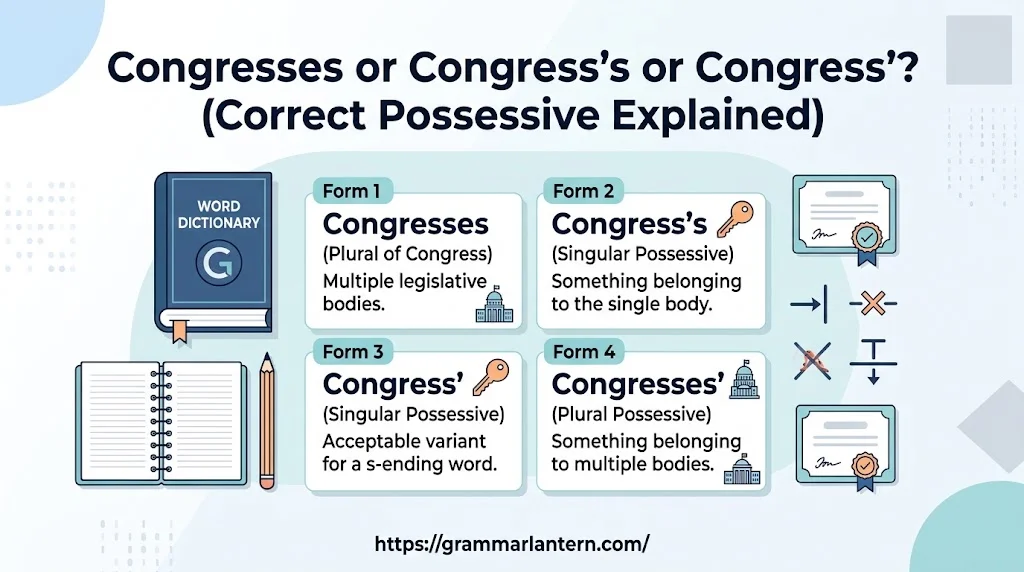
Congresses is the plural form of congress, referring to multiple congresses, meetings, or legislative bodies. For example, “Several international congresses discussed education reform.” Congress’s is the standard singular possessive form in most American English style guides. You might write, “Congress’s decision affected the entire country.” However, some style guides prefer Congress’, particularly in formal or institutional writing.
Before choosing a spelling, consider your intended meaning and the rules of your preferred grammar guide. Correct apostrophe placement matters in professional reports, business documents, and everyday communication. Consistent punctuation also improves readability across project management, meetings, calendar planning, scheduling, and administration. Whether you’re preparing educational materials, organizing events, or writing about government decisions, choose the form that fits your sentence. When following an organization’s specific conventions, apply its preferred style consistently throughout the document.
Quick Answer
The correct form depends on the meaning of your sentence and the style guide you’re following.
| Form | Meaning | Example |
| Congresses | Plural noun; more than one congress | Several congresses discussed the proposal. |
| Congress’s | Singular possessive; something associated with one congress | Congress’s decision attracted attention. |
| Congress’ | Alternative singular possessive used by some style guides | Congress’ decision attracted attention. |
| Congresses’ | Plural possessive; something associated with multiple congresses | The congresses’ schedules overlapped. |
Here’s the simplest way to remember these forms:
- Use congresses when you mean more than one congress.
- Use Congress’s for singular possession when your chosen style guide adds ’s to singular nouns ending in s.
- Use Congress’ when your style guide permits or requires the apostrophe-only form.
- Use congresses’ when something belongs to or is associated with multiple congresses.
In American English, The Chicago Manual of Style generally favors Congress’s for singular possession, while The Associated Press Stylebook uses Congress’ for the U.S. legislative body. Follow the style guide required by your publication or organization.
What Does Congresses Mean?
Congresses is the plural form of the noun congress. It refers to two or more congresses, whether they are legislative bodies, formal assemblies, or organized gatherings.
Unlike the possessive forms, congresses does not contain an apostrophe. You simply add -es to the singular noun because it ends in s.
For example:
- Several congresses addressed environmental concerns.
- International congresses bring researchers together to share their findings.
- The historical congresses influenced later political discussions.
- Two medical congresses took place in different cities.
In each sentence, congresses identifies multiple events or bodies. It doesn’t show that something belongs to them.
When Should You Use Congresses?
Use congresses whenever you’re referring to more than one congress.
The word can describe different kinds of gatherings. A political congress might bring representatives together to discuss legislation, while a scientific congress might allow researchers to present their findings.
Consider this example:
Correct: Several congresses examined the issue during the same year.
The sentence refers to multiple congresses. Nothing in it indicates possession, so an apostrophe isn’t necessary.
Now compare it with this sentence:
Correct: The congresses’ reports contained similar recommendations.
Here, the writer refers to reports associated with multiple congresses. The plural noun becomes possessive, so the apostrophe appears after the final s.
This distinction is important because plural nouns don’t automatically require apostrophes. Apostrophes indicate possession or certain contractions, not ordinary plural forms.
What Does Congress’s Mean?
Congress’s is a singular possessive form. Writers use it to show that something belongs to, comes from, or relates to one congress.
In American English, this spelling is widely accepted and is preferred by several major style guides.
Examples include:
- Congress’s decision affected the proposed legislation.
- The report examined Congress’s constitutional powers.
- Congress’s approval was necessary before the measure could proceed.
- The journalist analyzed Congress’s response to the investigation.
In these examples, the possessive form connects Congress with a decision, powers, approval, or response.
Possession doesn’t always mean physical ownership. It can also indicate responsibility, authority, involvement, or association.
For example, Congress’s responsibilities refers to duties associated with Congress rather than objects that Congress physically owns.
Read More: MYF Meaning in Text: What Does MYF Stand For?
Why Does Congress’s Have Two S’s?
The spelling may look unusual because Congress already ends in s. However, many American English style guides form the possessive of a singular noun by adding ’s, even when the noun ends in s.
The same principle appears in these examples:
- James → James’s book
- the witness → the witness’s statement
- the business → the business’s profits
- Congress → Congress’s decision
The additional s doesn’t create a plural. It marks the singular possessive form.
For example, Congress’s decision means a decision associated with Congress. By contrast, congresses means multiple congresses.
The grammatical function matters more than the number of letters that appear at the end.
Is Congress’s Correct in American English?
Yes. Congress’s is correct under style guides that form singular possessives by adding ’s to nouns ending in s.
For example, The Chicago Manual of Style generally recommends adding ’s to singular nouns, including those that end in s.
However, some publications follow different conventions. The Associated Press style for the U.S. legislative body uses Congress’.
Both forms can communicate the same possessive meaning. The important point is to follow the style required for your writing rather than treating one convention as universally mandatory.
What Does Congress’ Mean?
Congress’ is an alternative singular possessive form. It uses an apostrophe after the final s without adding another s.
Some editorial styles prefer this construction for certain singular nouns ending in s. In particular, Associated Press style uses Congress’ when referring to the U.S. Congress.
Examples include:
- Congress’ authority is defined by the Constitution.
- The article examined Congress’ role in the investigation.
- The committee discussed Congress’ responsibilities.
- The reporter analyzed Congress’ response to the proposal.
These sentences express the same general possessive relationship as their Congress’s versions.
Is Congress’ Grammatically Correct?
Yes, in styles that accept or prescribe the apostrophe-only form.
The choice between Congress’s and Congress’ is generally an editorial preference rather than a difference in meaning. However, the applicable style guide determines which form is appropriate in a particular publication.
Consider the following comparison:
| Style or context | Preferred form |
| Chicago-style writing | Congress’s |
| Associated Press style for the U.S. legislative body | Congress’ |
| A publication with its own style guide | Follow its stated preference |
You shouldn’t assume that Congress’ is always incorrect simply because it lacks an additional s. Likewise, don’t assume that every publication requires Congress’s.
Consistency is the key. If you use Congress’s in one section, avoid switching to Congress’ elsewhere without a clear editorial reason.
What Is the Plural Possessive Form of Congress?
The plural possessive form is congresses’. Use it when you refer to something associated with two or more congresses.
To form it correctly, follow these steps:
- Start with the singular noun: congress.
- Make it plural: congresses.
- Add an apostrophe after the final s: congresses’.
Examples include:
- The congresses’ schedules conflicted with one another.
- Researchers compared the congresses’ final reports.
- The congresses’ representatives agreed to meet again.
- The congresses’ decisions shaped later discussions.
The apostrophe comes after the final s because the noun is already plural.
Congresses vs. Congresses’: What Is the Difference?
The difference is simple: congresses identifies multiple congresses, while congresses’ indicates possession or association.
Compare these sentences:
Plural noun: The congresses met in different locations.
Plural possessive: The congresses’ meetings took place in different locations.
In the first sentence, congresses tells readers that more than one congress met. In the second, congresses’ connects the meetings to those congresses.
Here’s another comparison:
| Congresses | Congresses’ |
| The congresses issued reports. | The congresses’ reports contained recommendations. |
| The congresses attracted delegates. | The congresses’ delegates represented different countries. |
| The congresses discussed reforms. | The congresses’ discussions covered several reforms. |
Notice how the apostrophe changes the grammatical relationship without changing the basic noun.
Key Differences
These spellings become easier to remember when you compare their functions directly.
| Form | Grammatical number | Possessive? | Example |
| Congress | Singular | No | Congress passed the measure. |
| Congresses | Plural | No | Several congresses discussed the measure. |
| Congress’s | Singular | Yes | Congress’s decision attracted attention. |
| Congress’ | Singular | Yes, in applicable styles | Congress’ decision attracted attention. |
| Congresses’ | Plural | Yes | The congresses’ decisions attracted attention. |
The main distinction involves number and possession.
Number tells you whether the noun refers to one congress or multiple congresses. Possession indicates that something belongs to or is associated with the noun.
A useful way to check your sentence is to ask two questions:
- Am I talking about one congress or more than one?
- Am I showing possession or simply naming the congress?
If you mean several congresses without possession, use congresses. If you mean something associated with several congresses, use congresses’.
For a singular possessive, choose between Congress’s and Congress’ according to your style guide.
How to Choose the Correct Form of Congress
You don’t need to memorize every example to make the right choice. Instead, identify the meaning of the sentence and apply the appropriate rule.
Step 1: Identify Whether the Noun Is Singular or Plural
First, determine whether you’re referring to one congress or several.
For example:
- One congress reviewed the proposal.
- Three congresses reviewed the proposal.
The first sentence uses congress because it refers to one body or gathering. The second uses congresses because it refers to multiple bodies or gatherings.
Don’t add an apostrophe merely because a noun ends in s. Ordinary plural nouns don’t need one.
Step 2: Check Whether the Sentence Shows Possession
Next, determine whether the noun has a possessive relationship with another word.
Compare these examples:
- Congress approved the proposal.
- Congress’s approval was necessary.
The first sentence identifies an action. The second uses a possessive form to connect Congress with its approval.
You can sometimes clarify the relationship by rewriting the sentence with of:
- The decision of Congress
- The decision of the congresses
These phrases can help you identify the intended relationship. However, the of construction doesn’t always sound as natural as the possessive form.
Step 3: Follow Your Style Guide
Once you’ve identified the singular possessive, check the editorial rules for your document.
A school assignment, newspaper article, legal document, or academic paper may follow a specific style guide. That guide might prefer Congress’s or Congress’.
If no style guide applies, choose a recognized convention and use it consistently.
For many general American English contexts, Congress’s is a clear choice. If you’re writing for an Associated Press publication, use its prescribed Congress’ form for the U.S. legislative body.
Step 4: Check the Full Sentence
Finally, read the sentence to make sure the noun and its possessive form fit the meaning.
Example one: Congress’s report explained the findings.
This sentence refers to a report associated with one Congress.
Example two: The congresses published separate reports.
This sentence refers to multiple congresses. The noun is plural, not possessive.
Example three: The congresses’ reports contained different findings.
This sentence connects the reports with multiple congresses.
Reading the whole sentence often reveals the correct form more clearly than examining the apostrophe alone.
Congress or congress: When Should You Capitalize It?
Apostrophe placement and capitalization follow different rules. You can use the correct possessive form and still capitalize the noun incorrectly.
In American English, capitalize Congress when referring to the U.S. federal legislative body. Use lowercase congress for a generic assembly or gathering unless another capitalization rule applies.
Examples:
- Congress passed the legislation.
- Congress’s decision prompted further discussion.
- Several scientific congresses took place that year.
- The international congresses’ schedules overlapped.
The capitalization of Congress in the U.S. political context doesn’t change how you form its possessive.
For instance, Congress’s authority and Congress’ authority can both express singular possession under different style conventions.
When referring to a generic gathering, lowercase is usually appropriate:
- The annual congress attracted researchers.
- Several congresses discussed the same scientific question.
Remember: Capitalization identifies how the noun is being used, while the apostrophe helps show its grammatical relationship.
Common Mistakes to Avoid
Apostrophe mistakes often occur when writers focus on spelling rather than meaning. The following errors are easy to prevent once you understand the differences.
Adding an Apostrophe to an Ordinary Plural
Incorrect: Several congresses’ discussed the proposal.
Correct: Several congresses discussed the proposal.
The first sentence incorrectly uses a possessive form before discussed. The second uses the ordinary plural noun because the congresses are performing an action.
Confusing Congresses With Congress’s
Incorrect: The congresses decision attracted attention.
Correct: The congress’s decision attracted attention.
If you’re referring to one congress and its decision, you need a singular possessive form. Depending on the style guide, Congress’s decision may be preferred when referring to the U.S. legislative body.
Assuming Congress’ Is Always Wrong
Incorrect assumption: Congress’ is never grammatically acceptable.
Correction: Congress’ is accepted in certain style conventions, including Associated Press style for the U.S. legislative body.
Always check the relevant editorial rules before correcting this form.
Using Congress’s for Multiple Congresses
Incorrect: The congress’s schedules overlapped.
Correct: The congresses’ schedules overlapped.
If multiple congresses have schedules that overlap, use the plural possessive form. The singular possessive refers to one congress.
Switching Between Possessive Styles
A document that uses Congress’s in one paragraph and Congress’ in another may look inconsistent.
Choose one style and apply it throughout the document unless you’re following different requirements for quoted material or distinct editorial contexts.
Forgetting That Possession Can Be Abstract
Possession doesn’t always mean ownership of a physical object.
For example, Congress’s authority describes a relationship involving power or responsibility. Similarly, Congress’s decision connects the decision to Congress.
Recognizing these relationships helps you form possessives correctly, even when the noun doesn’t own a tangible object.
Real-World Examples of Congresses and Possessives
The best way to understand these forms is to see how they work in different kinds of writing.
Political Writing
Political writing often discusses legislative authority, decisions, responsibilities, and actions.
Examples:
- Congress’s constitutional responsibilities are an important subject of public debate.
- Congress’ actions received extensive coverage in the newspaper.
- Several congresses examined similar legislative questions.
- The congresses’ proposals differed in their approach to reform.
The first two examples use alternative singular possessive styles. The third uses the plural noun, and the fourth uses the plural possessive.
Academic Writing
Academic writing often refers to formal gatherings, published proceedings, and research presentations.
Examples:
- Several scientific congresses discussed recent research findings.
- The congresses’ proceedings provided material for comparative analysis.
- The annual congress’s schedule included several research presentations.
In the final example, congress’s is the singular possessive of the lowercase common noun congress. The lowercase spelling is appropriate because the sentence doesn’t identify the U.S. legislative body.
Historical Writing
Historical writing may discuss legislative bodies, formal assemblies, and their decisions.
Examples:
- Historians examined Congress’s role in the political process.
- The congresses’ agreements influenced subsequent negotiations.
- Several historical congresses brought representatives together to address shared concerns.
These examples show that the same spelling principles apply across subjects. The writer must identify the noun’s number and determine whether the sentence expresses possession.
Practice Quiz
Test your understanding by completing the sentences below. Choose the form that best fits each context.
Questions
- Several international ______ met to discuss economic cooperation.
- ______ decision attracted considerable public attention. (Refer to the U.S. legislative body and follow Chicago style.)
- The ______ schedules overlapped, so the organizers changed the dates. (Refer to multiple congresses.)
- The article examined ______ constitutional powers. (Refer to the U.S. legislative body and follow Associated Press style.)
- The scientific ______ attracted researchers from several countries.
- The ______ reports contained different recommendations. (Refer to multiple congresses.)
- The annual ______ program included workshops and presentations. (Refer to one generic gathering.)
- ______ approval was required before the proposal could proceed. (Refer to the U.S. legislative body and follow Chicago style.)
- The historical ______ discussed several major political questions.
- The two ______ proceedings were published in separate volumes.
Answers and Explanations
- Congresses — The sentence refers to multiple international gatherings.
- Congress’s — Chicago style generally adds ’s to form a singular possessive.
- Congresses’ — The schedules belong to or are associated with multiple congresses.
- Congress’ — Associated Press style uses this form for the U.S. legislative body.
- Congress — The sentence refers to one scientific gathering, so the singular noun is appropriate.
- Congresses’ — The reports are associated with multiple congresses.
- Congress’s — The program belongs to or is associated with one congress. The singular possessive is appropriate.
- Congress’s — Chicago style generally uses ’s for this singular possessive.
- Congresses — The sentence identifies multiple historical gatherings.
- Congresses’ — The proceedings are associated with two congresses, so the plural possessive is appropriate.
Questions two, four, and eight illustrate why the style guide matters. In contexts that permit both singular possessive conventions, the choice depends on the required editorial style.
Read More: Snowball Kisses Meaning: What Does It Mean in Slang?
FAQs
1. Is Congresses or Congress’s correct?
Both are correct, but they have different meanings. Congresses is the plural form of congress, while Congress’s is the singular possessive form. Choose the spelling that matches your sentence.
2. Is Congress’s grammatically correct?
Yes, Congress’s is grammatically correct and follows the common American English rule for forming the possessive of a singular noun. For example, “Congress’s decision surprised everyone.”
3. Is Congress’ also correct?
Yes, Congress’ is an accepted possessive form in some style guides. However, many American English guides prefer Congress’s. Follow the style guide required for your writing.
4. What is the plural form of Congress?
The plural form is congresses. Use it when referring to multiple congresses, conferences, or legislative bodies. For example, “Several congresses addressed international issues.”
5. Should I use Congress’s or Congress’ in American English?
Congress’s is generally preferred in American English. However, certain publications and institutional style guides use Congress’. Consistency with your chosen style guide is essential.
6. Does Congress’s mean something belongs to Congress?
Yes. Congress’s indicates possession or association with Congress. For example, “Congress’s responsibilities include passing federal laws.” The possessive can also describe decisions, actions, or policies associated with Congress.
7. When should I use Congresses in a sentence?
Use Congresses when discussing more than one congress. For example, “The congresses met in different cities.” Remember that this form does not indicate possession.
8. Is it wrong to write Congress’?
No, Congress’ is not universally considered incorrect. Some style guides accept it as a possessive form of Congress. Check the relevant grammar guide before using it in formal or professional documents.
9. Do I need an apostrophe in Congresses?
No, you don’t need an apostrophe when using congresses as a regular plural noun. For example, “The congresses attracted international delegates.” Add an apostrophe only when expressing possession, following the applicable style rules.
10. How can I remember the difference between Congresses, Congress’s, and Congress’?
Remember these three basic distinctions: Congresses means more than one congress, Congress’s is the commonly preferred singular possessive form, and Congress’ is an alternative accepted by some style guides. Check the sentence’s meaning before choosing.
Conclusion
Choosing between Congresses, Congress’s, and Congress’ becomes easier when you understand their meanings and grammatical functions. Use Congresses for the plural, Congress’s for the singular possessive in most American English styles, and Congress’ when your preferred style guide permits or recommends it.
For clear, professional writing, focus on correct apostrophe placement and consistent punctuation. Whether you’re preparing reports, educational materials, or business documents, following a reliable grammar guide will help you make the right choice and communicate your ideas confidently.

For Shafiq ur Rehman, writing is an art form and grammar is the toolbox that makes it beautiful. As a dedicated content writer at Grammar Lantern, Shafiq approaches every topic like an architect carefully laying down strong foundations of understanding before adding the finer details. He loves diving into the trickiest grammar points and resurfacing with simple, bite-sized takeaways that anyone can grasp. When he’s not crafting articles, you’ll likely find him strategizing over a game of chess, exploring dusty local bookshops, or quietly jotting down poetic observations in his notebook.