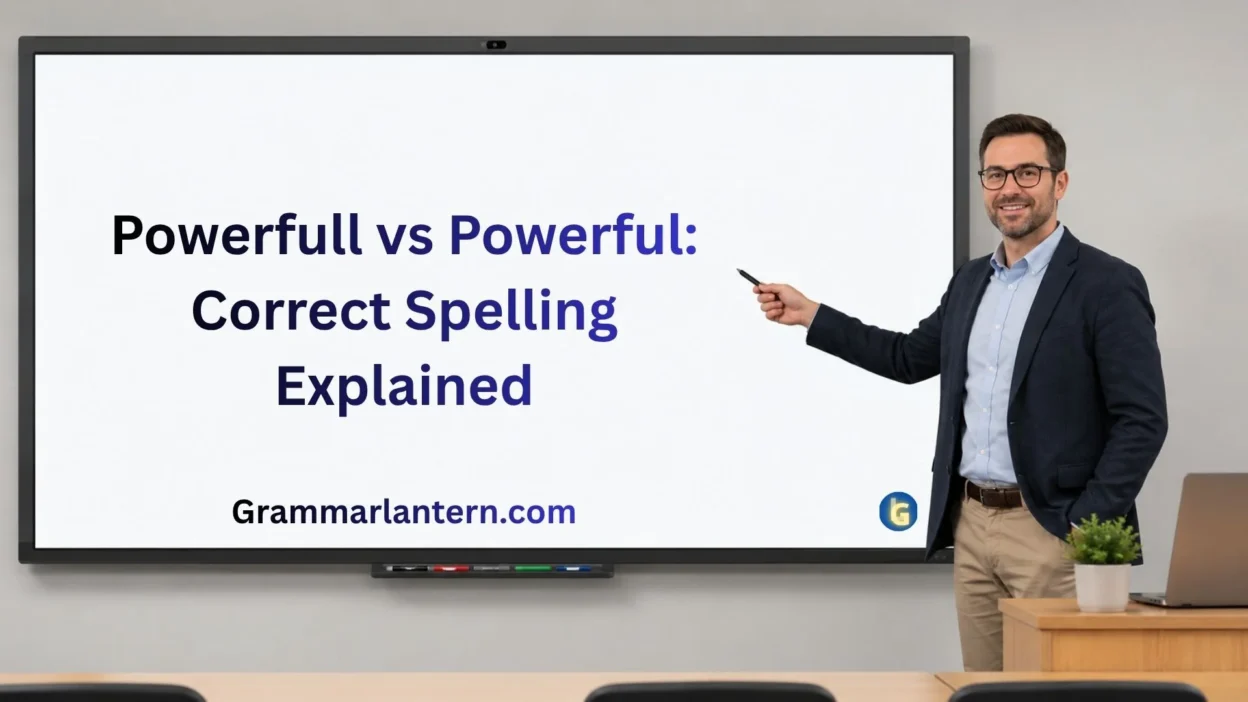
If you wonder about the difference in Powerfull vs Powerful, remember that the correct spelling in the English language is Powerful. It is a word formed from the noun power by adding the suffix -ful and following standard grammar rules. From my experience with writing, this is one of the most common spelling mistakes because a single extra letter can completely change how a term is viewed. Learning the right form early makes it easier to avoid errors in everyday communication.
The comparison between Powerfull and Powerful is simple once you understand the meaning and usage of each word. Powerful is the accepted adjective in standard English, while Powerfull is an incorrect spelling. Powerfully, however, is an adverb that describes how an action is performed. Taking time to learn these differences helps you use each term correctly and with confidence.
Take another instance with a friend who is friendly and practices English every day. You can compare the forming, translation, and translated terms to understand how change and changes happen in different context. Looking at examples is an easy way to remember which spelling belongs in formal writing and which one should be avoided.
For example, Powerful is often translated as poderoso, while Powerfully may be translated as fuerte, depending on the sentence. Keeping these adjectives, adverbs, every term, and each spelling rule in account will help you follow good language habits. As you practice, choosing the correct word, understanding its meaning, and applying proper grammar will become much more natural.
Quick Answer: Powerfull vs Powerful
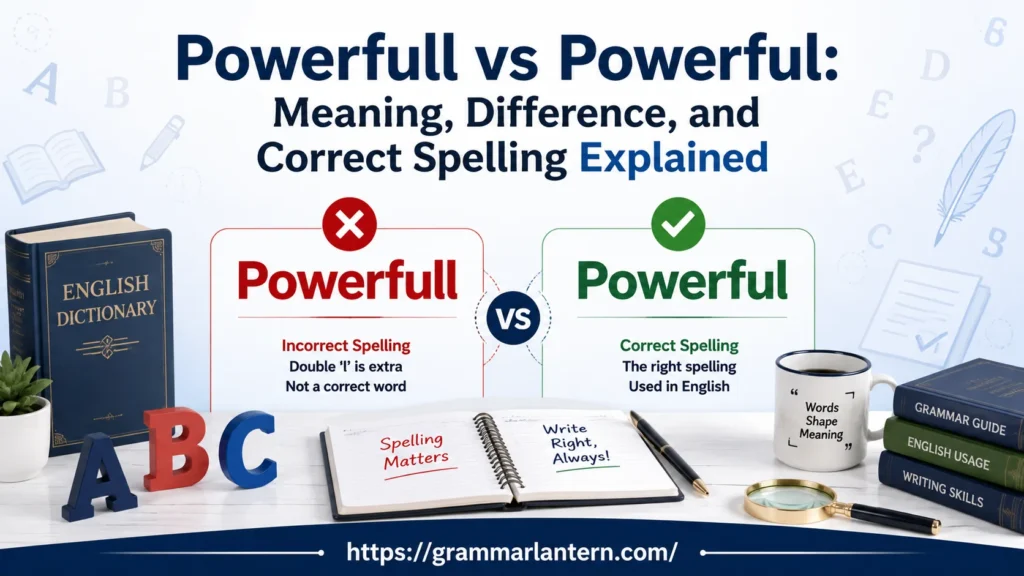
Powerful ✅ is the correct spelling.
Powerfull ❌ is incorrect and considered a spelling mistake in standard English.
The word powerful means having great strength, ability, influence, authority, or impact.
| Word | Correct Spelling | Meaning | Example |
| Powerful | ✅ Yes | Having great power, strength, or influence | She gave a powerful speech. |
| Powerfull | ❌ No | Incorrect spelling | He wrote a powerfull message. |
The correct sentence is:
“He wrote a powerful message.”
Not:
“He wrote a powerfull message.”
Meaning of Powerful
The word powerful is an adjective that describes something or someone with a high level of strength, influence, ability, or effect.
It comes from two parts:
- Power = strength, ability, control, or influence
- -ful = full of or having a quality
So, powerful literally means “full of power.”
However, the meaning changes depending on the context.
Powerful Meaning in Physical Strength
When we talk about physical objects or people, powerful often means having great force or strength.
Examples:
- A powerful engine can move a heavy truck.
- The athlete has a powerful body built through years of training.
- The storm created powerful winds across the region.
In these examples, powerful describes physical force.
Powerful Meaning in Influence or Authority
Powerful can also describe people, organizations, or ideas that have the ability to influence others.
Examples:
- A powerful leader can change the direction of a country.
- Social media has become a powerful communication tool.
- Education is a powerful force for personal growth.
Here, powerful does not mean physical strength. It means having influence or impact.
Powerful Meaning in Emotional Impact
Sometimes something is powerful because it creates a strong emotional reaction.
Examples:
- The documentary shared a powerful story.
- Her words had a powerful effect on the audience.
- The film delivered a powerful message about equality.
A message cannot physically have strength, but it can strongly affect people.
Read More: Plandid or Candid Meaning and Difference with Examples
Why Is Powerful Correct and Powerfull Wrong?
The confusion happens because many people connect powerful with the word full.
The word “full” has two l’s:
- The glass is full.
- The room is full of people.
Because of this, writers sometimes think:
Power + full = Powerfull
But English spelling follows a different rule when -ful works as a suffix.
The suffix -ful always has only one l.
Examples:
| Base Word | Correct Form | Incorrect Form |
| Power | Powerful | Powerfull |
| Help | Helpful | Helpfull |
| Use | Useful | Usefull |
| Beauty | Beautiful | Beautifull |
| Care | Careful | Carefull |
The ending -ful is not the same as the independent word full.
Compare:
- The bottle is full.
- This bottle is useful.
The first sentence uses “full” as a separate word. The second uses “-ful” as a suffix.
The Word Formation of Powerful
The spelling becomes easier when you understand how the word is built.
Power + ful = Powerful
The suffix -ful creates adjectives that mean “having” or “containing.”
For example:
- Hope + ful = Hopeful → full of hope
- Skill + ful = Skillful → having skill
- Thought + ful = Thoughtful → showing thought
- Wonder + ful = Wonderful → full of wonder
The same pattern applies to powerful:
Powerful = having power
The extra “l” is removed because English does not add another letter when using the suffix -ful.
How to Use Powerful Correctly in Sentences
The word powerful appears in everyday conversations, academic writing, journalism, and professional communication.
Here are the most common uses.
Powerful Before a Noun
Powerful usually appears before a noun to describe its quality.
Examples:
- The company developed a powerful computer system.
- She shared a powerful idea during the meeting.
- The scientist created a powerful tool for research.
In these examples, powerful explains the strength or impact of the noun.
Powerful After Linking Verbs
Powerful can also come after verbs like is, was, seems, or becomes.
Examples:
- His speech was powerful.
- The argument seems powerful.
- Her message became powerful after reaching millions of people.
Powerful in Figurative Language
English speakers often use powerful to describe things that create a strong effect.
Examples:
- Music can be a powerful emotional experience.
- Kindness is a powerful way to build relationships.
- A simple idea can become a powerful movement.
These examples show that power is not always about force. It can also mean influence, importance, or impact.
Common Mistakes Related to Powerful
Many spelling mistakes happen because people apply incorrect patterns. Here are some common errors.
Mistake 1: Writing Powerfull
Incorrect:
The speaker gave a powerfull presentation.
Correct:
The speaker gave a powerful presentation.
The correct spelling always contains one l.
Mistake 2: Confusing Powerful With Strong
Although powerful and strong are similar, they are not always interchangeable.
| Word | Meaning | Example |
| Powerful | Having great influence or effect | A powerful speech |
| Strong | Having physical or mental strength | A strong athlete |
| Effective | Producing the desired result | An effective plan |
| Influential | Able to affect opinions or actions | An influential writer |
For example:
- “She is a strong person” usually refers to character or physical ability.
- “She is a powerful person” may refer to authority, influence, or status.
Mistake 3: Adding Extra Letters to -Ful Words
Many people make the same error with other words.
Incorrect:
- Beautifull
- Helpfull
- Usefull
- Wonderfull
Correct:
- Beautiful
- Helpful
- Useful
- Wonderful
Remember this simple rule:
The suffix -ful has one “l.”
Powerful vs Similar Words: Understanding the Differences
Knowing similar words helps you choose the right expression.
| Word | Definition | Example |
| Powerful | Having great strength, influence, or impact | A powerful message |
| Strong | Having physical or emotional strength | A strong foundation |
| Mighty | Extremely strong or impressive | A mighty warrior |
| Influential | Able to affect people or decisions | An influential teacher |
| Effective | Able to produce results | An effective solution |
A powerful idea may not be physically strong, but it can change the way people think.
For example, the idea behind human rights became powerful because it influenced societies worldwide.
Powerful in Different Contexts
The word powerful appears in many areas of life.
Powerful Technology
In technology, powerful often describes devices or systems with high performance.
Examples:
- A powerful processor can handle complex tasks.
- A powerful computer can run advanced software.
- A powerful search engine can analyze huge amounts of information.
Powerful Leadership
Leadership is another area where the word appears frequently.
A powerful leader often has:
- Strong communication skills
- The ability to inspire others
- Decision-making ability
- Social influence
However, power does not always mean control. The most respected leaders often use their influence to create positive change.
Powerful Writing and Communication
Words can be powerful when they connect with people emotionally.
A powerful article, speech, or story usually includes:
- Clear ideas
- Strong examples
- Emotional connection
- Useful information
For example, a short sentence like:
“Small actions can create big changes.”
can become powerful because it communicates a meaningful idea simply.
Powerful Emotions and Experiences
People often describe memories and experiences as powerful.
Examples:
- Meeting someone after many years was a powerful moment.
- The experience changed her life in a powerful way.
- The book created powerful emotions among readers.
These examples show how powerful describes impact rather than physical force.
How to Remember the Correct Spelling of Powerful
If you often confuse powerfull vs powerful, use these simple tricks.
Remember the Suffix Rule
Think:
Power + ful = Powerful
Not:
Power + full = Powerfull
Compare With Other Words
Remember:
- Helpful
- Useful
- Careful
- Beautiful
All have one l.
Use the Sentence Trick
Create a memory sentence:
“Powerful people use helpful words.”
Both words follow the same spelling pattern.
FAQs
1. Is Powerfull a correct English word?
No. Powerfull is an incorrect spelling. The correct English word is Powerful.
2. Why is Powerful spelled with one “l”?
The noun power takes the suffix -ful, which is normally spelled with one l when added to a word.
3. What does Powerful mean?
Powerful is an adjective that describes someone or something with great strength, influence, or ability.
4. What is the difference between Powerful and Powerfully?
Powerful is an adjective that describes a noun, while Powerfully is an adverb that describes how an action is performed.
5. Can I use Powerfull in formal writing?
No. You should never use Powerfull in formal or informal English because it is a spelling mistake.
6. How can I remember the correct spelling of Powerful?
Remember that power becomes Powerful by adding the suffix -ful, not -full.
7. Is Powerfully also a correct English word?
Yes. Powerfully is the correct adverb form of Powerful.
8. Can spell check always catch Powerfull?
Most modern spell checkers identify Powerfull as incorrect, but proofreading is still important.
9. What is an example of Powerful in a sentence?
“The speaker gave a powerful presentation that inspired the audience.”
10. What is an example of Powerfully in a sentence?
“The athlete finished the race powerfully despite the difficult conditions.”
Conclusion
Understanding Powerfull vs Powerful is simple once you know the spelling rule. Powerful is the only correct form in standard English, while Powerfull is a common spelling mistake. Knowing how the suffix -ful works helps you avoid this error and write with greater accuracy.
It is also useful to remember that Powerful is an adjective, whereas Powerfully is its adverb form. By practicing these words in everyday reading and writing, you can improve your grammar, build confidence, and choose the correct form naturally in any situation.

Muhammad Haroon is the voice behind many of the clear, practical grammar guides you’ll find on Grammar Lantern. With a strong background in content writing and a genuine love for the English language, Haroon specializes in breaking down intimidating grammar topics into simple, digestible lessons. His goal is simple: to empower readers to write with confidence and clarity. Whether he’s explaining tricky tenses or demystifying punctuation, Haroon approaches each topic with patience, precision, and a touch of warmth—because he knows that learning grammar is a journey, not a race.