
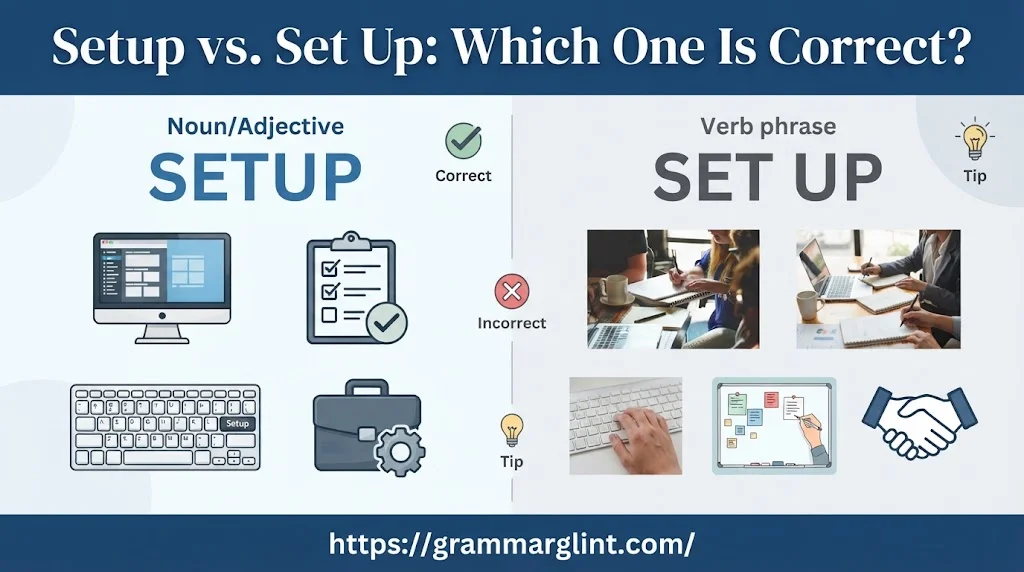
Setup vs. Set Up has nuanced differences. Setup is one word and a noun, while set up is two words and a verb with different meanings, uses, and roles. In the English language, they look alike, sound similar when pronounced, and share similarities, but they differ in how they work. Setup refers to an arrangement or configuration of elements, showing the way something is arranged.
A nice setup might describe the entirety of a room or desk, while a setup disk identifies the name or function of a disk. In the first example, setup names a thing rather than an action. This distinction makes it easier to recognize when the noun form fits naturally in a sentence.
The two-word form, set up, is a verb phrase that shows action, especially arranging or establishing something. You might set up a printer, set up a room, or create a nice-looking setup. This form needs a subject to perform the action, while the noun setup can work as a subject or object in a sentence.
Understanding these separate meanings and contexts is crucial for clarity in spoken and written contexts. Simple examples can prevent common misconceptions and improve effective communication, helping you choose the correct form instead of treating them as the same word or the same thing. The article highlights this distinction for better understanding.
The Quick Answer
Here’s the simplest way to remember the difference:
| Form | Grammatical Role | Meaning | Example |
| setup | Noun | An arrangement, configuration, or preparation | “The setup looks professional.” |
| setup | Modifier | Related to setup or preparation | “Read the setup instructions.” |
| set up | Phrasal verb | To arrange, prepare, install, or establish | “Please set up the equipment.” |
| set-up | Hyphenated noun variant | An arrangement or deceptive situation | “It was a set-up.” |
In contemporary US English, setup is the usual one-word form for the noun. Set up remains two words when it functions as a verb.
So, if you’re wondering whether to write “setup the computer” or “set up the computer,” choose “set up the computer.”
What Does “Setup” Mean?
Setup is primarily a noun. It names something rather than describing the action of doing something.
The word can refer to an arrangement of objects, a configuration of equipment, a way something is organized, or a situation created for a particular purpose.
For instance:
- “The studio has a professional setup.”
- “I like your gaming setup.”
- “The conference room setup was unusual.”
- “The camera setup took nearly an hour.”
- “This setup works well for remote meetings.”
In each example, setup identifies an arrangement or configuration.
You aren’t telling someone to arrange anything. You’re talking about the arrangement itself.
“Setup” as a Noun
The noun setup has several closely related meanings.
Arrangement: It can describe how objects, equipment, people, or systems are organized.
“The office setup gives everyone more space.”
Configuration: It can describe how technology or equipment has been arranged to work together.
“My editing setup includes a powerful desktop and two monitors.”
Preparation: It can refer to the process or stage involved in getting something ready.
“The initial setup took longer than expected.”
Situation: It can describe a situation arranged for a particular purpose.
“He has a comfortable setup for working from home.”
Trick or trap: It can also describe a situation designed to deceive someone.
“She believed the entire thing was a setup.”
That last meaning is worth remembering because setup doesn’t always involve computers, furniture, or equipment.
“Setup” as a Modifier
You may also see setup immediately before another noun:
- setup instructions
- setup guide
- setup process
- setup screen
- setup wizard
- setup file
- setup procedure
- setup costs
Here, setup modifies the noun that follows it.
Consider this sentence:
“Read the setup instructions before installing the software.”
The word instructions is the noun. Setup tells you what kind of instructions they are.
This is why setup instructions is the standard compact form when you mean instructions related to the setup process.
What Does “Set Up” Mean?
Set up is a phrasal verb. It describes an action.
The verb can mean arrange, prepare, install, establish, organize, or create, depending on the context.
For example:
- “Please set up the projector.”
- “I’ll set up the meeting.”
- “They set up a new company.”
- “She set up the camera.”
- “We need to set up the room.”
- “He set up an online account.”
The important point is that someone is doing something.
“Set Up” Means “Arrange”
When you physically arrange things, use set up.
“The staff will set up the chairs before the event.”
The staff performs an action. They arrange the chairs.
Compare that with:
“The chair setup looks organized.”
Now you’re talking about the arrangement itself.
“Set Up” Means “Prepare”
You can also use set up when preparing something for use.
“We need to set up the equipment before the presentation.”
Here, someone performs the preparation. The phrase describes what that person needs to do.
“Set Up” Means “Establish”
The phrase can also mean establishing a company, organization, system, fund, or similar entity.
“She plans to set up her own business.”
“The university set up a new scholarship fund.”
This meaning has little to do with physically placing objects somewhere. The underlying idea is still establishment: something is being created and put into operation.
Read More: Gases vs. Gasses: Which Spelling Is Correct?
“Set Up” Can Mean “Arrange a Meeting”
This is one of the most common sources of confusion.
The correct expression is:
“Let’s set up a meeting.”
Not:
“Let’s setup a meeting.”
A meeting can involve a setup in a different grammatical construction:
“The meeting setup was complicated.”
The distinction becomes clear once you look at what the word does.
Set up a meeting = arrange the meeting.
Meeting setup = the arrangement or preparation of the meeting.
“Set Up” Can Have an Idiomatic Meaning
English phrasal verbs often develop meanings that go beyond their literal parts. Set up is a good example.
It can mean to trick or frame someone:
“He claimed that someone set him up.”
In this use, set someone up can mean creating circumstances that make someone appear guilty or deceiving them.
So the phrase isn’t limited to arranging equipment.
Side-by-Side Examples
The fastest way to understand the difference is to compare the two forms directly.
| Sentence | Correct Form | Why? |
| “Please ___ the computer.” | set up | It describes an action. |
| “The computer ___ looks clean.” | setup | It names an arrangement. |
| “Read the ___ instructions.” | setup | It modifies “instructions.” |
| “We need to ___ a meeting.” | set up | It means arrange a meeting. |
| “The meeting ___ took 20 minutes.” | setup | It names the preparation. |
| “They ___ a new business.” | set up | It means establish a business. |
| “The business ___ is expensive.” | setup | It refers to the arrangement. |
| “Please ___ the camera.” | set up | It describes preparation. |
| “The camera ___ is impressive.” | setup | It refers to the configuration. |
| “Follow the ___ guide.” | setup | It modifies “guide.” |
Notice the pattern. The spelling changes because the grammatical function changes.
“Setup” or “Set Up” a Meeting?
If you’re arranging a meeting, use set up.
Correct:
“I’ll set up a meeting for Thursday.”
Correct:
“Can you set up a meeting with the marketing team?”
Incorrect in standard US English:
“I’ll setup a meeting for Thursday.”
Why? Because set up acts as the verb. It tells us what the speaker will do.
Now compare:
“The meeting setup took 30 minutes.”
Here, setup is a noun. It describes the preparation or arrangement of the meeting.
This distinction works in other professional contexts too:
- set up a conference
- set up an interview
- set up an appointment
- set up a presentation
- set up a training session
- meeting setup
- conference setup
- presentation setup
- event setup
A Useful Workplace Test
Ask yourself:
Am I arranging the meeting, or am I talking about the arrangement?
If you’re arranging it:
“I need to set up a meeting.”
If you’re describing the arrangement:
“The meeting setup is complete.”
That one question eliminates most mistakes.
“Setup” or “Set Up” a Computer?
Technology provides some of the clearest examples of this distinction.
Suppose you bought a new laptop. You might say:
“I need to set up my new laptop.”
That’s an action.
After you’ve finished, you could say:
“My laptop setup is finally complete.”
That’s a noun.
You could also write:
“Follow the setup instructions.”
Here, setup modifies “instructions.”
And you could say:
“The laptop is set up and ready to use.”
This last example deserves special attention.
Set up remains two words because it comes from the verb set up. The fact that it appears after is doesn’t turn it into the noun setup.
Technology Examples
| Meaning | Correct Example |
| Installing or configuring a device | “I need to set up my laptop.” |
| Describing the arrangement | “My laptop setup is simple.” |
| Instructions for setup | “Read the setup instructions.” |
| Completed action | “The laptop is set up.” |
| Equipment arrangement | “The studio setup includes three cameras.” |
| Configuring equipment | “The technician will set up the cameras.” |
This pattern appears throughout technical writing.
You’ll encounter phrases such as:
- software setup
- hardware setup
- network setup
- printer setup
- account setup
- device setup
- camera setup
- home office setup
- gaming setup
But when the sentence describes the action, use set up:
- set up software
- set up hardware
- set up a network
- set up a printer
- set up an account
- set up a device
- set up a camera
Is “Set-Up” Correct?
This question can be confusing because set-up also appears in English writing as a hyphenated noun.
For modern US English, however, setup is generally the cleaner choice when the word functions as a noun.
So these are good choices:
“The setup looks great.”
“The equipment setup is complete.”
“Follow the setup instructions.”
The verb remains two words:
“Please set up the equipment.”
“We need to set up the system.”
The hyphen shouldn’t be inserted simply because the two-word verb feels like one concept.
Why Does the Hyphen Cause Confusion?
English contains many compound words whose spelling has changed over time. Some began as separate words, appeared in hyphenated forms, and eventually became closed compounds.
That’s why you’ll encounter variation in dictionaries and different varieties of English.
For modern US English, the practical distinction is simple:
Noun: setup
Verb: set up
That gives you a reliable default for everyday and professional writing.
How to Know Whether to Use
You don’t need to memorize hundreds of examples. A few practical tests can help.
Use “Set Up” for an Action
If someone is doing the arranging, preparing, installing, or establishing, use set up.
For example:
- “They will set up the stage.”
- “I need to set up my account.”
- “She’ll set up the equipment.”
- “We should set up a meeting.”
- “The company plans to set up a new office.”
Try replacing set up with arrange, prepare, or establish.
“We need to arrange a meeting.”
Therefore:
“We need to set up a meeting.”
Use “Setup” for the Thing or Arrangement
If you’re naming the arrangement, configuration, or resulting situation, use setup.
For example:
- “The setup is simple.”
- “I like this setup.”
- “The office setup works well.”
- “The camera setup is expensive.”
- “The initial setup took an hour.”
Try replacing setup with arrangement or configuration.
“The camera configuration is expensive.”
Therefore:
“The camera setup is expensive.”
This isn’t a perfect substitution test in every sentence, but it’s extremely useful for ordinary usage.
The “Will” Test
Another quick trick is to put will before the expression.
“I will set up the equipment.”
That works because set up is a verb phrase.
You wouldn’t normally say:
“I will setup the equipment.”
The verb needs to remain set up.
The “The” Test
Now try placing the before the word.
“The setup is ready.”
That works because setup is a noun.
You wouldn’t write:
“The set up is ready.”
when you mean the arrangement.
This test is especially useful when proofreading.
In Different Verb Forms
Because set up is a verb, it appears in different grammatical forms.
| Verb Form | Example |
| Present | “I set up the equipment.” |
| Past | “I set up the equipment yesterday.” |
| Continuous | “I am setting up the equipment.” |
| Future | “I will set up the equipment tomorrow.” |
| Perfect | “I have set up the equipment.” |
| Infinitive | “I want to set up the equipment.” |
| Modal | “We should set up the system.” |
| Passive | “The equipment is set up.” |
The past tense deserves special attention because set does not change form.
Present: “I set up the camera.”
Past: “I set up the camera yesterday.”
Perfect: “I have set up the camera.”
The spelling of set stays the same.
The present participle is different:
“I am setting up the camera.”
The word setting takes the usual -ing form.
Common Mistakes
Mistake: “Please Setup the Computer”
Incorrect:
“Please setup the computer.”
Correct:
“Please set up the computer.”
The sentence describes an action, so the phrasal verb needs two words.
Mistake: “The Set Up Looks Great”
When referring to an arrangement, use the closed noun form in standard US English:
“The setup looks great.”
Here, the phrase names an arrangement.
Mistake: “We Need to Setup a Meeting”
Incorrect:
“We need to setup a meeting.”
Correct:
“We need to set up a meeting.”
The infinitive to is followed by the verb set up.
Mistake: “Read the Set Up Instructions”
When setup modifies instructions, the closed form is generally preferred in US English:
“Read the setup instructions.”
This means instructions related to setup.
Mistake: Adding a Hyphen to the Verb
Avoid writing:
“Please set-up the printer.”
Use:
“Please set up the printer.”
The hyphenated form shouldn’t be used as the default spelling of the verb.
In Real-World Contexts
The distinction becomes much easier when you see it across different situations.
Technology
Technology frequently uses both forms in the same paragraph.
“First, set up the router. Then check the network setup.”
Here, the first phrase describes an action. The second names the resulting configuration.
Other examples include:
- set up a printer
- printer setup
- set up an account
- account setup
- set up software
- software setup
- set up a device
- device setup
Work and Business
Business writing uses set up when someone establishes or arranges something.
“The founders set up the company in 2026.”
The noun appears when discussing the resulting organization or arrangement:
“The company has a flexible setup.”
The same distinction works with meetings:
“Maria will set up the meeting.”
“The meeting setup includes a projector and six microphones.”
Events
Event planning creates plenty of natural examples:
“The crew will set up the stage at 7 a.m.”
“The stage setup includes six microphones.”
“The team finished the setup before the guests arrived.”
“We still need to set up the lighting.”
Again, the action uses two words. The arrangement uses one.
Read More: Into vs. In To: What’s the Difference and When Should Use Each?
Home and Everyday Life
You might say:
“I want to set up a workspace in my bedroom.”
Once it’s finished:
“My new workspace setup is much more comfortable.”
The same pattern applies to:
- kitchen setup
- home office setup
- gaming setup
- workout setup
- photography setup
- study setup
Social Situations
The verb also appears in informal expressions:
“My friends set me up with someone.”
Here, set me up means they arranged an introduction or meeting.
In another context:
“He said the situation was a setup.”
Now setup functions as a noun meaning a deceptive or deliberately arranged situation.
A Practical Case Study: Setting Up a Home Office
Imagine you’re turning a spare room into a home office.
First, you perform several actions:
“I need to set up my desk.”
“I’ll set up the monitor.”
“I also need to set up the printer.”
Afterward, you can describe the finished arrangement:
“My office setup is much more efficient.”
You might then read a manual:
“The printer setup instructions were easy to follow.”
And if someone asks what you did yesterday, you could say:
“I set up the entire office.”
Four sentences. One simple rule.
The actions use set up.
The arrangement or setup-related noun uses setup.
A Practical Case Study: Organizing a Meeting
Now imagine a manager needs to organize a team meeting.
The manager might say:
“I’ll set up a meeting for Friday.”
After sending invitations and preparing the room, the manager might report:
“The meeting setup is complete.”
The team could then discuss the room:
“The meeting setup gives everyone a clear view of the screen.”
If the manager needs to change the arrangement, the verb returns:
“Let’s set up the chairs differently.”
This example shows why context matters more than pronunciation.
A Practical Case Study: Launching a Business
Consider someone starting a small business.
They might:
- set up a company
- set up a website
- set up a payment system
- set up a business account
- set up a workspace
Once everything is running, they can discuss:
- the business setup
- the office setup
- the website setup
- the payment setup
- the account setup
The grammatical distinction remains stable even when the meaning of set up shifts from physical preparation to business establishment.
Setup vs. Set Up vs. Set-Up
These three forms can look almost interchangeable, but they aren’t.
| Form | Main Function | Example |
| setup | Noun | “The setup is complete.” |
| setup | Modifier | “The setup guide is useful.” |
| set up | Phrasal verb | “Please set up the device.” |
| set-up | Hyphenated noun variant | “The set-up was unusual.” |
For a US English audience, setup is the most useful default for the noun.
The verb remains set up.
The hyphenated set-up isn’t something you need to insert into every occurrence.
A Simple Memory Trick
Here’s the rule worth remembering:
Set up = do it. Setup = the thing.
That tiny distinction handles most everyday cases.
Do the action:
“Set up the camera.”
Name the arrangement:
“The camera setup is excellent.”
Do the action:
“Set up the account.”
Name the process or configuration:
“The account setup was easy.”
Do the action:
“Set up a meeting.”
Name the arrangement:
“The meeting setup is ready.”
When you’re uncertain, ask yourself:
Am I doing something, or am I naming something?
If you’re doing it, choose set up.
If you’re naming the arrangement, choose setup.
Quick Practice: Choose “Setup” or “Set Up”
Try these sentences before checking the answers.
- “Please ___ the new monitor.”
- “The monitor ___ looks impressive.”
- “Read the ___ instructions.”
- “I’ll ___ a meeting with the client.”
- “The meeting ___ is almost finished.”
- “They plan to ___ a new company.”
- “The office ___ gives employees more room.”
- “We need to ___ the projector.”
- “The projector ___ is simple.”
- “She ___ the equipment before the event.”
Answers
- set up — It describes an action.
- setup — It names the arrangement.
- setup — It modifies “instructions.”
- set up — It means arrange a meeting.
- setup — It refers to the meeting arrangement.
- set up — It means establish a company.
- setup — It describes the office arrangement.
- set up — It describes preparation.
- setup — It names the configuration.
- set up — It describes what she did.
Quick Reference Guide
| If You Mean… | Use | Example |
| Arrange something | set up | “Set up the chairs.” |
| Prepare something | set up | “Set up the equipment.” |
| Install or configure something | set up | “Set up the software.” |
| Establish something | set up | “Set up a business.” |
| Arrange a meeting | set up | “Set up a meeting.” |
| An arrangement | setup | “The setup looks good.” |
| A configuration | setup | “The camera setup works.” |
| Preparation as a noun | setup | “The setup took an hour.” |
| A related modifier | setup | “Read the setup guide.” |
| A deceptive situation | setup | “It was a setup.” |
FAQs
1. What is the main difference between setup and set up?
Setup is usually a noun that refers to an arrangement, configuration, or preparation. Set up is a verb that means to arrange, organize, or prepare something.
2. Is “setup” one word or two?
Setup is one word when you use it as a noun or adjective. For example, “The computer setup looks great.”
3. Is “set up” always a verb?
Yes. Set up functions as a phrasal verb. For example, “I need to set up my new computer.”
4. Can “setup” be used as a verb?
No. In standard English, use set up as the verb, not setup.
5. Which is correct: “set up a meeting” or “setup a meeting”?
Set up a meeting is correct because “set up” acts as a verb.
6. Which is correct: “a setup” or “a set up”?
A setup is correct when you mean an arrangement or configuration. For example, “Her desk has a simple setup.”
7. Is “setup” an adjective?
Yes, setup can work as an attributive noun before another noun. For example, “The setup process was easy.”
8. How can I remember the difference?
A simple trick is to ask whether you’re naming a thing or describing an action. If it’s a thing or arrangement, use setup. If it’s an action, use set up.
9. What is an example of “setup”?
“The studio has a professional recording setup.” Here, setup refers to the arrangement of equipment.
10. What is an example of “set up”?
“Please set up the equipment before the presentation.” Here, set up describes the action of preparing the equipment.
Conclusion
Understanding the difference between setup and set up becomes much easier when you focus on their grammatical roles. Setup is generally a noun describing an arrangement, configuration, or preparation, while set up is a verb describing the action of arranging or preparing something. Although the two forms look and sound similar, they aren’t interchangeable.
When you’re writing, simply ask yourself whether you’re talking about a thing or an action. If you mean an arrangement, choose setup; if you mean the act of arranging something, choose set up. Once you recognize this simple pattern, you’ll be able to use both forms naturally and avoid one of those small grammar mistakes that can sneak into otherwise polished writing.




[…] Read More: Setup vs. Set Up: Which One Is Correct? […]