
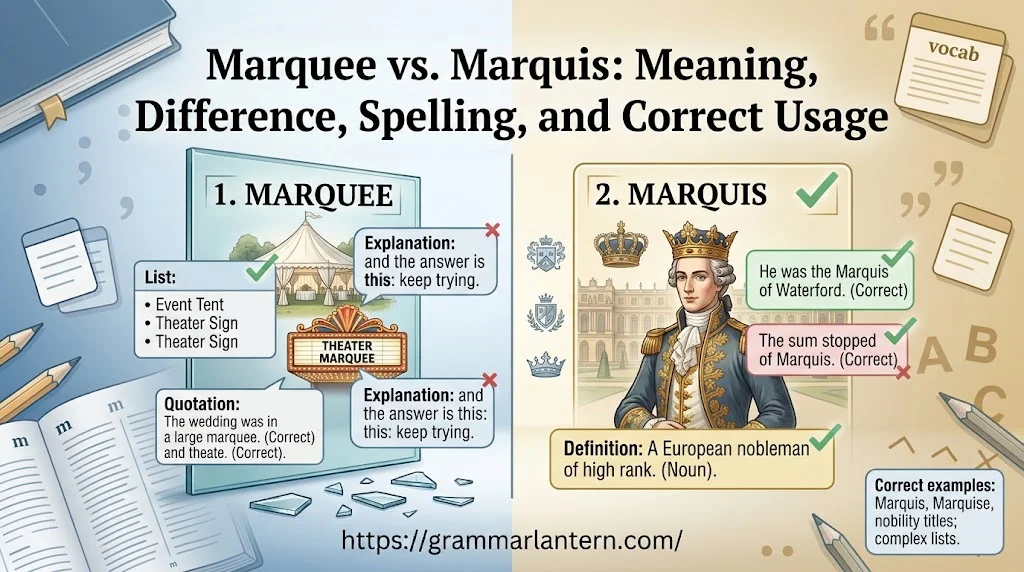
When learning English, I found Marquee vs. Marquis confusing because these words sound identical but have different meanings. Marquee refers to a large structure, tent, or canopy used for outdoor events, weddings, and marketing. It may also hang over the entrance of a theater, hotel, or stadium, where it advertises a movie, play, or entertainer.
Marquis, also spelled marquess, is a noble title from European history and aristocracy. A marquis is a nobleman whose rank is below a duke and above a count. Although both words share French roots, their meanings belong to completely different worlds.
As a writer, I learned that context makes the difference clear. A marquee relates to architecture, commercial spaces, films, and events, while marquis relates to royal courts, history, and aristocratic titles. Recognizing this distinction helps me write more precisely and confidently.
Quick Answer
The quickest way to remember the difference is this:
- Marquee means a large tent, a theater or venue sign, or something prominent or high-profile.
- Marquis means a nobleman of a particular aristocratic rank.
- Marquess is the usual British spelling for the corresponding noble title.
- Marquee is commonly connected with events, theaters, entertainment, sports, and major attractions.
- Marquis belongs mainly to historical, aristocratic, and literary contexts.
| Word | Meaning | Common Context | Example |
| Marquee | Large tent | Weddings, parties, outdoor events | We rented a marquee for the reception. |
| Marquee | Theater or venue sign | Movies, plays, entertainment | Her name appeared on the theater marquee. |
| Marquee | Prominent or high-profile | Sports, business, entertainment | He became the team’s marquee player. |
| Marquis | Nobleman | History, aristocracy, literature | The marquis attended the royal ceremony. |
| Marquess | British noble title | British peerage | The marquess inherited the title. |
So, if you’re talking about a tent or a major attraction, choose marquee. If you’re talking about an aristocratic title, choose marquis or marquess, depending on the context.
What Does Marquee Mean?
The word marquee has several established meanings. Its exact meaning depends on how someone uses it in a sentence.
Marquee as a Large Tent
In British English especially, a marquee can mean a large temporary tent used for an outdoor event. These structures often provide covered space for dining, entertainment, receptions, exhibitions, or celebrations.
Imagine a garden wedding with rows of tables beneath a large elegant structure. That structure can be called a marquee.
For example:
- The guests gathered inside the marquee after the ceremony.
- They decorated the marquee with flowers and hanging lights.
- The company hired a large marquee for its annual celebration.
- Heavy rain forced the organizers to move the dinner into the marquee.
This meaning is particularly common in British usage.
Marquee as a Theater or Venue Sign
In American English, marquee commonly refers to the structure or sign above the entrance of a theater or similar entertainment venue.
A traditional theater marquee might display:
- The name of a movie
- The title of a play
- The name of a performer
- A special event
- Showtimes or promotional information
For example:
The new film’s title appeared in bright letters on the theater marquee.
This meaning connects naturally with entertainment because the marquee tells people what’s happening inside.
Marquee as an Adjective
Here’s where marquee takes on a more figurative meaning.
As an adjective, marquee can describe someone or something that has major name recognition and attracts attention. In simple terms, it means big-name, leading, or highly prominent.
You may encounter expressions such as:
- marquee player
- marquee athlete
- marquee event
- marquee attraction
- marquee signing
- marquee performer
- marquee matchup
For example:
The championship game became the marquee event of the season.
Here, marquee doesn’t mean a tent. It means the event is one of the biggest or most anticipated attractions.
Similarly:
The club signed a marquee player during the offseason.
The phrase suggests that the player has enough reputation or star power to attract attention.
Read More: Remanent vs Remnant: Meaning and Differences Explained
What Does Marquis Mean?
Marquis is a noun associated with European aristocracy. It traditionally refers to a nobleman holding a particular rank.
The word commonly appears in historical accounts, biographies, novels, period dramas, and discussions about European nobility.
For example:
The marquis arrived at the estate shortly before sunset.
Here, marquis identifies the man’s social or hereditary rank. It has nothing to do with a tent, theater sign, or famous athlete.
Marquis as a Noble Title
Historically, aristocratic systems used different titles to establish rank and status. A marquis or marquess occupied a high position within the nobility.
In the British peerage hierarchy, a marquess ranks:
Duke → Marquess → Earl → Viscount → Baron
That ranking matters because it explains why the word often appears in historical writing alongside titles such as duke, earl, and baron.
However, noble titles developed differently across European countries. You shouldn’t assume that every country used precisely the same hierarchy or rules.
Where You’ll See Marquis
Modern readers are most likely to encounter marquis in contexts such as:
- European history
- Historical biographies
- Aristocratic families
- Historical fiction
- Period dramas
- Literature
- Discussions of noble titles
For example:
The marquis owned a large estate outside the city.
The context immediately signals aristocracy.
What’s the Real Difference?
The central difference is semantic rather than grammatical.
Marquee belongs to the world of events, entertainment, structures, and prominence.
Marquis belongs to the world of aristocracy and noble titles.
Consider these two sentences:
The guests entered the marquee.
The guests greeted the marquis.
The spelling differs by only a few letters. The meanings couldn’t be more different.
The first sentence describes a structure. The second identifies a nobleman.
| If you’re talking about… | Use |
| A large event tent | Marquee |
| A theater sign | Marquee |
| A major attraction | Marquee |
| A star athlete | Marquee |
| A prominent event | Marquee |
| A European nobleman | Marquis |
| A historical aristocratic title | Marquis |
| A British peerage title | Marquess |
Pronunciation
Pronunciation can make these words even more confusing.
In American English, marquee is pronounced with the stress toward the end:
marquee: /mɑrˈkiː/
The word sounds like the final part of a familiar word such as key.
Marquis has more than one established pronunciation depending on context and regional usage. A common English pronunciation is:
marquis: /ˈmɑr.kwɪs/
A French-influenced pronunciation may sound different from the common English reading.
The safest approach is to pay attention to context. If you’re reading about a noble title, marquis is probably the word in question. If you’re reading about a theater, sports event, or outdoor reception, marquee is likely correct.
Etymology
The two words have interesting histories. Their modern meanings are distinct, but their linguistic backgrounds help explain why they look so similar.
History of Marquee
Marquee entered English through French. Its earlier history connected it with a tent or canopy associated with prominent people or military settings.
Over time, English usage developed beyond the physical structure.
The word eventually became associated with the prominent canopy or sign placed above a theater entrance. From that sense came the modern figurative use of marquee for something or someone that attracts attention.
That’s why a marquee player isn’t literally standing beneath a theater sign. The expression draws on the idea of a name important enough to appear prominently on one.
History of Marquis
Marquis developed from older European terms associated with a nobleman connected with a border territory or march.
The title reflected a historical political and military role. Border regions often had strategic importance, so rulers appointed powerful nobles to govern or defend them.
The title later became part of broader European systems of aristocratic rank.
This history explains why marquis has nothing to do with theater signs or event tents despite its visual similarity to marquee.
Marquis vs. Marquess: Are They the Same?
This is where another spelling enters the picture.
Marquis and marquess refer to the same general noble rank in different usage traditions. The British form is commonly marquess, while marquis appears in French and other historical or international contexts.
For example:
The British marquess attended the ceremony.
In historical writing about France, Spain, or other European settings, you may encounter:
The marquis arrived at the royal court.
The distinction isn’t simply about spelling preference in every situation. Titles can be tied to a specific country’s historical system.
Marquis vs. Marquess Comparison
| Word | Typical use |
| Marquis | European and international historical contexts |
| Marquess | British peerage |
| Marquee | Tents, theater signs, prominent attractions |
A useful rule is to preserve the established title used for the person or historical figure you’re discussing.
Examples
It make the difference much easier to remember.
Examples With Marquee
Event tent:
The wedding reception took place inside a beautifully decorated marquee.
Theater sign:
The actor’s name appeared on the theater marquee.
Major attraction:
The festival’s marquee attraction drew thousands of visitors.
Sports:
The tournament featured several marquee players.
Entertainment:
The singer became the marquee performer at the summer festival.
Each sentence uses marquee because the context involves a structure, entertainment, prominence, or star power.
Examples With Marquis
Historical context:
The marquis controlled a large estate during the period.
Aristocracy:
The young marquis inherited his father’s title.
Literature:
The novel introduces a mysterious marquis who lives in an isolated castle.
Historical biography:
The marquis played an important role in the political negotiations.
These examples use marquis because the word identifies a nobleman.
Common Mistakes
These words create several predictable spelling mistakes.
Mistake: Using Marquis for a Tent
Incorrect:
We rented a marquis for the outdoor reception.
Correct:
We rented a marquee for the outdoor reception.
A tent is a marquee.
Mistake: Using Marquee for a Nobleman
Incorrect:
The marquee inherited the family estate.
Correct:
The marquis inherited the family estate.
A nobleman is a marquis in contexts where that title is appropriate.
Read More: Seak vs Seek: Which Spelling Is Correct?
Mistake: Confusing Marquis With Marquess
Both marquis and marquess can refer to the same general aristocratic rank. However, marquess is the conventional British form.
Therefore, don’t automatically change one spelling to the other without considering the historical or regional context.
Mistake: Assuming Similar Spelling Means Similar Meaning
English contains many words that look alike but have unrelated modern meanings.
Marquee and marquis are a good example.
Their spellings are close enough to cause confusion. Their meanings are far enough apart that context usually resolves the problem.
Marquee vs. Marquis in American English
American English frequently uses marquee in entertainment and sports.
You’ll commonly see expressions such as:
- marquee event
- marquee player
- marquee matchup
- marquee attraction
- theater marquee
The noble title marquis also appears in American English, particularly in historical writing and references to European aristocracy.
For example:
The museum displayed a portrait of a French marquis.
The word doesn’t describe an American rank. It refers to the historical European title.
In British English
British English gives marquee an especially familiar meaning: a large temporary tent used for events.
For example:
They installed a marquee in the garden for the wedding.
British English also commonly uses marquess for the relevant noble title.
This creates an especially useful three-word distinction:
- Marquee = event tent, theater sign, or prominent attraction
- Marquess = British noble title
- Marquis = corresponding title in other European or historical contexts
That distinction helps prevent a surprisingly common spelling mix-up.
Marquise: Another Word You Should Know
There’s one more related word worth knowing: marquise.
In French-derived aristocratic usage, marquise can refer to the feminine form associated with marquis.
However, marquise has another completely different meaning in jewelry. A marquise-cut gemstone has an elongated shape with pointed ends.
For example:
She wore a ring with a marquise-cut diamond.
So the family of similar-looking words becomes:
| Word | Meaning |
| Marquee | Tent, theater sign, or prominent attraction |
| Marquis | Nobleman |
| Marquess | British form of the noble title |
| Marquise | Feminine aristocratic title or elongated gemstone cut |
This is one reason spelling matters so much. A single letter can move the word into an entirely different semantic category.
Case Study: Choosing the Right Word
Imagine a travel writer describing a historic European wedding.
The writer wants to say that the guests entered a large temporary structure before mentioning a nobleman attending the event.
Two sentences might appear:
Guests gathered beneath the marquee before dinner.
Later, the marquis arrived at the reception.
Both words are correct because each matches its context.
Now imagine replacing them:
Guests gathered beneath the marquis before dinner.
The sentence becomes nonsensical because a person cannot serve as the event tent.
Likewise:
Later, the marquee arrived at the reception.
The sentence makes no sense if the writer intends to identify a nobleman.
Context acts like a compass. When you’re unsure, ask what the word actually describes.
How to Remember
A simple memory trick can save you from repeated spelling mistakes.
Think of marquee as connected to movies and major events.
A theater has a marquee. A major sports event can be marquee. An outdoor celebration can take place inside a marquee.
Think of marquis as connected to monarchy and nobility.
A marquis is a person with a noble title.
You can also use this quick test:
- Can people stand inside it? → Marquee
- Can it display a movie title? → Marquee
- Can it describe a star player? → Marquee
- Is it a noble title? → Marquis
- Is it a British peerage title? → Marquess
It’s a small distinction with a big payoff.
Which Word Should You Use?
When you’re writing, use the surrounding meaning to choose the correct word.
| Situation | Correct Word |
| Wedding tent | Marquee |
| Outdoor reception tent | Marquee |
| Theater sign | Marquee |
| Main attraction | Marquee |
| Star athlete | Marquee |
| Major event | Marquee |
| European nobleman | Marquis |
| Historical aristocratic title | Marquis |
| British noble title | Marquess |
The most important point is simple: marquee and marquis aren’t interchangeable.
FAQs
1. What is the main difference between marquee and marquis?
Marquee usually refers to a large tent, canopy, or sign outside a building, while marquis refers to a European nobleman whose rank is below a duke and above a count.
2. Is marquee a noun?
Yes. Marquee is mainly used as a noun. It can describe a large outdoor tent, a canopy over an entrance, or a sign displaying information about a movie, theater, or event.
3. What does marquis mean?
A marquis is a nobleman who traditionally holds a rank in the European aristocracy below a duke and above a count. Marquess is another spelling, especially common in British English.
4. Are marquee and marquis homophones?
Yes. In many varieties of English, marquee and marquis are pronounced almost identically or identically, even though their meanings and spellings are different.
5. How do you use marquee in a sentence?
You can say, “The guests gathered under the marquee during the wedding.” You can also use it for a theater sign, such as, “The movie title appeared on the theater marquee.”
6. How do you use marquis in a sentence?
For example: “The marquis owned several large estates in France.” Here, marquis refers to the person’s aristocratic title.
7. Is marquess the same as marquis?
Yes. Marquess is an alternative spelling of marquis. The spelling marquess is particularly associated with British usage, while marquis is widely used in other contexts.
8. Why are marquee and marquis often confused?
They are commonly confused because they have very similar pronunciation and share French historical roots. However, their meanings developed in completely different contexts.
9. What is the plural of marquee?
The plural of marquee is marquees. For example, “Several marquees were set up for the outdoor festival.”
10. What is the easiest way to remember marquee vs. marquis?
Think of marquee as something connected with a building, event, tent, or theater sign. Think of marquis as a noble title. Remembering the context makes the spelling much easier.
Conclusion
Understanding Marquee vs. Marquis becomes simple once you connect each word with its meaning. Marquee belongs to events, tents, canopies, theaters, and signs, while marquis belongs to European history and aristocratic titles. Although they sound alike, they should never be treated as interchangeable words.
The easiest way to avoid confusion is to focus on context rather than pronunciation. When you are talking about a large tent, an entrance canopy, or a theater sign, choose marquee. When you mean a nobleman with a specific historical rank, choose marquis or marquess.



[…] Read More: Marquee vs. Marquis: Meaning, Difference and Usage […]