
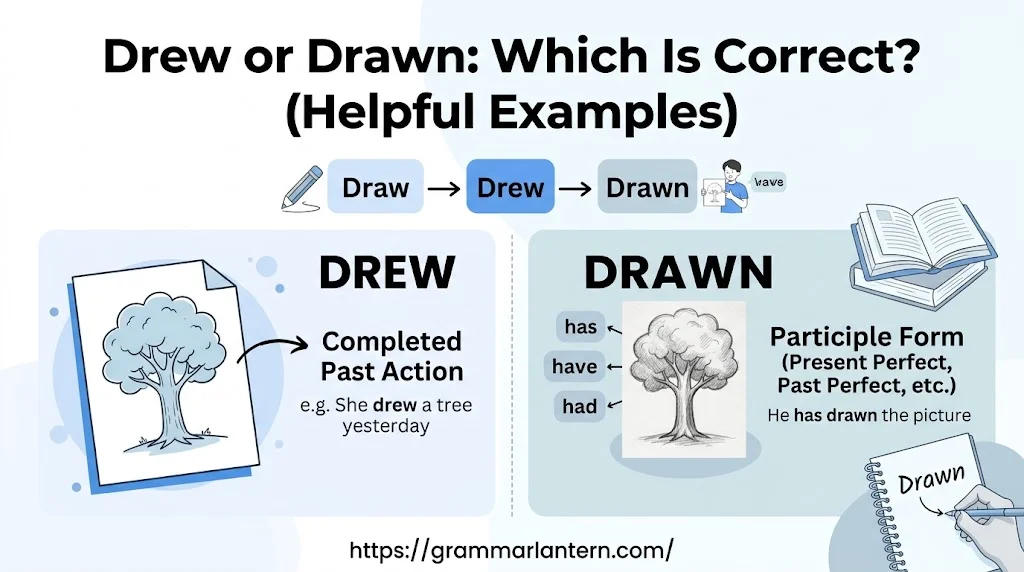
When you write about something that happened in the past, choosing the correct past tense forms of draw can make your writing much clearer. Drew or Drawn can seem confusing at first, but the rule is simple. Drew is the simple past tense of the irregular verb draw. You can use it alone in a sentence without any additions. For example, “She drew a picture yesterday.” This grammatical form clearly shows that the action happened in the past.
Drawn, on the other hand, is the past participle form. It usually needs an auxiliary verb and can be used with the three perfect tenses. For example, “She has drawn a picture.” Here, the words are combined to create the perfect form. This difference in sentence structure changes the meaning, which is why understanding the grammatical usage matters.
In everyday English grammar, I find that using these forms becomes much easier once you understand their roles. If you understand when each word is used, you won’t have to worry about getting it wrong in the future. Avoid incorrectly choosing drawn when you mean drew. Instead, choose each form correctly according to the sentence and the action you want to describe. This article will explore that distinction further.
Quick Answer
Drew is the simple past tense of draw. Drawn is the past participle of draw.
Here’s the quickest way to remember the difference:
| Word | Verb form | Main use | Example |
| Draw | Base form | Present tense, infinitives, after auxiliaries | “I draw every day.” |
| Drew | Simple past | Completed past actions | “I drew yesterday.” |
| Drawn | Past participle | Perfect and passive constructions | “I have drawn many pictures.” |
So, if you’re describing something that happened in the past, use drew:
“Maya drew a beautiful landscape last night.”
If you’re using has, have, or had, use drawn:
“Maya has drawn several landscapes.”
There’s one more important pattern. Drawn also appears in passive constructions:
“The portrait was drawn by Maya.”
The basic pattern is:
draw → drew → drawn
What Does “Drew” Mean?
Drew is the simple past form of draw. It describes an action that happened and was completed at a particular point in the past.
Unlike drawn, it can normally function as the main verb without another helping verb.
For example:
- “He drew a map.”
- “She drew the curtains.”
- “The speaker drew a large crowd.”
- “Tom drew a card from the deck.”
- “The boat drew closer to the shore.”
Each sentence describes something that happened in the past.
The meaning of draw can change depending on context, but drew remains its simple past form.
Examples of “Drew” in Sentences
Consider these examples:
Drawing a picture
“Lena drew a picture of her dog.”
The drawing happened in the past.
Pulling something
“He drew the curtains before going to bed.”
Here, draw means to pull or close the curtains.
Attracting attention
“The unusual painting drew everyone’s attention.”
Here, drew means attracted.
Taking something
“She drew a card from the deck.”
In this sentence, drew means selected or took a card.
Moving closer
“The train drew closer to the station.”
Here, drew describes movement toward something.
The different meanings may look unrelated at first. Grammatically, however, they all follow the same past-tense pattern.
Read More: Tapped vs Taped: Difference, Meaning, and Usage Explained
What Does “Drawn” Mean?
Drawn is the past participle of draw. It generally appears with another verb that helps establish the grammatical structure.
The most common examples involve has, have, had, was, and were.
For example:
- “She has drawn a portrait.”
- “They have drawn several conclusions.”
- “He had drawn a map.”
- “The picture was drawn by a child.”
- “Several conclusions were drawn from the evidence.”
Notice something important: drawn doesn’t normally act as the simple past tense by itself.
You wouldn’t normally write:
“She drawn a picture yesterday.”
Instead, write:
“She drew a picture yesterday.”
However, this works:
“She has drawn a picture.”
The helping verb has creates the perfect construction, so the past participle drawn is required.
The Main Difference
The easiest way to understand drew vs. drawn is to focus on their grammatical jobs.
Drew stands on its own as the simple past form.
Drawn works as a past participle and typically needs a helping verb in perfect constructions or passive voice.
| Feature | Drew | Drawn |
| Verb form | Simple past | Past participle |
| Can be the main past-tense verb? | Yes | Usually no |
| Used with has/have/had? | No | Yes |
| Used in passive constructions? | No | Yes |
| Example | “She drew a flower.” | “She has drawn a flower.” |
| Example | “He drew attention.” | “He has drawn attention.” |
A useful shortcut is to look at the word immediately before the verb.
If you see has, have, or had, drawn is usually the correct choice.
If you’re simply describing a completed past action, drew is usually right.
Draw, Drew, and Drawn: Complete Verb Forms
The verb draw is irregular. That means its past forms don’t follow the regular -ed pattern.
You don’t say drawed in standard English.
Instead, the three principal forms are:
| Verb form | Name | Example |
| Draw | Base form | “I draw every morning.” |
| Drew | Simple past | “I drew this yesterday.” |
| Drawn | Past participle | “I have drawn this before.” |
This three-form pattern is worth memorizing:
Draw → Drew → Drawn
You’ll see the same basic pattern in many irregular English verbs:
- Go → went → gone
- See → saw → seen
- Write → wrote → written
- Take → took → taken
- Draw → drew → drawn
Learning irregular verbs as a group of three can make English grammar much easier to remember.
When Should You Use “Drew”?
Use drew when you’re talking about a completed action in the past.
This often happens when the sentence includes a specific past-time expression.
Common signals include:
- yesterday
- last night
- last week
- last month
- two days ago
- earlier
- in 2022
- when I was younger
- this morning, when the morning has ended
For example:
“I drew that picture yesterday.”
“She drew a map last night.”
“The artist drew the character in 2021.”
The important point isn’t the presence of a time expression alone. The sentence structure matters too. Drew is the simple past form, so it describes a completed past event.
More Examples With “Drew”
“James drew a cartoon for his little brother.”
“The announcement drew criticism from several readers.”
“She drew a line across the page.”
“The child drew a circle on the board.”
“The team drew thousands of supporters to the stadium.”
Each example describes something that happened in the past.
When Should You Use “Drawn”?
Use drawn when the grammar requires the past participle.
The most common structure is the perfect tense.
Present Perfect
Use has/have + drawn.
“She has drawn five portraits this month.”
“They have drawn several conclusions from the experiment.”
The present perfect connects a past action to the present in some way.
Past Perfect
Use had + drawn.
“She had drawn the picture before dinner.”
The drawing happened before another past event.
Future Perfect
Use will have + drawn.
“By Friday, he will have drawn ten illustrations.”
The action will be completed before a specified future point.
Passive Voice
Use a form of be + drawn.
“The portrait was drawn by a professional artist.”
“Several conclusions were drawn from the results.”
Here, drawn doesn’t describe who performed the action as the main focus. Instead, the sentence focuses on what received the action.
Common Mistakes
These two words often cause trouble because English uses different forms of irregular verbs in different structures.
“I Have Drew a Picture”
This is incorrect.
Have requires the past participle in this construction.
Correct:
“I have drawn a picture.”
The structure is:
have + past participle
Therefore:
have + drawn
Not:
have + drew
“She Drawn a Picture Yesterday”
This is also incorrect.
The sentence describes a completed past action and doesn’t have a helping verb that requires a past participle.
Correct:
“She drew a picture yesterday.”
The structure is simply:
subject + simple past verb
“They Had Drew a Map”
This sentence contains the wrong verb form after had.
Correct:
“They had drawn a map.”
The structure is:
had + past participle
Therefore, drawn is required.
“He Drawn the Picture Last Night”
The phrase last night points to a completed past event. Without a helping verb, use drew.
Correct:
“He drew the picture last night.”
Drew vs. Drawn in Different Meanings of “Draw”
One reason draw can be confusing is that it has many meanings.
Fortunately, its grammatical forms don’t change with the meaning.
Draw a Picture
“Emma drew a picture of a mountain.”
“Emma has drawn several mountain scenes.”
Draw the Curtains
“He drew the curtains before sunrise.”
“He had drawn the curtains before the guests arrived.”
Draw Attention
“The mistake drew attention.”
“The mistake has drawn attention.”
Draw a Card
“She drew a card from the deck.”
“She has drawn the ace.”
Draw a Conclusion
“The researchers drew a conclusion from the evidence.”
“The researchers have drawn several conclusions.”
The meaning changes with context, but the verb forms follow the same grammatical rules.
“Drew” vs. “Drawn” in Questions and Negative Sentences
Questions and negative sentences introduce another useful rule.
When did appears in a question or negative statement, use the base form draw, not drew.
For example:
“Did she draw this picture?”
Not:
“Did she drew this picture?”
Why? Because did already marks the past tense. The main verb returns to its base form.
The same principle applies to negative sentences:
“She didn’t draw this picture.”
Not:
“She didn’t drew this picture.”
Compare that with the perfect construction:
“Has she drawn this picture?”
The three structures look similar, but each requires a different verb form:
| Structure | Correct example |
| Simple past | “She drew it.” |
| Past question | “Did she draw it?” |
| Past negative | “She didn’t draw it.” |
| Present perfect | “She has drawn it.” |
| Past perfect | “She had drawn it.” |
This is one of the most useful distinctions to remember.
In Passive Sentences
Passive sentences commonly use drawn, not drew.
Consider:
“Sarah drew the portrait.”
This is active voice. Sarah performs the action.
Now change the focus:
“The portrait was drawn by Sarah.”
This is passive voice. The portrait becomes the focus of the sentence.
The same difference appears with other meanings of draw.
Active:
“The researchers drew several conclusions.”
Passive:
“Several conclusions were drawn from the evidence.”
The passive construction uses a form of be followed by the past participle.
That’s why drawn fits naturally after was, were, is, or are when the sentence uses passive voice.
“Drew” vs. “Drawn” With “Draw Attention”
The phrase draw attention deserves special attention because it appears frequently in everyday and academic writing.
Compare these sentences:
“The unusual design drew attention.”
This describes a completed past event.
“The unusual design has drawn attention.”
This uses the present perfect and connects the past event to the present.
“The unusual design will draw attention.”
This describes a future possibility.
The noun phrase remains the same. Only the verb form changes.
| Time or structure | Correct form | Example |
| Present | draw | “The design draws attention.” |
| Past | drew | “The design drew attention.” |
| Present perfect | drawn | “The design has drawn attention.” |
| Future | draw | “The design will draw attention.” |
This example shows why memorizing a single rule isn’t enough. You need to recognize the sentence structure.
A Practical Comparison of Draw, Drew, and Drawn
When you’re unsure, use the structure around the verb as your clue.
| Sentence pattern | Correct form | Example |
| I/you/we/they + present action | draw | “They draw every day.” |
| He/she/it + present action | draws | “She draws portraits.” |
| Completed past action | drew | “She drew yesterday.” |
| Did + subject | draw | “Did she draw this?” |
| Didn’t + subject | draw | “She didn’t draw this.” |
| Has/have + past participle | drawn | “She has drawn this.” |
| Had + past participle | drawn | “She had drawn this.” |
| Will have + past participle | drawn | “She will have drawn this.” |
| Be + past participle | drawn | “It was drawn by hand.” |
The table reveals an important pattern: auxiliary verbs often tell you which form to choose.
How to Remember the Difference
A simple memory trick can save you from many mistakes.
Think of drew as the word for a finished past action:
Yesterday → drew
Think of drawn as the form that usually needs grammatical support:
Has/have/had → drawn
And in passive constructions:
Was/were + drawn
So remember:
Drew = simple past
Drawn = past participle
If you’re writing a sentence and see has, have, or had, pause for a moment. In most ordinary perfect constructions, drawn is the form you need.
Practice: Choose Drew or Drawn
Try these sentences before checking the answers.
- Maria ___ a picture yesterday.
- Daniel has ___ three portraits this week.
- The artist ___ the landscape last summer.
- Several conclusions were ___ from the data.
- She had ___ a map before the journey began.
- The unusual performance ___ a large crowd.
- The students have ___ several diagrams.
- He ___ a card from the deck.
- The portrait was ___ by a young artist.
- Did you ___ this picture yourself?
Answer Key
- drew — The sentence describes a completed past action.
- drawn — Has requires the past participle.
- drew — Last summer refers to a completed past period.
- drawn — The sentence uses passive voice with were.
- drawn — Had requires the past participle.
- drew — The sentence uses the simple past.
- drawn — Have requires the past participle.
- drew — This is a completed action in the past.
- drawn — Passive voice requires the past participle.
- draw — Did already marks the sentence as past tense.
A Quick Test
When you’re editing your writing, ask three questions.
First, is the sentence describing a completed past action?
If yes, drew may be correct.
“She drew the picture yesterday.”
Second, does the sentence contain has, have, or had?
If yes, you generally need drawn.
“She has drawn the picture.”
Third, is the sentence passive?
If a form of be introduces the verb, drawn may be required.
“The picture was drawn yesterday.”
There’s a useful fourth question, too:
Does the sentence contain did or didn’t?
If it does, use the base form draw.
“Did she draw it?”
“She didn’t draw it.”
This four-question check can catch most common errors quickly.
Read More: 6 Good Ways To Spell a Whistle Sound and Onomatopoeia
FAQs
1. Is “drew” the past tense of “draw”?
Yes. Drew is the simple past tense of draw. You use it for an action that happened and finished in the past.
2. Is “drawn” the past tense of “draw”?
No. Drawn is the past participle of draw. It usually needs an auxiliary verb such as “has,” “have,” or “had.”
3. What is the difference between drew and drawn?
Drew works as the simple past, while drawn is used as a past participle. For example, “She drew a cat” and “She has drawn a cat.”
4. Can I use “drew” by itself?
Yes. Drew can stand alone as the main verb in a past-tense sentence. You don’t need an auxiliary verb with it.
5. Can “drawn” be used alone?
Usually, no. Drawn normally works with an auxiliary verb in a perfect tense, such as “He has drawn a picture.”
6. Is “I have drew” correct?
No. The correct sentence is “I have drawn.” After “have” or “has,” you need the past participle drawn.
7. Is “I drew a picture” correct?
Yes. “I drew a picture” is grammatically correct because drew is the simple past tense of draw.
8. Is “I had drawn” correct?
Yes. “I had drawn” uses drawn correctly as the past participle after the auxiliary verb “had.”
9. What tense is “has drawn”?
“Has drawn” is the present perfect tense. Has is the auxiliary verb, and drawn is the past participle.
10. How can I remember drew vs. drawn?
A simple trick is to remember: drew = simple past, while drawn = past participle. If you see “has,” “have,” or “had,” drawn is usually the right choice.
Conclusion
Understanding drew and drawn doesn’t have to be difficult. Drew is the simple past form, while drawn is the past participle. Once you know how each form works, choosing the right one becomes much more natural.
When you’re talking about a completed action in the past, use drew. When an auxiliary verb such as “has,” “have,” or “had” comes before the verb, use drawn. Keep this simple distinction in mind, and you’ll be much less likely to mix them up.

For Shafiq ur Rehman, writing is an art form and grammar is the toolbox that makes it beautiful. As a dedicated content writer at Grammar Lantern, Shafiq approaches every topic like an architect carefully laying down strong foundations of understanding before adding the finer details. He loves diving into the trickiest grammar points and resurfacing with simple, bite-sized takeaways that anyone can grasp. When he’s not crafting articles, you’ll likely find him strategizing over a game of chess, exploring dusty local bookshops, or quietly jotting down poetic observations in his notebook.



[…] Read More: Drew or Drawn: Which Is Correct? […]
[…] Read More: Drew or Drawn: Which Is Correct? […]