Seeing vs. Seing explains a common English spelling confusion where people check the correct form, avoid mistakes, and improve clear writing. English spelling can feel like walking through a maze while blindfolded because one wrong turn can make a perfectly normal word appear suspicious.
This often happens when people type quickly, and autocorrect misses the mistake, causing confusion to spread through emails, email messages, blog posts, and post writing. The simple truth is that seeing is correct, while seing is incorrect.
This tiny mistake connects with grammar, English grammar, rules, vowel patterns, pronunciation, typing behavior, and search engine trends. Many writers pause while wondering if they need one or two e letters, but they are not alone.
This guide helps learners understand the real difference, remember why seeing keeps both letters, and use examples in sentences to build a strong memory connection. These tricks help native speakers and learners avoid future errors and stop second-guessing the word.
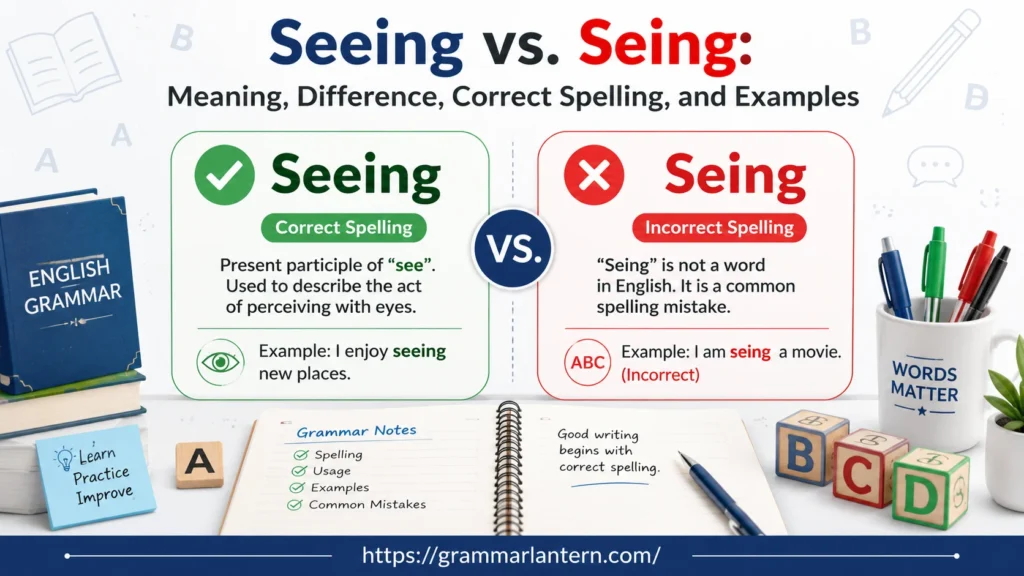
Quick Answer: Seeing vs. Seing:
Seeing is the correct spelling.
- ✅ Seeing = the present participle or gerund form of the verb see
- ❌ Seing = an incorrect spelling that is not accepted in standard English
Examples:
✅ Correct: I am seeing my friend tomorrow.
❌ Incorrect: I am seing my friend tomorrow.
The reason is that see keeps both “e” letters when adding “-ing.”
Correct:
see → seeing
Incorrect:
see → seing
What Does Seeing Mean?
Seeing is the -ing form of the verb see. It describes the action of noticing something through your eyes, understanding something, or meeting someone.
The meaning of seeing changes depending on how it appears in a sentence.
For example:
- I am seeing a beautiful sunset.
- She is seeing a doctor tomorrow.
- I am seeing your point now.
In each sentence, “seeing” has a slightly different meaning.
Seeing as the Act of Using Your Eyes
The most common meaning of seeing relates to vision. It describes the ability to notice something visually.
Examples:
- I am seeing a bird in the garden.
- Are you seeing the same thing I am seeing?
- She is seeing the ocean for the first time.
When you see something, your eyes collect information and your brain interprets what you observe. This process allows you to recognize objects, people, colors, and movements.
Seeing as Understanding or Realizing Something
English speakers also use seeing to describe understanding an idea or recognizing a situation.
Examples:
- Now I see why you were angry.
- I am seeing the problem more clearly.
- After the explanation, he started seeing the bigger picture.
In these examples, seeing does not involve physical vision. Instead, it means gaining knowledge or understanding.
It is similar to when a confusing puzzle suddenly makes sense. You do not physically see the answer, but your mind recognizes the connection.
Visit for More: Stripping vs Striping: Explained with Examples
Seeing as Meeting or Spending Time With Someone
The word seeing can also mean meeting someone regularly or being involved with someone.
Examples:
- I am seeing my cousin this weekend.
- She has been seeing someone for a few months.
- I am seeing my manager tomorrow.
In these situations, seeing means spending time with or visiting someone.
What Does Seing Mean?
Seing is not a correct English word in standard usage.
People usually write “seing” because they apply a spelling rule incorrectly. They know that many verbs remove their final “e” before adding “-ing”, so they assume:
- see → seing
However, this spelling is wrong.
The correct form is:
- see → seeing
Although “seing” may look logical, English spelling does not always follow one simple rule. Some words keep their original spelling when adding endings.
Seeing vs. Seing: Key Difference Explained
The main difference between seeing and seing is accuracy.
| Word | Correct or Incorrect | Meaning | Example |
| Seeing | Correct | Looking, noticing, understanding, or meeting | I am seeing a movie tonight. |
| Seing | Incorrect | No standard English meaning | I am seing a movie tonight. |
The easiest way to remember this is:
Seeing exists. Seing does not.
Why Is Seeing Spelled With Two E’s?
Many English learners struggle with this word because they know another common spelling rule:
Drop the final “e” before adding “-ing.”
This rule works for many verbs.
Examples:
| Base Word | Correct -ing Form |
| make | making |
| write | writing |
| dance | dancing |
| use | using |
| hope | hoping |
However, see is different.
The word already ends with two “e” letters. Removing one “e” would create an incorrect spelling.
Correct:
see + ing = seeing
Incorrect:
se + ing = seing
The same pattern appears in other words:
| Base Word | Correct Form |
| agree | agreeing |
| free | freeing |
| flee | fleeing |
These words keep their double vowels because removing a letter would change the correct spelling.
Grammar Forms of See
Understanding the different forms of see makes it easier to use seeing correctly.
| Grammar Form | Word | Example |
| Base form | see | I see the problem. |
| Past tense | saw | I saw the movie yesterday. |
| Past participle | seen | I have seen that place before. |
| Present participle | seeing | I am seeing a doctor today. |
Each form has a different purpose.
For example:
- See describes something happening generally.
- Saw describes something that happened in the past.
- Seen describes something completed.
- Seeing describes an ongoing action.
Seeing vs. Seen: What Is the Difference?
Many learners confuse seeing with seen because both come from the verb see.
However, they work differently.
Seeing
Seeing describes an action that is happening now or around the present time.
Examples:
- I am seeing my teacher today.
- She is seeing improvements in her work.
- They are seeing positive results.
Seen
Seen describes something that has already happened. It usually appears with helping verbs like have, has, or had.
Examples:
- I have seen that movie before.
- She has seen the results.
- We had seen the warning signs.
A simple memory trick:
Seeing = happening
Seen = completed
Common Mistakes With Seeing
Writing Seing Instead of Seeing
This is the most common mistake.
Incorrect:
I am seing a new opportunity.
Correct:
I am seeing a new opportunity.
The mistake happens because writers remember the “drop the e” rule but forget that some words are exceptions.
Confusing Seeing With Watching
Although these words have similar meanings, they are not always interchangeable.
| Word | Meaning | Example |
| Seeing | Noticing or experiencing something | I am seeing my doctor tomorrow. |
| Watching | Paying attention to something over time | I am watching a football game. |
| Looking | Directing your eyes toward something | Look at that building. |
Consider these examples:
- I am watching a movie tonight.
- You are focusing on the movie as it plays.
- I am seeing a movie tonight.
- You are going to experience a movie.
Both sentences can be correct, but the meaning changes.
Real-Life Examples of Seeing in Sentences
Everyday Examples
- I am seeing my family this weekend.
- Are you seeing what I mean?
- I am seeing a lot of changes recently.
- She is seeing a beautiful view from her room.
Workplace Examples
- The company is seeing higher sales this year.
- We are seeing improvements in customer satisfaction.
- Managers are seeing better teamwork among employees.
Academic Examples
- Researchers are seeing new patterns in the data.
- Students are seeing how grammar works through examples.
- Scientists are seeing changes in the environment.
Easy Ways to Remember Seeing
Remember “See Has Two E’s”
A simple trick is to connect the spelling with the meaning.
The word see contains two “e’s,” just like two eyes help you see.
Remember:
Two eyes = two e’s = seeing
Remember the Phrase “Seeing Is Believing”
The famous phrase:
“Seeing is believing.”
uses the correct spelling.
This phrase can help you remember that seeing always keeps both e’s.
FAQs
1. Is “seeing” the correct spelling in English?
Yes, seeing is the correct spelling in English. It is the present participle and gerund form of the verb see. The spelling keeps both “e” letters before adding “-ing,” which makes seeing the only standard form.
2. Is “seing” a real word?
No, seing is not considered a correct spelling in modern English. It is usually a spelling mistake caused by forgetting that the verb see keeps its double “e” when forming seeing.
3. Why do people confuse seeing and seing?
People often confuse these words because they sound similar when spoken. Quick typing, autocorrect mistakes, and unfamiliar English spelling rules can also make writers choose seing by accident.
4. Why does seeing keep two “e” letters?
The word seeing keeps two “e” letters because the double “e” is part of the base verb see. Unlike some verbs that remove a silent “e” before adding “-ing,” see follows a different spelling pattern.
5. What is the meaning of seeing?
Seeing refers to the action of using your eyes to notice something. It can also mean understanding, experiencing, observing, or meeting someone depending on the context.
6. Is seeing a verb or an adjective?
Seeing comes from the verb see. It can work as a present participle in sentences, such as “I am seeing a movie,” or as a gerund, such as “Seeing is believing.”
7. Do native English speakers use the word seing?
Native English speakers normally do not use seing in standard writing. They use seeing because it follows accepted English spelling rules and appears in dictionaries.
8. How can I remember the spelling of seeing?
A simple memory trick is to remember that see has two “e” letters, and those letters stay when you add “-ing.” Think: see + ing = seeing.
9. Can using seing affect my writing?
Yes, using seing can make your writing look incorrect or unprofessional. Correct spelling helps readers understand your ideas clearly and improves the quality of your communication.
10. Where can I check whether seeing or seing is correct?
You can check reliable dictionaries, grammar guides, and style references. These sources confirm that seeing is the accepted spelling and seing is a common mistake.
Conclusion
The difference between seeing vs. seing is simple once you understand the spelling rule behind the verb see. Seeing is always correct because the word keeps both “e” letters before adding “-ing,” while seing is an incorrect spelling that should be avoided in standard English writing.
Learning small spelling details like this can improve your confidence, writing accuracy, and communication skills. By remembering the rule and practicing the correct form, you can avoid this common mistake and use seeing naturally in every situation.