Stripping vs Striping often confuses writers because both words sound alike, yet each has a different meaning and use in everyday English writing.
I remember Many people compare striping vs stripping because the terms have similar pronunciation and appear alike in English language usage. From my experience reviewing writing for students, writers, and professionals, they remain one of the most commonly confused pairs in English. The easiest guide is to start with the root word. The verb to stripe means adding, creating, or applying stripes, lines, marks, and markings.
You can mark with stripes, create decorative stripes, white lines, and painted lines on a road, roads, parking lot, surface, flags, or athletic fields for road striping, road markings, pavement marking, parking, road safety, construction, design, signage, and many practical applications.
Think of striping as additive and stripping as subtractive. This small spelling difference completely changes the meaning, different meanings, and different uses of each proper word and correct word.
The striping meaning focuses on creating stripes, marking, applying paint, and guiding vehicles safely, while the stripping meaning focuses on remove, paint, wallpaper, or another band of material from a surface. A stripe is a long, narrow band, band of color, band of texture, or band of material, often used for decorative purposes or functional purposes.If you confuse stripping and striping, the description, act, or action can express the opposite idea, vice versa.
That is why it is important to clarify every case by referring to the distinct, distinct meanings, and entirely different ideas, using clear examples, describe the purposes, notice the contrasts, explore the topic deeper, dig deeper, and remember that functional markings and decorative designs each have their own terms, uses, applications, and practical value.
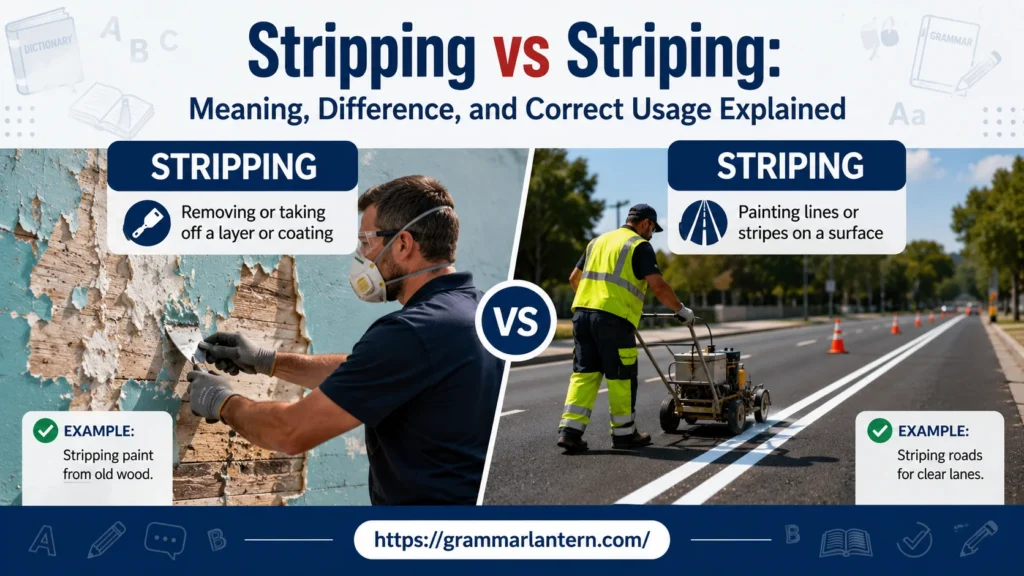
Quick Answer: Stripping vs Striping Difference
In short Stripping means removing something, such as paint, clothing, insulation, a covering, or unnecessary parts.
Striping means adding stripes, lines, or markings to something, such as roads, floors, vehicles, or clothing.
| Word | Meaning | Action | Example |
| Stripping | Removing a layer, covering, or material | Taking something away | The workers are stripping old paint from the door. |
| Striping | Adding stripes, lines, or markings | Putting something on | The city is striping the road after repairs. |
A simple way to remember:
- Stripping = removing
- Striping = adding stripes
What Does Stripping Mean?
Stripping is the “-ing” form of the verb strip. It means removing something from an object, surface, person, or situation.
The word focuses on taking something away. The removed item could be a physical layer like paint or wallpaper, or it could be something less visible like unnecessary information or extra costs.
For example:
“The company is stripping away unnecessary expenses.”
This does not mean the company is adding something. It means the company is removing costs.
Common Uses of Stripping
Stripping Paint and Coatings
One of the most common uses of stripping appears in home improvement and construction.
When someone removes an old layer of paint, varnish, or coating from a surface, they are stripping it.
Examples:
- Stripping paint from wooden furniture
- Stripping old wallpaper from walls
- Stripping a floor before applying a new finish
A restoration expert might say:
“The table needs stripping before we can apply a new stain.”
The meaning is clear: the old finish must be removed first.
Wire Stripping
In electrical work, wire stripping means removing the protective covering around electrical wires.
Electricians use special tools called wire strippers to remove insulation without damaging the metal inside.
Example:
“The electrician is stripping the wire before connecting it.”
Here, stripping has nothing to do with adding lines or colors. It refers to removing the outer layer.
Stripping Clothing or Coverings
The word can also describe removing clothing or another covering.
Examples:
- Stripping off a jacket
- Stripping a machine of its protective cover
- Stripping packaging from a product
The basic idea stays the same: something is being removed.
Figurative Meaning of Stripping
Stripping does not always involve physical objects. Writers often use it to describe removing unnecessary elements.
Examples:
- Stripping a story down to its main message
- Stripping away distractions
- Stripping a design of extra details
For example:
“The editor stripped the article of unnecessary information.”
The editor removed extra content to make the article clearer.
What Does Striping Mean?
Striping comes from the verb stripe. It means adding stripes, bands, or lines to a surface.
Unlike stripping, which removes something, striping creates a visible pattern or marking.
The purpose of striping is usually decoration, organization, identification, or safety.
Common Uses of Striping
Road and Parking Lot Striping
One of the most common examples of striping is road marking.
When workers paint lines on roads, parking spaces, or highways, they are striping the surface.
Examples:
- Parking lot striping
- Highway striping
- Crosswalk striping
- Lane striping
A construction company might advertise:
“We provide professional parking lot striping services.”
This means they create painted parking spaces and traffic markings.
Decorative Striping
Striping is also common in design and decoration.
People use stripes to improve appearance or create a specific style.
Examples:
- Striping on cars
- Decorative wall striping
- Sports uniform striping
- Furniture striping
A car enthusiast may add racing stripes to a vehicle. That process is called vehicle striping.
Safety Striping
Many workplaces use striping to improve safety.
Factories, warehouses, and parking areas often use painted lines to guide movement and mark important areas.
Examples:
- Yellow floor striping around dangerous areas
- Safety boundary striping
- Warehouse pathway striping
These markings help workers understand where they should walk or place equipment.
Read More: Stopped or Stoped: Meaning, Difference, and Usage
Stripping vs Striping: Key Differences Explained
Although these words look similar, their meanings are opposite in many situations.
| Feature | Stripping | Striping |
| Root word | Strip | Stripe |
| Main action | Removing | Adding |
| Purpose | Take away a layer or material | Create lines or patterns |
| Common industries | Construction, electrical, restoration | Roads, design, safety |
| Example phrase | Paint stripping | Road striping |
Think about it this way:
Imagine an old wooden chair.
- If you remove the old paint, you are stripping the chair.
- If you paint decorative lines on it, you are striping the chair.
The chair stays the same, but the action changes completely.
Stripping vs Striping Spelling Difference
The spelling difference creates much of the confusion.
How Stripping Is Formed
The word stripping comes from:
Strip + ing = stripping
The final letter “p” doubles before adding “-ing.”
Examples:
- Stop → stopping
- Run → running
- Strip → stripping
How Striping Is Formed
The word striping comes from:
Stripe + ing = striping
The silent “e” is removed before adding “-ing.”
Examples:
- Make → making
- Write → writing
- Stripe → striping
This small spelling rule creates two different words with completely different meanings.
Stripping vs Striping Examples in Sentences
Seeing both words in real sentences makes the difference easier to remember.
Examples of Stripping
- The workers are stripping the old paint before repainting the house.
- The electrician is stripping the wires carefully.
- She is stripping away unnecessary details from the report.
- The company is stripping the machine before repairs.
Examples of Striping
- The city is striping the roads after winter damage.
- The parking lot needs fresh striping.
- The designer added blue striping to the sports uniform.
- The warehouse uses floor striping for safety zones.
Common Mistakes With Stripping and Striping
Many people confuse these words because they sound nearly identical.
Mistake: Using Stripping for Painted Lines
Incorrect:
The workers are stripping the parking lot.
This sounds like workers are removing something from the parking lot.
Correct:
The workers are striping the parking lot.
They are adding painted parking lines.
Mistake: Using Striping for Removal
Incorrect:
The contractor is striping the old paint from the wall.
Correct:
The contractor is stripping the old paint from the wall.
The paint is being removed, not decorated with stripes.
How to Remember Stripping vs Striping Easily
A simple memory trick can prevent mistakes:
Strip = remove
Examples:
- Strip paint
- Strip wires
- Strip old flooring
Stripe = add lines
Examples:
- Stripe roads
- Stripe clothes
- Stripe vehicles
Another trick:
Think of a painter.
One worker removes old paint first. That is stripping.
Another worker adds decorative lines later. That is striping.
The two actions often happen in the same project but at different stages.
Stripping and Striping in Different Industries
Construction and Home Improvement
Both words appear frequently in construction.
Stripping examples:
- Removing old flooring
- Removing paint
- Removing damaged materials
Striping examples:
- Parking area markings
- Safety lines
- Floor organization markings
A renovation project may involve both processes:
- Workers strip the old surface.
- They prepare the area.
- They stripe the finished space if markings are needed.
Automotive Industry
Cars often use both terms.
Stripping:
- Removing old paint
- Removing protective coatings
- Removing decals
Striping:
- Adding racing stripes
- Creating decorative designs
- Applying vehicle graphics
Example:
A restoration shop may strip an old car before repainting it, then add custom striping afterward.
Electrical Work
Electrical professionals commonly use stripping.
Examples:
- Wire stripping
- Removing cable insulation
- Preparing wires for connections
Striping appears less often but may describe colored markings used to identify wires.
Roads and Transportation
Road work mainly uses striping.
Examples:
- Highway striping
- Parking space striping
- Bicycle lane striping
The goal is to organize traffic and improve safety.
FAQs
1. What is the difference between stripping and striping?
Stripping means removing a layer, coating, paint, wallpaper, or another material. Striping means adding stripes, lines, or markings to a surface.
2. Is it striping or stripping a parking lot?
The correct term is striping a parking lot because workers apply painted lines to mark parking spaces.
3. What does stripping mean?
Stripping refers to taking something away, such as paint, wallpaper, clothing, or another covering from a surface.
4. What does striping mean?
Striping means creating or applying stripes, lines, or markings for decorative or practical purposes, such as on roads or sports fields.
5. Why do people confuse striping and stripping?
The words look and sound similar, but they have different spellings and completely different meanings.
6. Is striping used only for roads?
No. Striping is also used for parking lots, warehouses, athletic fields, industrial floors, clothing designs, and many other surfaces.
7. Which word should I use when removing paint?
Use stripping because it describes the process of removing paint or another coating.
8. Which word relates to road markings?
Striping is the correct term because it refers to applying painted lines and markings on roads.
9. How can I remember the difference between stripping and striping?
Think of striping as adding stripes and stripping as taking something away. If you are applying lines, use striping. If you are removing a layer, use stripping.
10. Are stripping and striping interchangeable?
No. They are not interchangeable because each word describes a different action. Using the wrong one can completely change the meaning of your sentence.
Conclusion
Although stripping and striping differ by only one letter, they describe opposite actions. Striping is about adding lines, stripes, or markings, while stripping is about removing a layer, coating, or material. Knowing the difference helps you communicate more clearly, avoid common writing mistakes, and choose the right word in construction, design, maintenance, and everyday English. With a little practice, you’ll be able to use both terms confidently in the correct context.