Understanding Yours or Your’s or Yours’ starts with knowing the possessive form of you. It may seem less standard than expected, especially because nouns and pronouns can have a different interaction in a sentence. When providing an object alongside a pronoun, its position can change the grammar. This article helps explore these possessive forms and their use in a natural sentence.
The correct possessive form yours is used when the possessed object is already understood or mentioned. For example, “This book is yours” shows who the object belongs to. The word your is also possessive, but the object comes after it, as in “This is your book.”
Many common grammar mistakes happen because learners do not notice this important difference. Looking at the subject, object, and how each form works makes the rule easier. Through everyday writing and saying, I have found that regular practice helps these forms become natural and easier to remember.
Is “Yours” or “Your’s” Correct?
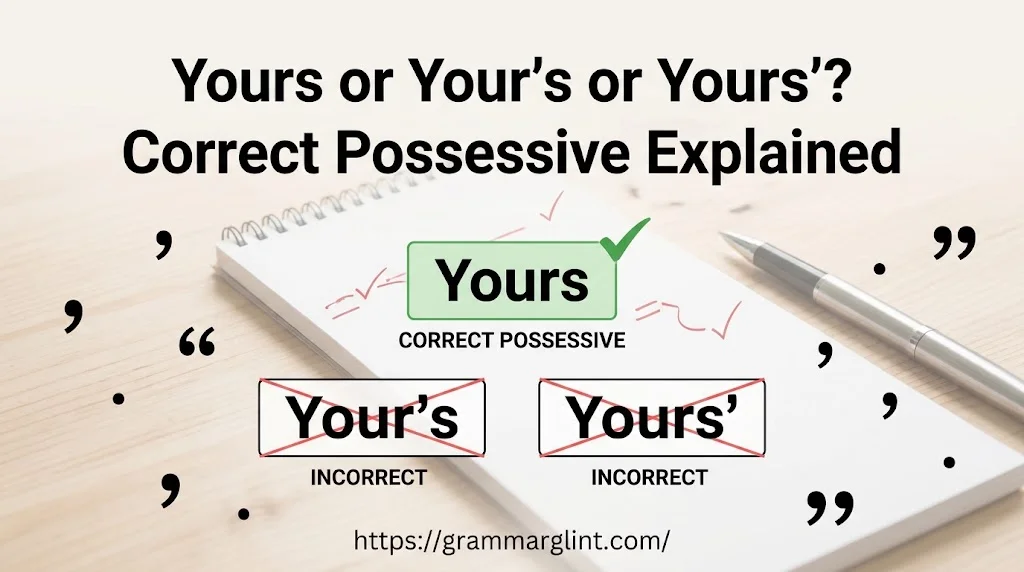
Yours is correct. Your’s is incorrect.
The word yours is a possessive pronoun. It shows that something belongs to the person being addressed.
Consider these examples:
- This book is yours.
- That seat is yours.
- The decision is yours.
- I think this jacket is yours.
- The blue car is yours.
In each sentence, yours indicates possession.
You might wonder why English doesn’t use an apostrophe. After all, possessive nouns commonly use apostrophes:
- Sarah’s notebook
- James’s bicycle
- the dog’s collar
- the teacher’s desk
That pattern makes your’s look tempting.
However, yours belongs to a different grammatical category. It’s a possessive pronoun rather than a possessive noun construction. Standard English spells it without an apostrophe.
Quick comparison
| Form | Correct? | Grammatical role | Example |
| your | Yes | Possessive determiner | Your phone is ringing. |
| yours | Yes | Possessive pronoun | The phone is yours. |
| your’s | No | Incorrect spelling | Your’s phone is ringing. |
| yours’ | No | Incorrect form | The phone is yours’. |
So if you’re deciding between yours or your’s, choose yours every time in standard English.
What Does “Yours” Mean?
Yours means “belonging to you” or “associated with you.”
It’s used when the listener already understands what object, idea, responsibility, or thing you’re discussing.
For example:
Is this your umbrella?
The word your modifies the noun umbrella.
Now compare:
Is this umbrella yours?
Here, yours stands on its own. It tells us that the umbrella belongs to you.
That’s one of the most useful ways to understand the difference.
Your + noun
Your needs a noun or noun phrase after it.
- your car
- your house
- your opinion
- your brother
- your problem
- your responsibility
- your idea
Examples:
- I like your idea.
- Where is your phone?
- That’s your responsibility.
- We visited your house.
Yours without the noun
Yours normally stands independently.
- The idea is yours.
- The phone is yours.
- The responsibility is yours.
- The house is yours.
Notice what happens when the noun changes position:
This is your book.
becomes:
This book is yours.
The noun book doesn’t follow yours because yours already represents the possessive relationship.
“Your” vs. “Yours”: What’s the Difference?
The difference between your and yours is grammatical rather than merely stylistic.
Your is a possessive determiner. It appears before a noun.
Yours is a possessive pronoun. It can stand independently.
Here’s the basic pattern:
Your + noun
Your answer is correct.
Noun + is + yours
The answer is yours.
Both sentences communicate possession. They simply structure the sentence differently.
Compare these examples
| Using “your” | Using “yours” |
| Your car is outside. | The car outside is yours. |
| Your answer was interesting. | The answer was yours. |
| Your jacket is blue. | The blue jacket is yours. |
| Your decision matters. | The decision is yours. |
| Your seat is over there. | That seat is yours. |
This distinction also explains why “yours car” doesn’t work.
You wouldn’t normally say:
Yours car is outside. ❌
You would say:
Your car is outside. ✅
But you can say:
The car outside is yours. ✅
Think of your as a word that introduces the possessed noun. Think of yours as the word that can replace the whole possessive phrase.
Why Is “Your’s” Incorrect?
The apostrophe in your’s doesn’t belong there.
The confusion usually comes from a reasonable but incorrect assumption: people learn that apostrophes often indicate possession, so they assume every possessive form needs one.
English doesn’t work that way.
Possessive pronouns follow their own established forms:
- my → mine
- your → yours
- his → his
- her → hers
- our → ours
- their → theirs
None of these standard possessive pronouns needs an apostrophe.
For example:
- This book is mine.
- That book is yours.
- The red bicycle is his.
- The blue coat is hers.
- The house is ours.
- The seats are theirs.
You wouldn’t normally write:
- mine’s ❌
- your’s ❌
- his’ ❌
- her’s ❌
- our’s ❌
- their’s ❌
The same principle applies to yours.
A useful memory trick
If you’re tempted to add an apostrophe to yours, ask yourself:
Am I using a possessive pronoun?
If the answer is yes, leave the apostrophe out.
Yours is complete by itself. It doesn’t need an apostrophe.
Read More: “Much More” Meaning, Grammar, and Correct Use With Examples
Why Is “Yours’” Incorrect?
Some writers make a second mistake by placing the apostrophe after the s:
The choice is yours’. ❌
This is also incorrect.
The form yours already expresses possession. Adding another apostrophe doesn’t make it “more possessive.”
The correct sentence is:
The choice is yours. ✅
The same rule applies elsewhere:
- The responsibility is yours.
- The final decision is yours.
- The blue folder is yours.
- That seat is yours.
Not:
- yours’ ❌
Why doesn’t the apostrophe belong after the “s”?
The s in yours isn’t functioning like the plural s in an ordinary noun.
Consider:
The students’ classroom
Here, students’ is a plural noun made possessive. The apostrophe shows possession.
But:
The classroom is theirs.
Theirs is already a possessive pronoun. It doesn’t require an apostrophe.
The same logic applies to yours.
Is “Yours’” Ever Correct?
In standard modern English, yours’ isn’t the normal possessive form of you.
When yours functions as a possessive pronoun, write it exactly this way:
yours
For example:
- The choice is yours.
- The money is yours.
- The responsibility is yours.
- The decision is yours.
- The victory is yours.
Don’t attach an apostrophe simply because the word expresses possession.
The apostrophe has specific jobs in English. It doesn’t serve as a universal possession marker.
When Should You Use “Yours”?
You’ll use yours whenever you need a possessive pronoun referring to the person you’re addressing.
That situation appears in everyday conversations, professional writing, academic work, and formal correspondence.
After a linking verb
One of the most common patterns is:
subject + linking verb + yours
Examples include:
- This book is yours.
- That seat was yours.
- The responsibility is yours.
- The final decision will be yours.
- This opportunity could be yours.
Here, yours identifies ownership or association.
When replacing “your + noun”
This is perhaps the most important use.
Compare:
My laptop is newer than your laptop.
Repeating laptop sounds clumsy.
English naturally shortens the second phrase:
My laptop is newer than yours.
Here, yours replaces your laptop.
More examples:
- My answer differs from yours.
- Her car is faster than yours.
- Our house is larger than yours.
- Their proposal is similar to yours.
- My opinion isn’t the same as yours.
The noun doesn’t need repeating because the context already makes it clear.
In “a friend of yours”
Another useful construction is:
a friend of yours
For example:
- I met a friend of yours yesterday.
- A colleague of yours called earlier.
- That’s an interesting idea of yours.
- One of your friends introduced us.
This construction is completely standard.
Notice the difference:
your friend
and
a friend of yours
Both indicate a relationship with you. The second uses yours as a possessive pronoun.
When Should You Use “Your” Instead of “Yours”?
Use your when a noun comes directly after it.
That’s the easiest practical rule.
Examples:
- your house
- your job
- your family
- your answer
- your question
- your computer
- your opinion
- your experience
For example:
I understand your concern.
Here, your modifies concern.
You can’t replace it with yours in the same position:
I understand yours concern. ❌
Instead, you could restructure the sentence:
I understand that the concern is yours. ✅
Or:
I understand your concern. ✅
A quick test
Look at the word immediately after the possessive form.
If you have:
your + noun
you’re probably using your correctly.
If the possessive form stands alone:
… is yours
you’re probably using yours correctly.
This test won’t explain every advanced grammatical construction. However, it handles most everyday situations remarkably well.
“Yours” in Letters and Emails
You may also encounter yours in formal or traditional letter closings.
Common examples include:
- Yours sincerely
- Yours faithfully
- Yours truly
- Sincerely yours
- Truly yours
These expressions can vary by writing tradition and regional convention. However, the spelling of yours remains the same.
It isn’t:
Your’s sincerely ❌
And it isn’t:
Yours’ sincerely ❌
The correct spelling is:
Yours sincerely ✅
The same applies to:
Yours truly ✅
If you’re writing a professional message, don’t let the apostrophe sneak into this familiar phrase.
Common Mistakes
The confusion surrounding yours usually produces a small group of recurring errors.
Understanding those errors makes them easier to avoid.
Mistake: “Your’s”
Incorrect:
Is this your’s?
Correct:
Is this yours?
The apostrophe has no grammatical function in the correct form.
Mistake: “Yours’”
Incorrect:
The decision is yours’.
Correct:
The decision is yours.
The possessive pronoun doesn’t need an additional apostrophe.
Mistake: “Yours” before a noun
Incorrect:
Yours car is parked outside.
Correct:
Your car is parked outside.
Or:
The car parked outside is yours.
The first sentence uses your as a possessive determiner. The second uses yours as a possessive pronoun.
Mistake: Confusing “Yours” and “You’re”
This error involves more than possession.
You’re is a contraction of you are.
Yours expresses possession.
Compare:
You’re very kind.
This means:
You are very kind.
Now compare:
The seat is yours.
This means:
The seat belongs to you.
A simple substitution test can help:
- If you are fits, use you’re.
- If possession fits, use yours.
Yours vs. Other Possessive Pronouns
English uses several possessive pronouns. Looking at them together makes the pattern clearer.
| Person | Possessive determiner | Possessive pronoun |
| First person singular | my | mine |
| Second person | your | yours |
| Third person singular masculine | his | his |
| Third person singular feminine | her | hers |
| First person plural | our | ours |
| Third person plural | their | theirs |
Consider the difference:
This is my book.
versus:
This book is mine.
Then:
This is your book.
versus:
This book is yours.
The structure is parallel.
Notice the unusual case of “his”
His can function as both a possessive determiner and a possessive pronoun.
For example:
His car is outside.
and:
The car outside is his.
The form doesn’t change.
That doesn’t affect the rule for yours, which has the distinct forms your and yours.
Do Possessive Pronouns Use Apostrophes?
Generally, standard possessive pronouns such as yours, ours, hers, theirs, and mine don’t use apostrophes.
This creates an important distinction between possessive nouns and possessive pronouns.
Possessive nouns
A noun can use an apostrophe to express possession:
- John’s phone
- Maria’s notebook
- the dog’s leash
- the teacher’s desk
- the students’ projects
Possessive pronouns
Possessive pronouns use established forms:
- mine
- yours
- his
- hers
- ours
- theirs
Compare:
This is John’s phone.
with:
This phone is his.
The first uses a possessive noun. The second uses a possessive pronoun.
Likewise:
This is your phone.
becomes:
This phone is yours.
The apostrophe isn’t necessary because yours already has the grammatical form needed to express possession.
Why Do People Write “Your’s”?
The mistake makes sense once you consider how English teaches possession.
Many learners first encounter examples such as:
- Sarah’s book
- Tom’s car
- the dog’s bowl
- the company’s website
The apostrophe becomes strongly associated with possession.
Then they encounter:
This book is yours.
Because yours expresses possession, adding an apostrophe may feel logical.
But grammar isn’t always perfectly symmetrical.
English contains many irregular or specialized forms. Possessive pronouns are one of those areas where memorization helps.
A useful mental model is this:
Don’t ask whether the word shows possession. Ask what kind of word it is.
If it’s a possessive noun, an apostrophe may be relevant.
If it’s the possessive pronoun yours, don’t add one.
Read More: Stared vs Starred: Meaning, Difference, Examples, and Usage
Case Study: Fixing a Common Email Error
Imagine someone writes:
I believe this proposal is your’s.
At first glance, the sentence looks understandable. The intended meaning is obvious.
However, the spelling is incorrect.
The corrected version is:
I believe this proposal is yours.
The sentence doesn’t need restructuring. Only the unnecessary apostrophe needs to disappear.
Now consider a different sentence:
Your proposal is impressive.
Here, your is correct because proposal follows it.
These two sentences demonstrate the central distinction:
Your proposal is impressive.
The proposal is yours.
Same basic possessive relationship. Different grammatical structures.
Case Study: Comparing Two Similar Sentences
Consider these examples:
My phone is newer than your phone.
The sentence is grammatical, but the repeated noun sounds awkward.
A more natural version is:
My phone is newer than yours.
Why?
Because yours replaces your phone.
The same transformation works elsewhere:
Her answer was better than your answer.
becomes:
Her answer was better than yours.
And:
Their house is larger than our house.
becomes:
Their house is larger than ours.
This substitution is one of the most practical functions of possessive pronouns.
Case Study: “Your” Before a Noun
Now consider:
Yours opinion matters.
This sentence sounds wrong because yours cannot normally function as the possessive determiner in this construction.
The corrected sentence is:
Your opinion matters.
If the writer wants to use yours, the sentence needs a different structure:
The opinion is yours.
Or:
That opinion of yours matters.
Each sentence is grammatical because yours occupies an appropriate position.
The lesson is straightforward:
Don’t choose between your and yours based only on meaning. Look at the sentence structure.
“Yours” in Comparisons
Possessive pronouns often appear naturally after words such as than and from.
Examples:
- My car is faster than yours.
- Her grades are higher than yours.
- Their house is bigger than ours.
- His opinion differs from yours.
- My approach is different from yours.
In these sentences, the noun after the possessive pronoun is understood from context.
For example:
My car is faster than yours.
The full underlying comparison is:
My car is faster than your car.
Repeating car isn’t necessary. Yours carries that information efficiently.
“Yours” Can Refer to More Than Physical Objects
Possession doesn’t always mean literal ownership.
Yours can refer to responsibilities, ideas, opinions, decisions, relationships, or other forms of association.
For example:
- The decision is yours.
- The responsibility is yours.
- That idea is yours.
- The choice is yours.
- The opinion is yours.
- The problem isn’t yours to solve.
This broader use matters because learners sometimes associate possession only with objects.
In English, possessive language can describe connection or association, not merely legal ownership.
Common Expressions
Several everyday expressions use yours naturally.
“A friend of yours”
A friend of yours called earlier.
This means one of your friends called earlier.
“A colleague of yours”
I spoke with a colleague of yours.
The phrase identifies someone connected professionally with you.
“An idea of yours”
That’s an interesting idea of yours.
This identifies the idea as something you proposed or hold.
“The choice is yours”
You can stay or leave. The choice is yours.
This expression means that you have control over the decision.
“Yours truly”
Yours truly
This traditional expression can serve as a letter or email closing. It also has an idiomatic use referring humorously or indirectly to oneself.
“Yours” vs. “Your’s”: A Simple Rule to Remember
If you remember only one thing, remember this:
Yours never needs an apostrophe.
Then remember the second rule:
Your comes before a noun.
Together, these rules solve most problems.
Use “your” here
- your name
- your job
- your phone
- your family
- your idea
- your question
Use “yours” here
- The name is yours.
- The job is yours.
- The phone is yours.
- The family is yours.
- The idea is yours.
- The question is yours.
And never turn yours into your’s simply because it expresses possession.
A Practical Editing Test
When proofreading, use this three-step check.
Step 1: Look for an apostrophe
If you see your’s or yours’, stop.
In standard English, neither form is the correct possessive pronoun.
Change it to:
yours
Step 2: Check what follows “your”
If a noun follows the word, your is usually the right choice.
your computer
your answer
your plan
your experience
Step 3: See whether “yours” stands alone
If it replaces your + noun, use yours.
My computer is newer than yours.
Here, yours replaces your computer.
This quick test works especially well during proofreading because it focuses on structure rather than intuition.
“Yours” in Academic and Professional Writing
Correct possessive forms matter in formal writing because small grammatical errors can distract readers.
Consider a business email:
Please let me know if this proposal is your’s.
The reader will probably understand the message. However, the incorrect apostrophe can make the writing look less polished.
A better version is:
Please let me know if this proposal is yours.
In academic writing, the same principle applies:
The final interpretation is yours to defend.
Here, yours correctly identifies the interpretation as belonging to or originating with the person addressed.
Good grammar doesn’t need to call attention to itself. Ideally, it simply works.
Quick Reference: Your, Yours, Your’s, and Yours’
| Word | Status | Meaning or function | Example |
| your | Correct | Possessive determiner | Your book is here. |
| yours | Correct | Possessive pronoun | The book is yours. |
| your’s | Incorrect | Common misspelling | Your’s book is here. |
| yours’ | Incorrect | Incorrect possessive form | The book is yours’. |
The table gives you the entire distinction at a glance.
A Final Practice Quiz
Choose your, yours, your’s, or yours’.
- Is this ___ notebook?
- This notebook is ___.
- I think that jacket is ___.
- Where is ___ phone?
- My answer is different from ___.
- ___ opinion matters.
- The final decision is ___.
- I spoke with a friend of ___.
- Is that ___ car outside?
- The blue car is ___.
Answers
- your
- yours
- yours
- your
- yours
- your
- yours
- yours
- your
- yours
Notice the pattern. Every sentence follows the same underlying distinction.
FAQs
1. Which is correct: yours, your’s, or yours’?
Yours is the correct spelling when showing possession. Your’s and yours’ are generally incorrect.
2. Why does “yours” not have an apostrophe?
Yours is a possessive pronoun. Possessive pronouns already show ownership, so they do not need an apostrophe.
3. Is “your’s” ever correct?
No. Your’s is a common spelling mistake. Use your or yours, depending on the sentence.
4. What is the difference between “your” and “yours”?
Your comes before a noun, while yours can stand alone without a noun after it.
5. Can I say “This book is yours”?
Yes. This is correct because yours shows that the book belongs to you.
6. Can I say “This is yours book”?
No. Use your book or say, “This book is yours.”
7. What type of word is “yours”?
Yours is a possessive pronoun that shows ownership.
8. Does “yours” always refer to one person?
No. Yours can refer to one person or more than one person, depending on the context.
9. Is “yours’” correct in formal writing?
No. Yours’ is not the standard possessive form in English.
10. How can I remember the correct form?
Remember that your needs a noun after it, while yours can usually stand by itself.
Conclusion
The difference between yours, your’s, and yours’ is simple once you understand how possessive forms work. Yours is the correct standalone possessive pronoun, while your is used before a noun. The forms your’s and yours’ should usually be avoided.
The easiest way to choose the right word is to look at the sentence. If a noun follows, your is often correct. If the word stands alone and shows ownership, use yours. With regular reading and writing, this grammar rule quickly becomes easier to remember.

For Shafiq ur Rehman, writing is an art form and grammar is the toolbox that makes it beautiful. As a dedicated content writer at Grammar Lantern, Shafiq approaches every topic like an architect carefully laying down strong foundations of understanding before adding the finer details. He loves diving into the trickiest grammar points and resurfacing with simple, bite-sized takeaways that anyone can grasp. When he’s not crafting articles, you’ll likely find him strategizing over a game of chess, exploring dusty local bookshops, or quietly jotting down poetic observations in his notebook.