
Have you ever wondered whether to write check-in or check in? You’re not alone. Both forms are correct, but choosing the right one depends on its role in a sentence. Understanding check-in vs. check in can improve your grammar, strengthen your writing, and help you communicate more clearly in everyday and professional situations.
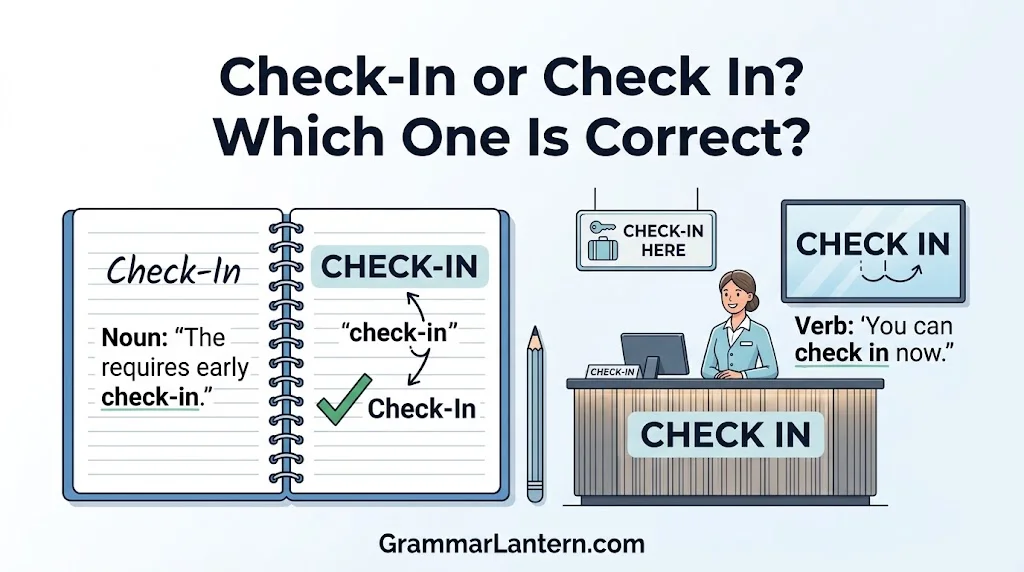
The main difference is simple: check in is a verb phrase that describes an action, while check-in is usually a noun or adjective. For example, you check in at a hotel, but you might visit the hotel’s check-in desk. Although the words look nearly identical, the hyphen changes how they function in a sentence.
In this guide, you’ll learn the meaning of check-in and check in, the essential grammar rules, and the correct usage of both forms. With practical examples from travel, hotels, airports, and workplace conversations, you’ll quickly understand when to use each spelling and avoid common mistakes.
Quick Answer
Use check-in as a noun or adjective and check in as a verb phrase. Both forms are standard, but they aren’t interchangeable in every sentence.
Here’s a quick comparison:
| Form | Grammatical role | Example |
| Check-in | Noun | The check-in took ten minutes. |
| Check-in | Adjective | Please visit the check-in desk. |
| Check in | Verb phrase | We need to check in before boarding. |
| Checked in | Past-tense verb phrase | They checked in yesterday. |
| Checking in | Verb form | She’s checking in online. |
The easiest way to remember the difference is to ask yourself: Am I naming something or describing an action?
- If you’re naming a process, meeting, or event, use check-in.
- If someone is performing the action of registering, reporting an arrival, or contacting another person, use check in.
- If you’re describing an action in the past, write checked in.
- If the action is ongoing, write checking in.
Consider these examples:
- Correct: The hotel check-in was quick.
- Correct: We checked in before noon.
- Correct: Our check-in time is 2 p.m.
- Correct: We need to check in at the front desk.
The difference isn’t about which spelling looks better. It’s about how each expression works in the sentence.
What Does Check-In Mean?
The hyphenated term check-in usually names a process, event, or interaction. Its exact meaning depends on the situation.
At a hotel, check-in refers to the process of registering as a guest. At an airport, it refers to confirming your flight arrangements and completing the necessary departure procedures. In a workplace, a check-in might be a brief meeting about progress, priorities, or concerns.
People also use check-in to describe a short conversation intended to see how someone is doing.
For example:
- Our hotel check-in went smoothly.
- The airline’s online check-in is convenient.
- I have a check-in with my manager this afternoon.
- The weekly check-in gives everyone a chance to discuss progress.
In each sentence, check-in names something. It doesn’t describe the action of checking in.
Check-In as a Noun
A noun names a person, place, thing, event, or idea. When check-in functions as a noun, it refers to the process or interaction itself.
For example, consider this sentence:
“The check-in took longer than expected.”
Here, check-in names the process that took time. You could rewrite the sentence as “The registration process took longer than expected” without changing its basic meaning.
Other examples include:
- The check-in begins at 3 p.m.
- Our airport check-in was delayed.
- Online check-in saves time at the airport.
- She scheduled a check-in with her supervisor.
- The hotel offers early check-in for eligible guests.
- We had a quick check-in before the presentation.
Notice how the expression works with words such as the, a, our, and early. These words often appear with nouns, although the surrounding grammar ultimately determines the role of the phrase.
A workplace example makes the distinction particularly clear. Suppose your manager schedules a brief meeting to review your progress. You could say, “We have a check-in on Friday.”
The word check-in names the meeting. You’re not describing the act of contacting your manager; you’re identifying an event on your calendar.
Check-In as an Adjective
An adjective describes or identifies a noun. The hyphenated form check-in can serve as a compound modifier that tells readers what kind of item you’re discussing.
Common examples include:
- Check-in desk: A place where guests or passengers register.
- Check-in counter: A designated airline service counter.
- Check-in time: The scheduled time for registration.
- Check-in process: The steps involved in registering.
- Check-in procedure: Instructions for completing registration.
- Check-in meeting: A brief discussion about progress or well-being.
Consider the sentence, “Please follow the check-in procedure.”
The word check-in describes the type of procedure. It helps readers understand that the instructions relate specifically to registration.
Likewise, in “The check-in desk is near the entrance,” the compound modifier identifies the purpose of the desk.
The hyphen connects the two words and makes their relationship clear. This is especially helpful when a phrase contains more than one word but functions as a single modifier.
However, hyphenation can vary in some compound expressions depending on the dictionary or editorial style. In ordinary American English, forms such as check-in desk, check-in time, and check-in procedure are clear and conventional choices.
Read More: Congresses or Congress’s or Congress’? Correct Possessive
What Does Check In Mean?
The expression check in is a verb phrase that describes an action. Depending on the context, it can mean registering your arrival, confirming your participation, reporting your status, or contacting someone.
For example:
- We need to check in before boarding.
- Please check in at the front desk.
- I’ll check in with my manager tomorrow.
- She checked in using the airline’s website.
- He called to check in on his neighbor.
The words remain separate because the phrase functions as a verb rather than a noun or adjective.
One useful clue is that you can change the verb’s tense without joining the words:
- Present: We check in at the desk.
- Past: We checked in yesterday.
- Ongoing action: We are checking in now.
- Future: We will check in tomorrow.
This pattern remains consistent across most ordinary uses of the expression.
Check In as a Verb Phrase
The verb phrase check in appears in travel, business, education, healthcare, and everyday communication.
In travel, it often describes registering for a flight or arriving at a hotel. In a workplace, it can mean giving an update or contacting a colleague. In personal communication, it often means asking how someone is doing.
For example:
- We need to check in at the hotel before dinner.
- Passengers should check in before the airline’s deadline.
- I’ll check in with the project manager this afternoon.
- The teacher checks in with students who need extra support.
- She called to check in after the interview.
In each example, someone performs an action. That’s the key difference between the verb phrase and the noun check-in.
You can also use check in with an object in certain constructions. For example, “We need to check in two suitcases” means that the travelers need to hand over their luggage for transport in the aircraft’s hold.
The phrase remains two words because check in still describes an action.
Check In With Someone
The expression check in with someone usually means contacting that person, exchanging information, asking for an update, or discussing a situation.
For example, a project manager might say, “I’ll check in with the design team before approving the final draft.”
The sentence describes a planned conversation. It doesn’t name a meeting or formal event.
Here are more examples:
- I’ll check in with my supervisor about the deadline.
- She checked in with her friend after the interview.
- We should check in with the customer before changing the order.
- The teacher checks in with students about their assignments.
- Please check in with me if you need additional information.
In professional settings, the expression often suggests a brief, informal conversation. However, it can also describe a more detailed discussion when the circumstances call for one.
Compare these two sentences:
- Noun: We have a check-in with the client at noon.
- Verb: We will check in with the client at noon.
The first sentence identifies a scheduled interaction. The second describes the action of contacting the client.
Check In On Someone
The phrase check in on someone usually emphasizes checking that person’s well-being, safety, or current circumstances.
For example, “I’ll check in on my neighbor after the storm.”
The focus is on making sure the neighbor is doing well. It may involve a phone call, a text message, or a visit.
More examples include:
- She checked in on her elderly father after the storm.
- The teacher checked in on the student who had been absent.
- I’ll check in on the team to see whether anyone needs help.
- We should check in on our friends during a difficult week.
The expressions check in with and check in on sometimes overlap, but they often emphasize different things.
| Expression | Main emphasis | Example |
| Check in with | Communication or consultation | I’ll check in with my manager about the schedule. |
| Check in on | Someone’s well-being or situation | I’ll check in on my neighbor after the storm. |
Both expressions use the two-word verb phrase check in. The preposition that follows helps clarify the intended meaning.
Key Differences
The most reliable way to choose between these forms is to identify their grammatical roles. Check-in names a process or describes something related to it, while check in expresses an action.
| Feature | Check-in | Check in |
| Grammatical role | Noun or adjective | Verb phrase |
| Main purpose | Names a process or describes a related item | Describes an action |
| Example | The check-in was quick. | We checked in early. |
| Before a noun | The check-in counter is open. | We need to check in today. |
| Workplace usage | We scheduled a check-in. | I’ll check in with the team. |
| Travel usage | Our check-in time is 2 p.m. | We will check in at 2 p.m. |
How to Choose the Correct Form
You don’t need to memorize dozens of examples. Follow these simple steps whenever you feel unsure.
Step 1: Ask whether you’re naming something.
If the phrase identifies a process, meeting, or service, use check-in.
Example: “The check-in took fifteen minutes.”
Step 2: Look for an action.
If someone needs to register, confirm an arrival, or contact another person, use check in.
Example: “We need to check in before the event begins.”
Step 3: Check the sentence structure.
Words such as will, must, should, and can often introduce the verb phrase.
For example:
- We will check in tomorrow.
- You must check in before boarding.
- She can check in online.
These words don’t automatically determine the answer, but they offer useful clues.
Step 4: Try replacing the expression.
If meeting, process, or registration fits the sentence, you may need the noun form.
For example, “Our check-in starts at noon” can become “Our registration starts at noon.”
This test works well in many situations, although context still matters.
In Different Situations
The distinction between these forms stays consistent across travel, work, and personal communication. Let’s look at practical situations where writers commonly confuse them.
Check-In or Check In at a Hotel
Hotels use both expressions when describing guest registration.
The noun check-in refers to the process, while the verb phrase check in describes the guest’s action.
Examples:
- Our hotel check-in time is 3 p.m.
- The check-in desk is near the main entrance.
- We plan to check in after lunch.
- Can we check in early?
- The hotel offers online check-in.
Imagine you’ve booked a room and want to arrive before the standard registration time. You might ask, “Is early check-in available?”
Here, check-in names the service you’re requesting. If you’re explaining your plans, however, you’d say, “We hope to check in early.”
Practical tip: Use check-in time, check-in policy, and early check-in when naming hotel services. Use check in when describing what guests do.
Check-In or Check In at an Airport
Airports provide another clear example because passengers complete a formal process before departure.
Examples include:
- Online check-in is available for eligible passengers.
- Please proceed to the check-in counter.
- Passengers must check in before the deadline.
- I checked in through the airline’s website.
- We finished checking in before heading to security.
The noun form describes the registration process or designated area. The verb form describes the passenger’s action.
There’s also an important related expression: check in a bag.
For example, “We need to check in two suitcases.”
This sentence describes the action of handing luggage over to the airline for transport in the aircraft’s hold. The verb phrase remains two words even though it takes an object.
Check-In or Check In at Work
In professional settings, a check-in often refers to a short meeting about progress, priorities, or problems.
A manager might schedule a weekly check-in to review deadlines. A team member might check in with a colleague to clarify responsibilities.
Examples:
- Our weekly check-in begins at 9 a.m.
- The manager scheduled a check-in with the new employee.
- I’ll check in with the team before the presentation.
- We should check in with the client about the revised schedule.
- She checks in regularly to make sure everyone has the support they need.
Consider a project manager preparing for an important launch. On Monday, the manager schedules a brief meeting to discuss progress. That meeting is a check-in.
On Tuesday, the manager contacts a designer to ask about a delayed task. The manager checks in with the designer.
The situation is similar, but the grammatical roles differ.
Check-In or Check In in Personal Communication
People also use these expressions when talking about relationships, friendships, and everyday conversations.
A check-in can refer to a brief conversation or message. The verb phrase check in describes the act of reaching out.
Examples:
- Thanks for the check-in yesterday.
- We had a quick check-in before the event.
- I’ll check in with you tomorrow.
- She called to check in after the interview.
- He checks in on his grandparents every weekend.
Suppose your friend has been dealing with a difficult week. You send a message asking how things are going. You could say, “I wanted to check in with you.”
If your friend later thanks you for the message, they might say, “Thanks for the check-in.”
The first sentence describes an action. The second names the interaction.
Check-In or Check In in Apps and Online Services
Digital services use these forms when people register for flights, events, appointments, or other activities.
For example:
- Complete online check-in before your flight.
- Tap the button to check in.
- The app offers a faster check-in process.
- I checked in using my phone.
- Online check-in opens before the scheduled departure.
Interface labels sometimes follow a company’s preferred capitalization or styling. That doesn’t necessarily change the standard grammatical distinction used in ordinary writing.
When writing instructions for an app, choose the form according to the sentence.
“Select Check in to continue” describes an action. “The online check-in process takes two minutes” names the process.
Is Check-In Hyphenated?
Yes. In standard US English, check-in normally takes a hyphen when it functions as a noun or adjective.
Examples include:
- The check-in process is straightforward.
- Our check-in time has changed.
- Please visit the check-in counter.
- We arranged an early check-in.
- The airline updated its check-in policy.
The hyphen connects the two words into a compound expression. It helps readers recognize that the phrase names a process or describes a related noun.
When the expression functions as a verb, write it as two separate words.
- Please check in at the desk.
- We checked in before noon.
- She is checking in online.
- They will check in tomorrow.
The key rule is simple: Don’t add a hyphen automatically just because the words appear together. Their grammatical function determines the conventional spelling.
Is Checkin One Word?
In ordinary American English prose, checkin is generally not the standard spelling.
Use check-in for the noun or adjective and check in for the verb phrase.
| Nonstandard form in ordinary prose | Preferred form | Example |
| Checkin | Check-in | The check-in was quick. |
| Checkin time | Check-in time | Our check-in time is 4 p.m. |
| Checkin online | Check in online | Please check in online. |
| Checkedin | Checked in | We checked in early. |
A company might use Checkin as an official product name, username, or branded label. Such names can follow their own spelling conventions.
However, those exceptions don’t make checkin the standard form in ordinary sentences. Unless you’re reproducing an official name, stick with the conventional spellings.
Check-In, Checked In, and Checking In
The verb phrase check in changes form depending on tense and sentence structure. Its two words generally remain separate.
| Verb form | Example |
| Present | I check in at the front desk. |
| Third-person singular | She checks in before boarding. |
| Simple past | We checked in yesterday. |
| Present participle | They are checking in now. |
| Present perfect | He has checked in already. |
| Future | We will check in tomorrow. |
| Infinitive | They plan to check in early. |
These forms help you describe actions at different times. None requires you to combine the ordinary verb phrase into one word.
Is It Checked-In or Checked In?
In ordinary verb constructions, write checked in as two words.
For example:
- We checked in at the hotel.
- She had checked in before the meeting.
- They were checked in by the receptionist.
- I have already checked in online.
The spelling stays the same even when the action happened in the past or appears in a passive construction.
However, a hyphen may appear when the expression functions as a compound modifier before a noun, depending on the construction and editorial style. For instance, an editor might use checked-in passenger to describe a passenger who has completed registration.
That usage is less common than straightforward verb constructions. Don’t assume every instance of checked in needs a hyphen.
When in doubt, choose the familiar form that fits your sentence: “The passenger checked in early.”
Common Mistakes
Even experienced writers sometimes mix up these forms. Most errors happen when people focus on the words themselves rather than their grammatical function.
Here are the mistakes worth avoiding.
- Using a hyphen with a verb: Write “We need to check in,” not “We need to check-in.”
- Leaving out the hyphen in a noun: Write “The check-in was smooth,” not “The check in was smooth.”
- Writing the expression as one word: Use check-in or check in, not checkin in ordinary prose.
- Hyphenating every form: Write “She checked in yesterday,” not “She checked-in yesterday.”
- Confusing a meeting with an action: Write “We scheduled a check-in” for the meeting and “We will check in” for the action.
- Ignoring the sentence structure: Choose the form that fits the phrase’s grammatical role, even when both versions seem understandable.
A Quick Practice Exercise
Choose the correct form for each sentence.
- We need to (check-in / check in) before boarding.
- The hotel (check-in / check in) process was simple.
- I’ll (check-in / check in) with you tomorrow.
- Our weekly (check-in / check in) starts at 11 a.m.
- She (checked-in / checked in) online last night.
Answers:
- Check in
- Check-in
- Check in
- Check-in
- Checked in
The pattern should now be clear. Use the hyphenated form when naming the process or meeting, and keep the verb phrase separate when describing an action.
Easy Ways to Remember the Difference
You don’t need to memorize every example in this article. A few practical reminders will help you choose the correct spelling quickly.
- Check-in names something. Think of a check-in meeting, check-in desk, or check-in time.
- Check in describes an action. Think of checking in at a hotel or checking in with a friend.
- Look for the main verb. In “We will check in,” the action is expressed by the two-word phrase.
- Try replacing the noun. If meeting, process, or registration fits, you may need check-in.
- Check the tense. Forms such as checked in and checking in keep the verb and particle separate.
One final comparison brings everything together:
“The check-in took ten minutes, but we still had to check in before the deadline.”
The first check-in names a process. The second check in describes an action.
Once you recognize that distinction, the hyphen becomes much easier to manage.
Read More: Provider vs. Providor: Which Spelling Is Correct?
FAQs
1. What is the difference between check-in and check in?
Check-in is usually a noun or adjective, while check in is a verb phrase. For example, “The check-in process was quick” uses the noun form, while “We need to check in early” uses the verb phrase.
2. Is check-in one word or two words?
Check-in is written as one hyphenated word when it functions as a noun or adjective. When it describes an action, write check in as two separate words.
3. Is it check-in or check in at a hotel?
Use check in when describing the action of registering at a hotel. For example, “We will check in at 3 p.m.” Use check-in when referring to the process, such as “Hotel check-in begins at 3 p.m.”
4. Should I write flight check-in or flight check in?
Both forms can be correct, depending on the sentence. Write “Flight check-in opens two hours before departure” when using the phrase as a noun. Write “Passengers can check in online” when describing an action.
5. Is check in a phrasal verb?
Yes, check in is a phrasal verb. It can mean registering your arrival, reporting to someone, or providing an update. For example, “I’ll check in with my manager tomorrow.”
6. Is check-in hyphenated in American English?
Yes, American English commonly uses check-in as a noun or adjective. The verb phrase remains two separate words: check in. For example, “The check-in counter is open, so you can check in now.”
7. Is it online check-in or online check in?
Online check-in is the standard form when the phrase acts as a noun. For example, “Online check-in saves time at the airport.” However, write “You can check in online” when using it as a verb phrase.
8. Can check in mean contacting someone?
Yes, check in can mean contacting someone to see how they are doing or share an update. For example, “I wanted to check in and see how your project was going.” In this sentence, the phrase describes an action.
9. What is the plural of check-in?
The plural of the noun check-in is check-ins. For example, “The hotel handles hundreds of check-ins every day.” The verb phrase check in does not have a plural form, although its subject can change: “They check in early.”
10. How can I remember when to use check-in and check in?
Use a simple grammar trick: if the phrase describes an action, write check in. If it names a process, event, or place, or describes a noun, use check-in. For example, “Please check in at the desk” and “The check-in desk is on the left.”
Conclusion
Understanding check-in vs. check in is easier than it first appears. The key is to identify how the phrase functions in your sentence. Use check in as a verb phrase when someone registers their arrival, contacts another person, or provides an update. Use check-in as a noun or adjective when referring to a process, procedure, or related service.
Once you learn this simple rule, you can use both forms confidently in emails, travel plans, workplace messages, and everyday conversations. Remember the examples in this guide, pay attention to the role of the phrase, and you’ll find it much easier to choose the correct form every time.

For Shafiq ur Rehman, writing is an art form and grammar is the toolbox that makes it beautiful. As a dedicated content writer at Grammar Lantern, Shafiq approaches every topic like an architect carefully laying down strong foundations of understanding before adding the finer details. He loves diving into the trickiest grammar points and resurfacing with simple, bite-sized takeaways that anyone can grasp. When he’s not crafting articles, you’ll likely find him strategizing over a game of chess, exploring dusty local bookshops, or quietly jotting down poetic observations in his notebook.