Have you ever wondered whether Gitty or Giddy is the correct spelling? These words look similar, but only one is commonly used in standard English to describe excitement, happiness, or dizziness. If you want to express these feelings clearly, choosing the right word matters.
Giddy is the correct word when you describe someone who feels unusually excited, cheerful, or lightheaded. For example, you might feel giddy when you receive exciting news or experience a sudden rush of happiness. In contrast, gitty is generally a misspelling when used with this meaning, so you should avoid it in formal and informal writing.
In this guide, you’ll learn the difference between Gitty and Giddy, their meanings, and how to use the correct spelling in everyday conversations, messages, and professional writing. You’ll also find simple examples, common mistakes, and practical tips to help you remember the correct word. By the end, you’ll feel more confident using giddy whenever you want to describe excitement or dizziness.
Quick Answer
Giddy is the correct standard English spelling when you mean feeling dizzy, lightheaded, or extremely excited. Gitty is generally a misspelling when used with these meanings.
For example:
- Correct: She felt giddy with excitement before the concert.
- Incorrect: She felt gitty with excitement before the concert.
The word giddy can describe a physical sensation, such as feeling unsteady after spinning around. It can also describe an emotional state, such as overwhelming happiness before an important event.
Although Gitty may appear as a name, username, or specialized spelling in a particular context, it doesn’t replace the standard adjective giddy.
| Feature | Giddy | Gitty |
| Standard spelling for dizziness | Correct | Incorrect |
| Standard spelling for excitement | Correct | Incorrect |
| Meaning in this comparison | Dizzy, lightheaded, or very excited | Usually a spelling mistake |
| Part of speech | Primarily an adjective | Not the standard adjective for these meanings |
| Suitable for formal writing | Yes | Not when you mean giddy |
What Does Giddy Mean?
Giddy is an adjective that describes a feeling of dizziness or intense excitement. Its exact meaning depends on the situation in which you use it.
Imagine stepping off a spinning amusement park ride. You might feel unsteady and struggle to walk in a straight line. That’s one meaning of giddy.
Now imagine receiving wonderful news about a job you’ve wanted for years. You might smile, laugh, and feel so excited that you can barely sit still. That feeling can also be described as giddy.
The word connects physical sensations with strong emotional reactions. Understanding the context helps you identify which meaning a writer intends.
Giddy Meaning Dizzy or Lightheaded
When giddy describes a physical sensation, it means feeling dizzy, unsteady, or as though your surroundings are moving.
This feeling may happen after spinning around, riding a fast amusement park attraction, or looking down from a great height. People sometimes use giddy informally to describe a brief sensation of lightheadedness.
Consider these examples:
- I felt giddy after spinning around in the garden.
- The child became giddy after getting off the merry-go-round.
- Looking down from the tall observation deck made him feel giddy.
- She sat down because the sudden movement left her feeling giddy.
In each sentence, giddy describes a physical sensation rather than happiness.
However, the word doesn’t identify the medical cause of dizziness. If dizziness is severe, persistent, or accompanied by other concerning symptoms, it’s important to seek appropriate medical advice instead of treating the word as a diagnosis.
Giddy Meaning Extremely Excited or Happy
The emotional meaning of giddy describes intense excitement, happiness, or delight. Someone who feels giddy may laugh frequently, speak quickly, or struggle to contain their enthusiasm.
For example, a student who learns they’ve earned a scholarship might feel giddy with excitement. A couple planning their wedding may experience the same feeling as the big day approaches.
Here are more examples:
- She was giddy with excitement about her first international trip.
- He felt giddy after receiving the long-awaited job offer.
- The children became giddy when they opened their birthday presents.
- They exchanged giddy smiles after hearing the good news.
Notice the phrase giddy with excitement. It is a common expression that clearly communicates overwhelming enthusiasm.
You can also write giddy with happiness, giddy with delight, or giddy with anticipation. Each phrase emphasizes a different source of excitement.
Giddy as a Description of Something Thrilling or Unsteady
The word giddy can also describe experiences or situations that seem exhilarating, dizzying, or almost overwhelming.
For example, a person might describe a steep climb as reaching giddy heights. The phrase suggests a great height that may make someone feel dizzy or uneasy.
Consider these sentences:
- The hikers climbed to giddy heights above the valley.
- The company enjoyed a giddy period of rapid success.
- The roller coaster sent passengers through a giddy series of twists and turns.
In the second example, giddy suggests excitement and a dramatic rise in success. It doesn’t necessarily mean that the company or its employees literally felt dizzy.
This figurative use adds color to writing because it helps readers imagine an experience rather than simply describing it as exciting or unusual.
Read More: Wore or Worn: Which Is Correct? Helpful Examples
What Does Gitty Mean?
Gitty is not the standard English spelling of the adjective giddy. If you want to describe dizziness, lightheadedness, or overwhelming excitement, use giddy instead.
For example, writing gitty with excitement in an ordinary sentence would generally be considered a spelling error.
However, it’s important to avoid an overly broad conclusion. A spelling that isn’t standard for one meaning can still appear in a name, username, fictional setting, or specialized context.
The key is to understand what the writer intends to communicate.
Is Gitty a Real Word?
Whether Gitty has a particular meaning depends on the context. It may appear as a proper name, an online username, or a spelling used within a specific community.
That doesn’t make it an accepted substitute for giddy in standard English.
Compare these examples:
- Incorrect for the intended meaning: He felt gitty before the performance.
- Correct: He felt giddy before the performance.
- Possible name usage: Gitty sent an invitation to the group.
In the final example, Gitty functions as a name. Its spelling isn’t being used to describe an emotion or physical sensation.
Capitalization can offer a clue, but context matters more. A capital letter doesn’t automatically establish that a word is a name or a standard vocabulary item.
Why Do People Write Gitty Instead of Giddy?
Several factors can lead people to confuse these spellings.
Similar-looking letters: The letters d and t can be confused when someone types quickly or doesn’t remember the spelling.
Unfamiliar vocabulary: Someone who rarely encounters giddy may guess its spelling instead of checking it.
Typing mistakes: A person may accidentally press the wrong key and overlook the error during proofreading.
Sound-based spelling: Writers sometimes spell words according to how they think the words sound. This strategy doesn’t always work because English spelling isn’t perfectly predictable.
Automatic correction: Spell-checking tools can miss errors when a typed form resembles a name or another valid character sequence. A grammar checker may also fail to recognize the intended meaning.
The solution is simple: learn the standard spelling and check the sentence’s meaning. A quick review can prevent an incorrect form from appearing in otherwise polished writing.
Key Differences Explained
The most important difference between giddy and gitty is their status in standard English usage.
Giddy is an established adjective with recognized meanings. Gitty generally represents a spelling error when someone intends to use that adjective.
Here are the main distinctions to remember:
| Comparison point | Giddy | Gitty |
| Standard adjective | Yes | No, not for the meanings discussed |
| Describes dizziness | Yes | No |
| Describes excitement | Yes | No |
| Common expression | Giddy with excitement | Not standard |
| Correct in formal writing | Yes | Only when a specific name or context calls for it |
| Recommended for ordinary use | Yes | No, if you mean dizzy or excited |
These differences are especially important in professional writing, educational work, and published content.
A reader may understand what you mean when you write gitty, but the intended meaning doesn’t make the spelling standard. Correct spelling helps your writing appear clear and carefully edited.
Giddy vs. Gitty in Everyday Communication
In casual messages, people sometimes overlook spelling mistakes because the meaning remains understandable. Nevertheless, using the correct form helps prevent confusion.
Imagine sending a friend this message:
“I’m so gitty about our vacation!”
Your friend may understand that you’re excited. However, the standard version is:
“I’m so giddy about our vacation!”
The second sentence communicates the same feeling with the correct spelling.
In an academic essay, business email, or blog post, the distinction becomes even more important. Readers often expect published writing to follow standard spelling conventions.
The goal isn’t to make every casual message sound formal. It’s to choose the correct word whenever you want your writing to be accurate.
Example Sentences
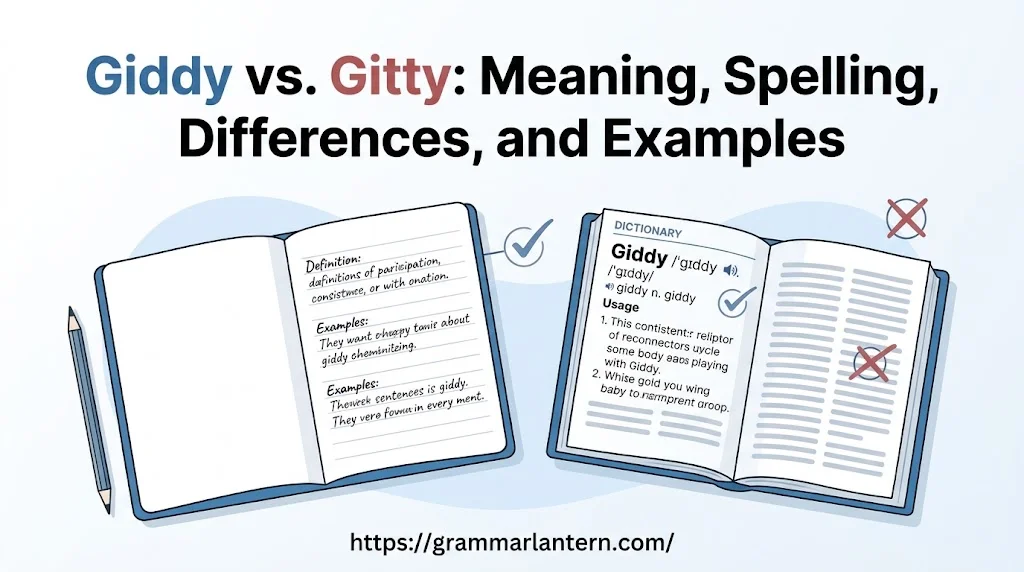
Examples make spelling differences easier to remember. The following sentences show how giddy works in everyday English and how to correct gitty when it appears by mistake.
Examples of Giddy in Everyday Sentences
Physical dizziness
- I felt giddy after spinning around several times.
- The sudden movement left him feeling giddy.
- She became giddy while looking down from the tall tower.
- The children felt giddy after their amusement park ride.
Emotional excitement
- Mia was giddy about her upcoming birthday party.
- He felt giddy when his favorite team won the championship.
- They were giddy with excitement after announcing their engagement.
- I became giddy when I learned that I’d passed the final exam.
Figurative use
- The business experienced a giddy rise in popularity.
- The climbers reached giddy heights above the surrounding hills.
- She spoke with giddy enthusiasm about her new project.
Each example uses giddy to communicate a specific physical or emotional experience.
Incorrect Gitty Examples and Their Corrections
Here are common mistakes and the appropriate corrections.
| Incorrect sentence | Correct sentence |
| I felt gitty after the spinning ride. | I felt giddy after the spinning ride. |
| She was gitty about her new job. | She was giddy about her new job. |
| The children grew gitty before the party. | The children grew giddy before the party. |
| He felt gitty with happiness. | He felt giddy with happiness. |
| They were gitty about their vacation. | They were giddy about their vacation. |
The correction is consistent because each sentence describes dizziness or excitement.
A Practical Case Study: Correcting a Blog Post
Imagine an editor reviewing this paragraph for a travel website:
“After the roller coaster stopped, Emma felt gitty. A few minutes later, she was gitty with excitement because she wanted to ride it again.”
The editor needs to correct both instances of gitty.
The revised paragraph reads:
“After the roller coaster stopped, Emma felt giddy. A few minutes later, she was giddy with excitement because she wanted to ride it again.”
The first use describes a physical sensation. The second describes emotional enthusiasm.
This example highlights an important point: the same word can have different meanings in different sentences without changing its spelling.
How to Remember the Correct Spelling
Remembering the correct spelling becomes easier when you connect the word with its meaning and appearance.
The standard spelling is G-I-D-D-Y. It contains two consecutive d letters, not two t letters.
Here are several practical strategies.
Use a Simple Spelling Trick
Remember the phrase “giddy with delight.”
Both words describe a positive emotional experience, and the phrase gives you a familiar example to recall whenever you hesitate over the spelling.
You can also connect giddy with feeling dizzy after spinning around. Imagine stepping off a carousel and feeling unsteady. The mental image can help you remember the word.
Write the word a few times if you regularly confuse the two forms:
- Giddy with excitement.
- Giddy with happiness.
- Giddy after spinning.
Repeated exposure to correct examples can strengthen your memory.
Check the Meaning Before Choosing the Word
Before using either spelling, ask yourself what you want to express.
- If you mean dizzy or lightheaded, use giddy.
- If you mean intensely excited or happy, use giddy.
- If you’re referring to someone named Gitty, preserve the intended name.
- If you encounter gitty in a specialized context, check how that context defines it.
This approach works better than relying on the letters alone because it connects spelling with meaning.
Use Spell-Checking Tools Wisely
Spell-checking tools can help you catch typing errors, but they shouldn’t replace your own judgment.
If a tool doesn’t flag gitty, that doesn’t prove it’s correct for your sentence. Some tools accept names, unusual terms, or character sequences that aren’t appropriate for the meaning you intend.
Read the full sentence after checking spelling. Ask whether the word expresses the intended idea.
For example, “She felt gitty with excitement” may remain understandable, but giddy is the correct standard form.
Synonyms
Choosing a synonym can make your writing more precise. However, the best alternative depends on whether giddy describes a physical sensation or an emotional reaction.
Synonyms for Giddy Meaning Dizzy
These words describe physical sensations associated with dizziness or instability.
| Synonym | Meaning | Example |
| Dizzy | Feeling as though you or your surroundings are spinning | I felt dizzy after the ride. |
| Lightheaded | Feeling faint or slightly unsteady | She felt lightheaded after standing up quickly. |
| Unsteady | Having difficulty maintaining balance | He felt unsteady on the narrow path. |
| Faint | Feeling as though you might lose consciousness | I felt faint in the crowded room. |
| Vertiginous | Relating to vertigo or a sensation of spinning | The vertiginous view made him uneasy. |
These words have slightly different meanings. For instance, lightheaded often suggests feeling faint, while vertiginous is more specialized.
Don’t assume that every synonym fits every sentence. Choose the word that best describes the actual experience.
Synonyms for Giddy Meaning Excited
When giddy describes happiness or enthusiasm, these alternatives may work better.
| Synonym | Meaning | Example |
| Elated | Extremely happy | She was elated by the news. |
| Delighted | Very pleased | He was delighted with the results. |
| Thrilled | Intensely excited or pleased | They were thrilled about the trip. |
| Overjoyed | Filled with great happiness | Her family was overjoyed at the announcement. |
| Exuberant | Energetic and full of enthusiasm | The exuberant crowd cheered loudly. |
For example, “She was giddy with excitement” and “She was thrilled about the announcement” express similar feelings.
However, giddy can suggest a more uncontrolled or almost dizzying excitement. Elated emphasizes happiness, while exuberant often describes visible energy and enthusiasm.
Common Mistakes to Avoid
Even a small spelling error can weaken an otherwise excellent sentence. Watch out for these common mistakes.
Using gitty as a standard adjective: When you mean dizzy or excited, write giddy.
Assuming similar spellings have identical meanings: Two words that look alike aren’t necessarily interchangeable.
Forgetting the physical meaning of giddy: The word can describe dizziness as well as emotional excitement.
Treating every use of Gitty as an error: A person’s name or a context-specific term may legitimately use that spelling.
Trusting spell-checkers without reviewing context: Automated tools can miss mistakes that require an understanding of meaning.
Choosing a synonym without checking its meaning: Words such as dizzy, elated, and thrilled overlap with giddy but don’t mean exactly the same thing.
The best habit is to review the spelling, consider the context, and make sure the sentence communicates what you intend.
Read More: 6 More Formal Ways to Say “Please Provide…” at Work
FAQs
1. Is it gitty or giddy?
Giddy is the correct spelling when describing someone who feels excited, happy, or dizzy. Gitty is generally a misspelling when used with this meaning.
2. What does giddy mean?
Giddy means feeling very excited, cheerful, or lightheaded. For example, a person might feel giddy after receiving wonderful news.
3. Is gitty a real English word?
Gitty is not a standard spelling of the adjective giddy. Although it may appear as a name or in specialized contexts, you should use giddy when describing excitement or dizziness.
4. How do you use giddy in a sentence?
You can use giddy to describe excitement, happiness, or dizziness. For example: “She felt giddy when she learned that she had won the competition.”
5. What is the difference between giddy and excited?
Excited describes a feeling of enthusiasm or anticipation. Giddy often describes a stronger, less controlled feeling of excitement and can also mean lightheadedness.
6. Can giddy mean dizzy?
Yes, giddy can mean dizzy or lightheaded. For example, “I felt giddy after spinning around several times.”
7. Is giddy a noun or an adjective?
Giddy is an adjective. It describes a person’s feelings or physical state, as in “a giddy child” or “a giddy feeling.”
8. What is the opposite of giddy?
The opposite depends on the context. When giddy means overly excited, words such as calm, composed, or serious may work. When it means dizzy, steady or balanced may be more appropriate.
9. What is the past tense of giddy?
Giddy is an adjective, not a verb, so it does not have a past tense. You can say, “She felt giddy yesterday” or “He became giddy after the ride.”
10. How can I remember the correct spelling of giddy?
Remember that giddy contains a d, just like dizzy describes a similar feeling. When writing about excitement, happiness, or lightheadedness, choose giddy rather than gitty.
Conclusion
Choosing between Gitty or Giddy becomes easy once you understand the correct spelling and meaning. Giddy is the standard English adjective used to describe excitement, happiness, or dizziness, while gitty is generally considered a misspelling when used in the same sense.
To improve your writing, remember to use giddy in messages, school assignments, articles, and everyday conversations. Practice with simple sentences, and check your spelling whenever you feel uncertain. With this small change, you can communicate more clearly and confidently.

For Shafiq ur Rehman, writing is an art form and grammar is the toolbox that makes it beautiful. As a dedicated content writer at Grammar Lantern, Shafiq approaches every topic like an architect carefully laying down strong foundations of understanding before adding the finer details. He loves diving into the trickiest grammar points and resurfacing with simple, bite-sized takeaways that anyone can grasp. When he’s not crafting articles, you’ll likely find him strategizing over a game of chess, exploring dusty local bookshops, or quietly jotting down poetic observations in his notebook.