
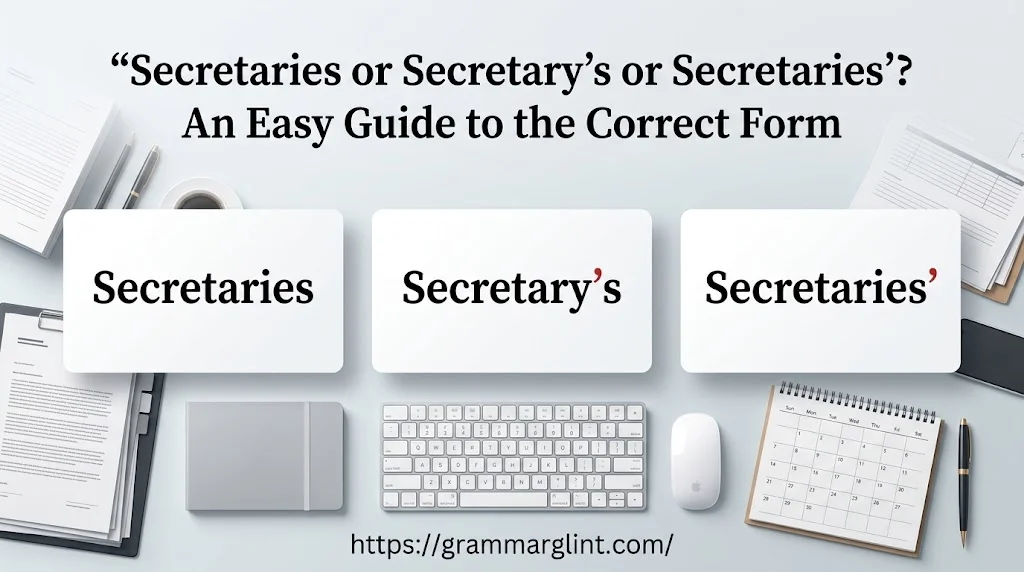
Secretaries or Secretary’s or Secretaries’ can seem confusing, but each form has a clear meaning. The plural form is secretaries, while secretary’s is the singular possessive form. We use the plural possessive, secretaries’, when multiple secretaries show ownership of an object or something. The correct possessive form depends on whether you mean one secretary or two or more secretaries.
In writing, one of the best ways to get it right is to understand the number of people involved and check the correct spelling. For example, secretary’s degree may refer to a degree in politics, while the secretaries’ role in a company can be vital. If an organization hired four new secretaries, the word is simply plural, not possessive.
A quick comparison of these different forms can explain the difference in most cases. A chart, overview, or simple examples can show the word in singular, plural, and possessive forms. You use secretary’s to refer to something one person possesses, while secretaries’ to refer shows multiple people own or possess something.
The Quick Answer
Before digging into the details, here’s the entire distinction at a glance.
| Form | Grammatical function | Meaning | Example |
| secretary | Singular noun | One secretary | The secretary arrived early. |
| secretaries | Plural noun | Two or more secretaries | The secretaries arrived early. |
| secretary’s | Singular possessive | Belonging to one secretary | The secretary’s desk is clean. |
| secretary’s | Contraction | Secretary is / secretary has | The secretary’s working today. |
| secretaries’ | Plural possessive | Belonging to multiple secretaries | The secretaries’ desks are clean. |
Think of the forms as a small grammatical family.
Secretary is the singular form.
Secretaries is the plural.
Secretary’s shows singular possession.
Secretaries’ shows plural possession.
Once that pattern becomes familiar, choosing the correct form takes only a few seconds.
What Does “Secretaries” Mean?
Secretaries is simply the plural form of secretary.
Use it when you mean two or more people who are secretaries. There is no apostrophe because you’re not showing possession.
For example:
The secretaries attended the staff meeting.
Here, secretaries tells you that more than one secretary attended. Nothing belongs to the secretaries in this sentence.
Other examples include:
- The company employs several secretaries.
- Three secretaries work in the main office.
- The secretaries prepared the documents.
- Several secretaries attended the training session.
- The secretaries discussed the new procedures.
The important point is that secretaries only indicates plurality in these examples.
Why Is the Plural “Secretaries”?
The word secretary ends in a consonant followed by y. When forming its regular plural, the y changes to ies.
The pattern looks like this:
secretary → secretaries
You can see the same spelling pattern in other English words:
- library → libraries
- dictionary → dictionaries
- university → universities
- company → companies
- country → countries
This is why secretarys is incorrect when you mean more than one secretary.
“Secretaries” Does Not Need an Apostrophe
One of the most common mistakes is writing an apostrophe before the final s simply because the word refers to multiple people.
That’s incorrect.
Incorrect: The company employs five secretary’s.
Correct: The company employs five secretaries.
The apostrophe isn’t a plural marker here. It has a specific grammatical purpose.
A useful rule is:
Apostrophes usually don’t make ordinary nouns plural.
So if you simply mean more than one secretary, use secretaries.
What Does “Secretary’s” Mean?
Secretary’s has two major uses.
First, it can show possession or association involving one secretary.
Second, it can work as a contraction of “secretary is” or “secretary has.”
Context usually makes the intended meaning obvious.
“Secretary’s” as a Singular Possessive
Use secretary’s when something belongs to, relates to, or is associated with one secretary.
The basic structure is:
one secretary + possession = secretary’s
For example:
The secretary’s desk is near the window.
The desk belongs to or is assigned to one secretary.
Here are more examples:
- The secretary’s office is on the second floor.
- I reviewed the secretary’s report.
- The secretary’s schedule changed this morning.
- The secretary’s computer needs an update.
- The secretary’s responsibilities include scheduling meetings.
- We discussed the secretary’s role in the project.
The apostrophe comes before the s because secretary is singular.
Possession Doesn’t Always Mean Ownership
The term possessive can sometimes mislead learners. It doesn’t always mean literal ownership.
Consider this sentence:
The secretary’s responsibilities have increased.
The secretary doesn’t necessarily own those responsibilities. The phrase simply means the responsibilities associated with the secretary.
The same idea appears in phrases such as:
- the manager’s decision
- the teacher’s responsibilities
- the doctor’s appointment
- the employee’s role
- the company’s policy
English possessives often express a close relationship rather than physical ownership.
How to Form the Singular Possessive
The rule is straightforward:
Singular noun + ’s = singular possessive
So:
- secretary → secretary’s
- manager → manager’s
- teacher → teacher’s
- employee → employee’s
For secretary, the spelling remains intact and ’s is added.
The secretary’s phone is ringing.
That means the phone belongs to or is associated with one secretary.
“Secretary’s” Can Also Mean “Secretary Is”
Here’s where things get interesting.
Secretary’s isn’t always possessive. It can also be a contraction.
In informal writing and everyday speech:
secretary’s = secretary is
For example:
The secretary’s working late.
Expand the contraction:
The secretary is working late.
Both sentences have the same basic meaning.
More examples include:
- The secretary’s available now.
- The secretary’s reviewing the documents.
- The secretary’s waiting for your call.
- The secretary’s preparing the meeting room.
- The secretary’s already in the office.
In each example, ’s represents is.
Read More: Eccentric vs Eclectic: Meaning and Differences
How Can You Tell If “Secretary’s” Means “Is”?
Try expanding the sentence.
Replace secretary’s with secretary is.
If the sentence still makes sense, you’ve probably found a contraction.
For example:
The secretary’s busy.
Becomes:
The secretary is busy.
That works perfectly.
Now consider:
The secretary’s desk is large.
Try replacing ’s with is:
The secretary is desk is large.
That doesn’t work.
Therefore, secretary’s is possessive in the original sentence.
This substitution test is one of the fastest ways to identify the difference.
“Secretary’s” Can Also Mean “Secretary Has”
There’s another possibility.
Secretary’s can sometimes represent secretary has when has functions as an auxiliary verb.
For example:
The secretary’s finished the report.
This means:
The secretary has finished the report.
Another example:
The secretary’s already sent the email.
This means:
The secretary has already sent the email.
The contraction usually appears before a past participle or similar verb construction.
Examples include:
- The secretary’s completed the form.
- The secretary’s sent the invitation.
- The secretary’s finished the report.
- The secretary’s already spoken with the manager.
However, this construction tends to sound more conversational. In formal business writing, spelling out has can sometimes make the sentence clearer.
What Does “Secretaries’” Mean?
Secretaries’ is the plural possessive form of secretary.
Use it when something belongs to, relates to, or is associated with multiple secretaries.
The formation works like this:
secretary → secretaries → secretaries’
First, form the plural.
secretary → secretaries
Then add an apostrophe after the existing plural s.
secretaries → secretaries’
For example:
The secretaries’ offices are on the second floor.
The offices belong to or are associated with multiple secretaries.
Other examples include:
- The secretaries’ schedules were updated.
- The secretaries’ meeting begins at noon.
- The secretaries’ responsibilities differ by department.
- The secretaries’ lounge is being renovated.
- The secretaries’ reports were submitted yesterday.
Why Does the Apostrophe Come After the “S”?
This follows the standard rule for regular plural possessives.
When a plural noun already ends in s, add an apostrophe after the s.
For example:
- students → students’
- teachers → teachers’
- employees → employees’
- managers → managers’
- secretaries → secretaries’
So:
one secretary’s desk
versus:
several secretaries’ desks
That tiny apostrophe changes the grammatical relationship.
The Main Difference
The easiest way to distinguish secretary’s from secretaries’ is to count the people first.
If you’re talking about one secretary, use:
secretary’s
If you’re talking about multiple secretaries, use:
secretaries’
Compare these sentences:
The secretary’s office is locked.
One secretary has an office.
The secretaries’ offices are locked.
Multiple secretaries have offices.
The difference becomes even clearer when you place the forms side by side.
| Meaning | Correct form | Example |
| One secretary | secretary | The secretary called. |
| Multiple secretaries | secretaries | The secretaries called. |
| One secretary’s possession | secretary’s | The secretary’s phone rang. |
| Multiple secretaries’ possession | secretaries’ | The secretaries’ phones rang. |
This number-first approach eliminates much of the guesswork.
Secretaries vs. Secretary’s: A Common Confusion
Many writers confuse secretaries and secretary’s because both forms contain the letters secretary and an s.
Their grammatical functions are completely different.
“Secretaries” Means More Than One
The secretaries prepared the documents.
There is no possession here.
The sentence simply says that multiple secretaries prepared the documents.
“Secretary’s” Shows One Secretary’s Relationship
The secretary’s documents were on the desk.
Now the documents are associated with one secretary.
The apostrophe tells you that you’re dealing with a possessive construction.
Compare:
The secretaries prepared the documents.
The secretary’s documents were prepared.
The first sentence identifies multiple people. The second identifies documents associated with one person.
Secretaries vs. Secretaries’: Another Important Difference
The difference between secretaries and secretaries’ is equally important.
Secretaries is plural.
Secretaries’ is plural possessive.
Compare:
The secretaries attended the meeting.
Here, secretaries functions as the subject.
Now look at:
The secretaries’ meeting lasted two hours.
Here, secretaries’ modifies meeting. It tells you that the meeting is associated with multiple secretaries.
A simple test works well:
Does something belong to or relate to the secretaries?
If yes, you may need secretaries’.
If you’re simply talking about the people themselves, use secretaries.
Secretary’s vs. Secretaries’: Practical Examples
Consider these paired examples.
Office
The secretary’s office is upstairs.
One secretary’s office.
The secretaries’ offices are upstairs.
Multiple secretaries’ offices.
Schedule
The secretary’s schedule is full.
One secretary has the schedule.
The secretaries’ schedules are full.
Multiple secretaries have their own schedules.
Meeting
The secretary’s meeting starts at 10.
A meeting associated with one secretary.
The secretaries’ meeting starts at 10.
A meeting associated with multiple secretaries.
Responsibilities
The secretary’s responsibilities include scheduling.
Responsibilities associated with one secretary.
The secretaries’ responsibilities vary across departments.
Responsibilities associated with multiple secretaries.
These examples demonstrate an important principle: the apostrophe isn’t decoration. It carries grammatical information.
A Simple Trick for Choosing the Correct Form
When you’re unsure, use this two-step method.
Step One: Count the Secretaries
Ask:
Am I talking about one secretary or several?
If it’s one:
secretary
If it’s several:
secretaries
Step Two: Check for Possession
Ask:
Does something belong to, relate to, or associate with the secretary or secretaries?
If one secretary is involved:
secretary’s
If multiple secretaries are involved:
secretaries’
This produces a simple formula:
One + possession = secretary’s
Several + possession = secretaries’
Several without possession = secretaries
There’s one additional possibility:
Secretary’s = secretary is / secretary has
Context determines whether the apostrophe marks possession or contraction.
Common Mistakes
Mistake: Using “Secretary’s” as a Plural
Incorrect:
The company has four secretary’s.
Correct:
The company has four secretaries.
Why?
Because the sentence refers to four people. It doesn’t express possession.
Mistake: Writing “Secretarys”
Incorrect:
Several secretarys attended the meeting.
Correct:
Several secretaries attended the meeting.
The plural spelling changes y to ies.
Mistake: Using “Secretaries’” for an Ordinary Plural
Incorrect:
Five secretaries’ attended the training.
Correct:
Five secretaries attended the training.
The apostrophe in secretaries’ indicates possession. It doesn’t simply mean “more than one.”
Mistake: Using “Secretaries’s”
Incorrect:
The secretaries’s meeting was canceled.
Correct:
The secretaries’ meeting was canceled.
Because secretaries already forms a regular plural ending in s, add only an apostrophe.
The structure is:
secretaries + ’ = secretaries’
Not:
secretaries + ’s = secretaries’s
Case Study: A Workplace Memo
Imagine a company needs to send this message:
The secretaries’ schedules have changed because the secretary’s responsibilities have expanded.
At first glance, the sentence may look complicated. It actually contains two different possessive structures.
Secretaries’ schedules
This refers to schedules associated with multiple secretaries.
Secretary’s responsibilities
This refers to the responsibilities of one secretary.
Now remove the apostrophes:
The secretaries schedules have changed because the secretary responsibilities have expanded.
The meaning becomes unclear and the grammar breaks down.
The apostrophes act like small signposts. They tell the reader how the nouns relate to each other.
Case Study: One Office vs. Multiple Offices
Consider a company with three secretaries.
If you mean one specific person:
The secretary’s office is near reception.
If you mean all three people:
The secretaries’ offices are near reception.
If you’re simply referring to the employees:
The secretaries work near reception.
Notice how the grammatical form changes based on meaning rather than pronunciation.
This is why reading the sentence aloud isn’t always enough. Secretaries, secretary’s, and secretaries’ can sound similar in fast speech. Writing requires you to identify the grammatical relationship.
Case Study: The Company Secretary
The word secretary can also appear in formal job titles.
Examples include:
- company secretary
- executive secretary
- private secretary
- legal secretary
- general secretary
The same grammatical rules still apply.
For one executive secretary:
The executive secretary’s office is nearby.
For multiple executive secretaries:
The executive secretaries’ offices are nearby.
For a simple plural:
Several executive secretaries attended the event.
The longer job title doesn’t change the underlying possessive rule.
Read More: Nutria vs Capybara: Complete Comparison and Differences
Secretary as a Formal Title
In some contexts, secretary refers to a senior official or officeholder rather than an administrative employee.
The grammar remains the same.
For example:
The secretary announced the decision.
Multiple officeholders:
The secretaries announced their decisions.
One person’s statement:
The secretary’s statement attracted attention.
Multiple people’s statements:
The secretaries’ statements attracted attention.
The meaning of secretary can change with context, but its plural and possessive forms follow the same grammatical principles.
When Should You Use “Secretary Is” Instead of “Secretary’s”?
Although secretary’s can mean secretary is, formal writing sometimes benefits from spelling out the contraction.
Compare:
The secretary’s reviewing the document.
and:
The secretary is reviewing the document.
Both are grammatically acceptable. The second version sounds more formal and explicit.
For a formal report, policy, legal document, or official announcement, secretary is may provide a cleaner tone.
For casual communication, the contraction can sound more natural:
The secretary’s reviewing it now.
The choice often depends on tone rather than grammar.
When Should You Use “Secretary Has” Instead of “Secretary’s”?
The same principle applies when ’s means has.
Informal:
The secretary’s already sent the email.
More formal:
The secretary has already sent the email.
Both express the same basic idea.
If your audience expects a formal tone, spelling out has can remove even a moment of ambiguity.
How Context Changes the Meaning of Secretary’s
The form secretary’s can look ambiguous when viewed by itself.
Consider:
The secretary’s here.
Here, ’s means is.
The secretary’s report is here.
Here, ’s is possessive.
The secretary’s finished the report.
Here, ’s means has.
The surrounding words reveal the intended function.
| Sentence | Meaning of ’s |
| The secretary’s here. | secretary is |
| The secretary’s working. | secretary is |
| The secretary’s finished. | secretary has |
| The secretary’s report arrived. | Possessive |
| The secretary’s computer broke. | Possessive |
This is why grammar can’t always be judged by one word alone. Syntax and context work together.
A Quick Decision Tree
When you’re writing secretaries, secretary’s, or secretaries’, follow this sequence.
Are you talking about more than one secretary?
- No → Use secretary
- Yes → Use secretaries
Then ask:
Are you showing possession or association?
- One secretary → secretary’s
- Multiple secretaries → secretaries’
- No possession → secretaries
Finally, ask:
Could “secretary’s” be expanded to “secretary is” or “secretary has”?
- Yes → It’s a contraction.
- No → It may be a singular possessive.
This method works in ordinary workplace writing, academic writing, emails, reports, and everyday communication.
Practice: Choose the Correct Form
Choose secretaries, secretary’s, or secretaries’ for each sentence.
- The company hired two new ________.
- The ________ desk is beside the entrance.
- The ________ desks are beside the entrance.
- The ________ reviewing the applications.
- Several ________ attended the conference.
- The ________ schedules were updated.
- The ________ already submitted the form.
- The ________ responsibilities include answering calls.
- The manager met with the ________.
- The ________ meeting starts at 9 a.m.
Practice Answers and Explanations
One: Secretaries
The company hired two new secretaries.
The sentence refers to multiple people. There is no possessive relationship.
Two: Secretary’s
The secretary’s desk is beside the entrance.
One secretary is associated with the desk.
Three: Secretaries’
The secretaries’ desks are beside the entrance.
Multiple secretaries are associated with the desks.
Four: Secretary’s
The secretary’s reviewing the applications.
Here, secretary’s means secretary is.
Five: Secretaries
Several secretaries attended the conference.
This is an ordinary plural.
Six: Secretaries’
The secretaries’ schedules were updated.
The schedules belong to or are associated with multiple secretaries.
Seven: Secretary’s
The secretary’s already submitted the form.
Here, secretary’s means secretary has.
Eight: Secretary’s
The secretary’s responsibilities include answering calls.
The responsibilities are associated with one secretary.
Nine: Secretaries
The manager met with the secretaries.
The word functions as a plural noun without possession.
Ten: Secretaries’
The secretaries’ meeting starts at 9 a.m.
The meeting is associated with multiple secretaries.
The Easiest Rule to Remember
If all these forms still look confusing, forget the spelling for a moment and focus on number and function.
Ask:
Do I mean one secretary?
Use secretary.
Do I mean multiple secretaries?
Use secretaries.
Do I mean something belonging to one secretary?
Use secretary’s.
Do I mean something belonging to multiple secretaries?
Use secretaries’.
Does “secretary’s” mean “secretary is” or “secretary has”?
Then secretary’s is a contraction.
The entire distinction can be reduced to this:
| What you mean | Correct form |
| One secretary | secretary |
| More than one secretary | secretaries |
| One secretary’s possession | secretary’s |
| Secretary is | secretary’s |
| Secretary has | secretary’s |
| Multiple secretaries’ possession | secretaries’ |
FAQs
1. What is the difference between secretary, secretaries, secretary’s, and secretaries’?
Secretary refers to one person, while secretaries refers to more than one. Secretary’s shows possession by one secretary, and secretaries’ shows possession by multiple secretaries.
2. Is secretary’s singular or plural?
Secretary’s is the singular possessive form. It shows that something belongs to or is connected with one secretary.
3. Is secretaries’ a correct word?
Yes, secretaries’ is correct. It is the plural possessive form used when something belongs to two or more secretaries.
4. When should I use secretaries without an apostrophe?
Use secretaries when you are simply talking about more than one secretary and are not showing possession.
5. Can I say “the secretary’s office”?
Yes. The secretary’s office means the office belongs to or is used by one secretary.
6. What does “the secretaries’ meeting” mean?
It means the meeting belongs to, involves, or is attended by multiple secretaries.
7. How can I remember where to place the apostrophe?
For one secretary, add ’s to make secretary’s. For multiple secretaries, place the apostrophe after the final s to make secretaries’.
8. Is secretary’s always used for ownership?
Not always. It can also show a relationship or connection, such as in the secretary’s role or the secretary’s responsibilities.
9. Which form should I use for two secretaries?
Use secretaries when no possession is involved. Use secretaries’ when something belongs to or is connected with both secretaries.
10. What is the easiest way to avoid mistakes?
First, decide whether you are talking about one person or more than one. Then check whether the sentence needs a possessive form before choosing secretary, secretaries, secretary’s, or secretaries’.
Conclusion
Understanding the difference between secretary, secretaries, secretary’s, and secretaries’ becomes much easier when you first identify whether the noun is singular or plural. After that, you only need to decide whether the sentence shows possession or a simple reference to one or more people.
A small apostrophe can change the meaning of a word, so checking the form carefully can improve your writing. With regular practice and simple examples, choosing between these four forms becomes quick, natural, and much less confusing.

For Shafiq ur Rehman, writing is an art form and grammar is the toolbox that makes it beautiful. As a dedicated content writer at Grammar Lantern, Shafiq approaches every topic like an architect carefully laying down strong foundations of understanding before adding the finer details. He loves diving into the trickiest grammar points and resurfacing with simple, bite-sized takeaways that anyone can grasp. When he’s not crafting articles, you’ll likely find him strategizing over a game of chess, exploring dusty local bookshops, or quietly jotting down poetic observations in his notebook.

[…] Read More: Secretaries or Secretary’s or Secretaries’? An Easy Guide […]