Intention vs Intension explains a common confusion where writers compare similar words with different meanings, usage, and contexts in writing. Many people mix these words because their spelling looks alike and they sound almost the same when spoken. In casual and professional communication, this creates mistakes because their meaning is different. In the simplest form, intention shows a person’s purpose, goal, or planned action behind something.
It represents a person’s purpose, aim, plan, actions, and decisions through a conscious thought that guides their behavior. From my editing work, I have noticed that this writing mistake often happens when people ignore context and fail to check the sentence context carefully. Understanding the spelling difference, pronunciation, and language patterns improves communication skills, vocabulary, and accurate English words usage.
Intension, spelled with an “s,” is a specialized term mainly used in academic fields such as philosophy, semantics, linguistics, logic, and other technical fields. It focuses on internal meaning, conceptual meaning, concept, concept meaning, defining characteristics, and the inherent meaning of a term rather than a personal objective. These terms have subtle differences, and understanding their distinct meanings builds stronger conceptual understanding.
A helpful guide with simple examples and practical examples explains, describes, highlights, provides, and shares useful advice for selecting the correct word. In everyday situations, academic writing, professional writing, and legal writing documents, intention remains the preferred word. Careful writers consider contexts, different meanings, and proper usage to choose the right word every time.
Quick Answer
Intention means a purpose, plan, or goal behind an action.
Intension means the internal meaning, definition, or set of qualities that describe a concept.
| Word | Meaning | Example |
| Intention | A plan, purpose, or aim | “My intention is to start a new career.” |
| Intension | The meaning or defining qualities of a concept | “The intension of a term explains its essential characteristics.” |
In normal conversations and everyday writing, you will almost always need intention. The word intension appears mainly in philosophy, logic, linguistics, and academic discussions.
What Does Intention Mean?
Intention refers to what someone plans, hopes, or wants to do. It explains the reason behind an action or the goal someone wants to achieve.
The word comes from the Latin word intentio, which means “a stretching toward” or “a purpose.” Over time, English adopted the word to describe a person’s aim or motivation.
When you have an intention, you have a direction in your mind. You may not have completed the action yet, but you have decided what you want to do.
Examples:
- “My intention is to learn Spanish this year.”
- “She had good intentions when she offered help.”
- “The company’s intention was to create affordable products.”
In each example, the word describes a purpose or reason behind an action.
Common Uses of Intention in Everyday English
The word intention appears frequently because people constantly make plans, explain decisions, and discuss motivations.
Intention as a Personal Goal
People often use intention when talking about future plans.
Examples:
- “My intention is to exercise regularly.”
- “His intention was to complete the project before Friday.”
Here, intention shows a desired outcome.
Intention in Communication
Sometimes people discuss intention when they want to understand the meaning behind someone’s words or behavior.
Example:
“I know your comment sounded harsh, but what was your intention?”
The speaker is asking about the purpose behind the comment.
Intention in Relationships
Intentions often matter because actions can be misunderstood.
For example, imagine someone gives advice to a friend. The advice might sound critical, but the person’s intention could be to help.
The action and the intention are not always viewed the same way.
Read More: Together vs. Togather: Which Spelling Is Correct?
Intention in Law and Ethics
In legal discussions, intention can determine whether an action was deliberate.
For example:
- A person accidentally damages property.
- A person deliberately damages property.
The physical action may look similar, but the intention behind it changes the situation.
What Does Intension Mean?
Intension is a technical word that describes the meaning, qualities, or characteristics that make up a concept.
Unlike intention, it does not describe a person’s goal or plan.
Instead, intension focuses on the internal meaning of an idea.
For example, consider the word “triangle.”
The intension of “triangle” includes:
- A closed shape
- Three sides
- Three angles
Those characteristics define what a triangle is.
The extension of “triangle” would include all actual triangles that exist in the world.
Intension in Philosophy and Linguistics
The concept of intension is mainly used when studying language, meaning, and ideas.
Philosophers and linguists often examine how words connect to concepts.
A word has:
- Intension → the qualities and meaning associated with the word
- Extension → the actual objects or examples represented by the word
Here is a simple comparison:
| Concept | Intension | Extension |
| Cat | A small domesticated animal with fur, whiskers, and certain biological traits | Every individual cat in the world |
| Vehicle | A machine designed for transportation | Cars, trucks, buses, motorcycles |
| Tree | A plant with a trunk, branches, and leaves | Oak trees, pine trees, maple trees |
Think of it this way:
Intension describes the recipe. Extension describes the finished products made from that recipe.
Main Differences
Although these words look almost identical, their meanings are separated by purpose and context.
| Difference | Intention | Intension |
| Basic meaning | A purpose or plan | Meaning or defining features |
| Used by | Everyday speakers and writers | Scholars, philosophers, and linguists |
| Focuses on | Actions and goals | Concepts and definitions |
| Related words | Aim, goal, purpose, objective | Meaning, concept, definition |
| Common frequency | Very common | Rare |
| Example | “My intention is to help.” | “The intension of this concept includes specific traits.” |
The easiest way to remember the difference:
Intention involves doing. Intension involves defining.
Why Do People Confuse?
The confusion happens for several reasons.
They Sound Exactly the Same
Both words are pronounced:
/ɪnˈtenʃən/
Because pronunciation does not help, writers must depend on meaning and context.
They Have Similar Spelling
The only major spelling difference is the letter s instead of t after “inten.”
That small difference can easily cause mistakes.
Intension Looks Like a Stronger Version of Intention
Many people assume:
- intention = normal purpose
- intension = stronger purpose
However, this is incorrect.
Intension does not mean a stronger intention.
It belongs to a different area of language study.
Common Mistakes
Understanding common errors makes it easier to avoid them.
Incorrect:
“My intension is to get a promotion.”
Correct:
“My intention is to get a promotion.”
Why?
Because getting a promotion is a personal goal, not a discussion about the meaning of a concept.
Another example:
Incorrect:
“The intension behind my decision was kindness.”
Correct:
“The intention behind my decision was kindness.”
The word refers to motivation, so intention is correct.
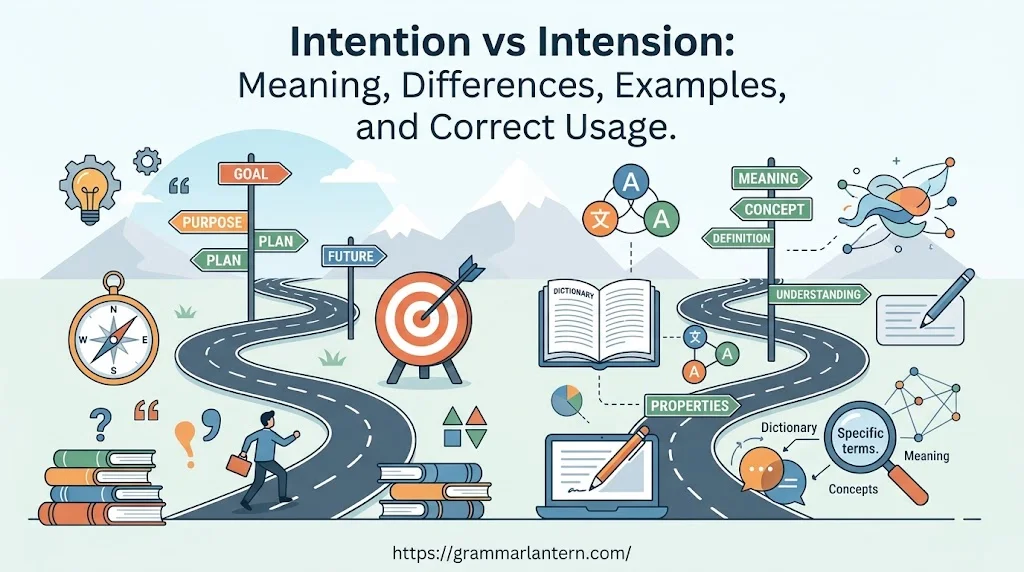
When Should You Use Intention Instead of Intension?
A simple rule can help:
Use intention when you are talking about:
- Plans
- Goals
- Decisions
- Reasons
- Motivation
- Future actions
Examples:
- “I intend to finish my homework tonight.”
- “Her intention was to support her team.”
- “The organization announced its intention to expand.”
Use intension when you are discussing:
- Definitions
- Concepts
- Logic
- Language analysis
- Meaning of terms
Examples:
- “The intension of this word changes depending on context.”
- “The philosopher examined the intension of moral concepts.”
Intend vs Intention: Understanding the Connection
Many people also confuse intend and intention.
They are related because one is a verb and the other is a noun.
Intend
Intend means to plan or mean to do something.
Examples:
- “I intend to study abroad.”
- “They intend to launch a new service.”
Intention
Intention is the noun form.
Examples:
- “My intention is to study abroad.”
- “Their intention was to improve customer service.”
A simple pattern:
I intend to do something.
My intention is to do something.
Intentional vs Intensional: Another Important Difference
These two words create another common confusion.
Intentional
Intentional means done deliberately or on purpose.
Examples:
- “The mistake was intentional.”
- “She made an intentional effort to improve.”
It connects with intention.
Intensional
Intensional relates to meaning, concepts, or logic.
Example:
- “The researcher studied intensional definitions.”
It connects with intension.
| Word | Meaning | Example |
| Intentional | Done deliberately | “It was an intentional action.” |
| Intensional | Related to meaning or concepts | “The paper examined intensional logic.” |
Real-World Examples
Example in Business
A company announces:
“Our intention is to provide affordable healthcare.”
This means the company’s goal is affordable healthcare.
However:
“The intension of the term ‘affordable healthcare’ depends on its definition.”
This discusses the meaning of the phrase.
Example in Education
A student says:
“My intention is to graduate with high marks.”
This describes a personal goal.
A linguistics professor says:
“The intension of the word ‘education’ includes knowledge, learning, and development.”
This discusses meaning.
Example in Daily Life
Imagine someone leaves a gift on your desk.
You might ask:
“What was their intention?”
You want to know their purpose.
You would not ask about the “intension” unless you were analyzing the meaning of a concept.
Memory Tricks to Remember
A few simple tricks can prevent confusion.
Remember Intention = Action
The word intention connects with intend.
If someone intends to do something, they have a plan.
Example:
“I intend to travel.”
“My intention is to travel.”
Remember Intension = Sense
Think of intension as being connected to “sense” or meaning.
It explains what something means and what qualities define it.
Quick Test
Ask yourself:
Is this about a person’s goal?
Use:
✅ Intention
Is this about the meaning of an idea?
Use:
✅ Intension
Read More: Countries or Country’s or Countries’? Possessive Explained
FAQs
1. What is the main difference between intention and intension?
The main difference between intention and intension is their meaning and usage. Intention refers to a person’s purpose, goal, or plan behind an action, while intension refers to the internal meaning or defining characteristics of a concept or term.
2. Is intention more common than intension?
Yes, intention is much more common in everyday English. People use it when talking about plans, aims, decisions, or purposes. Intension is mainly used in technical fields like philosophy, linguistics, and semantics.
3. Why do people confuse intention and intension?
People often confuse these words because they have almost identical spelling and similar pronunciation. The small spelling difference makes it easy to choose the wrong word without checking the context.
4. How can I remember the difference between intention and intension?
You can remember that intention with “t” relates to a person’s target, purpose, or plan. Intension with “s” connects with specialized subjects that study meanings, concepts, and definitions.
5. Can intention be used in academic writing?
Yes, intention is commonly used in academic writing when discussing goals, purposes, or objectives. However, intension may appear in academic fields that focus on language, logic, or conceptual analysis.
6. What does intension mean in linguistics?
In linguistics, intension refers to the internal meaning or qualities that define a word or concept. It focuses on what makes a term meaningful rather than a person’s goal or plan.
7. Is intension a commonly used English word?
No, intension is not commonly used in daily conversations. It is a technical vocabulary term mostly found in philosophy, semantics, logic, and linguistics.
8. What are some examples of intention?
Examples of intention include planning to study for an exam, deciding to help someone, or having a goal to complete a project. These examples show a person’s purpose behind an action.
9. What are some examples of intension?
An example of intension is studying the qualities that define a concept, such as the characteristics that make a “triangle” a triangle in logic or philosophy.
10. Which word should I use in normal communication?
In normal communication, intention is usually the correct choice. Use intension only when discussing technical ideas related to meaning, concepts, or definitions.
Conclusion
Understanding the difference between intention vs intension helps you avoid common writing mistakes and improve your word choice. Although these words look and sound similar, they belong to different contexts. Intention focuses on a person’s purpose, plan, or goal, while intension explains the deeper meaning and characteristics of a concept. Learning this distinction makes your writing clearer and more accurate.
Good vocabulary skills come from understanding how words function in real situations. By paying attention to context, meaning, and usage, you can confidently choose the correct term in everyday conversations, academic writing, and professional communication. A clear understanding of these two words strengthens your language skills and prevents unnecessary confusion.