
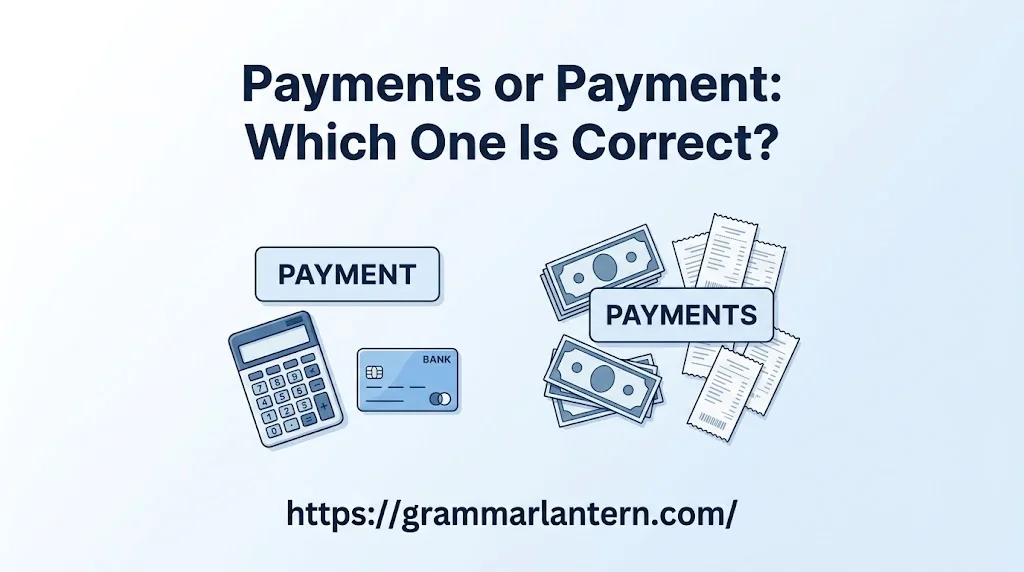
Payments or Payment: Which One Is Correct? depends on whether you’re talking about one transaction or several. Payment is the singular form, meaning a single financial transaction or the act of paying an amount you owe. For example, your monthly payment may be due on Friday. Payments, however, refers to multiple transactions, such as paying bills in installments or receiving money several times.
Common payment methods include credit cards, debit cards, bank transfers, digital wallets, and cash. Credit and debit cards connect to bank accounts, while digital wallets store payment details for quick mobile and online checkouts. Bank transfers move money between accounts through services such as wires and ACH. Cash uses physical banknotes and coins, offering a straightforward way to pay without digital tools.
Choosing the correct word makes your writing clearer. Use payment when referring to one transaction, and use payments when discussing several transactions. For example, “I made a payment yesterday” describes one transaction, while “I made three payments this month” describes multiple transactions.
Quick Answer
Payment is the singular form of the noun. It usually refers to one transaction, one amount paid, or the act of paying money in a general sense.
Payments is the plural form. It refers to two or more separate payments, such as monthly installments, multiple bills, or several transactions.
| Word | Meaning | Example |
| Payment | One payment or the general act of paying | Your payment has been received. |
| Payments | Two or more separate payments | Your payments have been received. |
Here is a simple way to remember the difference:
- Use payment when referring to one transaction or payment in general.
- Use payments when referring to multiple transactions or amounts paid.
- Match the verb to the noun. For example, payment is and payments are.
- Consider the meaning of the entire sentence rather than choosing a word based only on how it sounds.
The easiest rule: One payment, multiple payments. However, payment can also describe the general process of paying, so context matters.
What Does Payment Mean?
The word payment refers to the act of giving money to someone or an amount of money given in exchange for goods, services, or the settlement of a debt.
You might make a payment when buying groceries, paying rent, settling a credit card bill, or purchasing something online. The word works in many financial situations, from casual conversations to formal business documents.
Consider these examples:
- I made a payment for my new laptop.
- Your rent payment is due on Friday.
- The company received a payment from its customer.
- We accept payment by credit card.
- She completed the final payment on her loan.
Each sentence uses payment in a slightly different way. In the first, it refers to a transaction. In the second, it identifies a specific financial obligation and In the fourth, it describes payment as a general activity rather than counting individual transactions.
Is Payment a Countable or Uncountable Noun?
One useful detail is that payment can function as both a countable and an uncountable noun, depending on its meaning.
When you count individual transactions, it is a countable noun.
For example:
- I made a payment yesterday.
- We received three payments this week.
- The first payment is due next month.
You can use a, one, or a number when referring to an individual payment.
However, payment can also refer to the general act or means of paying without counting separate transactions.
For example:
- Payment is required before delivery.
- We accept payment in cash.
- Payment must be made in advance.
In these sentences, payment describes a general condition or process. You don’t need to identify a particular transaction.
Common Expressions With Payment
The singular form appears in many familiar expressions, especially in financial and business writing.
| Expression | Meaning | Example |
| Make a payment | Give money to settle an obligation | I need to make a payment today. |
| Receive payment | Get money owed to you | The contractor received payment. |
| Payment method | A way to pay | Choose your preferred payment method. |
| Payment confirmation | A message confirming a transaction | I received a payment confirmation by email. |
| Payment in full | Paying the entire amount owed | The customer paid the balance in full. |
| Payment due | An amount that must be paid | The payment is due on Monday. |
These expressions help you write clearly about financial activities without adding unnecessary words.
What Does Payments Mean?
Payments is the plural form of payment. Use it when referring to multiple transactions, separate amounts of money paid, or installments made over time.
For example, imagine you purchase a phone for $900 and agree to pay for it in three installments of $300. Each installment is a payment. Together, they are three payments.
You could describe the arrangement in these ways:
- I made the first payment yesterday.
- I have made two payments so far.
- My remaining payments are due over the next two months.
- The company received several payments from its customers.
- All outstanding payments must be completed by Friday.
Notice how the plural form tells readers that more than one transaction is involved.
When Should You Use Payments?
Use payments when the sentence refers to multiple financial transactions or amounts.
Common situations include:
- Monthly installments: The monthly payments are affordable.
- Recurring bills: My utility payments come out of my account automatically.
- Business transactions: The accounting team recorded five payments.
- Customer accounts: Several customer payments remain outstanding.
- Loan repayment: She has completed all her loan payments.
The plural form is especially useful when describing a series of transactions rather than one individual event.
Common Expressions With Payments
| Expression | Meaning | Example |
| Monthly payments | Payments made each month | Our monthly payments are manageable. |
| Online payments | Transactions completed online | Online payments are available through the website. |
| Late payments | Payments made after the deadline | Late payments may incur fees under the agreement. |
| Payments received | Multiple payments collected | All payments received have been recorded. |
| Payment plans | Arrangements for paying over time | The clinic offers payment plans. |
| Outstanding payments | Amounts that remain unpaid or unsettled | We need to review the outstanding payments. |
One important distinction: payment plans refers to multiple plans, while payments refers to the actual transactions. A single payment plan can include several payments.
Key Differences
The main difference between payment and payments is grammatical number, but their meanings can change depending on the context.
Use payment for one individual transaction or for payment as a general concept. Use payments when you mean multiple separate transactions.
| Feature | Payment | Payments |
| Grammatical form | Singular or uncountable noun | Plural noun |
| Number of transactions | Usually one when countable | Two or more |
| Common verbs | Is, was, has | Are, were, have |
| Common determiners | A, an, the, this, that | The, these, those, several |
| Financial example | The payment was delayed. | The payments were delayed. |
| Business example | We received a payment from the client. | We received payments from several clients. |
| Installment example | My first payment is due today. | My remaining payments are due monthly. |
How the Meaning Changes
Compare these two sentences:
Example 1: The payment has been processed.
This sentence refers to one payment. The singular noun payment takes the singular verb phrase has been.
Example 2: The payments have been processed.
This sentence refers to multiple payments. The plural noun payments takes the plural verb phrase have been.
Changing one word affects both the meaning and the grammar of the sentence.
However, the distinction isn’t always about counting transactions. Consider these examples:
- Payment is required before delivery. This describes a general condition.
- Payments are required before each delivery. This describes multiple payments associated with separate deliveries.
Both sentences are grammatically correct. The right choice depends on what you want to communicate.
When to Use Payment
Use payment when you mean one specific transaction, one amount paid, or the general process of paying.
The following situations show how the singular form works in everyday and professional writing.
When Referring to One Transaction
If someone makes a single purchase or settles one bill, use payment.
Examples:
- Your payment has been received.
- I made a payment for the groceries.
- The payment was declined by the bank.
- Please confirm your payment before leaving.
- We processed the payment this morning.
In each example, the sentence focuses on one transaction. If several transactions were involved, payments might be more appropriate.
When Discussing Payment in General
You don’t always need to count individual transactions. Sometimes, payment describes the general act or condition of paying.
For example:
- Payment is required before the service begins.
- We accept payment by bank transfer.
- Payment must be made within 30 days.
- The seller requested payment in advance.
Here, payment refers to a general requirement or method. It doesn’t necessarily describe one particular transaction.
This usage is common in contracts, policies, checkout instructions, and formal business documents.
When Writing About Invoices and Receipts
Invoices and receipts often refer to one transaction at a time.
For example:
- Your payment is overdue.
- The payment was recorded on October 10.
- Please include your invoice number with the payment.
- We have received your payment in full.
If you’re discussing several invoices or receipts, the plural form may be more suitable.
For example, “The payments for all three invoices have been recorded.”
The distinction helps readers understand whether a message concerns one specific account activity or several.
When to Use Payments
Use payments when you refer to multiple transactions, installments, or separate amounts of money.
The plural form is especially common in financial planning, accounting, lending, and business communication.
When Referring to Multiple Transactions
Imagine a business receives money from five different customers. If you’re describing those transactions collectively, payments is the natural choice.
Examples:
- We received several payments this morning.
- The payments have been added to the accounting records.
- Two payments are still pending.
- All payments were completed successfully.
- The bank identified three duplicate payments.
Each sentence refers to more than one transaction.
When Discussing Monthly Installments
Loans, car financing, and other installment arrangements often involve repeated payments over a set period.
For example:
- My monthly payments are due on the first day of each month.
- She missed two loan payments.
- The remaining payments will be deducted automatically.
- We reduced our monthly payments by extending the repayment period.
However, if you’re referring to just one installment, use the singular form.
For example, “My next payment is due on November 1.”
When Describing Business Accounts
Businesses frequently track payments from customers, vendors, and other organizations.
Examples include:
- Customer payments are reviewed every afternoon.
- The finance team reconciled the payments.
- Several supplier payments were delayed.
- We need to verify the payments listed on the statement.
The plural form makes sense because the records contain multiple financial transactions.
Keep in mind that a single customer may make several payments, while several customers may each make one payment. The correct noun depends on the number of payments, not simply the number of people involved.
In Common Situations
The difference becomes clearer when you apply both forms to familiar situations. The following examples cover common areas where people often confuse the singular and plural forms.
Payment or Payments for Bills and Invoices
Use payment when discussing one bill, one invoice settlement, or one transaction.
Use payments when discussing several bills, invoices, or installments.
Consider these examples:
- One bill: The payment for your electricity bill is due tomorrow.
- Multiple bills: The payments for your electricity and water bills are due tomorrow.
- One invoice: We received payment for invoice 104.
- Multiple invoices: We received payments for invoices 104, 105, and 106.
There’s another useful distinction in business writing. The phrase payment received often appears as a short status label on a receipt or account record. A full sentence might read, “Payment has been received.”
For multiple transactions, write “Payments have been received.”
Both forms are acceptable when the noun matches the number of transactions being described.
Payment or Payments for Loans and Installments
Loan agreements often involve one initial payment followed by several scheduled installments.
For example, imagine you borrow $6,000 and agree to repay it through 12 monthly installments of $500, excluding any interest or additional fees.
You could describe the arrangement like this:
- Your first payment is due in January.
- Your monthly payments are $500 each.
- You have made four payments so far.
- Your final payment is due in December.
The singular form identifies an individual installment. The plural form describes the installments collectively.
One more detail matters: a monthly payment doesn’t always equal the amount that reduces the loan principal. Depending on the agreement, an installment may include interest, fees, and principal repayment.
Payment or Payments in Online Transactions
Online stores and payment platforms use both forms because they handle individual transactions as well as transaction histories.
Common examples include:
- Payment successful: One transaction succeeded.
- Payment failed: One transaction did not go through.
- View payments: Open a list of multiple transactions.
- Payment history: Review records of transactions over time.
- Payments pending: Several transactions have not yet been completed.
A website might display “Payment successful” immediately after checkout. That message confirms the status of one transaction.
By contrast, an account dashboard might display “Payments” as a menu heading because the section contains many records.
The wording should reflect the function of the page or message.
Payment or Payments in Business and Accounting
Accounting systems record individual transactions and organize them into reports. That’s why both forms appear frequently in financial records.
Use payment when referring to one recorded transaction or a general process.
Examples:
- The payment was entered into the ledger.
- We received payment from the supplier.
- Payment is due within 30 days.
Use payments when discussing multiple records or transactions.
Examples:
- The payments were entered into the ledger.
- We reviewed the customer payments for September.
- Several payments remain unmatched.
In accounting, the number of payment records may differ from the number of invoices. One payment can settle several invoices, while one invoice can be settled through multiple payments.
That distinction is important when reconciling accounts or explaining why a balance remains outstanding.
Payment or Payments in Salary and Compensation
The correct form depends on whether you’re discussing one disbursement or several.
For example:
- The payment was deposited into her account.
- The company made two payments during the month.
- All employee payments have been processed.
- Your final payment will include the remaining amount owed.
However, salary and payment aren’t interchangeable in every context. Salary usually refers to regular compensation for employment, while payment is a broader term for money given to settle an obligation or compensate someone.
For example, “Her salary is paid monthly” describes a regular compensation arrangement. “Her salary payment arrived today” focuses on a particular disbursement.
Common Grammar Rules
Understanding a few basic grammar rules will help you choose the correct form without second-guessing yourself.
Subject–Verb Agreement With Payment and Payments
The noun determines whether you need a singular or plural verb when it serves as the subject of a sentence.
Use singular verbs with singular payment and plural verbs with plural payments.
| Singular: Payment | Plural: Payments |
| The payment is overdue. | The payments are overdue. |
| The payment was delayed. | The payments were delayed. |
| The payment has arrived. | The payments have arrived. |
| This payment needs approval. | These payments need approval. |
A common mistake is to write “The payments is complete.” The correct sentence is “The payments are complete.”
Remember that the plural ending changes the verb agreement, too.
Articles and Determiners With Payment and Payments
Articles and other determiners help you identify whether you’re discussing one payment or several.
Use these patterns:
- A payment: I made a payment yesterday.
- The payment: The payment arrived this morning.
- This payment: This payment requires approval.
- These payments: These payments require approval.
- Several payments: Several payments are overdue.
- All payments: All payments must be recorded.
Because payment is a singular countable noun in the first three examples, it can take a, the, or this. The plural noun payments can take these, several, or all.
You generally wouldn’t write “a payments” or “these payment” when referring to countable transactions.
Adjectives With Payment and Payments
Adjectives can describe both forms. The adjective usually stays the same while the noun changes.
For example:
- A late payment
- Several late payments
- One monthly payment
- Twelve monthly payments
- A successful payment
- Multiple successful payments
You don’t need to change late, monthly, or successful to make the phrase plural. Simply change the noun when the meaning requires it.
Can Payment Be Used Without an Article?
Yes. You can use payment without an article when referring to the general process of paying or when it appears in certain established expressions.
Examples:
- Payment is required before shipping.
- We accept payment by credit card.
- Payment must be made in advance.
- The customer requested payment in cash.
However, when referring to one specific countable transaction, an article or another determiner is often necessary.
For example, write “I made a payment” rather than “I made payment” in ordinary American English when you mean one specific transaction. The article-free version can occur in formal, legal, or specialized expressions, but it isn’t the usual choice for everyday writing.
Common Mistakes
Even experienced writers occasionally mix up these forms, particularly when writing quickly. Here are some mistakes to watch for.
| Incorrect or less suitable | Correct or more suitable | Why |
| The payments is overdue. | The payments are overdue. | A plural subject needs a plural verb. |
| The payment have arrived. | The payment has arrived. | A singular subject takes has. |
| I made three payment. | I made three payments. | A number greater than one normally takes the plural noun. |
| Please select your payments method. | Please select your payment method. | Payment method is the standard compound noun. |
| My next payments is due tomorrow. | My next payment is due tomorrow. | One upcoming installment requires the singular form. |
| All payment have been received. | All payments have been received. | The sentence refers to multiple payments. |
Confusing Payment Method With Payments Method
The correct expression is payment method, not payments method, when describing a way to pay.
For example:
- Select your preferred payment method.
- Credit cards are a popular payment method.
- You can change your payment method in your account settings.
The word payment functions as a modifier describing the type of method. This pattern is common in English compound nouns, where the first noun usually remains singular.
Confusing Payment Plan With Payments
A payment plan is an arrangement for paying money over time. It may contain several individual payments.
For example, “I signed a payment plan that includes six monthly payments.”
Here, payment plan refers to one arrangement, while payments refers to the six installments.
This distinction is useful when discussing loans, medical bills, tuition fees, and other financial obligations.
Example Sentences
These practical examples show how the two forms work in different situations.
| Situation | Example sentence |
| Shopping | Your payment has been approved. |
| Rent | My rent payment is due on Friday. |
| Multiple bills | The payments for both bills are overdue. |
| Online shopping | The payment failed because of a card issue. |
| Loan repayment | Her monthly payments are manageable. |
| Business | We received a payment from the client. |
| Accounting | The payments have been recorded in the ledger. |
| Salary | The payment arrived in my bank account. |
| Installments | I have completed four payments so far. |
| Refunds | The payment was refunded to the customer. |
| Customer accounts | Several payments are still pending. |
| Subscriptions | Your subscription payment will be processed tomorrow. |
A Practical Case Study: One Invoice, Multiple Payments
Imagine a freelance designer sends a client an invoice for $1,200. The client agrees to pay $600 upfront and the remaining $600 after the project finishes.
The designer might write:
“The first payment of $600 has been received.”
After the second installment arrives, the designer could write:
“Both payments have been received.”
The first sentence uses payment because it refers to one transaction. The second uses payments because it refers to two transactions.
This example also shows why the amount of money alone doesn’t determine the noun. A single $1,200 transaction is one payment, while two $600 transactions are two payments.
Read More: Choosing vs. Chosing: Which Spelling Is Correct?
FAQs
1. Is it payment or payments?
Both words are correct. Use payment for one transaction and payments for two or more transactions.
2. What is the difference between payment and payments?
Payment refers to a single act of paying money, while payments refers to multiple transactions or a series of installments.
3. Is payment singular or plural?
Payment is a singular noun. It describes one transaction or a specific amount paid or owed.
4. When should I use payments in a sentence?
Use payments when discussing multiple transactions. For example, “I made three payments this month.”
5. Is monthly payment or monthly payments correct?
Both are correct, depending on the context. Use “monthly payment” for one payment and “monthly payments” for recurring or multiple payments.
6. Is it online payment or online payments?
Use online payment for one transaction and online payments for multiple transactions or online transactions in general.
7. Should I write payment method or payments method?
Payment method is correct when referring to a way of paying, such as cash, a credit card, or a bank transfer. “Payments method” is generally incorrect.
8. Is payment processing or payments processing correct?
Payment processing is the standard expression for handling transactions. It covers activities such as verifying, authorizing, and completing payments.
9. Can payment refer to money owed?
Yes. Payment can refer to money given to settle a debt, bill, or obligation. For example, “Your payment is due tomorrow.”
10. Is payments used in formal writing?
Yes. Payments is appropriate in formal writing when discussing multiple transactions, recurring installments, business finances, or payment systems.
Conclusion
Choosing between payment and payments is simple once you understand the difference between singular and plural nouns. Use payment when referring to one transaction or a specific amount owed. Use payments when describing multiple transactions, recurring bills, or several installments.
When writing emails, business reports, invoices, or everyday messages, consider how many transactions you’re discussing. For example, “Your payment has been received” refers to one transaction, while “Your payments have been received” refers to multiple transactions. Using the correct form makes your writing clearer, more natural, and easier for readers to understand.

Muhammad Haroon is the voice behind many of the clear, practical grammar guides you’ll find on Grammar Lantern. With a strong background in content writing and a genuine love for the English language, Haroon specializes in breaking down intimidating grammar topics into simple, digestible lessons. His goal is simple: to empower readers to write with confidence and clarity. Whether he’s explaining tricky tenses or demystifying punctuation, Haroon approaches each topic with patience, precision, and a touch of warmth—because he knows that learning grammar is a journey, not a race.