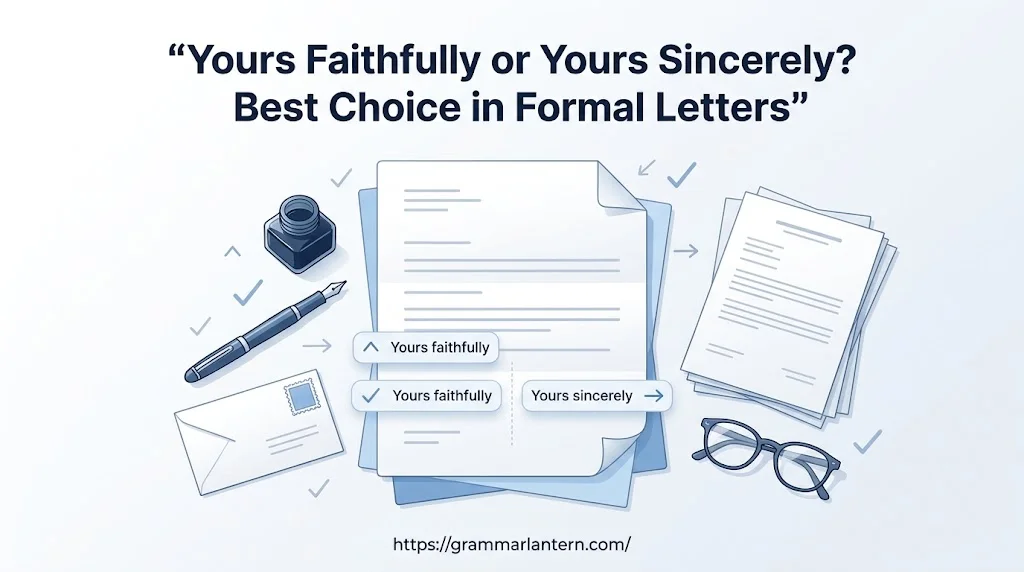
Choosing between Yours Faithfully or Yours Sincerely can feel confusing when you write a formal letter. The good news is that the rule is simple. Your choice depends on how you greet the recipient and whether you know their name. Both expressions are polite and professional, but they fit different situations.
Use Yours faithfully when you begin your letter with “Dear Sir,” “Dear Madam,” or “Dear Sir/Madam.” This traditional British English convention applies when you don’t know the recipient’s name. For example, if you’re writing to an unknown hiring manager, this closing is a suitable option. It keeps your business communication respectful and formal.
Choose Yours sincerely when you know the recipient’s name. For instance, if your letter begins with “Dear Mr. Smith,” this closing is appropriate. Matching your greeting with the correct sign-off makes your writing clear and professional. Always check the conventions used in your country or organization, as formal letter-writing rules can vary.
Quick Answer
Use “Yours faithfully” when you don’t know the recipient’s name and “Yours sincerely” when you address the recipient by name in traditional British English. In American English, “Sincerely” and “Sincerely yours” are common formal closings for both named and unnamed recipients.
Here is the basic distinction:
| Situation | Recommended closing | Example greeting |
| British English, recipient’s name unknown | Yours faithfully | Dear Sir or Madam |
| British English, recipient’s name known | Yours sincerely | Dear Ms. Taylor |
| American English, recipient’s name known | Sincerely or Sincerely yours | Dear Ms. Taylor |
| American English, recipient’s name unknown | Sincerely or Sincerely yours | Dear Hiring Manager |
| Professional email with an established working relationship | Kind regards or Best regards | Dear Alex |
Remember: The distinction between faithfully and sincerely isn’t a simple ranking of formality. In traditional British correspondence, the opening greeting determines which expression normally fits.
What Is the Difference Between Yours Faithfully and Yours Sincerely?
Although both expressions close formal correspondence, they follow different conventions in traditional British English. Understanding their meanings makes it easier to choose the right phrase without second-guessing yourself.
Meaning of Yours Faithfully
“Yours faithfully” is a traditional formal letter closing commonly used in British English when the writer doesn’t address the recipient by name.
The word faithfully conveys loyalty, reliability, and a sense of good faith. In modern correspondence, however, the phrase functions mainly as a conventional sign-off rather than a personal promise of loyalty.
You might use it when writing to an organization, contacting a government department, or sending a formal inquiry to an unnamed recipient.
For example:
Dear Sir or Madam,
I am writing to request information about your company’s graduate training program.
Yours faithfully,
Jordan Miller
This closing fits the traditional British convention because the greeting doesn’t identify the recipient by name.
Meaning of Yours Sincerely
“Yours sincerely” is a formal closing traditionally used in British English when the writer knows the recipient’s name and includes it in the greeting.
The word sincerely suggests honesty and genuine intent. It helps maintain a respectful tone without sounding overly personal or casual.
For example:
Dear Ms. Taylor,
Thank you for considering my application for the marketing assistant position. I look forward to hearing from you.
Yours sincerely,
Jordan Miller
Because the greeting names Ms. Taylor, the closing follows the traditional British rule.
In everyday business correspondence, the phrase doesn’t necessarily express deep personal feelings. It’s simply a recognized way to end a professional letter politely.
Key Differences Between Yours Faithfully and Yours Sincerely
The easiest way to remember the distinction is to look at the greeting first.
| Feature | Yours faithfully | Yours sincerely |
| Traditional British use | Recipient’s name is unknown | Recipient’s name is known |
| Typical greeting | Dear Sir or Madam | Dear Ms. Taylor |
| Level of formality | Formal | Formal |
| Common purpose | Official letters, inquiries, and complaints | Job applications, business letters, and professional requests |
| American English usage | Less common | Sincerely is more common |
| Main consideration | The recipient isn’t named | The recipient is named |
Both closings are appropriate in formal situations when you follow the relevant convention. Neither is automatically more respectful than the other.
When Should You Use Yours Faithfully?
Use “Yours faithfully” when writing a formal British-style letter to someone whose name you don’t know. This convention is particularly useful when contacting an organization rather than an identified individual.
When You Don’t Know the Recipient’s Name
Imagine that you want to ask a university about its admission requirements. You’ve found the correct department, but you can’t identify the staff member who handles inquiries.
You could begin your letter with “Dear Sir or Madam” and close with “Yours faithfully.”
This pairing follows the traditional British rule because the salutation doesn’t include a person’s name.
Other situations include:
- Requesting information from a government office.
- Sending a formal complaint to an organization.
- Asking a company about its services.
- Writing to an unnamed recruitment officer.
- Making an official inquiry to a school or university.
However, you don’t need to use an outdated or awkward greeting if a more natural alternative is available. When possible, find the recipient’s name or use a suitable role-based greeting, such as “Dear Hiring Manager.”
Read More: 6 More Formal Ways to Say “Please Provide…” at Work
When Writing to an Organization or Department
A letter addressed to a department can still follow the traditional unnamed-recipient convention.
For example, you might contact a bank’s complaints department about an incorrect transaction. If you don’t know who will handle the matter, “Dear Sir or Madam” followed by “Yours faithfully” is a traditional option in British English.
Here is a practical example:
Opening:
Dear Sir or Madam,
I am writing to request a review of the service charge applied to my account on October 10.
Closing:
Yours faithfully,
Alex Morgan
The closing works because the writer hasn’t addressed a named individual.
That said, many modern organizations use department names, online forms, or customer-service email addresses. In those situations, a greeting such as “Dear Customer Support Team” may feel more natural. The traditional distinction still offers useful guidance, although an organization’s preferred style may take priority.
Examples of Yours Faithfully in Formal Letters
Consider these common situations:
Formal complaint
Dear Sir or Madam,
I am writing to raise a concern about a damaged item delivered with my recent order.
Yours faithfully,
Morgan Lee
Business inquiry
Dear Sir or Madam,
Could you please provide your current pricing and delivery terms for bulk orders?
Yours faithfully,
Morgan Lee
Job application
Dear Sir or Madam,
Please find enclosed my application for the administrative assistant position advertised on your careers page.
Yours faithfully,
Morgan Lee
Each example uses an unnamed salutation, making “Yours faithfully” suitable under traditional British conventions.
When Should You Use Yours Sincerely?
Choose “Yours sincerely” when writing a formal British English letter to someone you’ve identified by name. It works well for professional communication that calls for courtesy and a clear sense of respect.
When You Know the Recipient’s Name
Suppose you’re writing to a university admissions officer named Dr. Patel. You know the person’s name and use it in your greeting.
The traditional closing would be “Yours sincerely.”
For example:
Dear Dr. Patel,
I am writing to ask whether supporting documents can be submitted after the application deadline.
Yours sincerely,
Morgan Lee
The same rule applies when you address someone as Mr. Brown, Ms. Taylor, Professor Ahmed, or another named recipient.
One important detail: knowing someone’s name matters more than knowing their job title. If you know the person’s name and use it in the greeting, “Yours sincerely” is the traditional British choice.
When Writing to a Manager, Colleague, or Business Contact
Professional relationships often become less formal over time. However, a letter to a manager, client, or business contact may still require a formal closing.
For instance, if you write to a named hiring manager about an interview, “Yours sincerely” is appropriate in a traditional British letter.
A professional email to a colleague you work with daily may call for something less formal, such as “Kind regards” or simply “Best regards.”
Consider the difference:
Formal letter
Dear Mr. Wilson,
Thank you for reviewing my proposal. I would welcome the opportunity to discuss the next steps.
Yours sincerely,
Daniel Reed
Routine professional email
Hi James,
Thanks for reviewing the proposal. Let’s discuss the next steps during tomorrow’s meeting.
Best regards,
Daniel
Both messages are professional. The difference lies in the relationship, the purpose, and the level of formality.
Examples of Yours Sincerely in Formal Letters
Cover letter to a named hiring manager
Dear Ms. Robinson,
I am pleased to submit my application for the content editor position. My experience in editing and digital publishing aligns closely with the requirements.
Yours sincerely,
Taylor James
Formal request to a supervisor
Dear Mr. Ahmed,
I would appreciate your approval to attend the professional development workshop scheduled for November 12.
Yours sincerely,
Taylor James
Business proposal
Dear Ms. Carter,
Thank you for discussing your company’s requirements with us. Please find our proposal attached for your consideration.
Yours sincerely,
Taylor James
These examples show how the same closing fits different professional situations when the writer addresses a named recipient.
In British and American English
One reason people struggle with these expressions is that English letter-writing conventions differ across countries. A closing that follows traditional British practice may sound less typical in the United States.
British English Convention
Traditional British correspondence follows a straightforward rule:
- Dear Sir or Madam → Yours faithfully
- Dear Mr. Smith → Yours sincerely
The same distinction generally applies when a letter begins with a named person’s professional title.
For example, a letter beginning “Dear Professor Green” would traditionally end with “Yours sincerely.”
A letter beginning “Dear Sir or Madam” would traditionally end with “Yours faithfully.”
These conventions remain useful in formal British letters, including official correspondence, traditional business letters, and some job applications.
However, modern British workplaces also use alternatives such as “Kind regards” and “Best regards,” especially in email. Not every professional message needs a traditional letter closing.
American English Convention
American English generally doesn’t apply the same strict distinction between named and unnamed recipients.
“Sincerely” and “Sincerely yours” are common closings in formal American correspondence. Either may follow a greeting that includes a person’s name or a role-based greeting.
For example:
Dear Hiring Manager,
I am writing to apply for the communications specialist position at your organization.
Sincerely,
Taylor James
You could also write:
Dear Ms. Robinson,
Thank you for considering my application. I look forward to discussing my qualifications with you.
Sincerely,
Taylor James
Both examples follow common American business-writing practice.
Although Americans may understand “Yours faithfully,” it isn’t the usual default for many modern American business letters. If you’re writing to a US employer or company, “Sincerely” is generally a more familiar option.
Which Rule Should International Writers Follow?
When writing across borders, follow the recipient’s local convention whenever possible. This small detail can make your letter feel more natural and appropriate.
Use these guidelines:
- Writing to a British organization: Follow the traditional greeting-based distinction when using formal letter closings.
- Writing to an American organization: Consider “Sincerely” or “Sincerely yours.”
- Writing to an international company: Follow its established correspondence style if one exists.
- Writing to an unknown recipient abroad: Choose a widely accepted professional closing that suits the recipient’s country.
- Writing a routine business email: Consider whether “Kind regards” or “Best regards” better matches the relationship.
If you aren’t sure which convention applies, look at the organization’s existing correspondence or follow its style guide. Consistency is more useful than trying to make every letter sound equally formal.
How to Choose the Right Formal Letter Sign-Off
Choosing between “Yours faithfully” and “Yours sincerely” becomes easier when you consider three things: the greeting, the recipient’s location, and the purpose of your message.
Consider Whether You Know the Recipient’s Name
Start by checking the greeting at the beginning of your letter. In traditional British English, this is the clearest way to select the closing.
| Your greeting | Traditional British closing |
| Dear Sir or Madam | Yours faithfully |
| Dear Mr. Wilson | Yours sincerely |
| Dear Dr. Ahmed | Yours sincerely |
| Dear Professor Green | Yours sincerely |
| Dear Hiring Manager | Yours faithfully is the traditional choice when the recipient remains unnamed |
The last example deserves a little attention. “Hiring Manager” identifies the recipient’s role but doesn’t give their name. Under the traditional British rule, that makes “Yours faithfully” the conventional choice.
In American English, you can generally use “Sincerely” for any of these greetings.
Consider the Purpose of Your Letter
The purpose of your letter helps you decide how formal the closing should sound. However, it doesn’t replace the traditional British rule about named and unnamed recipients.
For example, a complaint letter addressed to a named customer service manager can end with “Yours sincerely.” A general inquiry to an unnamed department can end with “Yours faithfully.”
The same principle applies to job applications. Whether you’re requesting an interview or asking about a vacancy, consider the greeting before choosing the sign-off.
Match the Level of Formality
Not every professional message needs a traditional closing.
A formal letter to a government official may call for “Yours sincerely” or “Yours faithfully,” depending on the greeting and regional convention. A quick email to a colleague may sound more natural with “Kind regards.”
Use this simple guide:
- Highly formal correspondence: Yours faithfully, Yours sincerely, or Sincerely.
- Routine professional emails: Kind regards or Best regards.
- Friendly workplace communication: Best regards or Thanks, depending on context.
- Formal messages requiring a respectful tone: Respectfully, where appropriate.
The best closing is one that fits the message rather than making it unnecessarily stiff.
Follow the Recipient’s or Organization’s Preferred Style
Some organizations have established rules for business letters and emails. If a company asks applicants to use a particular format, follow that guidance.
Likewise, if you’re replying to an existing email conversation, matching the other person’s level of formality can help your message feel consistent.
You don’t need to copy every detail of another person’s writing. Simply choose a respectful closing that suits the relationship and context.
Real-World Examples
The following examples show how the distinction works in everyday professional situations. Each one includes a practical explanation so you can apply the rule to your own correspondence.
Formal Complaint Letter
Imagine that you received a damaged product and need to contact a company’s complaints department. You don’t know who will review your case.
In traditional British English, you could write:
Dear Sir or Madam,
I am writing to complain about an item delivered to my address on October 12. The product arrived damaged and cannot be used as intended. I would appreciate a replacement or refund.
Yours faithfully,
Alex Morgan
Why it works: The writer doesn’t identify the recipient by name, so “Yours faithfully” follows the traditional British convention.
If the complaint were addressed to a named complaints manager, “Yours sincerely” would be the traditional choice instead.
Job Application Letter
Job applications provide a useful example because applicants often know the job title but not the recruiter’s name.
Scenario A: The recruiter’s name is unknown
Dear Hiring Manager,
I am applying for the junior accountant position advertised on your careers page. My experience with financial records and account reconciliation would help me contribute to your team.
Yours faithfully,
Alex Morgan
Scenario B: The recruiter’s name is known
Dear Ms. Robinson,
I am applying for the junior accountant position advertised on your careers page. My experience with financial records and account reconciliation would help me contribute to your team.
Yours sincerely,
Alex Morgan
The body remains almost identical. Only the greeting and closing change.
This comparison shows why you should identify the recipient before preparing the final version of a formal British letter.
Business Inquiry Letter
Suppose you’re contacting a supplier to ask about bulk pricing.
When you don’t know the contact person’s name, a traditional British letter might begin with “Dear Sir or Madam” and end with “Yours faithfully.”
However, if a sales representative named Mr. Carter has already contacted you, the letter can begin with “Dear Mr. Carter” and end with “Yours sincerely.”
Both options are professional. The greeting determines which one fits traditional British usage.
Formal Request Letter
Consider an employee requesting permission to attend a training program.
If the employee writes to a named manager, the letter might look like this:
Dear Ms. Ahmed,
I would appreciate your approval to attend the professional development workshop scheduled for November 12. The program covers skills directly related to my current responsibilities.
Yours sincerely,
Sam Wilson
If the employee doesn’t know which official will review the request, a general salutation and “Yours faithfully” may be appropriate in traditional British correspondence.
The key is to avoid treating the letter’s purpose as the only deciding factor. The recipient and greeting remain central to the choice.
International Business Correspondence
Suppose a UK-based writer contacts a US company about a possible partnership.
The writer could use “Dear Hiring Manager” or another suitable greeting, then close with “Sincerely.” This would sound natural in American business correspondence.
If the same writer were sending a traditional formal letter to a British organization, the greeting would guide the closing under British conventions.
When writing internationally, the recipient’s local expectations matter more than the writer’s personal preference. A little attention to regional usage can prevent an otherwise polished letter from feeling unfamiliar.
Common Mistakes
Even experienced writers can mix up these expressions. Fortunately, most mistakes are easy to correct.
Using Yours Sincerely After an Unnamed Salutation in Traditional British English
A letter that begins “Dear Sir or Madam” traditionally ends with “Yours faithfully” in British English.
Using “Yours sincerely” isn’t the conventional pairing. If you’re following traditional British letter-writing rules, check the greeting before signing off.
Using Yours Faithfully After a Named Salutation
If you begin with “Dear Ms. Taylor,” the traditional British closing is “Yours sincerely.”
Using “Yours faithfully” after a named greeting reverses the conventional distinction. It may still be understood, but it doesn’t follow the standard British rule.
Confusing British and American Conventions
Not every English-speaking country follows the same letter-writing practices.
A writer who applies British conventions to every American business letter may choose an unusual closing. Similarly, using an American default without considering a British organization’s expectations may miss a familiar convention.
When in doubt, consider the recipient’s country and the organization’s preferred style.
Mixing Formal and Informal Language
Imagine writing a detailed complaint to a government office and ending with “Catch you later!”
The closing clashes with the message.
You don’t have to make every formal letter sound old-fashioned, but your sign-off should match the tone of the body. Choose “Yours faithfully,” “Yours sincerely,” or another suitable professional closing instead.
Formatting the Closing Incorrectly
Correct wording matters, but formatting also affects how polished your letter looks.
Keep these points in mind:
- Start the closing on a separate line after the body.
- Leave appropriate space for your signature in a printed letter.
- Type your full name beneath your handwritten signature.
- Use consistent capitalization.
- Follow the punctuation style expected by your organization or recipient.
A simple, consistent layout helps your letter look professional without unnecessary decoration.
What Are the Alternatives?
Sometimes, neither traditional closing feels quite right. Several alternatives work well in modern professional correspondence, especially email.
Sincerely
“Sincerely” is a common formal closing in American English. It’s suitable for job applications, business letters, formal requests, and messages to recipients you don’t know personally.
Example:
Dear Hiring Manager,
Thank you for considering my application.
Sincerely,
Morgan Lee
It’s a straightforward choice when writing to an American organization.
Sincerely Yours
“Sincerely yours” is another established American business-letter closing. It conveys a respectful, formal tone and can follow either a named or an unnamed greeting.
Example:
Dear Mr. Johnson,
Thank you for reviewing my proposal. I look forward to discussing it with you.
Sincerely yours,
Morgan Lee
The choice between “Sincerely” and “Sincerely yours” often comes down to personal preference and organizational style.
Kind Regards
“Kind regards” is a popular choice for professional emails. It sounds courteous without feeling overly formal.
Use it when writing to a colleague, client, supplier, or business contact with whom you have an established relationship.
Example:
Hi Sarah,
I’ve attached the revised report for your review. Please let me know if you’d like any changes.
Kind regards,
Morgan
It’s especially useful when a traditional letter closing feels too formal for the conversation.
Best Regards
“Best regards” works well in everyday business communication. It strikes a balance between friendliness and professionalism.
You might use it when following up on a meeting, sharing a document, or replying to a client.
For example:
Hello David,
Thanks for sending the updated figures. I’ll review them before our meeting tomorrow.
Best regards,
Morgan
Although it’s widely accepted, consider the recipient’s expectations when writing particularly formal or official correspondence.
Yours Truly
“Yours truly” appears in some formal American correspondence, although its use varies by context and individual preference.
It’s a recognized alternative, but it isn’t necessary to use it simply because you’re unsure about “Yours faithfully” or “Yours sincerely.”
For many modern American business letters, “Sincerely” remains a familiar option.
Respectfully
“Respectfully” emphasizes deference or respect. It may suit letters to certain officials, senior authorities, or recipients in contexts where a particularly respectful tone is appropriate.
For example, a formal request to an official might close with “Respectfully,” followed by the writer’s name.
However, this expression can sound overly deferential in routine workplace communication. Use it when the context supports that tone rather than treating it as a universal formal sign-off.
How to Format Yours Faithfully and Yours Sincerely Correctly
Once you’ve selected the right closing, make sure the rest of your letter follows a consistent format. Small details such as capitalization, punctuation, and signature placement can affect the overall presentation.
Capitalization
The standard forms are:
- Yours faithfully
- Yours sincerely
In ordinary sentence-style capitalization, only the first word begins with a capital letter. Some organizations use title-style capitalization, such as “Yours Faithfully,” but consistency with the required style matters most.
Avoid switching capitalization styles randomly within the same document.
Punctuation
Punctuation practices can vary between British and American correspondence.
In American business letters, writers commonly place a comma after the closing:
Sincerely,
Morgan Lee
In British formal letters, writers may omit the comma after “Yours faithfully” or “Yours sincerely,” depending on the style they follow.
Neither approach should be applied blindly to every document. Follow the recipient’s or organization’s preferred format.
Signature Placement
A printed letter generally places the closing beneath the final paragraph, followed by a handwritten signature and the writer’s typed name.
For example:
Yours sincerely,
Handwritten signature
Morgan Lee
In an email, you normally don’t need to leave space for a handwritten signature. Instead, place your typed name beneath the closing.
A professional email might look like this:
Kind regards,
Morgan Lee Marketing Coordinator
The job title is optional, but it can help the recipient understand your role.
Formal Letter Closing Examples
Here are two complete examples that demonstrate regional differences.
British English example
Dear Ms. Taylor,
Thank you for providing information about the available internship opportunities. I would appreciate the opportunity to discuss the application process in greater detail.
Yours sincerely,
Morgan Lee
American English example
Dear Ms. Taylor,
Thank you for providing information about the available internship opportunities. I would appreciate the opportunity to discuss the application process in greater detail.
Sincerely,
Morgan Lee
Notice that both letters use the same greeting and body. The main difference is the conventional closing used in each regional style.
Read More: Wore or Worn: Which Is Correct? Helpful Examples
FAQs
1. What is the difference between Yours Faithfully and Yours Sincerely?
Yours faithfully is traditionally used when you don’t know the recipient’s name, while Yours sincerely is used when you address the recipient by name.
2. When should I use Yours faithfully?
Use Yours faithfully when your formal letter begins with a greeting such as “Dear Sir/Madam” and you don’t know the recipient’s name.
3. When should I use Yours sincerely?
Use Yours sincerely when you know the recipient’s name and address them personally, such as “Dear Mr. Smith.”
4. Is Yours faithfully more formal than Yours sincerely?
Both expressions are formal and professional. The main difference is how you address the recipient at the beginning of the letter.
5. Can I use Yours sincerely in a business letter?
Yes, Yours sincerely is suitable for business letters when you know the recipient’s name. It creates a polite and professional closing.
6. Should I capitalize Yours Faithfully or Yours Sincerely?
You can capitalize the first word of the closing and write the second word in lowercase: “Yours faithfully” or “Yours sincerely.” Follow your organization’s style guide if it specifies otherwise.
7. Is Yours faithfully used in American English?
In American English, Sincerely or Sincerely yours is more common in formal correspondence. Yours faithfully is more closely associated with traditional British English.
8. Can I use Yours sincerely when writing to someone I have never met?
Yes. If you know the person’s name and address them by name, Yours sincerely is appropriate even if you have never met them.
9. What is another way to end a formal letter?
Other professional closings include Kind regards, Best regards, and Sincerely. Choose one that suits your relationship with the recipient and the purpose of your letter.
10. Are Yours faithfully and Yours sincerely interchangeable?
Not always. In traditional British letter-writing conventions, the greeting determines which expression you should use. However, practices may differ across countries and organizations.
Conclusion
Choosing between Yours Faithfully or Yours Sincerely becomes easier when you understand the greeting that comes before the closing. Use Yours faithfully when you don’t know the recipient’s name, and use Yours sincerely when you address someone by name. Both expressions help you maintain a respectful tone in formal correspondence.
Before sending your letter, check your greeting, choose the appropriate sign-off, and follow the conventions of your country or workplace. These small details can make your business letters, job applications, and professional emails clearer and more polished.

For Shafiq ur Rehman, writing is an art form and grammar is the toolbox that makes it beautiful. As a dedicated content writer at Grammar Lantern, Shafiq approaches every topic like an architect carefully laying down strong foundations of understanding before adding the finer details. He loves diving into the trickiest grammar points and resurfacing with simple, bite-sized takeaways that anyone can grasp. When he’s not crafting articles, you’ll likely find him strategizing over a game of chess, exploring dusty local bookshops, or quietly jotting down poetic observations in his notebook.