Have you ever paused while writing dialogue and wondered how to spell the sound of a kiss? Learning 5 Ways To Spell The Sound Of Kissing can help make your writing more vivid, natural, and expressive. Different writers use different spellings to represent this affectionate sound, and choosing the right form can improve clarity, readability, and natural expression.
In modern English usage, small details can make a big difference. Writers may use playful forms such as muah, mwah, or smooch depending on the context and tone. These expressions can appear in fiction, comics, subtitles, social media posts, and broadcasting content. Understanding their differences also supports better grammar, consistency, and overall writing style.
This guide explores common ways to spell the sound of kissing and explains when each expression works best. Whether you are writing dialogue, creating entertainment content, or developing informal communication, knowing these variations can help you select the most suitable spelling for your audience, tone, and writing purpose.
Quick Answer
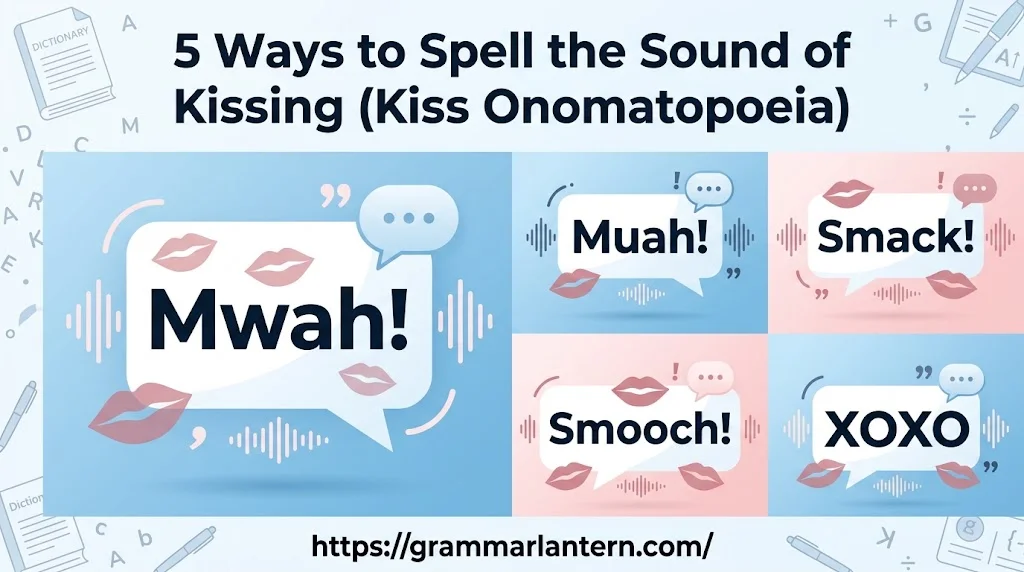
The most recognizable spelling for a kiss sound is “mwah!”
Other forms you may see include “muah,” “smack,” “smooch,” and “X” or “XOXO” in affectionate written communication.
However, these expressions aren’t exact equivalents.
| Kiss expression | What it communicates | Best context |
| Mwah! | A stylized kiss sound | Texts, dialogue, blown kisses |
| Muah! | A variant of the kiss sound | Casual messages and dialogue |
| Smack! | A sharp or audible kissing sound | Fiction, comics, dramatic scenes |
| Smooch | A kiss or the act of kissing | Informal prose and dialogue |
| X / XOXO | A symbolic kiss or affection | Messages, letters, sign-offs |
If the goal is specifically to spell the sound of a kiss, “mwah!” is usually the clearest choice.
What Is Kiss Onomatopoeia?
Onomatopoeia refers to words or expressions that imitate, echo, or suggest sounds. Common examples include buzz, hiss, clang, and splash.
A kiss sound is a little different because there isn’t one universal acoustic pattern. The sound depends on how the kiss happens.
A gentle kiss on someone’s forehead might make almost no audible noise. A playful cheek kiss can create a noticeable smacking sound. A blown kiss produces yet another kind of sound.
That’s why written kiss sounds are better understood as stylized representations rather than exact phonetic recordings.
Think of them like a sketch.
A sketch doesn’t reproduce every detail of a person’s face. It captures the features that matter most. In the same way, “mwah!” gives readers the general impression of a kiss without attempting to reproduce every tiny sound produced by the lips.
Why Does “Mwah” Sound Like a Kiss?
The spelling mwah combines a lip-related opening sound with a broad vowel sound. That gives it a shape that feels natural for a pursed-lip kiss.
The word also works visually. When readers see:
Mwah!
they usually understand the intended action immediately.
That instant recognition makes it especially useful in informal writing.
5 Ways to Spell the Sound of Kissing
Mwah
“Mwah” is probably the most recognizable modern spelling for a written kiss sound.
It commonly represents an affectionate kiss, especially a blown kiss or a kiss given in a playful way. You may see it in text messages, social media posts, casual dialogue, and fictional conversations.
For example:
- Mwah! See you tomorrow.
- Good night, mwah!
- Mwah! Love you.
- You deserve a big mwah for that.
The punctuation can change the feeling.
1.“Mwah!” sounds energetic and expressive.
2.“Mwah…” can feel softer, teasing, or deliberately dramatic.
3.“Mwah, darling.” sounds theatrical or playful.
The surrounding words matter just as much as the sound itself.
If a character says, “Mwah! Take care,” the expression may suggest a friendly goodbye. If someone writes “Mwah 😘,” the message usually feels more affectionate or romantic.
Read More: 5 Words for the Sound of Glass Breaking (Onomatopoeia)
When Should You Use “Mwah”?
Use mwah when you want the reader to recognize a kiss sound immediately.
It works particularly well for:
- Blown kisses
- Playful kisses
- Cheek kisses
- Text messages
- Casual dialogue
- Humorous writing
- Social media captions
- Comic-style dialogue
It isn’t normally appropriate for formal business writing. A sentence such as “Mwah! Thanks for reviewing the contract” would obviously create a very different impression from “Thank you for reviewing the contract.”
Context is king.
Muah
“Muah” is a common variant of “mwah.”
The two forms serve much the same purpose. Both can represent a kiss sound in casual communication.
For example:
- Muah! Good night.
- Thanks, muah!
- Muah! See you soon.
- Sending you a muah from across town.
The difference is mainly visual rather than semantic.
Some people prefer mwah because the mw combination more directly suggests the movement of the lips. Others prefer muah because the spelling looks smoother or more intuitive.
Neither form needs to be forced into a rigid grammatical rule.
These are informal sound representations. Their spelling can vary because writers are trying to capture a sound rather than follow a fixed conventional spelling system.
Mwah vs. Muah
If you’re wondering which one to choose, mwah is the safer option when you want the most immediately recognizable English kiss sound.
That doesn’t make muah unusable. It remains a familiar informal variant.
| Feature | Mwah | Muah |
| Meaning | Kiss sound | Kiss sound |
| Tone | Playful and affectionate | Playful and affectionate |
| Typical setting | Texting, dialogue, social media | Texting, dialogue, social media |
| Formality | Informal | Informal |
| Main difference | Spelling | Spelling variant |
In other words, this isn’t a case where one spelling completely changes the meaning.
Smack
“Smack” gives you a different effect.
Unlike mwah, which was created specifically to represent a kiss-like sound, smack is an established English word with several meanings. One of those meanings refers to a sharp sound produced by the lips and can describe a loud kiss.
That makes smack especially useful when you want the reader to hear the action.
Consider these examples:
- Smack! She kissed him on the cheek.
- He planted a loud smack on her forehead.
- The room echoed with the sound of a quick smack.
- She gave her son a noisy smack on the cheek before he left.
The word can make the kiss feel louder and more physical.
Compare:
Mwah!
with:
Smack!
The first feels stylized and affectionate. The second feels sharper and more audible.
That distinction can make a big difference in fiction.
When Does “Smack” Work Best?
Choose smack when the sound itself matters.
It works well for:
- Loud kisses
- Quick cheek kisses
- Comedic scenes
- Exaggerated actions
- Comic books
- Children’s fiction
- Descriptive prose
It can also function as a verb.
For example:
She smacked a kiss onto his cheek.
Here, smacked describes the manner of the kiss rather than functioning as a standalone sound effect.
That flexibility makes smack particularly useful for writers.
Smooch
“Smooch” is related to kissing but deserves a careful distinction.
A smooch is a kiss. The word can work as both a noun and a verb.
For example:
- They shared a smooch before leaving.
- The couple smooched outside the theater.
- She gave her grandmother a quick smooch.
- He leaned over for a playful smooch.
Unlike mwah, smooch doesn’t primarily imitate the sound itself.
That distinction matters.
If you write:
Mwah!
the reader sees a representation of a sound.
If you write:
They shared a smooch.
the reader understands that a kiss happened.
So, smooch is useful for kiss-related writing, but it isn’t as direct a sound spelling as mwah.
Why Is “Smooch” Still Useful?
Because sometimes you don’t need a sound effect.
Imagine a romantic scene in a novel. Repeating mwah after every kiss could quickly make the prose feel cartoonish. A writer might instead write:
They shared a quick smooch before heading home.
That sentence communicates the action without forcing the reader to imagine a written sound.
Use smooch when the focus is on the kiss itself rather than the noise it creates.
X, XX, and XOXO
The final option is slightly different.
X, XX, XXX, and XOXO can communicate kisses or affection in written messages, but they don’t spell the physical sound of a kiss.
They function as symbols or written conventions.
For example:
Good night! X
or:
See you soon! XOXO
Here, the X traditionally represents a kiss while O represents a hug in the familiar “XOXO” convention.
These forms are especially common in informal messages, cards, letters, and social communication.
They can also vary in meaning depending on the relationship between the people involved.
An X at the end of a message might simply feel warm and friendly in one context. In another relationship, it might feel romantic.
That’s why XOXO belongs in the broader discussion of written kisses rather than strict kiss onomatopoeia.
Mwah vs. Muah vs. Smack vs. Smooch vs. XOXO
The easiest way to understand these expressions is to separate sound, action, and symbolism.
| Expression | Sound representation? | Means a kiss? | Informal? | Main purpose |
| Mwah | Yes | Yes | Yes | Represents a kiss sound |
| Muah | Yes | Yes | Yes | Variant kiss sound |
| Smack | Yes, in relevant usage | Yes | Mostly | Emphasizes a sharp kiss sound |
| Smooch | Not primarily | Yes | Yes | Names the act of kissing |
| X / XOXO | No | Symbolically | Yes | Shows affection or kisses |
This distinction prevents a common mistake: treating every kiss-related expression as if it performs the same grammatical job.
It doesn’t.
Which Kiss Sound Spelling Is Best?
For most situations, mwah is the strongest choice if you specifically want to write the sound of kissing.
It is short, recognizable, and immediately associated with a kiss.
However, the best choice depends on what you’re trying to show.
Use “Mwah” for a recognizable kiss sound
Mwah! Have a great day.
This works especially well in texts and casual dialogue.
Use “Muah” for a casual variant
Muah! Talk to you later.
It carries essentially the same basic idea as mwah.
Use “Smack” for a louder kiss
Smack! She planted a kiss on his cheek.
This gives the reader a stronger sense of sound and impact.
Use “Smooch” for the action
They shared a quick smooch before the movie started.
Here, you’re describing a kiss rather than spelling its sound.
Use “X” or “XOXO” for symbolic affection
Good night! XOXO
This communicates kisses and affection without attempting to reproduce an audible sound.
How to Write a Kiss Sound Naturally
A kiss sound can add personality to a scene, but too much of it can make your writing feel forced.
The trick is to make the sound serve the scene.
Standalone kiss sound
A standalone sound works well in dialogue or comic-style writing.
“Mwah!”
The reader immediately understands the gesture.
Kiss sound with an action
Adding an action makes the meaning clearer.
“Mwah!” She blew him a kiss from the doorway.
Now the reader knows exactly what the sound represents.
Kiss sound inside narration
You can also blend the sound into prose.
She leaned over, gave him a quick smack, and hurried toward the train.
This approach often feels more natural in narrative writing.
Descriptive kiss without a sound effect
Sometimes the best choice is no onomatopoeia at all.
She kissed his forehead before switching off the light.
Simple. Clear. Effective.
Good writing doesn’t need a sound effect just because one exists.
Kiss Sound Spellings for Different Contexts
The same expression can feel completely different depending on where you use it.
Romantic Writing
Romantic scenes usually benefit from restraint.
Mwah can work in playful or lighthearted romance, particularly when characters tease each other. In a serious emotional scene, however, a descriptive sentence may create a stronger effect.
Compare:
“Mwah!”
with:
She pressed a soft kiss against his forehead.
The first feels playful. The second feels intimate.
Neither is automatically better. The emotional temperature of the scene decides.
Text Messages
Texting is probably the natural home of mwah and muah.
Examples include:
Good night, mwah ❤️
Miss you. Muah!
Thanks for everything! Mwah!
Digital communication often removes facial expressions and body language. A short expression such as mwah can restore some of that emotional information.
Fiction and Novels
In fiction, choose the form that matches the narrator’s style.
A humorous novel might happily use:
“Mwah!”
A realistic literary scene might instead say:
She kissed him softly on the cheek.
A comic scene could go bigger:
SMACK!
The choice isn’t merely grammatical. It’s stylistic.
Comics and Graphic Stories
Comic writing often benefits from short, visually striking sound effects.
SMACK! can communicate a loud kiss instantly.
MWAH! can suggest a playful blown kiss.
Capitalization also adds visual force.
MWAH!
feels more exaggerated than:
mwah.
Typography becomes part of the storytelling.
How to Make a Kiss Sound More Realistic in Writing
Here’s an important writing trick: don’t make every kiss sound the same.
Real kisses vary.
A kiss can be:
- Soft
- Quick
- Loud
- Wet
- Playful
- Awkward
- Affectionate
- Dramatic
- Surprising
- Barely audible
Because of that variation, one written sound cannot accurately represent every situation.
A soft kiss
She gave him a gentle kiss on the forehead.
A loud kiss
Smack! She kissed his cheek.
A playful kiss
Mwah! she said with a grin.
A quick kiss
He gave her a quick peck before running for the bus.
A blown kiss
She waved from the window and sent him a mwah.
The key is to combine the sound with enough context to guide the reader.
Case Study: Choosing the Right Kiss Sound
Imagine three characters saying goodbye.
Scene A: Close friends
One friend waves and says:
“Mwah! See you Monday.”
Here, mwah creates a lighthearted, affectionate mood.
Scene B: A loud family goodbye
A parent kisses a child’s cheek before school.
Smack! “Have a good day.”
The sharper sound emphasizes the physical action.
Scene C: A romantic goodbye
Two characters share a quiet kiss before one leaves.
She gave him a soft kiss and held his hand for another moment.
Adding “Mwah!” here could weaken the emotional atmosphere if the scene is meant to feel serious.
The lesson is simple:
Choose the kiss expression that matches the emotion, not merely the action.
Read More: 7 Ways to Spell the Sound of a Fart (Onomatopoeia)
Common Mistakes
A few mistakes appear repeatedly when people try to spell a kissing sound.
Treating “mwah” and “smooch” as identical
They aren’t.
Mwah represents a kiss sound. Smooch primarily names the act of kissing.
Assuming there is only one correct spelling
Informal sound effects don’t always follow the same rules as standard vocabulary.
Mwah and muah are both encountered as kiss-sound spellings.
Using kiss sounds in formal writing
Expressions such as mwah and muah belong mainly to informal communication.
A formal report doesn’t need:
Mwah! The quarterly results were impressive.
Save the kiss sounds for contexts where they actually fit.
Overusing sound effects
One well-placed smack can be effective.
Five consecutive mwahs may become distracting unless the scene intentionally calls for exaggerated humor.
Forgetting context
The same expression can feel friendly, romantic, sarcastic, or theatrical depending on the surrounding words.
Don’t rely on the sound alone.
Is “Mwah” Actually Onomatopoeia?
Yes, mwah functions as an onomatopoeic expression because it represents the sound associated with kissing.
It isn’t meant to provide a scientific acoustic transcription of a kiss. Instead, it gives readers a familiar written approximation.
That distinction matters because natural sounds rarely have one perfect written equivalent.
For example, people don’t all type a dog’s bark in exactly the same way. You might see woof, ruff, arf, or bow-wow. Writers choose the version that best suits their purpose.
Kiss sounds work in much the same way.
How Do You Spell the Sound of a Kiss in a Text?
If you’re texting someone and want to write the sound of a kiss, use:
Mwah!
You can also use muah as an informal variant.
Examples:
- Good night, mwah!
- Mwah 😘
- Thanks, muah!
- See you soon. Mwah!
For a playful message, stretching the spelling can create extra emphasis:
Mwaaah!
or:
Mwahhh!
These extended forms are stylistic rather than formal spellings. They work best when the conversation is already casual.
How Do You Write a Kiss Sound in Dialogue?
Put the sound where the character would naturally produce or express it.
For example:
“Mwah!” She blew him a kiss.
Or:
“Smack!” He planted a noisy kiss on her cheek.
You can also use a sound as part of a sentence:
She gave him a quick smack on the cheek before leaving.
For serious fiction, consider whether a descriptive sentence would work better than a standalone sound effect.
The strongest option is often the one that disappears naturally into the scene.
Is “XOXO” a Kiss Sound?
No.
XOXO doesn’t reproduce the sound of kissing. It is a written symbol for affection, traditionally understood as hugs and kisses.
That makes it useful in messages but different from mwah or smack.
For example:
Love you! XOXO
communicates affection.
Meanwhile:
Mwah!
represents a kiss sound.
The distinction is small but important.
What About “Kiss Kiss”?
“Kiss kiss” can describe or announce repeated kisses, especially in playful speech or informal writing.
For example:
Kiss kiss! See you later.
It doesn’t imitate the physical sound as directly as mwah does. Instead, it names the action through repetition.
It can work well when the intended tone is deliberately cute, theatrical, or affectionate.
Quick Reference Guide
When you need a fast answer, use this guide.
| You want to… | Best choice |
| Spell a recognizable kiss sound | Mwah |
| Use a common variant | Muah |
| Emphasize a sharp or loud kiss | Smack |
| Describe a kiss | Smooch |
| Show affection in a message | X / XOXO |
| Write a playful repeated kiss | Kiss kiss |
| Write a serious romantic scene | Descriptive prose may work better |
FAQs
1. What is the most common way to spell the sound of a kiss?
Mwah and muah are two of the most common spellings used to represent the sound of a kiss in informal writing.
2. Is “mwah” a real English word?
Mwah is an informal sound representation rather than a standard formal English word. It is commonly used in messages, comics, captions, and casual dialogue.
3. What does “muah” mean?
Muah is a playful spelling used to represent the sound or expression of giving a kiss. It is often used affectionately in informal communication.
4. Is “smooch” the sound of kissing?
Smooch usually refers to the act of kissing rather than the actual sound. It can also be used creatively as a sound effect in informal writing.
5. Can I use kissing sound words in formal writing?
Generally, kissing sound words are better suited to informal writing, fiction, dialogue, comics, and social media. Formal writing usually requires more descriptive language.
6. How do you write a kiss sound in a text message?
Common choices include mwah, muah, and smack. The best option depends on the tone and relationship between the people communicating.
7. What does “smack” mean when describing a kiss?
Smack can describe a short, audible kissing sound, especially when referring to a quick kiss on the cheek or lips.
8. Are kissing sound spellings considered onomatopoeia?
Some kissing sound spellings can function as onomatopoeia because they imitate or suggest an actual sound. Their spelling is flexible and depends heavily on context.
9. Which kissing sound spelling is best for fiction?
For fiction, choose the spelling that matches the character, mood, and scene. Mwah can sound playful, while smack may suggest a more noticeable kissing sound.
10. Why are there different ways to spell a kissing sound?
Kissing sounds do not have one universally accepted spelling. Writers use different forms to express tone, emotion, intensity, and personality, making the wording fit their specific context.
Conclusion
Learning the 5 Ways To Spell The Sound Of Kissing can make dialogue and informal writing more expressive. Forms such as mwah, muah, smack, and smooch can communicate different feelings and sounds, depending on how they are used.
There is no single correct spelling for every situation. The best choice depends on your audience, tone, and purpose. By understanding these variations, you can make your writing more natural, engaging, and consistent while choosing the expression that best fits your scene or conversation.

Muhammad Haroon is the voice behind many of the clear, practical grammar guides you’ll find on Grammar Lantern. With a strong background in content writing and a genuine love for the English language, Haroon specializes in breaking down intimidating grammar topics into simple, digestible lessons. His goal is simple: to empower readers to write with confidence and clarity. Whether he’s explaining tricky tenses or demystifying punctuation, Haroon approaches each topic with patience, precision, and a touch of warmth—because he knows that learning grammar is a journey, not a race.
[…] Read More: 5 Ways to Spell the Sound of Kissing (Kiss Onomatopoeia) […]