Some Is vs. Some Are can be confusing when you’re learning English grammar, especially when you need to choose the right verb. In my experience explaining grammar to learners, I’ve found that many people confuse “some is” and “some are” because some can refer to different types of noun. The word itself doesn’t always show whether the idea is singular or plural. Instead, you need to understand what some describes and whether the form is countable or uncountable.
For example, “some is” usually works with an uncountable amount, an uncountable noun, or one portion of something. “Some are” is more common when some refers to several countable things or objects. These two phrases may look alike, but they serve different purposes. Using phrases and clear examples can demonstrate the difference and help you make sure your sentence matches the idea you want to express.
When you explore these forms, pay attention to the following verb. A plural word, plural form, or grouping of a lot of things or a lot of objects normally takes “are,” making it a plural verb. An uncountable idea, however, may take “some is.” Checking the quantity and the noun first makes the choice easier and helps you use singular and plural verbs correctly.
Quick Answer
“Some” can work with both singular and plural verb forms depending on what it refers to.
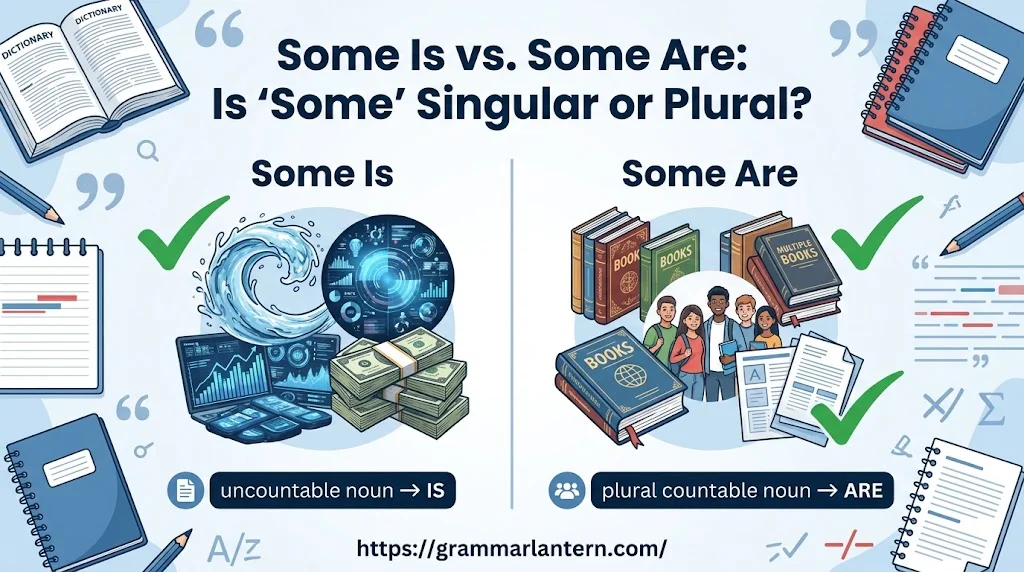
Use is when some refers to an uncountable noun, an amount, a substance, or an uncountable idea.
- Some water is left.
- Some information is missing.
- Some money is available.
- Some of the furniture is damaged.
Use are when some refers to plural countable nouns, people, or multiple individual things.
- Some students are absent.
- Some books are missing.
- Some of the employees are working remotely.
- Some of the answers are incorrect.
The easiest rule is:
Don’t ask whether “some” is singular or plural. Ask what “some” stands for.
If it stands for an uncountable amount, use is. If it stands for multiple countable things or people, use are.
Some Is vs. Some Are: The Basic Grammar Rule
The word some doesn’t determine subject-verb agreement by itself. The noun that follows it, or the noun that it replaces, usually determines the correct verb.
This becomes especially clear with some of.
Consider these examples:
- Some of the milk is spoiled.
- Some of the apples are spoiled.
Milk represents an uncountable substance. Apples represent several individual objects. Therefore, the verb changes from is to are.
Here’s the pattern:
| What “some” refers to | Correct verb | Example |
| An uncountable noun | is | Some water is cold. |
| An amount | is | Some money is missing. |
| An uncountable idea | is | Some information is outdated. |
| Plural countable nouns | are | Some books are missing. |
| Multiple people | are | Some students are absent. |
| Several individual things | are | Some problems are difficult. |
This is why saying “some is always plural” creates problems. So does saying “some is always singular.” Neither statement is accurate.
When to Use “Some Is”
Some Is With Uncountable Nouns
The most common use of some is occurs when some refers to an uncountable noun.
Uncountable nouns describe things that English usually treats as a mass, substance, concept, or general quantity rather than separate individual units.
Common examples include:
- water
- information
- advice
- money
- furniture
- equipment
- research
- evidence
- knowledge
- traffic
- homework
These nouns normally take singular verbs.
For example:
- Some information is missing.
- Some advice is useful.
- Some furniture is expensive.
- Some research is still needed.
- Some evidence is unreliable.
The quantity may be large or small. That doesn’t change the agreement.
Some water is correct even if the amount equals several gallons. English still treats water as an uncountable substance.
Some Is for an Amount or Portion
Sometimes some means a portion of something rather than several separate items.
That’s another reason to use is.
Look at these examples:
- Some of the cake is gone.
- Some of the coffee is cold.
- Some of the budget is already spent.
- Some of the fuel is contaminated.
- Some of the land is protected.
The noun after of controls the agreement.
You can think of some as pointing to a portion of the whole.
For instance, some of the cake means an unspecified portion of one mass or whole. It doesn’t mean several cakes.
That distinction makes the singular verb natural.
Some Is With Uncountable Abstract Nouns
The same principle applies to abstract nouns that English treats as uncountable.
Consider:
- Some knowledge is required.
- Some patience is necessary.
- Some preparation is needed.
- Some progress is visible.
- Some evidence is available.
These nouns don’t normally represent separate countable objects in these constructions.
Therefore, is fits naturally.
This pattern appears frequently in formal and professional writing because many abstract nouns are uncountable.
When to Use “Some Are”
Some Are With Plural Countable Nouns
Use some are when some refers to multiple countable nouns.
Examples include:
- Some students are absent.
- Some cars are expensive.
- Some houses are empty.
- Some questions are difficult.
- Some employees are unavailable.
Each noun represents individual items that you could count:
- one student, two students
- one car, two cars
- one house, two houses
- one question, two questions
Because the referent is plural, are is the correct verb.
Read More: Plating vs Platting: What’s the Difference?
Some Are When the Noun Is Omitted
You can also use some are without stating the noun.
For example:
Some are ready to leave.
What does some mean here?
The answer depends on the previous context.
If the previous sentence says, “Twenty employees attended the meeting,” then some are ready to leave means some of those employees are ready.
Likewise:
The paintings arrived this morning. Some are damaged.
Here, some replaces some of the paintings. Because paintings are plural countable nouns, are is correct.
This use makes writing less repetitive.
Instead of writing:
Some of the students finished early, Some of the students checked their answers. Some of the students left the classroom.
A smoother version is:
Some of the students finished early. Some checked their answers, while others left the classroom.
The pronoun-like use of some keeps the writing cleaner.
Some Is vs. Some Are With “Some of”
The construction some of + noun provides one of the easiest ways to determine the correct verb.
Look at the noun immediately after of.
Some of + Uncountable Noun + Is
Examples:
- Some of the water is dirty.
- Some of the information is incorrect.
- Some of the money is missing.
- Some of the equipment is broken.
- Some of the research is outdated.
Some of + Plural Countable Noun + Are
Examples:
- Some of the bottles are dirty.
- Some of the facts are incorrect.
- Some of the coins are missing.
- Some of the machines are broken.
- Some of the studies are outdated.
The contrast is straightforward:
| Singular agreement | Plural agreement |
| Some of the water is cold. | Some of the bottles are cold. |
| Some of the money is missing. | Some of the coins are missing. |
| Some of the information is wrong. | Some of the facts are wrong. |
| Some of the equipment is damaged. | Some of the machines are damaged. |
| Some of the research is outdated. | Some of the studies are outdated. |
This is one of the most useful patterns to remember.
Countable vs. Uncountable Nouns
Understanding countability makes the some is vs. some are question much easier.
A countable noun represents something that can be counted as separate units.
Examples:
- book
- student
- apple
- chair
- report
- employee
These nouns have singular and plural forms.
- one book → two books
- one student → two students
- one report → two reports
When some refers to their plural forms, use are.
An uncountable noun usually represents a substance, mass, field, concept, or general quantity.
Examples:
- water
- information
- advice
- money
- furniture
- equipment
You don’t normally say two informations or three advices in standard English.
Instead, English uses expressions such as:
- two pieces of information
- three pieces of advice
- several items of furniture
- two pieces of equipment
When some refers directly to these uncountable nouns, use is.
Common Noun Pairs
| Uncountable noun | Plural countable equivalent |
| information | facts |
| advice | suggestions |
| furniture | chairs |
| equipment | machines |
| research | studies |
| money | coins |
| water | bottles |
| traffic | vehicles |
Compare:
- Some information is useful.
- Some facts are useful.
And:
- Some furniture is damaged.
- Some chairs are damaged.
The meaning may overlap, but the grammar doesn’t.
Is “Some” Singular or Plural When It Appears Alone?
When some appears by itself, you need to use context.
Consider:
Some are expensive.
This sentence needs a plural interpretation. Perhaps the discussion concerns cars, houses, or computers.
Now consider:
Some is still available.
This sentence suggests an uncountable quantity or substance.
For example:
The store received a large shipment of rice. Some is still available.
Here, some replaces some of the rice. Since rice is uncountable, is works.
Now compare:
The store received several bags of rice. Some are still available.
Here, some refers to some of the bags. Since bags are plural countable nouns, are works.
The surrounding context supplies the missing information.
Can “Some” Be Used With a Singular Countable Noun?
Yes. However, this use has a different meaning from ordinary quantity expressions.
English can use some + singular countable noun when the speaker doesn’t identify the person or thing precisely.
For example:
- Some person called earlier.
- Some guy left this package here.
- There must be some mistake.
- Some problem is causing the delay.
Here, some can mean something like a certain, an unspecified, or an unidentified.
That’s different from:
Some apples are missing.
In that sentence, some means an unspecified number of apples.
This distinction matters because a simplified rule such as “some always goes with plural nouns” isn’t completely accurate.
Some + Singular Noun for an Unidentified Person or Thing
Consider:
Some person left a message.
The speaker knows that a person left the message but doesn’t identify the person.
Likewise:
Some mistake caused the error.
Here, some points to an unspecified mistake.
This construction doesn’t turn some into a universally singular word. Its meaning has changed according to the context.
“Some” With Numbers and Approximate Quantities
Another useful construction appears when some comes before a number.
For example:
- Some 50 people attended.
- Some 200 customers visited the store.
- Some 30 pages remain.
- Some 10% of the budget is reserved for emergencies.
Here, some can mean approximately or around.
This use differs from ordinary quantity some.
Compare:
Some people attended.
This means an unspecified number of people attended.
Now:
Some 50 people attended.
This gives an approximate number.
The number adds a much clearer estimate.
The verb still follows the noun or noun phrase being discussed:
- Some 50 people are waiting.
- Some 50 dollars is enough.
The second sentence treats 50 dollars as an amount of money rather than 50 separate objects. That distinction affects agreement.
In Questions
Questions don’t change the basic agreement rule.
If some refers to an uncountable noun, use is.
- Is some water still available?
- Is some information missing?
- Is some money still owed?
If some refers to plural countable nouns, use are.
- Are some students absent?
- Are some documents missing?
- Are some employees working today?
The position of the verb changes because questions often place the auxiliary before the subject. The underlying agreement relationship remains the same.
Read More: Stuck vs Stock: What’s the Difference?
In Negative Sentences
Negative constructions follow the same principle.
For uncountable nouns:
- Some information isn’t accurate.
- Some of the equipment isn’t working.
- Some of the money isn’t available.
For plural countable nouns:
- Some students aren’t prepared.
- Some of the machines aren’t working.
- Some of the documents aren’t complete.
Notice another useful point: isn’t corresponds to singular agreement while aren’t corresponds to plural agreement.
Common Mistakes
Mistake: Assuming “Some” Always Takes “Are”
A common mistake looks like this:
Some of the information are incorrect.
The problem is information. In standard English, information is uncountable.
The correct sentence is:
Some of the information is incorrect.
If the writer means separate facts, the sentence can change:
Some of the facts are incorrect.
Mistake: Assuming “Some” Always Takes “Is”
The opposite mistake happens just as often.
Incorrect:
Some of the students is absent.
Correct:
Some of the students are absent.
The noun students clearly refers to multiple people.
Mistake: Looking Only at “Some”
Another trap occurs when writers focus on the word some instead of its referent.
Consider:
Some of the furniture is old.
The temptation to use are may come from the idea that furniture represents many objects. Grammatically, however, furniture is an uncountable noun.
The sentence remains singular.
If you replace it with a plural countable noun, the verb changes:
Some of the chairs are old.
Mistake: Confusing “Some” With “A Few”
A few normally refers to plural countable nouns.
For example:
- A few students are absent.
- A few books are missing.
- A few employees are late.
You can’t normally use a few directly with an uncountable noun.
You wouldn’t normally say:
A few information is missing.
Instead, say:
Some information is missing.
Or:
A few pieces of information are missing.
That difference highlights why countability matters so much.
Case Study: Why the Noun Changes Everything
Imagine a manager reviewing office supplies.
First, the manager says:
Some equipment is missing.
Here, equipment is uncountable. The sentence uses is.
Later, the manager identifies the missing items:
Some machines are missing.
Now machines is plural and countable. The sentence uses are.
The situation hasn’t changed dramatically. The grammatical viewpoint has.
The first sentence treats the missing supplies as an amount or category of equipment. The second identifies separate machines.
This simple comparison shows why some itself isn’t the deciding factor.
In Academic and Professional English
The distinction becomes especially important in formal writing because English frequently uses uncountable nouns in academic and workplace contexts.
Examples include:
- Some research is incomplete.
- Some evidence is inconclusive.
- Some information is confidential.
- Some data are inconsistent.
- Some findings are surprising.
- Some results are difficult to explain.
The last three examples also show why writers need to pay attention to individual nouns rather than memorizing a single rule.
When writing professionally, check the noun that some modifies or replaces.
A Practical Editing Checklist
Before finalizing a sentence containing some, ask:
- What does “some” refer to?
- Is that noun countable or uncountable?
- If it is countable, is it singular or plural?
- Does the sentence use is or are consistently with that noun?
- Does the meaning match the intended quantity?
This quick check catches most agreement errors.
A Simple Trick to Choose
Use the replacement test.
Replace some with the noun or noun phrase it represents.
For example:
Some are missing.
Ask: “Some what?”
If the answer is some documents, then:
Some documents are missing.
Therefore, are is correct.
Now consider:
Some is missing.
Ask: “Some what?”
If the answer is some information, then:
Some information is missing.
Therefore, is is correct.
This trick works particularly well when the noun isn’t written in the sentence.
Quick Reference Table
| Sentence | Correct? | Reason |
| Some water is cold. | ✅ | Water is uncountable. |
| Some bottles are cold. | ✅ | Bottles are plural countable nouns. |
| Some information is missing. | ✅ | Information is uncountable. |
| Some facts are missing. | ✅ | Facts are plural countable nouns. |
| Some furniture is damaged. | ✅ | Furniture is uncountable. |
| Some chairs are damaged. | ✅ | Chairs are plural countable nouns. |
| Some are ready. | ✅ | Refers to multiple countable people or things. |
| Some is available. | ✅ | Refers to an uncountable amount or substance. |
| Some of the money is gone. | ✅ | Money is uncountable. |
| Some of the coins are gone. | ✅ | Coins are plural countable nouns. |
Practice: Choose “Is” or “Are”
Fill in each blank with is or are.
- Some of the water ___ dirty.
- Some of the students ___ absent.
- Some information ___ missing.
- Some of the documents ___ incomplete.
- Some of the furniture ___ old.
- Some of the chairs ___ broken.
- Some ___ ready to leave.
- Some ___ still available.
- Some of the money ___ missing.
- Some of the employees ___ working late.
- Some evidence ___ unreliable.
- Some of the results ___ surprising.
Answers and Explanations
- is — Water is uncountable.
- are — Students is plural and countable.
- is — Information is uncountable.
- are — Documents is plural and countable.
- is — Furniture is uncountable.
- are — Chairs is plural and countable.
- are — The omitted noun refers to multiple people or things.
- is — The omitted noun refers to an uncountable amount or substance.
- is — Money is normally uncountable.
- are — Employees is plural and countable.
- is — Evidence is uncountable.
- are — Results is plural and countable.
FAQs
1. Is “some” singular or plural?
Some can work with both singular and plural ideas. Its verb depends on the noun or amount it describes.
2. Is “some is” grammatically correct?
Yes. “Some is” is correct when some refers to an uncountable amount or one portion of something.
3. Is “some are” grammatically correct?
Yes. “Some are” is correct when some refers to several countable people, things, or objects.
4. Why do we use “some are” so often?
Some are is common because some frequently refers to multiple countable nouns, which need a plural verb.
5. Can “some” be used with uncountable nouns?
Yes. When some refers to an uncountable noun, it can be followed by a singular verb, such as “some is.”
6. What is the difference between “some is” and “some are”?
Some is refers to an uncountable amount or portion, while some are refers to several countable things or people.
7. Does “some” itself decide the verb?
No. The noun or idea that some represents helps determine whether you need a singular or plural verb.
8. Is “some” always a plural word?
No. Although some often refers to plural things, it can also refer to an uncountable amount.
9. How can I choose between “some is” and “some are”?
Look at what some describes. If it represents several countable things, use are. If it represents an uncountable amount, use is.
10. What is the easiest way to remember the rule?
Think about countability. Countable things → some are. Uncountable amounts → some is.
Conclusion
Understanding Some Is vs. Some Are becomes much easier when you focus on what some represents rather than treating it as automatically singular or plural. Use some are when you’re talking about several countable people, things, or objects. Use some is when some refers to an uncountable amount, substance, or portion.
When you’re unsure, look at the noun and then choose the verb that matches it. This simple habit can help you avoid common grammar mistakes and make your sentences sound more natural. With a few clear examples and regular practice, choosing between “some is” and “some are” becomes much more straightforward.




[…] Read More: Some Is vs. Some Are: Is “Some” Singular or Plural? […]
[…] Read More: Some Is vs. Some Are: Is “Some” Singular or Plural? […]