
Affend or Offend is a question many writers ask when they first notice these similar words, and knowing the proper choice helps you write with confidence. Have you ever wondered whether to use affend or offend in writing? You are not alone. Many people see each word and think it has the same meaning, but they are often mistaken because they sound alike.
The truth is that offend is the proper English language term, while affend is a common misspelling. Using the wrong form can make your message unclear or confusing, so understanding the difference, differences, and related terms is important for accurate and professional writing.
In this article, we explore, explain, and provide examples so you know exactly which form to choose and use correctly in different contexts and every context. From my own editing experience, I have seen this mistake many times, and it should be avoided because the correct form is always used when you want to cause someone to feel hurt, upset, annoy, or angry by something you say or do. The verb can also describe actions that break a law or rule. No other word carries this exact meaning, so learning it will help you avoid confusion from the very end of your writing process.
Quick Answer
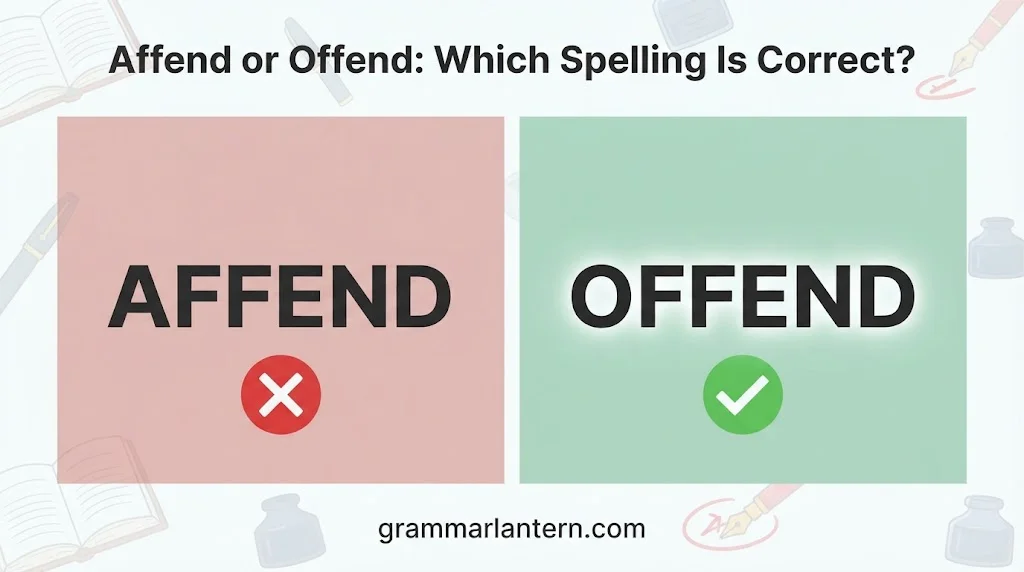
Offend is the correct spelling.
Affend is not the standard English spelling of this word. When you mean “to upset,” “to hurt someone’s feelings,” or “to make someone angry,” use offend. English spelling references consistently identify offend as the established form and affend as a misspelling.
| Spelling | Correct? | Meaning |
| Offend | ✅ Yes | To upset, hurt, anger, or disrespect someone |
| Affend | ❌ No | Nonstandard spelling of offend |
For example:
- Correct: I didn’t mean to offend you.
- Incorrect: I didn’t mean to affend you.
The same rule applies to related forms:
- offended ✅
- offending ✅
- offensive ✅
- offense ✅ in American English
- affended ❌
- affending ❌
What Does “Offend” Mean?
The verb offend has more than one established meaning. In everyday English, it most often describes a reaction involving someone’s feelings.
Read More: Emasculate vs. Demasculate: Which Word Is Correct?
Offend Meaning: To Hurt Someone’s Feelings
The most common use involves causing emotional discomfort, anger, or resentment.
For example:
“I didn’t mean to offend you.”
This sentence doesn’t necessarily mean the speaker intended to insult the other person. It can mean that something they said or did unintentionally caused hurt feelings.
Consider these examples:
- Her comment offended several people.
- I hope my question doesn’t offend you.
- He was offended by the way she spoke to him.
- They didn’t intend to offend their guests.
- That remark could offend someone.
The word can describe both intentional and accidental behavior. That’s an important distinction.
Someone can offend another person without intending to do so. A careless joke, insensitive remark, or thoughtless comment might cause offense even when the speaker meant no harm.
Offend Can Also Mean to Commit a Crime
There’s another established meaning that appears more often in legal, formal, or news contexts.
Offend can mean to commit a crime.
For example:
- The defendant was warned not to offend again.
- The court was concerned that he might offend again.
- Repeat offenders may face additional legal consequences.
This meaning explains why you may encounter words such as offender, offense, and offending in legal writing.
The expression “offend against” also exists, particularly in formal English. It means to violate a rule, law, principle, or standard.
Why Do People Write “Affend” Instead of “Offend”?
The confusion isn’t surprising. English spelling often fails to provide a perfect map of pronunciation.
Offend is pronounced /əˈfend/. The first syllable contains a weak vowel sound, while the second syllable receives the main stress.
That pronunciation can make the opening vowel less obvious when you hear the word in rapid conversation.
For example, when someone says:
“I didn’t mean to offend you.”
The first syllable can sound quite light. A learner who hasn’t seen the word written often may remember the sound but guess the wrong initial letter.
The Real Problem Is Spelling, Not Meaning
There isn’t a meaningful distinction between affend and offend.
You shouldn’t choose between them based on context. The choice is much simpler:
Use “offend.”
The spelling affend doesn’t represent a standard alternative form of the verb. English spelling references identify it as an incorrect form.
How Do You Spell “Offend” Correctly?
The easiest way to remember the spelling is to focus on its opening:
OFF + END = OFFEND
The word begins with off-, followed by -end.
A useful memory chain is:
offend → offense → offensive → offender
All these related words keep the off- beginning.
A Simple Memory Trick
Think:
“Offend starts with OFF.”
If someone’s words make you uncomfortable, you might think, “That was a bit off.”
The trick isn’t a rule of English spelling. It’s simply a practical memory aid.
You can also visualize the word:
O + F + F + E + N + D
That’s six letters, with two f’s in the middle.
Offend Pronunciation
The standard pronunciation of offend is:
/əˈfend/
It has two syllables:
uh-FEND
The second syllable carries the main stress. Cambridge gives this pronunciation in both its UK and US English entries.
This pronunciation helps explain why the spelling can trip people up. The first vowel is a reduced sound rather than a strong, clearly pronounced “o.”
Compare:
- offend → /əˈfend/
- offended → /əˈfendɪd/
- offensive → /əˈfensɪv/
Offend: Verb Forms
Because offend is a regular verb, its main forms are straightforward.
| Verb form | Word | Example |
| Base form | offend | Don’t offend your audience. |
| Third-person singular | offends | His attitude often offends people. |
| Past tense | offended | Her comment offended me. |
| Past participle | offended | He has offended several customers. |
| Present participle | offending | She apologized for offending him. |
Notice what happens when you add -ed:
offend → offended
The spelling doesn’t become affended. The initial off- remains intact.
The same principle applies to -ing:
offend → offending
These forms are especially useful because “affended” and “affending” are common extensions of the original spelling mistake.
Examples of “Offend” in a Sentence
The best way to understand a word is to see how it behaves in real sentences.
Examples About Feelings
Here are natural examples using offend in everyday communication:
- I didn’t mean to offend you with my question.
- His joke offended some members of the audience.
- She was offended by his rude response.
- Try not to offend your hosts.
- He apologized because he realized his comment had offended her.
- The remark wasn’t intended to offend anyone.
- Some readers may find the language offensive.
- She didn’t want to risk offending her coworkers.
Read More: Title vs. Tittle: What’s the Difference?
Examples in Formal Writing
The word also fits naturally into professional and academic contexts:
- The advertisement was changed because some customers found it offensive.
- The organization apologized for comments that had offended its members.
- The policy aims to prevent conduct that could offend employees.
- The speaker clarified that she had not intended to offend anyone.
In these sentences, offend doesn’t automatically mean “insult.” It has a broader range.
Offend vs. Insult: Are They the Same?
Offend and insult overlap, but they aren’t perfect synonyms.
To insult someone usually means to say or do something disrespectful, demeaning, or deliberately rude.
To offend someone is broader. A person can feel offended because of something rude, insensitive, inappropriate, disturbing, or disrespectful.
Consider this difference:
“His insult offended her.”
Here, insult describes the disrespectful act, while offended describes her emotional reaction.
You could also say:
“The comment offended her.”
That doesn’t tell us exactly what the comment was. It simply tells us that the comment caused hurt, anger, or displeasure.
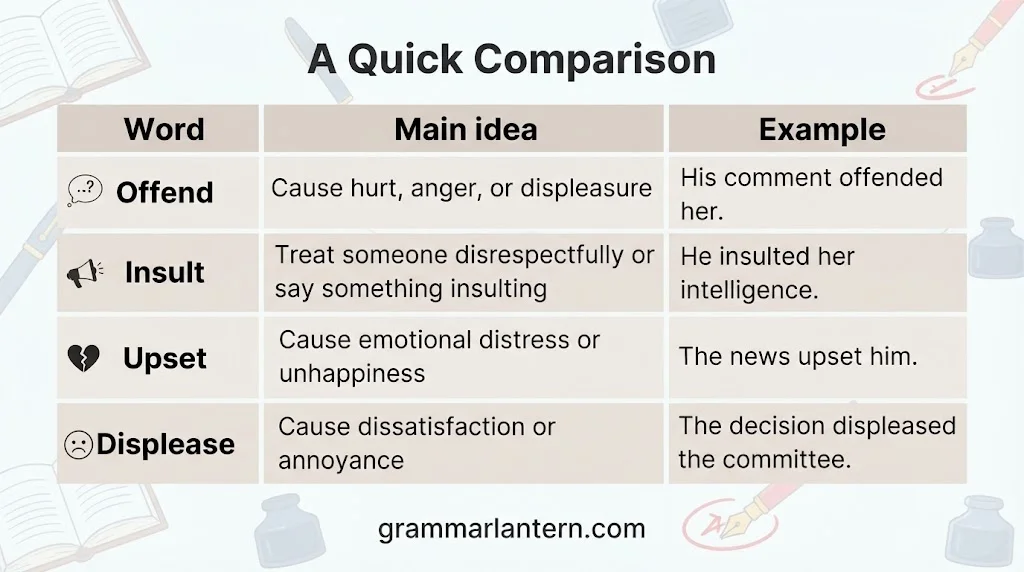
A Quick Comparison
| Word | Main idea | Example |
| Offend | Cause hurt, anger, or displeasure | His comment offended her. |
| Insult | Treat someone disrespectfully or say something insulting | He insulted her intelligence. |
| Upset | Cause emotional distress or unhappiness | The news upset him. |
| Displease | Cause dissatisfaction or annoyance | The decision displeased the committee. |
This distinction matters when you’re trying to choose the most precise word.
Offend vs. Offense vs. Offensive vs. Offender
These words belong to the same word family, but they don’t perform the same grammatical job.
| Word | Part of speech | Meaning |
| offend | Verb | To cause hurt, anger, or displeasure |
| offended | Adjective/verb form | Having experienced offense; past form of offend |
| offensive | Adjective | Causing offense or unpleasantness |
| offense | Noun | A hurtful act, feeling of being insulted, or crime |
| offender | Noun | Someone who commits an offense |
| offending | Verb/adjective | Causing offense or involved in wrongdoing |
Offense in American English
For US English, the noun is normally spelled:
offense
British English commonly uses:
offence
Cambridge explicitly identifies offense as the US spelling of offence.
So an American English sentence would be:
“I didn’t mean to cause offense.”
A British English version may use:
“I didn’t mean to cause offence.”
The verb doesn’t change:
offend is correct in both varieties.
Common Phrases With “Offend”
Knowing common combinations makes your writing sound more natural.
“Offend someone”
This is one of the most common patterns.
“I didn’t mean to offend anyone.”
Here, anyone is the object of the verb.
“Be offended by something”
This structure describes the person experiencing the reaction.
“She was offended by his comment.”
The thing causing the reaction follows by.
“Take offense”
This expression means to become upset or annoyed because of something someone said or did.
“I hope you don’t take offense at my question.”
The noun offense is used here, not the verb offend.
“Cause offense”
This means to make people feel upset or insulted.
“The advertisement caused offense among some viewers.”
“Offend against”
This is a more formal construction.
“The action offended against established rules.”
It’s less common in everyday American conversation, so don’t force it into casual writing.
Common Mistakes
Once you know the correct spelling, the most frequent errors become easy to spot.
| Incorrect | Correct |
| I didn’t mean to affend you. | I didn’t mean to offend you. |
| She was affended by the joke. | She was offended by the joke. |
| Don’t affend your guests. | Don’t offend your guests. |
| His comments were affending people. | His comments were offending people. |
| That remark was affensive. | That remark was offensive. |
| He took affense. | He took offense. |
The pattern is clear. Once the first spelling error appears, it can spread into the entire word family.
That’s why remembering off- is more useful than memorizing just one isolated word.
Case Study: A Small Spelling Error in a Professional Message
Imagine you’re sending this message to a client:
“I didn’t mean to affend you with my comments.”
The meaning is still understandable. However, the spelling error can distract the reader and make the message look less polished.
Now compare it with:
“I didn’t mean to offend you with my comments.”
The second version communicates the same idea without the spelling problem.
This matters particularly in professional settings. A spelling mistake in an informal text may be harmless. In an email, application, academic paper, or business document, the same mistake can undermine an otherwise careful piece of writing.
The lesson isn’t that one typo ruins your credibility. It doesn’t. The useful lesson is that small, repeated spelling errors are worth fixing when you can easily avoid them.
Is “Affend” Ever Correct?
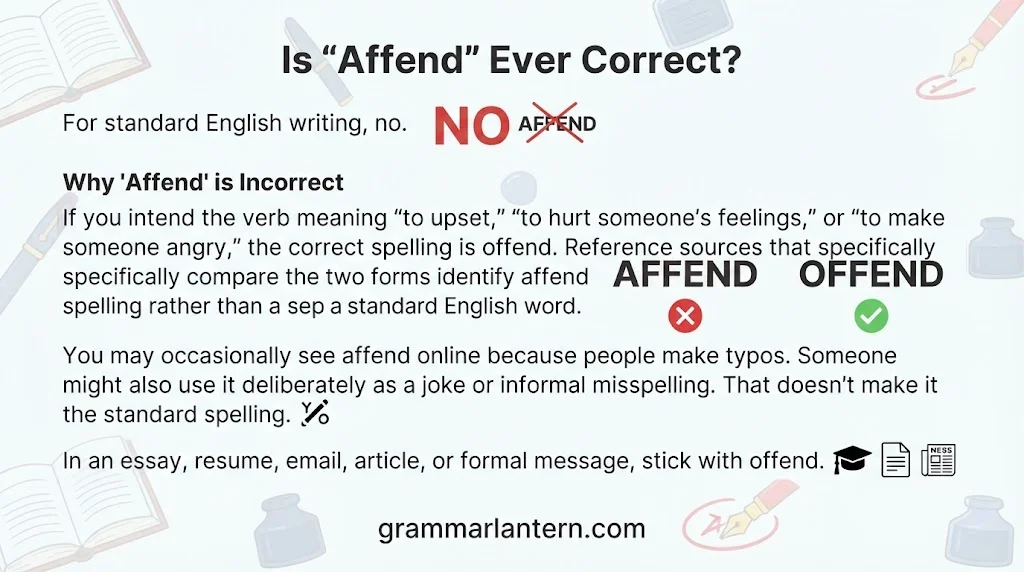
For standard English writing, no.
If you intend the verb meaning “to upset,” “to hurt someone’s feelings,” or “to make someone angry,” the correct spelling is offend. Reference sources that specifically compare the two forms identify affend as an incorrect spelling rather than a separate standard English word.
You may occasionally see affend online because people make typos. Someone might also use it deliberately as a joke or informal misspelling. That doesn’t make it the standard spelling.
In an essay, resume, email, article, or formal message, stick with offend.
How to Remember
A few simple techniques can make this spelling almost impossible to forget.
Remember the “OFF” Beginning
Think:
OFF + END = OFFEND
The word begins with off, not aff.
Remember the Word Family
Use this chain:
offend → offended → offending → offense → offensive → offender
If you remember the first three letters, you can reconstruct most of the family correctly.
Watch for the Double F
The correct spelling contains two f’s:
o-f-f-e-n-d
Not:
a-f-f-e-n-d
That tiny distinction is the entire spelling problem.
Quick Facts About “Offend”
- Correct spelling: offend
- Incorrect spelling: affend
- Part of speech: verb
- Pronunciation: /əˈfend/
- Syllables: two
- Past tense: offended
- Past participle: offended
- Present participle: offending
- US noun: offense
- UK noun: offence
- Adjective: offensive
- Related noun: offender
- Common meaning: to upset, hurt, or anger someone
- Legal meaning: to commit a crime
Read More: Bachelor vs Batchelor: Which Spelling Is Correct?
FAQs
1. Is affend a real English word?
No. Affend is not a recognized English word. It is a common misspelling of offend.
2. What does offend mean?
Offend means to upset, hurt, annoy, or anger someone through your words or actions. It can also mean to break a law or rule.
3. Which spelling is correct: affend or offend?
The correct spelling is offend. You should avoid using affend.
4. Why do people confuse affend and offend?
People often confuse them because they sound similar, especially when spoken quickly.
5. Can I use affend in formal writing?
No. Affend should never be used in formal or informal English writing.
6. How can I remember the correct spelling?
Remember that offend begins with “off-“, the only accepted spelling in standard English dictionaries.
7. Can offend refer to breaking a law?
Yes. Besides hurting someone’s feelings, offend can also mean to violate a law, rule, or regulation.
8. What is an example of offend in a sentence?
“I didn’t mean to offend anyone with my comment.”
9. Is offended the past form of offend?
Yes. Offended is the past tense and past participle of offend.
10. How can I avoid spelling offend incorrectly?
Proofread your writing, use spell-check tools, and remember that affend is not a valid English word.
Conclusion
Choosing between Affend or Offend is actually quite simple once you know the facts. Offend is the only correct English word, while affend is a misspelling that should be avoided. Understanding this small difference can make your writing clearer, more accurate, and more professional. Whether you’re writing an email, an essay, or a social media post, using the correct word helps your message come across the way you intend.
The easiest way to remember the difference is to think of offend as the standard spelling you’ll find in every English dictionary. If you’re ever unsure, take a moment to check your spelling before you publish or send your work. Building this habit will improve your confidence as a writer and help you communicate more effectively in every situation.



[…] Read More: Affend or Offend: Which Spelling Is Correct? […]
[…] Read More: Affend or Offend: Which Spelling Is Correct? […]