
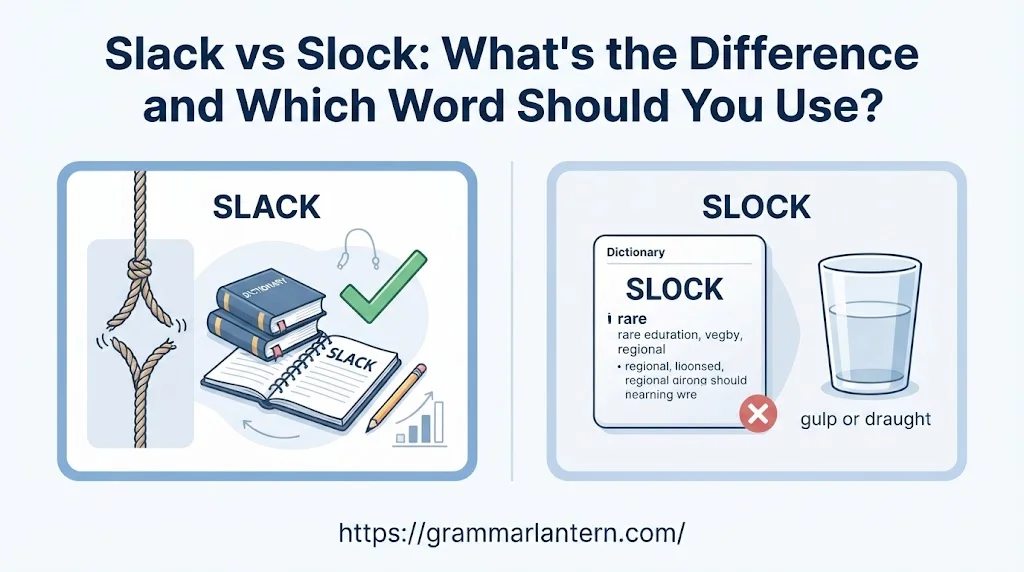
If you have ever wondered whether Slack and Slock are simply different spellings, you are not alone. These two words look remarkably similar, but they have very different places in English. Slack is a familiar word used in everyday conversations, while slock is much rarer and belongs mainly to older or regional forms of English.
The difference becomes clearer when you look at how each word is used. Slack can describe something loose, slow, or lacking activity. It can work as a noun, verb, or adjective, which gives it several useful meanings in modern English. Slock, on the other hand, has specialized meanings connected with drinking, thirst, drenching, and luring.
Understanding Slack vs Slock can help you avoid an unusual word choice, especially in modern writing. If you are reading older books or exploring British and Scottish dialects, you may come across slock. For normal conversation and standard writing, however, slack is usually the word you want.
Quick Answer
Slack is the correct word in ordinary English when you mean loose, not tight, inactive, slow, careless, or lacking effort. It can also refer to unused time, money, people, or capacity.
Slock is a real but uncommon word. In regional English, especially Scottish and Northern English usage, it can mean a gulp or draught. The verb slock can mean to swallow or gulp.
| Word | Main meaning | Commonness | Typical use |
| Slack | Loose, inactive, slow, careless, or unused capacity | Very common | Everyday, business, technical, informal |
| Slock | A gulp or draught; to gulp or swallow | Rare | Regional, historical, specialized |
| Slack off | Work less hard or become less active | Common | Informal English |
| Slocked | Past tense of slock in its relevant verb senses | Very rare | Regional or specialized contexts |
So if you’re writing a normal sentence such as “The rope is slack,” don’t replace slack with slock.
However, if a historical or regional text uses slock to describe drinking, the unusual spelling may be intentional.
Slack is a common word with many everyday meanings. Slock is a rare word whose meaning depends heavily on context.
What Does Slack Mean?
The word slack has a surprisingly broad range of meanings. Its central idea often involves something being loose, reduced, relaxed, or less active than expected.
You can use it as an adjective, noun, and verb. That flexibility explains why slack appears in so many different kinds of writing.
Slack as an Adjective
The most familiar meaning of slack is loose or not tight.
Imagine a rope hanging between two posts. If someone hasn’t pulled it tight, the rope droops in the middle. The rope is slack.
For example:
- The tent rope is slack and needs tightening.
- The cable became slack after the support moved.
- Keep the line slightly slack while you reposition the equipment.
This meaning appears frequently in physical and technical contexts.
However, slack can describe more than ropes and cables.
It can also mean not active or not busy.
For example:
- Business has been slack this month.
- The store is usually slack after lunch.
- Demand became slack during the winter period.
Here, nothing is physically loose. Instead, the level of activity has dropped.
Slack Can Also Mean Careless or Not Strict
Another important meaning describes someone or something that lacks proper effort, care, discipline, or strictness.
For example:
- The manager was criticized for slack supervision.
- His work became slack after several difficult weeks.
- The company’s safety procedures were too slack.
This meaning can carry a negative tone.
Calling someone slack may suggest that they aren’t working carefully enough. In some contexts, it can overlap with words such as careless, lazy, lax, or negligent, although those words aren’t always interchangeable.
Consider the difference:
The rope is slack.
Here, slack describes physical looseness.
Her work is slack.
Here, it suggests poor care, effort, or attention.
The surrounding words tell you which meaning applies.
Slack as a Noun
As a noun, slack can refer to the amount of looseness in something.
Consider a rope again. If the rope hangs several inches lower than necessary, that extra loose portion is slack.
For example:
- There was too much slack in the cable.
- The technician removed the slack from the line.
- The workers pulled the rope tight to eliminate the slack.
The noun also has a broader figurative meaning.
It can refer to unused time, money, resources, staff capacity, or room to maneuver.
For example:
- We don’t have much slack in the schedule.
- The team has enough slack to handle a small delay.
- The budget contains very little slack this quarter.
Think of this figurative meaning as breathing room.
If your schedule has two spare hours, those hours give you some slack. If a project has extra staff available, that staffing capacity creates slack.
Read More: 27 Best Replies to “I Don’t Care” Witty & Clever
Pick Up the Slack
One of the most common expressions is pick up the slack.
It means to do work that someone else hasn’t completed or to compensate for a shortage.
For example:
When two employees called in sick, the rest of the team had to pick up the slack.
The expression creates a useful mental picture. Imagine a loose rope with one person letting their end drop. Someone else has to pull it tight.
The same idea works figuratively.
- One person misses a deadline.
- Another person completes the unfinished work.
- The second person picks up the slack.
You can also hear take up the slack, especially when the focus involves removing excess looseness or filling a gap.
Slack as a Verb
Slack can also function as a verb.
As a verb, it generally describes becoming less active, less intense, or less effortful.
For example:
- Work tends to slack off late on Friday.
- Sales slackened during the slow season.
- Don’t slack on your responsibilities.
The phrasal verb slack off is especially common.
It means to work less hard, become less active, or reduce effort.
For example:
He started slacking off after the project deadline passed.
Another example:
The team can’t afford to slack off during the final week.
Notice that slack off isn’t simply another way to say rest. Rest can be intentional and healthy. Slack off usually suggests that someone is doing less than expected.
Common Expressions
The word slack appears in several useful expressions.
| Expression | Meaning | Example |
| Pick up the slack | Do work left unfinished by someone else | Maya picked up the slack after her coworker left. |
| Take up the slack | Remove excess looseness or compensate for a gap | The new employee helped take up the slack. |
| Slack off | Work less hard or become less active | Don’t slack off before the deadline. |
| Slack time | A period with less activity | January is often slack time for the business. |
| Slack in the schedule | Extra available time | We built some slack into the schedule. |
These expressions reinforce an important point: slack is deeply established in modern English.
You don’t need a special regional context to understand them.
What Does Slock Mean?
Now we reach the less familiar half of the slack vs slock comparison.
Slock is a real word, but it doesn’t function as a normal alternative spelling of slack.
One documented regional meaning of slock is a draught or gulp, particularly in Scottish and Northern English usage.
For example, a person might describe taking a slock of drink.
As a verb, slock can mean to swallow or gulp.
That gives the word a completely different semantic direction from everyday slack.
Compare these ideas:
- Slack → loose, inactive, insufficiently strict, or unused capacity
- Slock → gulp or draught in a regional sense
The words may look similar, but their meanings don’t line up.
Slock as a Regional Word
Regional vocabulary can seem strange if you’ve only encountered standard American English.
English has thousands of words and meanings that belong mainly to particular regions. Some survive in everyday speech. Others appear mostly in older writing, dialect collections, literature, or specialized discussions.
Slock belongs to this less familiar category.
That doesn’t make it fake.
It simply means that most readers won’t encounter it in ordinary modern American English.
A useful comparison would be regional food vocabulary. A local word may be perfectly legitimate in one community while sounding unfamiliar elsewhere.
Language doesn’t operate like a single nationwide dictionary.
Slock as a Verb
The verb slock carries the idea of swallowing or gulping in its regional use.
Its forms can therefore follow normal English verb patterns:
- slock
- slocks
- slocking
- slocked
These forms are uncommon, though.
You shouldn’t replace common verbs such as drink, swallow, or gulp with slock unless the specific regional or stylistic context calls for it.
Historical and Specialized Uses
The word slock has appeared in more than one linguistic setting.
Some uses are regional. Others are historical or specialized. This is one reason dictionary entries can make the word look more complicated than it appears in everyday writing.
A rare word can accumulate meanings over centuries without becoming a common modern word.
That distinction is crucial.
Dictionary existence and everyday usefulness aren’t the same thing.
A word may be recorded because speakers once used it in a particular region. Another may survive inside a niche community. A third may appear mainly in historical texts.
Therefore, finding slock in a dictionary doesn’t mean you can freely substitute it for slack.
Meaning Compared
The sharpest distinction becomes obvious when the words sit beside each other.
| Feature | Slack | Slock |
| Standard modern English | Yes | No, not as a common everyday word |
| Common in American English | Yes | Very rare |
| Means “loose” | Yes | No |
| Means “not busy” | Yes | No |
| Means “lacking effort” | Yes | No |
| Means “gulp or draught” | No | Yes, in regional usage |
| Can function as a verb | Yes | Yes |
| Common phrasal expressions | Yes | No |
| Regional/historical importance | Some | Stronger |
| Safe everyday choice | Yes | Usually no |
The biggest trap is assuming that similar spelling means similar meaning.
It doesn’t.
English contains countless pairs that look or sound similar while behaving differently. Slack and slock simply make that problem especially visible.
Spelling Difference
The spelling difference is tiny:
SLACK
SLOCK
Only one vowel changes.
- slack → a
- slock → o
That single vowel changes the word.
This is a good reminder that spelling isn’t decorative. A single letter can change meaning, pronunciation, grammar, and even whether most readers recognize the word.
For everyday English, slack is the spelling you almost certainly need when discussing looseness, reduced activity, or insufficient effort.
Why Do People Write Slock Instead of Slack?
Most cases of slock vs slack confusion probably come from simple spelling uncertainty rather than deliberate use of the rare word.
Several factors can cause the mix-up.
Typing Errors
On a keyboard, the letters A and O are both common vowel choices. A quick typo can turn slack into slock.
A spell-checker may catch the mistake. However, specialized dictionaries and unusual word lists can make automated checking less predictable.
Mishearing the Vowel
When people learn vocabulary mainly through speech, vowel differences can cause trouble.
Someone who has rarely seen slack written down may guess the spelling incorrectly.
This becomes more likely when the word appears in a fast conversation.
Unfamiliarity With Slack
A learner may understand the meaning but not remember the spelling.
For example, someone knows that a rope can be “loose” and wants to describe it as slack. If they’ve only heard the word, they may produce an unexpected spelling.
Assuming English Spelling Patterns
English spelling has no shortage of inconsistent patterns.
Words such as block, clock, stock, rock, lock, and shock make the spelling slock look visually plausible.
That doesn’t make it the correct spelling for the meaning of slack.
In Everyday Writing
For practical writing, the decision becomes much easier once you focus on meaning.
When to Use Slack
Use slack when something is loose or insufficiently tight.
The rope is slack.
Use slack when activity is lower than normal.
Business has been slack this week.
Use slack when someone’s effort or care is inadequate.
The team’s performance became slack.
Use slack for unused capacity.
We need some slack in the schedule.
Use slack off when someone reduces effort.
Don’t slack off just because the deadline moved.
These are all ordinary uses.
When Slock Could Be Correct
Slock can be correct when the writer intentionally uses one of its documented regional or specialized meanings.
For example, a historical or regional passage might use it to mean a gulp or draught.
In that situation, changing slock to slack would actually damage the meaning.
This is an important editing principle:
Don’t correct an unfamiliar word until you’ve checked what it means in context.
A strange word isn’t necessarily an error.
In American English
For American English, slack is overwhelmingly the practical choice in ordinary communication.
You’ll encounter it in workplaces, classrooms, technical documents, casual conversations, business reports, and everyday descriptions.
You might discuss:
- slack demand
- slack production
- slack cables
- slack ropes
- slack discipline
- slack performance
- slack time
- slack resources
- slack schedules
- slack capacity
By contrast, slock isn’t a normal everyday replacement for any of those expressions.
That doesn’t mean the word has no legitimacy. It means its legitimate uses belong to narrower contexts.
This distinction is especially important for writers, editors, students, and English learners.
Sentence Examples
Seeing the words inside complete sentences makes the distinction much clearer.
Examples With Slack
Physical looseness
The rope became slack when the load was removed.
Reduced business activity
Customer traffic was slack during the afternoon.
Insufficient effort
The supervisor warned the employee about his slack approach to the work.
Extra capacity
The project schedule contains enough slack to absorb a one-day delay.
Work less hard
The team began to slack off after completing the main task.
Taking responsibility
When the manager left, Priya had to pick up the slack.
Loose clothing or material
The fabric hung slack around the frame.
Examples With Slock
Because slock is rare, its examples should remain tied to its documented meanings.
Regional drinking sense
He took a slock of the drink before continuing.
Verb meaning
The traveler stopped to slock from the cup.
These examples illustrate the regional sense rather than suggesting that slock belongs in ordinary American prose.
If you’re writing for a broad audience, gulp, sip, or swallow will usually communicate the idea more clearly.
A Practical Case Study: Choosing the Right Word
Imagine an editor receives this sentence:
The cable has too much slock in it.
At first glance, the sentence might seem understandable.
However, the intended meaning is clearly looseness in the cable.
The editor should therefore write:
The cable has too much slack in it.
Now consider a different sentence:
He took a slock of water before leaving.
This one looks unusual.
But if the writer is intentionally using regional vocabulary to represent a Scottish or Northern English speaker, slock may be perfectly appropriate.
The lesson is simple:
Context decides whether an unusual word is wrong or merely unfamiliar.
What the Case Study Teaches
| Situation | Best choice | Why |
| Loose cable | Slack | Standard meaning |
| Quiet business period | Slack | Standard modern usage |
| Poor effort | Slack | Established adjective |
| Extra schedule capacity | Slack | Established noun |
| Regional word meaning a gulp | Slock | Specific regional meaning |
| General American writing about drinking | Gulp / sip / swallow | Clearer and more familiar |
Common Mistakes
Several mistakes repeatedly appear when people compare these words.
Mistake: Treating Slock as Another Spelling of Slack
This is the biggest problem.
Slock isn’t the normal spelling of slack.
If you mean loose, inactive, careless, or underused, use slack.
Mistake: Assuming Slock Is Always Wrong
The opposite mistake is possible too.
Because slock is unfamiliar, some readers may assume every appearance is an error.
That’s too broad.
A legitimate regional or specialized word doesn’t become incorrect simply because most readers don’t use it.
Read More: Chose vs. Chosen: Which Is Correct? A Complete Guide
Mistake: Assuming Dictionary Entry Means Common Word
Dictionaries record language rather than only the vocabulary used in everyday American conversation.
They can include:
- Regional words
- Historical terms
- Obsolete terms
- Technical vocabulary
- Slang
- Specialized meanings
Therefore, “It’s in a dictionary” doesn’t mean “Use it everywhere.”
Mistake: Ignoring the Audience
A regional word can be appropriate in a regional story.
It may be distracting in a business report.
Imagine sending a formal report to an international audience. A rare dialect word could force readers to stop and decode the sentence.
Clear writing should make the intended meaning easy to grasp.
How to Remember
A simple memory trick can save you from the spelling trap.
Think:
Slack = loose
Picture a slack rope hanging in a curve.
Then remember:
Slock = rare, regional, and meaning-specific
You don’t need to memorize every historical sense of slock to write correctly.
For everyday English, the practical rule is enough:
If you mean loose, inactive, careless, or unused capacity, choose slack.
Another useful association is the phrase pick up the slack.
Because that expression is extremely familiar, it can help anchor the spelling of slack in memory.
Which Word Should You Use?
The answer depends on what you mean.
Use Slack When You Mean “Loose”
The rope is slack.
This is standard English.
Use Slack When You Mean “Not Busy”
Business is slack during the winter.
This is also standard.
Use Slack When You Mean “Lacking Effort”
The team’s preparation was slack.
Here, the word criticizes the level of care or effort.
Use Slack When You Mean “Extra Capacity”
We need some slack in the project schedule.
This is especially useful in business and project management language.
Use Slack Off When You Mean “Work Less Hard”
The employees started to slack off after lunch.
The expression is informal and common.
Use Slock Only When Its Specific Meaning Fits
If a text uses slock to mean a gulp or swallow in a regional context, retain it.
If someone simply typed slock while meaning slack, correct it.
That distinction keeps editing accurate rather than mechanical.
An Easy Decision Chart
When you’re unsure, use this quick guide:
| What do you mean? | Word to use |
| Not tight | Slack |
| Loose rope | Slack |
| Loose cable | Slack |
| Quiet business activity | Slack |
| Low demand | Slack |
| Poor effort or care | Slack |
| Extra time or resources | Slack |
| Work less hard | Slack off |
| A regional gulp or draught | Slock |
| A rare regional verb meaning gulp/swallow | Slock |
The chart reveals the pattern immediately.
Slack covers ordinary modern meanings. Slock belongs to narrower contexts.
FAQs
1. Is Slack a correct English word?
Yes. Slack is a common and correct English word. It can work as an adjective, noun, or verb, depending on the sentence and context.
2. Is Slock a correct English word?
Yes, but slock is extremely rare. It is mainly found in older, British, Scottish, or regional dialects rather than modern everyday English.
3. What does Slack mean?
Slack can mean loose, slow, inactive, lazy, or careless. It can also describe a loose part of a rope, a quiet period, or casual trousers.
4. What does Slock mean?
Slock has several old or regional meanings. It can mean to quench thirst, take a drink, drench something, put out a fire, or lure someone.
5. Should I use Slack in modern writing?
Yes. Slack is the natural choice for modern writing, standard communication, and everyday speech.
6. Should I use Slock in everyday conversation?
Generally, no. Slock may sound strange or confusing to most native speakers because it is not commonly used in modern English.
7. Is Slack an adjective?
Yes. As an adjective, slack can describe something that is loose, slow, inactive, lazy, or careless.
8. Is Slack also a noun and verb?
Yes. As a noun, slack can refer to a loose part of a rope or a quiet period. As a verb, it can mean to slow down or lessen tension.
9. Where might I find the word Slock?
You may encounter slock when reading historic regional literature or studying old British, Scottish, or other regional dialects.
10. Which word should I choose: Slack or Slock?
Choose slack for normal modern English. Use slock only when the historical or regional context specifically calls for it.
Conclusion
The difference between Slack vs Slock is mainly about common usage and context. Slack is a familiar modern English word with several meanings and grammatical uses. It can describe something loose or inactive, refer to a quiet period, or describe a change in tension.
Slock is much less common and belongs mainly to old or regional English. Although it has genuine meanings, most people will not expect to hear it in everyday conversation. For clear modern communication, slack is almost always the safer and more natural choice.