
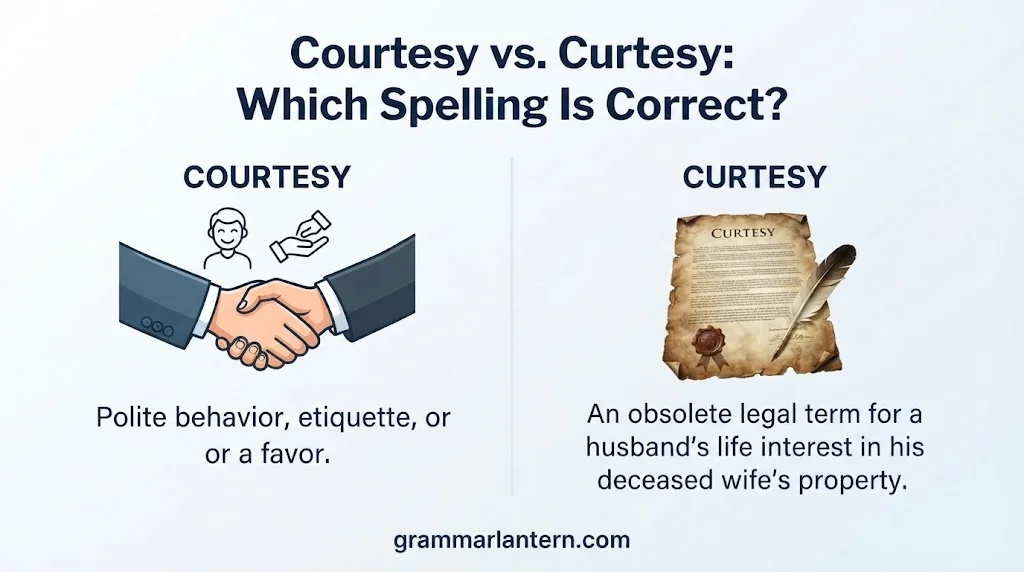
When comparing Courtesy vs. Curtesy, remember that courtesy means politeness, while curtesy is an old legal term with a different meaning today. These similar words have different spelling, pronunciation, and meanings, so many people, English learners, ESL learners, students, beginners, writers, and native speakers may struggle to differentiate them. Courtesy is the proper and widely accepted word for respect, consideration, and good manners in everyday interaction.
In contrast, curtesy is an outdated, legal term from old English law. Its meaning involves a husband’s right to a deceased wife’s property, making this old legal term rarely used in modern English. The difference between courtesy and curtesy can cause confusion in emails, school assignments, and social media posts, especially when the wrong word creates misunderstandings, embarrassing mistakes, or a simple mistake.
Because curtesy is a real word, spelling tools and grammar checkers may not detect it. To avoid errors, learn the correct term and correct spelling, follow simple rules, and use reading and writing to practice. Understanding the courtesy meaning, curtesy meaning, and key differences helps you choose the right word and build confidence.
Quick Answer
Use courtesy when you mean politeness, respect, a favor, or something provided by someone.
Use curtesy only when you’re discussing the historical legal concept involving a husband’s interest in certain real property belonging to his deceased wife.
Here’s the easiest way to remember the difference:
| Word | Meaning | Common Context |
| Courtesy | Politeness, respect, favor, or consideration | Everyday, business, academic, and professional writing |
| Curtesy | A historical property-law interest of a husband | Legal and historical writing |
| Curtsy | A formal gesture involving bending the knees | Etiquette, ceremonies, and performances |
So if you’re writing “Thank you for your ___,” the correct answer is courtesy.
If you’re discussing an old common-law inheritance rule, curtesy may be the correct term.
What Does Courtesy Mean?
Courtesy is a noun that describes polite behavior, a respectful action, or a favor. It can also describe something provided by another person or organization.
For example:
- “She treated everyone with courtesy.”
- “Thank you for the courtesy of your reply.”
- “He showed me the courtesy of calling ahead.”
- “The hotel provides a courtesy shuttle.”
- “The photograph appears courtesy of the museum.”
In everyday English, courtesy is overwhelmingly more common than curtesy.
Courtesy as Polite Behavior
The most familiar meaning of courtesy involves good manners and consideration for others.
Consider this sentence:
“She handled the disagreement with courtesy.”
Here, courtesy means that she remained respectful and civil even though the two people disagreed.
Courtesy can involve many small actions:
- Listening without interrupting
- Saying thank you
- Responding to an important message
- Holding a door open
- Allowing another driver to merge
- Giving someone advance notice
- Treating customers respectfully
These gestures might seem minor. Still, they make everyday interactions smoother.
Courtesy as a Favor or Consideration
Courtesy can also describe something offered as a favor or service.
For example:
“The company provided a courtesy car while the customer’s vehicle was being repaired.”
The car isn’t “polite.” The word describes why the company provided it.
You can see the same idea in expressions such as:
- courtesy call
- courtesy shuttle
- courtesy vehicle
- courtesy copy
- courtesy ticket
- courtesy reminder
The exact meaning depends on the phrase, but the central idea remains similar: something is offered as a helpful or considerate gesture.
What Does Curtesy Mean?
Curtesy is a genuine English word, but it’s highly specialized.
Historically, curtesy referred to a husband’s interest in certain real property belonging to his deceased wife under common law. Traditional rules placed specific conditions on this right, including circumstances involving children capable of inheriting the property.
Today, you’ll mainly encounter curtesy in:
- Legal history
- Property-law discussions
- Historical legal documents
- Academic research
- Legal dictionaries
- Discussions of common-law inheritance
It isn’t the word you want when you’re talking about manners.
Curtesy in Historical Property Law
The easiest way to understand curtesy is to place it within the older common-law system.
Traditional common law recognized different property rights for husbands and wives. Two historical concepts became especially important:
- Dower involved certain property rights associated with a wife after her husband’s death.
- Curtesy involved certain property rights associated with a husband after his wife’s death.
These concepts reflected historical legal systems in which husbands and wives didn’t necessarily have equal property rights.
Modern legal systems have largely replaced these traditional concepts with newer rules governing inheritance, marital property, and estates. The exact rules still depend on the jurisdiction.
That history explains why curtesy sounds familiar but rarely appears in modern everyday writing.
The Main Difference
Putting the words side by side makes the distinction much clearer.
| Feature | Courtesy | Curtesy |
| Basic meaning | Politeness, respect, favor, or consideration | Historical legal property interest |
| Part of speech | Mainly noun | Noun |
| Everyday use | Very common | Very rare |
| Business writing | Common | Rare |
| Academic writing | Common | Mostly legal or historical |
| Modern usage | Broad | Highly specialized |
| Example | “Thank you for your courtesy.” | “The text discusses curtesy rights.” |
The practical rule is simple:
If you’re talking about good manners, use “courtesy.”
If you’re discussing a historical common-law property right, use “curtesy.”
Why Do People Confuse?
The confusion makes sense because the two words look almost identical.
Their histories are also connected. Courtesy developed through Middle English and Anglo-French forms, while curtesy emerged from related historical forms and eventually developed its specialized legal meaning.
That shared history helps explain the similar spelling.
Modern usage, however, has pushed the two words into very different corners of English. Courtesy remains part of everyday vocabulary. Curtesy largely survives in specialized legal and historical contexts.
Think of them as linguistic relatives who took very different career paths.
One became a household word. The other became a legal-history term.
Read More: Bachelor vs Batchelor: Which Spelling Is Correct?
Courtesy vs. Curtesy in Everyday Writing
For almost every ordinary writing situation, choose courtesy.
That includes:
- Emails
- Text messages
- Business letters
- Academic essays
- Blog posts
- News articles
- Customer-service messages
- Social media posts
- Formal invitations
- Workplace communication
Correct Examples With Courtesy
“Thank you for your courtesy and patience.”
“Please extend the same courtesy to our guests.”
“The company provided a courtesy shuttle from the airport.”
“He had the courtesy to call before arriving.”
“The image is used courtesy of the museum.”
Each example involves politeness, consideration, a service, or attribution.
Incorrect Everyday Uses of Curtesy
These sentences use curtesy incorrectly:
- ❌ “Thank you for your curtesy.”
- ❌ “She treated everyone with curtesy.”
- ❌ “Please show some curtesy.”
- ❌ “The hotel provides a curtesy bus.”
- ❌ “The photograph is curtesy of the museum.”
The corrected versions use courtesy:
- ✅ “Thank you for your courtesy.”
- ✅ “She treated everyone with courtesy.”
- ✅ “Please show some courtesy.”
- ✅ “The hotel provides a courtesy bus.”
- ✅ “The photograph is courtesy of the museum.”
“Courtesy Of” vs. “Curtesy Of”
One of the most common questions involves the phrase courtesy of.
The correct expression is courtesy of.
It can mean provided by, with permission from, or because of, depending on the context.
For example:
“Photo courtesy of the museum.”
The museum provided or authorized the use of the photograph.
Another example:
“The team won the game courtesy of a late goal.”
Here, courtesy of means that the late goal helped cause the result.
You might also write:
“The meal was courtesy of our host.”
This means the host provided the meal.
Why “Curtesy Of” Is Usually Wrong
Curtesy of isn’t the standard expression when you mean “provided by” or “thanks to.”
Remember:
Courtesy of = provided by, permitted by, or thanks to
Curtesy = historical property-law term
One misplaced letter can change the entire meaning.
“Common Courtesy” or “Common Curtesy”?
The correct phrase is common courtesy.
Common courtesy means basic politeness or ordinary consideration for other people.
Examples include:
- “It’s common courtesy to let someone know if you’re running late.”
- “Holding the door for someone is a simple act of common courtesy.”
- “A little common courtesy can prevent unnecessary arguments.”
Therefore:
❌ common curtesy
✅ common courtesy
If you’re talking about basic manners, courtesy is the word you need.
“Courtesy Call” or “Curtesy Call”?
The correct expression is courtesy call.
A courtesy call is a visit, phone call, or other communication made as a polite gesture.
For example:
“The manager made a courtesy call to check whether the customer was satisfied.”
The expression can appear in business, diplomacy, customer service, and other formal settings.
So:
❌ curtesy call
✅ courtesy call
Again, the meaning points directly to courtesy.
Courtesy vs. Curtesy vs. Curtsy
There’s another word that often enters the mix: curtsy.
Although curtsy looks similar to both courtesy and curtesy, it means something entirely different.
A curtsy is a formal gesture traditionally made by bending the knees as a sign of respect or greeting.
That gives you three separate words:
| Word | Meaning | Example |
| Courtesy | Politeness, respect, favor, or consideration | “She showed great courtesy.” |
| Curtesy | Historical common-law property right | “The text discusses curtesy under common law.” |
| Curtsy | Formal gesture of respect | “The performer ended with a curtsy.” |
A Simple Memory Trick
Try this:
- Courtesy = kindness
- Curtesy = property law
- Curtsy = bending the knees
The first two may look like twins. The third simply happens to live nearby.
Courtesy as a Noun and Adjective
Courtesy primarily functions as a noun.
For example:
“His courtesy impressed everyone.”
It can also appear in adjective-like compounds:
- courtesy car
- courtesy bus
- courtesy call
- courtesy ticket
- courtesy copy
The word can describe something provided or performed as a courtesy.
Courtesy vs. Courteous
Don’t confuse courtesy with courteous.
Courtesy is generally a noun:
“Thank you for your courtesy.”
Courteous is an adjective:
“She was courteous throughout the meeting.”
You can use either depending on the grammatical structure.
Compare:
“He treated the customer with courtesy.”
“He was courteous to the customer.”
Both sentences describe respectful behavior. The grammar is different.
Case Study: Choosing the Right Word
Imagine a hotel website says:
“Guests receive a curtesy shuttle from the airport.”
The sentence looks plausible because curtesy resembles courtesy. However, the meaning immediately reveals the mistake.
The shuttle is provided as a service or favor.
The correct sentence is:
“Guests receive a courtesy shuttle from the airport.”
Now consider a historical law article:
“The historian examined the husband’s curtesy rights under medieval common law.”
Here, curtesy can be correct because the writer is discussing a historical property-law concept.
The context changes the answer.
That’s the key lesson: don’t choose between these words based only on spelling. Choose based on meaning.
Common Mistakes
These mistakes appear often because the two forms look so similar.
Using Curtesy for Politeness
Incorrect:
“He treated his colleagues with curtesy.”
Correct:
“He treated his colleagues with courtesy.”
Writing Curtesy Of
Incorrect:
“The photograph is curtesy of the museum.”
Correct:
“The photograph is courtesy of the museum.”
Writing Common Curtesy
Incorrect:
“It’s common curtesy to say thank you.”
Correct:
“It’s common courtesy to say thank you.”
Confusing Curtsy With Courtesy
If you mean a formal gesture, don’t use courtesy.
Incorrect:
“The actress gave a courtesy after the performance.”
Correct:
“The actress gave a curtsy after the performance.”
A Quick Decision Guide
When you’re unsure, ask what you mean.
Do you mean politeness?
→ Use courtesy.
Do you mean a favor or consideration?
→ Use courtesy.
Do you mean something provided by another person or organization?
→ Use courtesy, especially in the phrase courtesy of.
Are you discussing a historical husband’s property interest under common law?
→ Use curtesy.
Do you mean a formal knee-bending gesture?
→ Use curtsy.
This quick test covers almost every situation you’ll encounter in ordinary writing.
Read More: Emasculate vs. Demasculate: Which Word Is Correct?
FAQs
1. What is the difference between courtesy and curtesy?
Courtesy means politeness, respect, and good manners, while curtesy is an old legal term related to a husband’s rights to his deceased wife’s property.
2. Is courtesy the correct spelling?
Yes. Courtesy is the standard and widely accepted spelling when you mean polite or respectful behavior.
3. Is curtesy a real word?
Yes. Curtesy is a real word, but it’s an outdated legal term that rarely appears in modern English.
4. Why do people confuse courtesy and curtesy?
The two words have very similar spelling and pronunciation. However, their meanings and usage are completely different.
5. How do you use courtesy in a sentence?
You can say, “She showed courtesy by holding the door open for the elderly man.”
6. What does curtesy mean in law?
Historically, curtesy referred to a husband’s legal right to certain property belonging to his deceased wife.
7. Can I use curtesy to mean politeness?
No. Use courtesy when you mean politeness, respect, or consideration toward others.
8. Will grammar checkers catch curtesy as a mistake?
Not always. Since curtesy is a legitimate word, spelling and grammar tools may accept it even when you intended to write courtesy.
9. Is courtesy commonly used in everyday English?
Yes. Courtesy is common in everyday conversations, professional communication, emails, and formal writing.
10. What is an easy way to remember courtesy vs. curtesy?
Think of courtesy as good manners. If you’re talking about being polite, respectful, or considerate, courtesy is the word you need.
Conclusion
The difference between courtesy and curtesy is small in spelling but significant in meaning. Courtesy is the word you’ll use most often because it describes politeness, respect, and thoughtful behavior. Curtesy, on the other hand, belongs mainly to historical or legal contexts and is rarely used today.
When you’re unsure which word to choose, think about the context. If you’re talking about good manners or respectful behavior, choose courtesy. A little attention to spelling can help you avoid confusion and make your English clearer and more accurate.

For Shafiq ur Rehman, writing is an art form and grammar is the toolbox that makes it beautiful. As a dedicated content writer at Grammar Lantern, Shafiq approaches every topic like an architect carefully laying down strong foundations of understanding before adding the finer details. He loves diving into the trickiest grammar points and resurfacing with simple, bite-sized takeaways that anyone can grasp. When he’s not crafting articles, you’ll likely find him strategizing over a game of chess, exploring dusty local bookshops, or quietly jotting down poetic observations in his notebook.