The difference between Williams’ and Williams’s becomes clearer once you identify whether the surname refers to one person or several. For one person named Williams, Williams’s is commonly used to show possession. For example, “Williams’s car is parked outside” indicates that one person owns the car. This singular possessive follows the general rule of adding ’s, even when the name already ends in s.
However, Williams’ can be used in certain styles for a singular name ending in s. Many writers and style guides accept the shorter form because it avoids adding another s after the apostrophe. The choice often depends on the preferred grammar or editorial style. Therefore, both forms can be correct when Williams refers to one person.
The situation changes when Williams refers to several people who share the same surname. In that case, Williamses is the regular plural form, while Williamses’ shows plural possession. Understanding this distinction helps you avoid confusing singular, plural, and possessive forms. Always determine the number of people first, then choose the appropriate apostrophe pattern.
Quick Answer
If Williams is the surname of one person, Williams’s is the standard possessive form in style systems such as Chicago and MLA.
For example:
- Williams’s car was parked outside.
- Williams’s argument changed the discussion.
- Williams’s office is on the second floor.
Some writing styles allow or prefer Williams’ instead:
- Williams’ car was parked outside.
- Williams’ argument changed the discussion.
- Williams’ office is on the second floor.
So, Williams’s and Williams’ can both be correct for singular possession, depending on the style being followed. The plural possessive is different:
- The Williamses’ house is beautiful.
Here, Williamses means more than one person named Williams. The apostrophe comes after the plural ending.
| Meaning | Form | Example |
| One person named Williams | Williams’s | Williams’s car |
| One person named Williams under an apostrophe-only convention | Williams’ | Williams’ car |
| Several people named Williams | Williamses | The Williamses arrived |
| Several Williamses possess something | Williamses’ | The Williamses’ house |
| The family as a group | the Williams family | The Williams family moved |
The key is simple: identify the possessor before placing the apostrophe.
What Is the Possessive Form of Williams?
The possessive form of Williams depends on whether you’re talking about one Williams or more than one Williams.
Suppose a man named Daniel Williams owns a car. You could write:
Williams’s car is new.
Under a style that uses only an apostrophe for singular names ending in s, you might instead see:
Williams’ car is new.
Both examples identify one person as the possessor.
Now imagine that two or more members of the Williams family jointly own a house. The construction changes:
The Williamses’ house is on Oak Street.
The word Williamses first establishes the plural. The apostrophe then marks possession.
That distinction prevents a common mistake. Williams’ does not automatically mean “belonging to several Williams family members.” If you mean several people named Williams, Williamses’ makes the plural possessive explicit.
Read More: Emasculate vs. Demasculate: Which Word Is Correct?
Williams’s: The Singular Possessive Form
When One Person Named Williams Owns Something
Williams’s is the clearest singular possessive form when you’re referring to one individual whose surname is Williams.
Consider these examples:
- Williams’s car needs repairs.
- Williams’s apartment is downtown.
- Williams’s brother called earlier.
- Williams’s desk is near the window.
- Williams’s jacket was left in the office.
In each sentence, one person named Williams possesses or is closely associated with the following noun.
The construction follows a straightforward pattern:
Williams + ’s = Williams’s
That may look visually awkward at first. English has plenty of such constructions, though. Names such as James, Jones, and Davis can create the same question.
Williams’s in Professional Writing
Professional writing often benefits from making the relationship unmistakable.
For example:
Williams’s report contains three recommendations.
The reader immediately understands that one person named Williams produced the report.
You could also write:
According to Williams’s analysis, the project requires additional funding.
Here, the possessive identifies the source of the analysis. The apostrophe isn’t decorative. It tells the reader how Williams relates to analysis.
Williams’s in Academic Writing
Academic writing frequently uses possessive surnames when discussing an author’s ideas, arguments, theories, or research.
Examples include:
- Williams’s theory provides a useful framework.
- Williams’s research examines language change.
- Williams’s argument challenges the traditional interpretation.
- Williams’s findings support the proposed explanation.
MLA’s guidance states that singular proper names ending in s take ’s, giving examples such as Dumas’s novels.
Williams’: When Is This Form Correct?
Williams’ for Singular Possession
You may also encounter Williams’ when one person named Williams owns something.
For example:
- Williams’ car was parked outside.
- Williams’ office is upstairs.
- Williams’ research received attention.
- Williams’ proposal was accepted.
- Williams’ opinion influenced the committee.
The important point is that Williams’ can represent singular possession under an apostrophe-only convention.
This practice has a long history in English publishing. That means you shouldn’t automatically mark Williams’ as a grammar error simply because you prefer Williams’s.
Instead, ask what style governs the document.
Why Do Writers Use Williams’?
The apostrophe-only form can feel cleaner to some writers because the surname already ends in s.
Compare:
Williams’s speech
with:
Williams’ speech
The second version has fewer visible characters. Some publications, editors, and style traditions therefore use the apostrophe alone.
However, consistency matters. If your chosen style uses Williams’s, don’t switch to Williams’ halfway through the same article simply because one version looks more attractive.
What’s the Difference?
For one person named Williams, the basic difference is usually stylistic rather than semantic.
| Form | Possessor | Main use |
| Williams’s | One Williams | Singular possessive |
| Williams’ | One Williams | Singular possessive under an apostrophe-only convention |
| Williamses’ | Multiple Williamses | Plural possessive |
Consider this example:
Williams’s report was published yesterday.
The report belongs to one Williams.
Now change the style:
Williams’ report was published yesterday.
The meaning remains the same. The punctuation convention has changed.
Now change the number of possessors:
The Williamses’ report was published yesterday.
This sentence indicates that several Williams family members jointly produced or possessed the report.
That’s a completely different grammatical structure.
The Crucial Difference
This is where many possessive questions become tangled.
Williamses Means More Than One Williams
When you refer to multiple people who share the surname Williams, the ordinary plural is Williamses.
For example:
- The Williamses arrived at noon.
- The Williamses moved to Chicago.
- The Williamses attended the wedding.
- The Williamses are hosting dinner.
There is no apostrophe in Williamses because you’re simply making the surname plural.
The word answers the question “Who?”, not “Whose?”
Williamses’ Shows Plural Possession
Add an apostrophe when those multiple Williams family members possess something:
- The Williamses’ house is large.
- The Williamses’ car is in the driveway.
- The Williamses’ children attend the same school.
- The Williamses’ business has expanded.
The structure is:
Williamses + ’ = Williamses’
Why Williams’ Can Be Confusing
Consider this sentence:
Williams’ house is beautiful.
Who owns the house?
It could mean one person named Williams under an apostrophe-only convention. Without context, some readers might also momentarily interpret it as a plural construction.
Now compare:
The Williamses’ house is beautiful.
There’s no ambiguity about number. Several people named Williams own or share the house.
When clarity matters, the explicit plural form can be useful.
Is Williams a Singular or Plural Name?
The final s in Williams doesn’t automatically make the surname plural.
This is a crucial point.
A person can be named Williams. The surname itself remains singular because it identifies one individual.
For example:
Williams is speaking at the conference.
Here, Williams refers to one person.
You don’t turn that person into a plural merely because the surname ends in s.
If you’re referring to the family as a group, however, you might write:
The Williams family is speaking at the conference.
Or, if you need a plural surname:
The Williamses are speaking at the conference.
This distinction is similar to the difference between a singular noun and its plural form. The spelling of a surname doesn’t eliminate normal grammatical number.
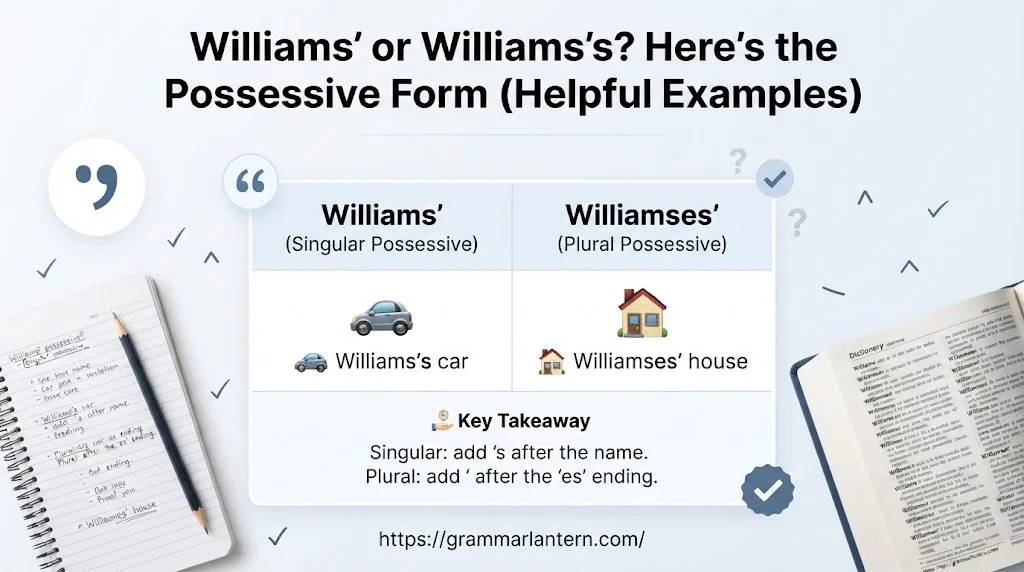
Williams Family vs. Williams’s vs. Williamses’
These three constructions can look similar while doing different jobs.
The Williams Family
Use the Williams family when you mean the family as a group.
The Williams family lives nearby.
This phrase doesn’t require a possessive apostrophe after Williams.
Williams’s
Use Williams’s when one person named Williams possesses something.
Williams’s daughter is a doctor.
The daughter is associated with one individual named Williams.
Williamses’
Use Williamses’ when multiple Williams family members possess something.
The Williamses’ house needs a new roof.
Here, several members collectively own the house.
The difference becomes much easier when you ask one question:
How many people named Williams are involved?
| Phrase | What it means |
| Williams family | The family as a group |
| Williams’s house | One Williams owns the house |
| Williamses’ house | Multiple Williams family members own the house |
Style Guide Differences
The biggest reason you’ll encounter both Williams’ and Williams’s is that style guides have not always treated singular names ending in s identically.
Chicago Style
Chicago’s current approach adds ’s to singular proper names ending in s.
So you would write:
Williams’s argument
rather than:
Williams’ argument
Chicago’s current 18th-edition material continues this approach. Its chapter on possessives includes specific guidance for proper names ending in s and an alternative practice that uses an apostrophe alone.
MLA Style
MLA also uses ’s for singular proper names ending in s.
For example:
Dumas’s novels
The MLA Style Center notes that some other styles may allow Dumas’, but its own general rule uses ’s for singular proper names ending in s.
What About Other Style Systems?
Different publications and organizations may establish their own house rules. Some use Williams’ for singular names ending in s, while others use Williams’s.
That’s why the most useful rule isn’t “always use one spelling.”
Instead:
Follow the style guide required for your document and apply its rule consistently.
If you’re writing for a newspaper, academic journal, company, university, or publisher, check its editorial standard when the distinction matters.
In Academic Writing
Academic writing requires special attention because instructors, departments, and publishers may specify a particular style.
If you’re using MLA, for example, a singular surname ending in s generally takes ’s:
Williams’s interpretation differs from the earlier study.
If your publication follows another convention that uses Williams’, follow that requirement instead.
The mistake isn’t necessarily choosing one accepted form over another. The bigger problem is mixing conventions without a reason.
For instance, this looks inconsistent:
Williams’s theory supports the claim, but Williams’ later article challenges it.
If both references concern the same singular author and the same document follows one style, choose one convention and stick with it.
In Professional Writing
Business writing has the same basic issue.
Imagine an employee named Sarah Williams. You might write:
Williams’s report is ready for review.
Or, under an apostrophe-only house style:
Williams’ report is ready for review.
Either construction can communicate singular possession when the relevant style permits it.
The important thing is to avoid accidental shifts:
- Williams’s report
- Williams’ presentation
- Williams’s recommendation
- Williams’ department
If these all refer to the same person, inconsistent punctuation can make the document look poorly edited.
A simple style sheet solves the problem. Once you’ve chosen the convention, apply it throughout the document.
Common Mistakes
Mistake: Treating Williams as Automatically Plural
The surname Williams can belong to one person.
Williams’s office is closed.
Don’t assume the final s means several people.
Mistake: Using Williamses’ for One Person
This is incorrect when only one person named Williams possesses something:
❌ Williamses’ office is closed.
If you’re talking about one Williams, use the appropriate singular possessive:
Williams’s office is closed.
Or use Williams’ if your style follows the apostrophe-only convention.
Mistake: Using Williams’ for Every Situation
Williams’ isn’t the plural possessive of the surname in the clearest grammatical sense.
For multiple Williams family members, write:
The Williamses’ home
not:
The Williams’ home
The latter can be confusing because Williams’ is also used by some styles for singular possession.
Mistake: Adding an Apostrophe to Williams When You Mean the Family
If you’re simply referring to the family, write:
The Williams family attended the event.
You don’t need:
❌ The Williams’ family attended the event.
That construction suggests a possessive relationship rather than simply identifying the family.
Mistake: Switching Styles Midway
A document should have a consistent editorial voice.
If your chosen convention uses Williams’s, continue using it unless a specific proper-name convention requires something different.
Helpful Examples
The following examples show how the forms work in real sentences.
Singular Possession
- Williams’s car is parked outside.
- Williams’s office is on the third floor.
- Williams’s book became a bestseller.
- Williams’s daughter graduated last year.
- Williams’s opinion influenced the decision.
- Williams’s research focuses on language.
- Williams’s proposal received approval.
- Williams’s signature appears at the bottom.
Under an apostrophe-only convention, these may appear as:
- Williams’ car
- Williams’ office
- Williams’ book
- Williams’ daughter
- Williams’ opinion
- Williams’ research
- Williams’ proposal
- Williams’ signature
Plural Williams Possession
- The Williamses’ house is near the lake.
- The Williamses’ business opened in 2018.
- The Williamses’ children attend the same school.
- The Williamses’ car was damaged in the storm.
- The Williamses’ garden attracts many visitors.
- The Williamses’ decision surprised their neighbors.
Notice the pattern. Williamses establishes the plural before the apostrophe marks possession.
A Simple Decision Rule
When you’re stuck, don’t stare at the apostrophe. Start with the meaning.
Ask These Questions
Is Williams one person’s surname?
Use:
Williams’s
or Williams’ if your chosen style uses the apostrophe-only form.
Are you talking about several people named Williams?
Use:
Williamses
Do several Williams family members possess something?
Use:
Williamses’
Are you simply referring to the family?
Use:
the Williams family
This quick decision tree handles most situations:
One Williams → Williams’s / Williams’
Several Williamses → Williamses
Several Williamses + possession → Williamses’
Family as a group → the Williams family
Once you think about the number of people first, the punctuation becomes much less mysterious.
Read More: Affend or Offend: Which Spelling Is Correct?
What About James, Jones, and Charles?
The same question appears with many other names.
Consider:
- James’s book
- Jones’s car
- Charles’s office
- Davis’s report
These follow the same general singular possessive pattern used by Chicago and MLA for proper names ending in s.
Under an apostrophe-only convention, you may instead encounter:
- James’ book
- Jones’ car
- Charles’ office
- Davis’ report
The broader lesson is more valuable than memorizing one surname:
Don’t confuse a singular name ending in s with a plural noun ending in s.
Compare:
the students’ books
with:
Williams’s book
Students is plural. Williams is the surname of one person.
That’s why the possessive constructions differ.
Case Study: Three Williams Families
Imagine three separate sentences:
Williams’s house has a red door.
One person named Williams owns or is associated with the house.
Now:
The Williamses live in a red house.
Several members of the Williams family live there.
Finally:
The Williamses’ house has a red door.
Several Williams family members collectively possess the house.
The three sentences differ by only a few letters, but the grammar changes significantly.
| Sentence | Number of people | Possessive? |
| Williams’s house has a red door. | One | Yes |
| The Williamses live in a red house. | Several | No |
| The Williamses’ house has a red door. | Several | Yes |
This is why punctuation isn’t merely cosmetic. It can carry grammatical information.
Does Williams’s Need an Extra Pronunciation?
When you write Williams’s, the possessive ending is generally pronounced rather than treated as silent punctuation.
In ordinary speech, the added possessive ending creates an additional sound after the surname. That makes sense because the written ’s isn’t merely an apostrophe marking possession. It also represents the possessive ending.
However, pronunciation can vary somewhat by speaker and context. Don’t use pronunciation alone to decide which written style your assignment or publication requires.
For formal writing, style consistency comes first.
How to Remember
Here’s the easiest memory trick:
One Williams → singular possessive. Multiple Williamses → plural possessive.
Then remember the spelling:
- One person: Williams’s or Williams’
- Several people: Williamses
- Several people possessing something: Williamses’
A useful visual comparison is:
Williams → Williams’s
Williamses → Williamses’
The first form adds ’s to a singular name. The second adds an apostrophe to an already plural surname.
Quick Reference
| Situation | Recommended form | Example |
| One person named Williams | Williams’s | Williams’s report |
| One person under apostrophe-only style | Williams’ | Williams’ report |
| Several people named Williams | Williamses | The Williamses arrived |
| Several Williams family members possess something | Williamses’ | The Williamses’ home |
| Family identified as a group | the Williams family | The Williams family arrived |
For Chicago and MLA-style writing, Williams’s is the straightforward singular possessive choice.
FAQs
1. Is Williams’s grammatically correct?
Yes. Williams’s is correct when Williams refers to one person and you want to show possession. For example, “Williams’s office is upstairs.”
2. Is Williams’ also correct?
Yes. Williams’ can also be correct for a singular person named Williams. Some style guides prefer this form for names ending in s.
3. Which is more common, Williams’ or Williams’s?
Both forms are used. Williams’s follows the general singular possessive rule, while Williams’ is preferred by some writers and style guides.
4. How do you make Williams plural?
If you mean more than one person with the surname Williams, the plural is Williamses. For example, “The Williamses attended the reunion.”
5. What is the plural possessive of Williams?
The plural possessive is Williamses’. For example, “The Williamses’ house is near the park.”
6. Does Williams’s mean more than one person?
No. Williams’s normally indicates possession by one person named Williams.
7. Does Williams’ always mean plural possession?
No. Williams’ can indicate singular possession when a particular style guide allows the apostrophe-only form for singular names ending in s.
8. Should I use Williams’s in formal writing?
Williams’s is a safe choice when your chosen style follows the general rule of adding ’s to singular names. However, always follow your organization’s preferred style guide.
9. What is the easiest way to remember the rule?
First, decide whether Williams refers to one person or several. One person can be Williams’s or Williams’, depending on style. Several people are Williamses, and their possession is Williamses’.
10. Can Williams’ and Williams’s be used interchangeably?
Not in every context. They can both show singular possession, but Williamses’ is needed when several Williamses own something. The meaning depends on both the number and the punctuation.
Conclusion
Understanding Williams’ or Williams’s doesn’t have to be difficult. When Williams refers to one person, both Williams’s and Williams’ may be acceptable, depending on the style you follow. The key is to stay consistent throughout your writing.
When you mean several people with the surname Williams, use Williamses for the plural and Williamses’ for the plural possessive. Once you separate singular, plural, and possessive forms, the apostrophe becomes much easier to place correctly.