
Many English learners and native speakers get confused when choosing between grew and grown. Both words come from the verb grow, but they have different grammatical purposes. The key difference is simple: grew is the past tense, while grown is the past participle. Because these irregular verb forms look and sound related, choosing the correct one can sometimes feel tricky.
You might write, “The plant grew quickly,” when describing a completed action in the past. However, “The plant has grown quickly” uses grown with the helping verb has. These examples describe a similar action, yet they follow different grammar rules. Understanding this pattern makes it much easier to recognize which form belongs in a particular sentence.
In this guide, we’ll explore grew or grown, including their meaning, usage, verb forms, common mistakes, and practical examples. You’ll learn how to use each form naturally in everyday conversations, emails, school assignments, business writing, and other situations. Once you understand the difference between the past tense and past participle, choosing the right word becomes far more straightforward.
Quick Answer
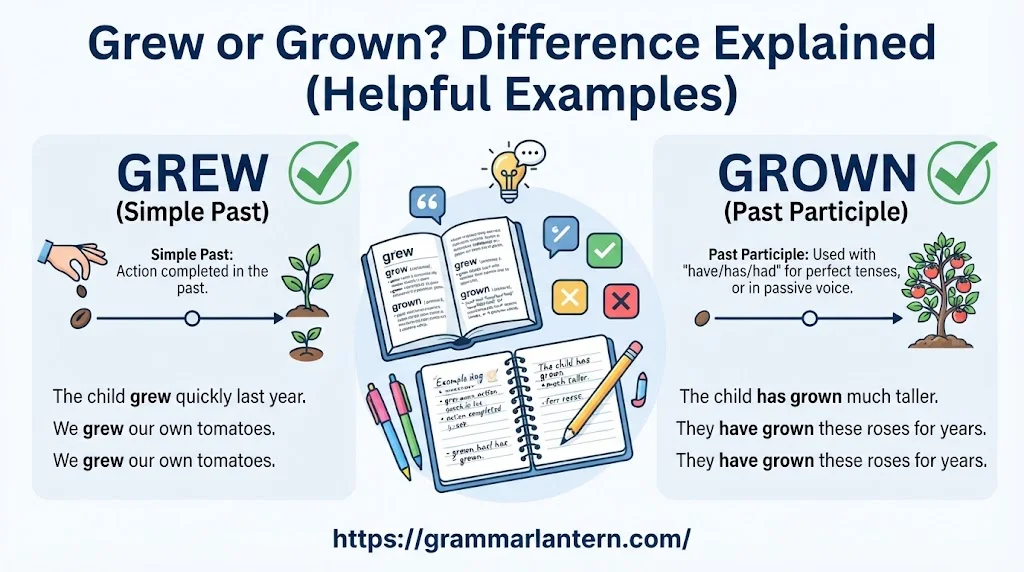
Grew is the simple past form of grow. Use it when you describe something that happened or changed in the past.
Grown is the past participle of grow. It normally appears with a helping verb such as has, have, had, is, was, or been.
The three principal forms are:
| Verb form | Word | Example |
| Base form | grow | Plants grow quickly. |
| Simple past | grew | The plants grew quickly. |
| Past participle | grown | The plants have grown quickly. |
A useful shortcut is:
- Yesterday → grew
- Has/have/had → grown
- Did → grow, not grew or grown
For example:
- She grew taller last year. ✅
- She has grown taller. ✅
- She had grown taller before the school year ended. ✅
- She has grew taller. ❌
- She did grown taller. ❌
The difference isn’t about meaning alone. It comes down to verb tense and grammatical structure.
What Does “Grew” Mean?
Grew is the simple past form of grow. It describes growth, development, or change that took place in the past.
The word can describe physical growth, but its meaning extends much further. Something can grow in size, number, strength, popularity, importance, intensity, or emotional depth.
For example:
- The baby grew quickly.
- The tree grew several feet.
- The company grew rapidly.
- Their friendship grew stronger.
- The crowd grew larger.
- Her confidence grew over time.
Notice that grew doesn’t require a helping verb when it functions as the main past-tense verb.
Grew for Completed Past Events
Use grew when you’re presenting growth as a past event.
Consider this sentence:
The company grew rapidly between 2018 and 2022.
The verb grew places the growth in the past. The sentence doesn’t need has, have, or had.
Another example makes the distinction even clearer:
When I was a child, I grew several inches in one summer.
The sentence refers to a completed period in the past. Therefore, grew fits naturally.
Grew With Past-Time Expressions
Words and phrases that clearly place an action in the past often work naturally with grew.
Common examples include:
- yesterday
- last year
- last summer
- when I was young
- during childhood
- several years ago
- between 2010 and 2020
- at that time
- during the previous decade
For example:
The plant grew quickly last summer.
The business grew significantly between 2019 and 2023.
His interest in music grew during high school.
The exact time expression isn’t required. Context alone can establish the past.
What Does “Grown” Mean?
Grown is the past participle of grow. Unlike grew, it generally doesn’t function as the simple past tense by itself.
You normally use grown with a helping verb.
For example:
- She has grown considerably.
- They have grown closer.
- The tree had grown beyond the fence.
- The business has grown rapidly.
- The crops were grown locally.
Here, grown works as part of a larger verb phrase.
The important point is that grown doesn’t replace grew in every past-tense sentence. The two forms have different grammatical roles.
The Main Grammar Difference
The easiest way to understand grew vs. grown is to compare the simple past with the past participle.
| Feature | Grew | Grown |
| Base verb | Grow | Grow |
| Verb form | Simple past | Past participle |
| Can stand alone as a past-tense verb? | Yes | Usually no |
| Common construction | Subject + grew | Subject + has/have/had + grown |
| Example | She grew quickly. | She has grown quickly. |
Think of grew as a complete past-tense verb.
Think of grown as a form that usually needs another verb to support it.
For example:
The child grew quickly.
Here, grew carries the past tense.
Now compare:
The child has grown quickly.
Here, has carries the present-perfect tense, while grown supplies the past participle.
That small grammatical distinction explains most grew or grown mistakes.
When to Use “Grew”
Use grew when you need the simple past form of grow.
Physical Growth
Physical development is one of the most common uses.
- The child grew five inches in two years.
- The puppy grew much larger than expected.
- My hair grew quickly during the summer.
- The tree grew toward the sunlight.
These sentences describe growth as a past event.
Development or Change
Grew can also describe gradual changes that aren’t physical.
- Her confidence grew after the presentation.
- Their friendship grew stronger over time.
- Public interest grew during the campaign.
- The problem grew more serious.
- His responsibilities grew after the promotion.
In each example, something changed or developed.
Read More: Preform or Perform: Which Word Is Correct?
Business and Organizations
English frequently uses grow when discussing companies and organizations.
For example:
The company grew rapidly after launching its new product.
You could also say:
The company grew from a small local operation into a national business.
The past-tense form grew works because the sentence describes development in a completed or specifically past context.
When to Use “Grown”
Use grown when the grammar calls for a past participle.
Present Perfect: Has Grown or Have Grown
The present perfect uses has/have + past participle.
Therefore:
- He has grown.
- She has grown.
- It has grown.
- They have grown.
- We have grown.
Examples:
The child has grown considerably since last year.
The company has grown into a major supplier.
Their relationship has grown stronger over time.
The present perfect often connects a past development with the present situation.
For example:
The business grew rapidly in 2022.
This focuses on a particular past period.
The business has grown rapidly since 2022.
This connects the past growth to the present.
That difference in perspective matters.
Past Perfect: Had Grown
The past perfect uses had + past participle.
Therefore:
had grown is correct.
For example:
By the time the storm arrived, the river had grown dangerously high.
The sentence contains two past events. The river became dangerously high before the storm arrived.
Another example:
The company had grown significantly before the new owner took control.
The growth happened first. The ownership change happened afterward.
Passive Constructions
Grown can also appear in passive constructions.
Consider:
These tomatoes are grown locally.
Here, are acts as the auxiliary verb and grown is the past participle.
Other examples include:
- The wheat is grown in several regions.
- These vegetables are grown without synthetic pesticides.
- The cotton was grown on a family farm.
- The crops have been grown there for generations.
This structure is especially common when discussing agriculture, food production, and cultivation.
“Grown” as an Adjective
There is another interesting use of grown. It can function as part of an adjective phrase.
For example:
- a fully grown tree
- a fully grown adult
- a home-grown product
- a grown-up conversation
In fully grown, the word describes the condition or state of something.
Consider:
The tree is now fully grown.
Here, grown describes the tree’s developed state.
However, don’t assume every appearance of grown is simply an adjective. Context determines its grammatical role.
Grew vs. Grown in Different Contexts
The distinction remains consistent even when the subject changes.
People and Animals
Grew:
The puppy grew quickly during its first year.
Grown:
The puppy has grown much larger.
Plants and Crops
Grew:
The tomatoes grew well during the summer.
Grown:
These tomatoes are grown locally.
Businesses
Grew:
The company grew rapidly after its expansion.
Grown:
The company has grown considerably since then.
Feelings and Relationships
Grew:
Their friendship grew stronger over the years.
Grown:
Their friendship has grown stronger since college.
Problems and Concerns
Grew:
The disagreement grew more serious.
Grown:
The disagreement has grown more serious.
The vocabulary changes very little. The verb form changes because the grammatical structure changes.
Common Mistakes
These mistakes often happen when writers treat grew and grown as interchangeable.
“I Have Grew” ❌
The correct sentence is:
I have grown. ✅
Why? Have requires the past participle, which is grown.
“She Has Grew Taller” ❌
Correct:
She has grown taller. ✅
The pattern is:
has + grown
not:
has + grew
“They Did Grown Quickly” ❌
Correct:
They grew quickly. ✅
Or:
They did grow quickly. ✅
After did, English uses the base form grow.
This gives you another useful rule:
Did + grow, not did + grew or did + grown.
“The Plant Has Grew” ❌
Correct:
The plant has grown. ✅
Again, has requires the past participle.
Grew vs. Grown After Helping Verbs
Helping verbs provide one of the fastest ways to choose the correct form.
| Helping verb or structure | Correct form | Example |
| Did | grow | Did the plant grow? |
| Does | grow | Does the plant grow quickly? |
| Has | grown | The plant has grown quickly. |
| Have | grown | The plants have grown quickly. |
| Had | grown | The plants had grown before winter. |
| Will | grow | The plants will grow quickly. |
| Will have | grown | The plants will have grown by then. |
| Is | growing / grown depending on meaning | The plant is growing. |
| Was | growing / grown depending on structure | The crop was grown locally. |
This table highlights an important point: not every helping verb automatically takes grown.
The entire verb construction matters.
In Questions
Questions reveal these differences particularly well.
Questions With “Did”
Use the base form after did:
Did the child grow quickly?
Not:
Did the child grew quickly? ❌
And not:
Did the child grown quickly? ❌
The auxiliary did already carries the past-tense marking. The main verb returns to its base form.
Questions With “Has” or “Have”
Use grown after has or have:
Has the child grown quickly?
Have the plants grown enough?
These questions use the present perfect.
Questions With “Had”
Use grown after had:
Had the tree grown before the storm?
The structure is:
had + grown
That pattern remains consistent regardless of the subject.
In Negative Sentences
Negative constructions provide another useful test.
With did not, use grow:
The plant did not grow quickly.
Not:
The plant did not grew quickly. ❌
With has not, use grown:
The plant has not grown quickly.
Not:
The plant has not grew quickly. ❌
With had not, use grown:
The plant had not grown enough before winter.
The Basic Pattern
Remember these three structures:
- did not + grow
- has not + grown
- had not + grown
Once you recognize the helping verb, the correct form becomes much easier to identify.
Grew vs. Grown in Real-World Writing
The distinction appears in everyday speech, business writing, academic writing, journalism, and technical descriptions.
Consider a business report:
Sales grew by 15% in 2023.
This describes a specific past period.
Now compare:
Sales have grown by 15% since 2023.
This connects the earlier period with the present.
Agricultural writing works similarly:
Farmers grew wheat in the region last year.
Compared with:
Wheat is grown throughout the region.
The first sentence describes a past action. The second describes a cultivation practice or current condition.
A Simple Case Study: Choosing Grew or Grown
Imagine you’re describing a young tree.
You might write:
The tree grew rapidly during its first summer.
This is simple past. The sentence points to a completed period.
Now imagine the tree is still developing:
The tree has grown rapidly since spring.
Here, the growth began in the past and remains relevant now.
Next, imagine you’re comparing two past events:
The tree had grown several feet before the gardener trimmed it.
The growth occurred before another past action.
Finally, describe the cultivation method:
The tree was grown in a controlled environment.
Each sentence uses a different grammatical structure, even though all four describe the same general concept.
How to Remember
A simple memory trick can save you from many mistakes.
Remember “Grew” as the Past Form
If you’re simply telling someone what happened, grew often fits.
The child grew quickly.
The business grew last year.
The plant grew after the rain.
Remember “Grown” With Has, Have, and Had
When you see has, have, or had, think grown.
has grown
have grown
had grown
This isn’t the only situation where grown appears. However, it’s one of the most useful shortcuts.
Remember “Did” + Grow
After did, return to the base form.
Did it grow?
It didn’t grow.
Never use grew directly after did.
Grew, Grown, and Grow: The Complete Verb Pattern
Learning all three forms together is more effective than memorizing grew vs. grown separately.
| Tense or form | Correct word | Example |
| Present/base | grow | Plants grow. |
| Simple past | grew | Plants grew. |
| Past participle | grown | Plants have grown. |
| Infinitive | grow | Plants need to grow. |
| After did | grow | Did plants grow? |
| After has/have/had | grown | Plants have grown. |
This pattern also demonstrates why irregular verbs can be tricky. English doesn’t form the past of grow by simply adding -ed. Instead, it changes internally:
grow → grew → grown
The same kind of pattern appears with other irregular verbs:
- go → went → gone
- see → saw → seen
- write → wrote → written
- take → took → taken
- break → broke → broken
Recognizing irregular verb patterns can make English grammar much easier to navigate.
A Quick Decision Guide
When you’re unsure, ask yourself a few questions.
Is the sentence describing a simple past event?
Use grew.
The plant grew quickly last year.
Does the sentence contain has, have, or had?
Use grown.
The plant has grown quickly.
Does the sentence contain did?
Use grow.
Did the plant grow quickly?
Is the word part of a passive construction?
You may need grown.
The tomatoes are grown locally.
This quick check handles most common cases.
Read More: Given vs. Gave: Difference Explained With Helpful Examples
FAQs
1. What is the difference between grew and grown?
Grew is the past tense of grow, while grown is the past participle. For example, “The child grew quickly” is correct, while “The child has grown quickly” uses the past participle.
2. Is grew the past tense of grow?
Yes. Grew is the simple past tense of grow. For example, “The flowers grew rapidly last summer.”
3. Is grown the past tense of grow?
No. Grown is the past participle, not the simple past tense. It normally appears with a helping verb such as has, have, had, or be.
4. Should I say “has grew” or “has grown”?
You should say “has grown.” The verb has requires the past participle, so “The business has grown significantly” is correct.
5. Can I use grew without a helping verb?
Yes. Grew can stand alone as the main verb in the simple past tense. For example, “The tree grew several feet last year.”
6. Can grown be used without a helping verb?
Usually, grown needs a helping verb when it functions as the past participle. For example, “The company has grown rapidly.” However, grown can also work as an adjective in certain sentences, such as “a grown man.”
7. Is “I have grew” correct?
No. The correct sentence is “I have grown.” After have, use the past participle grown, not the past tense grew.
8. Is “she grew up” correct?
Yes. “She grew up” is correct because grew is the simple past tense of grow. For example, “She grew up in a small town.”
9. Is “she has grown up” also correct?
Yes. “She has grown up” uses the present perfect tense. It connects her growth or development from the past to the present.
10. How can I remember when to use grew and grown?
A useful rule is to remember grow – grew – grown. Use grew for the simple past: “The plant grew.” Use grown after a helping verb such as has, have, or had: “The plant has grown.”
Conclusion
Understanding grew or grown becomes much easier once you remember that they have different grammatical jobs. Grew is the simple past tense of grow, so you can use it for an action that happened in the past. Grown is the past participle, so it usually appears with helping verbs such as has, have, or had. Remembering the sequence grow – grew – grown can help you avoid many common mistakes.
When you are unsure which word to choose, look at the words around it. If the sentence describes a completed past action without a helping verb, grew is often the right choice. If the sentence uses has, have, or had, you will generally need grown. With a little practice, the difference becomes natural, and you’ll be able to use both forms confidently in everyday English writing and conversation.




[…] Read More: Grew or Grown? Difference Explained with Examples […]
[…] Read More: Grew or Grown? Difference Explained with Examples […]