Many English learners hesitate when choosing between gave and given because both forms come from the irregular verb give. Although they share the same root, they serve different grammatical roles and cannot be swapped freely. Gave is the simple past tense, while given is the past participle. Understanding this basic distinction makes many confusing sentences much easier to handle.
The real challenge appears when sentence structure enters the picture. You can say, “She gave me a helpful suggestion yesterday,” but you cannot say, “She given me a helpful suggestion yesterday.” On the other hand, given normally appears with a helping verb, as in “She has given me helpful advice.” These patterns become much clearer once you see them in context.
In this guide, you’ll learn the practical difference between gave and given through clear explanations and everyday examples. We’ll look at their verb forms, common sentence patterns, typical mistakes, and useful memory tricks. By the end, choosing the correct form should feel more natural and much less confusing.
Quick Answer
The simplest way to remember given vs. gave is this:
- Gave is the simple past form of give.
- Given is the past participle of give.
- Gave can function as the main verb in a simple past sentence.
- Given usually appears with an auxiliary verb such as have, has, had, is, are, was, or were.
- The three principal forms are give → gave → given.
Quick examples
| Form | Correct Example | Grammar |
| Give | I give him advice. | Present |
| Gave | I gave him advice. | Simple past |
| Given | I have given him advice. | Present perfect |
| Given | He was given advice. | Passive |
So, if you’re talking about a completed action in the past, gave is generally the right choice:
She gave me a gift yesterday.
If you’re using have, has, or had, use given:
She has given me a gift.
The same applies to passive constructions:
She was given a gift.
The Main Difference
Although gave and given share the same root, they aren’t interchangeable. English uses different forms of irregular verbs to express different grammatical relationships.
Think of give as a three-part sequence:
give → gave → given
Each form has a specific job.
What Does “Gave” Mean?
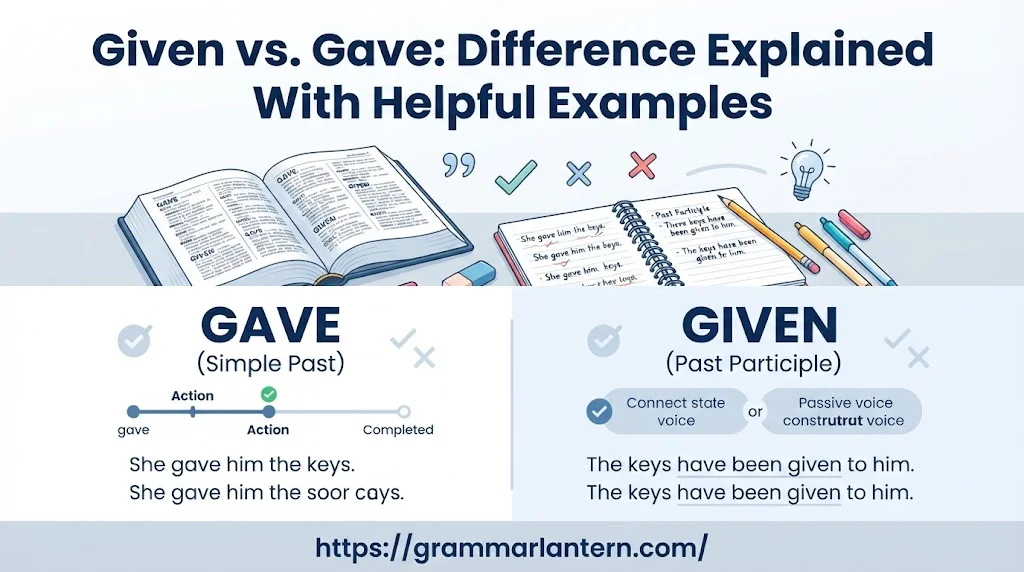
Gave is the simple past tense of give. It describes an action that happened in the past.
You can use gave without an auxiliary verb when the sentence itself is in the simple past.
For example:
- I gave him my phone number.
- She gave me a birthday card.
- They gave us directions.
- He gave his teacher an explanation.
- We gave the customer a refund.
Notice the pattern. Gave carries the past tense itself.
You don’t need have, has, or had to make these sentences grammatical.
What Does “Given” Mean?
Given is the past participle of give. Unlike gave, it doesn’t normally express the simple past by itself.
Instead, given commonly appears in perfect and passive constructions.
For example:
- I have given him the information.
- She has given us permission.
- They had given him enough time.
- He was given another opportunity.
- The students were given extra instructions.
Here, another verb helps establish the grammatical structure.
The important pattern is:
have/has/had + given
or:
be + given
That’s why “I have gave” doesn’t work in standard English. After have, you need the past participle given.
Give, Gave, Given: The Three Principal Forms
Understanding the complete verb family makes given vs. gave much easier.
| Verb Form | Word | Example |
| Base form | give | I give her advice. |
| Simple past | gave | I gave her advice. |
| Past participle | given | I have given her advice. |
The verb give is irregular. That means you can’t form its past tense by simply adding -ed.
For example:
- walk → walked
- talk → talked
- work → worked
But:
- give → gave
- give → given
That’s why learners often need to memorize these three forms together.
Give → Gave → Given
This sequence is worth remembering because it appears constantly in everyday English.
When to Use “Gave”
Gave for a Completed Past Action
Use gave when you’re describing an action that happened and finished in the past.
For example:
Maria gave me the documents yesterday.
The word yesterday places the action at a completed time in the past. The simple past gave fits naturally.
More examples include:
- He gave me his old laptop last month.
- She gave the children some candy.
- We gave them our final answer.
- The manager gave us permission to leave early.
- I gave my friend a ride home.
The key question is simple:
Did the action happen at a completed point or period in the past?
If yes, gave may be the form you need.
Gave With Past-Time Expressions
Certain time expressions frequently accompany the simple past.
Common examples include:
- yesterday
- last night
- last week
- last month
- last year
- two days ago
- an hour ago
- in 2023
- when I was younger
- earlier this morning
For example:
She gave me the answer yesterday.
They gave us the contract last Friday.
He gave his presentation two hours ago.
These sentences focus on a completed past event.
However, don’t assume that every sentence involving a past event automatically requires gave. The surrounding grammar matters too.
When to Use “Given”
Given With Have, Has, and Had
The most important rule for given is its use after have, has, and had.
These combinations form perfect constructions:
- have given
- has given
- had given
Examples:
I have given you enough information.
She has given me excellent advice.
They had given us the instructions before the meeting.
Using gave after these auxiliary verbs creates a grammatical error in standard English.
Incorrect:
I have gave him the book.
Correct:
I have given him the book.
The auxiliary have requires the past participle given.
Read More: Gases vs. Gasses: Which Spelling Is Correct?
Given in the Present Perfect
The present perfect uses:
have/has + past participle
Since given is the past participle of give, we get:
- I have given
- you have given
- he has given
- she has given
- we have given
- they have given
For example:
She has given us several useful suggestions.
The present perfect often connects a past action with the present situation. The exact past time may not matter.
Compare these sentences:
- She gave us the information yesterday.
- She has given us the information.
The first sentence identifies a finished past time. The second emphasizes the current relevance or completed experience rather than a specific finished time.
Given in the Past Perfect
The past perfect follows this structure:
had + given
Use it when one past action happened before another past action.
For example:
She had given me the address before I left.
Two events occurred:
- She gave me the address.
- I left.
The giving happened first, so had given clearly establishes that earlier relationship.
Another example:
The teacher had given the students their assignments before the class ended.
Again, had given identifies the earlier action.
Given in Passive Constructions
Given also appears frequently in passive sentences.
The basic structure is:
be + given
Depending on the tense, the first verb changes:
- was given
- were given
- is given
- are given
- has been given
- had been given
Examples:
He was given a warning.
The employees were given extra time.
She has been given a new responsibility.
The students were given detailed instructions.
You cannot replace given with gave in these constructions.
Incorrect:
He was gave a warning.
Correct:
He was given a warning.
Why? Because was is the auxiliary verb, while given supplies the past participle needed for the passive construction.
In Different Tenses
The following table shows how the forms work across common structures.
| Tense or Construction | Correct Form | Example |
| Simple present | give/gives | She gives good advice. |
| Simple past | gave | She gave good advice. |
| Present perfect | has/have given | She has given good advice. |
| Past perfect | had given | She had given good advice. |
| Simple passive | was/were given | They were given advice. |
| Present passive | is/are given | They are given advice. |
| Present perfect passive | has/have been given | They have been given advice. |
| Past perfect passive | had been given | They had been given advice. |
This comparison reveals a useful pattern: gave belongs to the simple past, while given works inside larger grammatical constructions.
In Questions
Questions create another common source of mistakes.
Correct Questions With “Gave”
When you use did to form a simple past question, the main verb returns to its base form.
Therefore:
Did you give her the message?
Not:
Did you gave her the message?
The same rule applies to other questions:
- Did he give you the keys?
- Did she give them enough time?
- What did they give you?
- Why did he give her the book?
The important structure is:
did + give
Not:
did + gave
Why “Did You Gave?” Is Incorrect
The word did already carries the past tense.
Think of it as a grammatical division of labor:
- did shows the past.
- give remains in its base form.
That’s why:
She gave me the book.
becomes:
Did she give me the book?
The past marker moves into did.
Correct Questions With “Given”
Perfect-tense questions use given because the auxiliary verb requires the past participle.
Examples:
- What have you given him?
- What has she given you?
- What had they given him?
- Who has given you permission?
The structure remains consistent:
have/has/had + given
Common Mistakes
“I Have Gave” vs. “I Have Given”
This is probably the most common error involving these two forms.
❌ I have gave him the documents.
✅ I have given him the documents.
The reason is grammatical rather than stylistic. Have requires the past participle, and the past participle of give is given.
“I Gave” vs. “I Have Given”
Both can be correct, but they aren’t identical.
I gave him the report yesterday.
I have given him the report.
The first uses the simple past and identifies a finished past time. The second uses the present perfect and emphasizes the completed action’s relevance to the present.
A useful distinction is:
Specific finished past time → gave
Perfect construction → given
For example:
- I gave her the keys this morning.
- I have given her the keys.
“Did You Gave?” vs. “Did You Give?”
The correct form is:
Did you give him the message?
Not:
Did you gave him the message?
After did, always use the base form of the verb.
The same principle applies to other irregular verbs:
- Did you go? not Did you went?
- Did she see it? not Did she saw it?
- Did they take it? not Did they took it?
- Did he give it? not Did he gave it?
“Was Gave” vs. “Was Given”
Use was given in a passive construction.
❌ He was gave a second chance.
✅ He was given a second chance.
Here, was acts as the auxiliary verb. The past participle given completes the passive structure.
“Had Gave” vs. “Had Given”
The correct combination is:
She had given me the information.
Not:
She had gave me the information.
The rule is straightforward:
had + past participle
Therefore:
had + given
Side-by-Side Examples
| Incorrect or Alternative Form | Correct Form | Explanation |
| I have gave him the book. | I have given him the book. | Have requires the past participle. |
| Did you gave her the message? | Did you give her the message? | Did takes the base form. |
| He was gave a chance. | He was given a chance. | Passive voice requires the past participle. |
| She had gave me the details. | She had given me the details. | Had takes the past participle. |
| He gave me the report yesterday. | Correct | Gave works as simple past. |
| They have given us enough time. | Correct | Given follows have. |
| She gave him permission last week. | Correct | The sentence uses simple past. |
| She has given him permission. | Correct | The sentence uses present perfect. |
Given as an Adjective
Given doesn’t always function as a verb. It can also act as an adjective in certain contexts.
For example:
Under the given circumstances, we changed our plans.
Here, given describes the circumstances.
You can also see it in expressions such as:
- given information
- given circumstances
- a given time
- a given situation
- a given condition
- a given value
Consider this sentence:
At a given time, the system records the temperature.
In this context, given means something like specified or particular.
“A Given”
The noun phrase a given has a slightly different meaning. It refers to something accepted as established or certain.
For example:
In this experiment, accurate measurements are a given.
The expression can also refer to an accepted fact or condition.
This use has nothing to do with choosing between gave and given as verb forms. Context determines its grammatical role.
“Given That” and “Given” as a Preposition
You may also encounter given at the beginning of a sentence.
For example:
Given that the road was closed, we took another route.
Here, given that introduces a fact that provides the basis for what follows.
Another example:
1.Given that she had limited time, she completed the work quickly.
2.Given can also introduce a noun phrase:
3.Given the circumstances, we decided to wait.
In these cases, given has a meaning close to considering or taking into account.
This use is different from the past participle in sentences such as “She has given me the book.”
Read More: Louis’ or Louis’s? Here’s the Possessive Form With Examples
In Everyday English
The distinction becomes easier when you see both forms in ordinary situations.
Giving a Gift
Simple past:
John gave me a watch for my birthday.
Present perfect:
John has given me several gifts over the years.
Giving Advice
Simple past:
My father gave me some useful advice yesterday.
Present perfect:
My father has given me useful advice many times.
Giving Permission
Simple past:
The manager gave us permission to leave.
Past perfect:
The manager had given us permission before we left.
Giving Instructions
Simple past:
The teacher gave us new instructions this morning.
Passive:
We were given new instructions this morning.
The meaning remains related to the act of giving. The grammatical structure changes the form.
In Workplace English
Professional communication uses both forms frequently.
Consider these examples:
- The manager gave the team new instructions yesterday.
- The manager has given the team new instructions.
- The employees were given additional training.
- The company had given the department extra resources.
- Did the manager give you the updated schedule?
The same distinction appears in reports, emails, meeting notes, and business documents.
When proofreading professional writing, look especially closely at have, has, had, was, were, is, and are. These words often signal that given may be required.
In Academic English
Academic writing also relies heavily on these forms.
For example:
The researchers gave participants a questionnaire.
The researchers have given participants several questionnaires.
Participants were given clear instructions.
The researchers had given participants enough time to respond.
These examples show why context matters more than the word alone.
Gave isn’t inherently more correct than given. Each belongs to a different grammatical structure.
Mini Case Study: Choosing Between Gave and Given
Imagine that you’re describing a teacher’s actions during a class.
You want to say that the teacher provided students with extra time yesterday.
The correct sentence is:
The teacher gave the students extra time yesterday.
Why? Yesterday identifies a completed past time, and the sentence uses the simple past.
Now change the sentence:
The teacher has given the students extra time.
Here, has requires the past participle. Therefore, given is correct.
Now make the sentence passive:
The students were given extra time.
Again, given is required because the sentence uses the passive construction.
Finally, turn it into a question:
Did the teacher give the students extra time?
The word did takes the past-tense burden, so the main verb returns to give.
This one scenario covers four important structures:
| Sentence | Form | Reason |
| The teacher gave extra time. | gave | Simple past |
| The teacher has given extra time. | given | Present perfect |
| Students were given extra time. | given | Passive |
| Did the teacher give extra time? | give | Question with did |
Practice
Choose the correct form in each sentence.
Questions
- She ___ me the documents yesterday.
- I have ___ him the information already.
- Did they ___ you enough time?
- He was ___ another opportunity.
- They had ___ us clear instructions.
- We ___ the customer a refund last week.
- She has ___ several presentations this year.
- Who ___ you that advice?
- The students were ___ extra homework.
- I ___ her the keys two hours ago.
Answers
| Sentence | Answer | Reason |
| She ___ me the documents yesterday. | gave | Simple past |
| I have ___ him the information already. | given | Present perfect |
| Did they ___ you enough time? | give | Did + base form |
| He was ___ another opportunity. | given | Passive |
| They had ___ us clear instructions. | given | Past perfect |
| We ___ the customer a refund last week. | gave | Simple past |
| She has ___ several presentations this year. | given | Present perfect |
| Who ___ you that advice? | gave | Simple past question with subject as the question word |
| The students were ___ extra homework. | given | Passive |
| I ___ her the keys two hours ago. | gave | Simple past |
How to Remember the Difference
A simple three-part rule can save you from most mistakes.
Remember This Pattern
Give → Gave → Given
Then attach each form to its most common structure:
- Give → present or after did
- Gave → simple past
- Given → after have, has, had or in passive constructions
A quick mental check can help:
Yesterday? → gave.
Have/has/had? → given.
Did? → give.
Passive with be? → given.
It isn’t a complete grammar rule for every possible use of these words. However, it’s an excellent practical shortcut for everyday writing.
Final Comparison
| Gave | Given |
| Simple past form | Past participle |
| Can stand alone as the past-tense verb | Usually needs an auxiliary verb |
| She gave me a book. | She has given me a book. |
| Used for completed past actions | Used in perfect constructions |
| Common with finished past-time expressions | Common with have/has/had |
| Not used after did | Used in passive constructions |
| They gave us directions. | We were given directions. |
The biggest mistake is treating gave and given as interchangeable versions of the same word. They come from the same verb, but grammar assigns them different jobs.
FAQs
1. What is the difference between gave and given?
Gave is the simple past tense of give, while given is the past participle. For example, “She gave me a book yesterday” uses the simple past. “She has given me a book” uses the past participle.
2. Is gave the past tense of give?
Yes. Gave is the simple past form of give. You use it when describing an action that happened in the past. For example, “He gave me his phone number last week.”
3. Is given the past tense of give?
No. Given is the past participle, not the simple past tense. It usually appears with a helping verb such as has, have, had, or be.
4. Can I say “I have gave”?
No. The correct form is “I have given.” After have, has, or had, you generally need the past participle. For example, “I have given her the information.”
5. Can I say “She given me a gift”?
Not by itself. The correct sentence is “She gave me a gift.” If you want to use given, you need a helping verb: “She has given me a gift.”
6. Is “I gave him the book” correct?
Yes. Gave is correct because the sentence describes a completed past action. You could say, “I gave him the book yesterday.”
7. Is “I have given him the book” correct?
Yes. Given works correctly with have in this sentence. The phrase have given forms the present perfect tense.
8. What is an easy way to remember gave vs. given?
Think of gave as the past action that can stand alone: “I gave.” Think of given as a form that usually needs help: “I have given,” “She had given,” or “They were given.”
9. What are all the main forms of the verb give?
The main forms are:
| Verb Form | Example |
| Give | I give him advice. |
| Gave | I gave him advice. |
| Given | I have given him advice. |
| Giving | I am giving him advice. |
Learning these four forms together can make the verb much easier to remember.
10. Which is correct: gave or given?
Neither word is always correct. The right choice depends on the sentence structure. Use gave for the simple past and given as a past participle with an appropriate helping verb or in other constructions that require the participle.
Conclusion
Understanding gave vs. given becomes much easier when you focus on their grammatical jobs rather than simply memorizing two similar-looking words. Gave is the simple past form of give, so it can directly describe something that happened in the past. Given is the past participle, so it commonly appears with helping verbs such as have, has, and had.
A simple memory trick can keep the difference straight: “I gave” works on its own, while “I have given” needs the helping verb have. Once you recognize that pattern, common mistakes like “I have gave” become much easier to spot. With a little practice, choosing between these two forms will become an automatic part of your everyday English grammar.

For Shafiq ur Rehman, writing is an art form and grammar is the toolbox that makes it beautiful. As a dedicated content writer at Grammar Lantern, Shafiq approaches every topic like an architect carefully laying down strong foundations of understanding before adding the finer details. He loves diving into the trickiest grammar points and resurfacing with simple, bite-sized takeaways that anyone can grasp. When he’s not crafting articles, you’ll likely find him strategizing over a game of chess, exploring dusty local bookshops, or quietly jotting down poetic observations in his notebook.


[…] Read More: Given vs. Gave: Difference Explained With Helpful Examples […]