
Understanding Hid or Hidden becomes easier when you know how the two forms of hide work. Hid is the simple past tense of the verb to hide, while hidden is the past participle of the same verb. At first, the difference may seem difficult, but the two different forms have clear meanings. For example, “She hid the letter yesterday” describes a completed action. This context helps you distinguish the correct forms and understand their grammatical usage.
The word hidden usually works with have or another helping verb before it. For example, “She has hidden the letter” uses the past participle correctly. When choosing either one, look at the context of the sentence and decide which form fits. This is a simple way to figure out which verb forms you need in your writing.
From my experience with English grammar, learners often confuse these forms because they connect to the same action. Once you recognize what the sentence needs, the difference becomes easier to spot. The article can help you understand these forms with practical examples.
Quick Answer
Hid is the simple past tense of hide.
Hidden is the past participle of hide.
The basic verb pattern is:
| Verb form | Word | Main use | Example |
| Base form | hide | Present, infinitive, after modals | “I want to hide the gift.” |
| Simple past | hid | Completed past action | “She hid the gift.” |
| Past participle | hidden | Perfect and many passive constructions | “She has hidden the gift.” |
A useful rule is simple:
- Use hid for a straightforward past action.
- Use hidden after have, has, or had.
- Use hidden in standard passive constructions with forms of be.
- After did or didn’t, use hide, not hid.
So these sentences are correct:
“He hid the documents yesterday.”
“He has hidden the documents.”
“The documents were hidden in a drawer.”
“Where did he hide the documents?”
That small pattern solves most hid vs. hidden questions.
Hide, Hid, and Hidden Verb Forms
The verb hide belongs to a group of irregular English verbs. Unlike regular verbs, it doesn’t form its past tense simply by adding -ed.
You don’t say hideed. Instead, English uses three distinct forms:
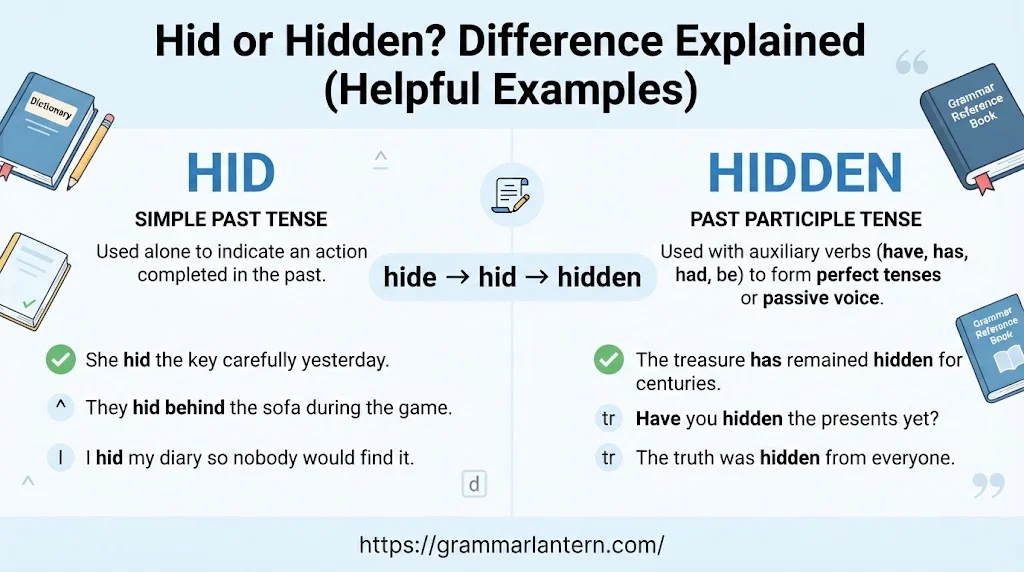
hide → hid → hidden
Each form has a specific grammatical role.
Hide
Hide is the base form of the verb. You use it for the simple present in appropriate contexts, infinitives, commands, and constructions involving modal verbs.
For example:
- “I usually hide my spare keys here.”
- “They want to hide the surprise.”
- “You should hide the gift.”
- “Please hide the package.”
- “She can hide the evidence.”
Notice what happens after did and didn’t as well. English returns to the base form.
- “Did you hide the letter?”
- “I didn’t hide anything.”
Hid
Hid is the simple past form of hide.
Use it when the action happened and finished in the past.
Consider these examples:
- “He hid behind the door.”
- “She hid the present under the bed.”
- “The child hid behind the curtain.”
- “They hid the documents yesterday.”
- “I hid the spare key last night.”
The word hid doesn’t need an auxiliary verb in an ordinary affirmative past-tense sentence.
You can simply say:
“She hid the letter.”
That’s complete.
Hidden
Hidden is the past participle of hide.
A past participle usually works with another verb rather than acting as the ordinary simple past form.
For example:
- “She has hidden the letter.”
- “They have hidden the money.”
- “He had hidden the keys.”
- “The documents were hidden carefully.”
- “The entrance was hidden behind the wall.”
This distinction explains why hidden often appears with auxiliary verbs.
Think of hid as the stand-alone past form. Think of hidden as the form that often needs grammatical support.
Read More: Grew or Grown? Difference Explained with Examples
The Main Grammar Difference
The central difference between hid and hidden involves tense and grammatical function.
Hid tells you that someone performed the action in the past.
Hidden usually appears as a past participle in perfect or passive constructions. It can also function as an adjective.
Compare these sentences:
| Sentence | Correct form | Why |
| “She ___ the keys yesterday.” | hid | Simple past |
| “She has ___ the keys.” | hidden | Present perfect |
| “She had ___ the keys.” | hidden | Past perfect |
| “The keys were ___ under the sofa.” | hidden | Passive construction |
| “Where did she ___ the keys?” | hide | Base form after did |
| “She didn’t ___ the keys.” | hide | Base form after didn’t |
The auxiliary verb acts like a grammatical traffic signal. It tells you which verb form should follow.
For example, has points toward the past participle:
“She has hidden it.”
Meanwhile, did requires the base form:
“Did she hide it?”
The sentence structure matters more than the basic meaning of the action.
When to Use Hid
Hid for a Completed Past Action
Use hid when you’re describing an action that occurred in the past.
The exact time may be stated or simply understood from context.
For example:
- “I hid the gift yesterday.”
- “He hid behind the tree.”
- “She hid the letter last night.”
- “They hid the money before leaving.”
- “The dog hid under the table.”
The important feature is that hid functions as the main past-tense verb.
You don’t need has, have, or had to form the basic past tense.
Hid in Questions
Here’s where many English learners make a common mistake.
After did, use hide, not hid.
Correct:
“Where did she hide the keys?”
Incorrect:
“Where did she hid the keys?”
Why?
Because did already carries the past tense. Adding hid would effectively put the past marking into the sentence twice.
The same pattern applies to other irregular verbs:
- “Did he go?” not “Did he went?”
- “Did she see it?” not “Did she saw it?”
- “Did they take it?” not “Did they took it?”
- “Did you hide it?” not “Did you hid it?”
This is one of the most useful rules for mastering irregular verbs.
Hid in Negative Sentences
The same principle applies with didn’t.
Use the base form hide after didn’t.
Correct:
“He didn’t hide the letter.”
Not:
“He didn’t hid the letter.”
Here, didn’t already establishes the past tense.
You can remember the pattern like this:
did + hide
didn’t + hide
Never:
did + hid
didn’t + hid
When to Use Hidden
Hidden With Have, Has, and Had
Use hidden after have, has, or had when forming perfect constructions.
For example:
- “I have hidden the present.”
- “She has hidden the keys.”
- “They have hidden the evidence.”
- “He had hidden the documents.”
- “We had hidden the supplies.”
The auxiliary verb expresses the tense relationship, while hidden supplies the past participle.
Compare the following:
“She hid the keys.”
“She has hidden the keys.”
The first sentence uses simple past. The second uses present perfect.
Now consider:
“She had hidden the keys before we arrived.”
The word had creates the past perfect construction. That’s why hidden, rather than hid, follows it.
Hidden in Passive Constructions
Hidden also appears frequently in passive constructions.
For example:
- “The treasure was hidden underground.”
- “The documents were hidden in a cabinet.”
- “The entrance was hidden by thick vines.”
- “The message was hidden inside the book.”
The passive construction focuses attention on the thing that was hidden rather than the person who hid it.
Compare:
Active: “Someone hid the treasure.”
Passive: “The treasure was hidden underground.”
In the active sentence, hid is the simple past verb.
In the passive sentence, was hidden uses the past participle.
This distinction is extremely useful because was hid sometimes appears in informal or nonstandard writing. In standard modern English, was hidden is the normal passive form.
Hidden as an Adjective
There’s another wrinkle worth knowing: hidden can also function as an adjective.
For example:
- “We discovered a hidden room.”
- “The website contains hidden features.”
- “There was a hidden compartment beneath the floor.”
- “The building has several hidden entrances.”
Here, hidden describes a noun.
That means you shouldn’t assume every occurrence of hidden represents a perfect or passive verb construction.
Context decides its role.
For instance:
“The hidden door opened suddenly.”
Here, hidden describes the door.
However:
“Someone has hidden the door behind a panel.”
Here, hidden is part of a perfect verb construction.
The spelling stays the same. The grammatical job changes.
In Different Tenses
Understanding the full tense pattern makes hid vs. hidden much easier.
| Tense or construction | Example |
| Simple present | “I hide the key here.” |
| Third-person present | “She hides the key here.” |
| Simple past | “She hid the key yesterday.” |
| Present perfect | “She has hidden the key.” |
| Present perfect | “They have hidden the key.” |
| Past perfect | “She had hidden the key.” |
| Future perfect | “She will have hidden the key.” |
| Passive present | “The key is hidden.” |
| Passive past | “The key was hidden.” |
| Passive plural past | “The keys were hidden.” |
This table reveals an important pattern.
Hid belongs specifically to the simple past. Hidden appears in several larger grammatical structures.
That doesn’t mean hidden always needs an auxiliary verb. As an adjective, it can stand directly before a noun.
Common Mistakes
“I Have Hid It”
The standard form is:
“I have hidden it.”
After have, use the past participle hidden.
The sentence I have hid it is generally considered nonstandard in contemporary standard English.
“She Had Hid the Money”
The standard form is:
“She had hidden the money.”
Because had forms the past perfect, the following verb should be the past participle.
“The Keys Were Hid”
The standard standard-English construction is:
“The keys were hidden.”
Here, were combines with the past participle to create the passive construction.
“Did He Hid It?”
Use:
“Did he hide it?”
The auxiliary did already marks the past tense.
Therefore, the main verb returns to its base form.
“He Didn’t Hid It”
The correct sentence is:
“He didn’t hide it.”
Again, didn’t carries the past-tense information.
“I Hid It Already”
This sentence can be completely grammatical.
For example:
“I hid it already.”
In American English, simple past can naturally describe a completed action with already, particularly when the speaker treats the event as a finished past occurrence.
You can also say:
“I have hidden it already.”
The present perfect connects the completed action more directly to the present situation.
The difference can be subtle, and context often determines which version sounds most natural.
Hid vs. Hidden in American English
In standard US English, the basic distinction remains clear:
hide → hid → hidden
American English speakers use hid as the simple past form and hidden as the past participle.
You’ll therefore encounter sentences such as:
- “She hid the gift.”
- “He has hidden the keys.”
- “They had hidden the documents.”
- “The information was hidden.”
- “Did you hide the package?”
Informal speech can produce nonstandard variations. However, informal usage doesn’t automatically make a form appropriate for formal writing.
For school assignments, professional emails, reports, articles, and other polished writing, the standard distinction is the safest choice.
Examples
Realistic examples make the distinction easier to remember.
Everyday Examples
| Context | Correct sentence |
| Past action | “She hid her phone under the pillow.” |
| Past action | “He hid behind the curtain.” |
| Present perfect | “She has hidden her phone.” |
| Past perfect | “He had hidden behind the curtain.” |
| Passive | “The phone was hidden under the pillow.” |
| Question | “Where did she hide her phone?” |
| Negative | “She didn’t hide her phone.” |
The surrounding grammar changes the verb form.
Formal and Professional Examples
The verb hide also appears in business, technology, legal writing, and other formal contexts.
For example:
- “The company hid the information from investors.”
- “The report claims that important details were hidden.”
- “The administrator has hidden the document.”
- “The system automatically hides inactive accounts.”
- “The records were hidden from public view.”
These examples show that the distinction isn’t limited to physical objects.
You can hide:
- information
- evidence
- records
- costs
- intentions
- mistakes
- features
- details
- identities
- documents
Questions and Answers
Question: “Who hid the package?”
Answer: “Maria hid it.”
Question: “Have you hidden the package?”
Answer: “Yes, I have hidden it.”
Question: “Where did you hide it?”
Answer: “I hid it in the closet.”
Question: “Why was it hidden?”
Answer: “It was hidden for security reasons.”
Notice how the same basic action appears in several grammatical forms.
A Practical Case Study: Choosing the Correct Form
Imagine someone writes these four sentences:
- “Yesterday, Daniel hid the spare key.”
- “Daniel has hidden the spare key.”
- “Where did Daniel hide the spare key?”
- “The spare key was hidden beneath a flowerpot.”
All four sentences describe the same general action.
Yet each sentence requires a different verb form.
Sentence One
Hid works because the sentence uses simple past.
The word yesterday reinforces that completed past-time reference.
Sentence Two
Hidden works because has requires the past participle in the present perfect construction.
Sentence Three
Hide works because did already carries the past-tense marking.
Sentence Four
Hidden works because was introduces a passive construction.
This case study reveals the key lesson: don’t choose hid or hidden based only on meaning. Look at the entire verb phrase.
Hid vs. Hidden vs. Hide
Keeping all three forms together can prevent confusion.
| Form | Function | Example |
| hide | Base form | “I want to hide the gift.” |
| hid | Simple past | “I hid the gift.” |
| hidden | Past participle | “I have hidden the gift.” |
Here’s another useful pattern:
Present: “I hide the keys.”
Past: “I hid the keys.”
Perfect: “I have hidden the keys.”
Passive: “The keys were hidden.”
Once you see these forms as a family, the difference becomes much less mysterious.
An Easy Memory Trick
Try this three-step memory pattern:
Hide = now or base form
Hid = past
Hidden = participle
Then remember two trigger groups.
Use hidden after:
- have
- has
- had
- is/are/was/were in passive constructions
Use hide after:
- did
- didn’t
- do
- does
- can
- could
- should
- would
- will
- might
- must
For example:
“Did you hide it?”
“Have you hidden it?”
The auxiliary tells you what happens next.
Read More: Given vs. Gave: Difference Explained With Helpful Examples
FAQs
1. Is “hid” the past tense of “hide”?
Yes. Hid is the simple past tense of hide.
2. Is “hidden” the past tense of “hide”?
No. Hidden is the past participle of hide.
3. What is the difference between hid and hidden?
Hid is used for a simple past action, while hidden usually appears with a helping verb such as has, have, or had.
4. Is “I hid the keys” correct?
Yes. “I hid the keys” is correct because hid describes a completed action in the past.
5. Is “I have hid the keys” correct?
No. In standard English, the correct form is “I have hidden the keys.”
6. Can I use “hidden” by itself?
Usually, hidden needs a helping verb in standard verb constructions, such as “She has hidden the gift.”
7. What is the past participle of hide?
The past participle of hide is hidden.
8. What are the three forms of hide?
The three main forms are hide, hid, and hidden.
9. Is “She hid the book” correct?
Yes. Hid is correct because the sentence describes a completed action in the simple past.
10. Is “She has hidden the book” correct?
Yes. Hidden is correct because it follows the helping verb has.
Conclusion
Understanding hid or hidden becomes simple once you remember their grammatical roles. Hid is the simple past form, while hidden is the past participle. The correct choice depends on the structure of the sentence.
A useful way to remember the difference is to look for a helping verb. Use hid for a straightforward past action, such as “He hid the letter.” Use hidden after forms of have, as in “He has hidden the letter.” With regular practice, these two forms become much easier to use correctly.

For Shafiq ur Rehman, writing is an art form and grammar is the toolbox that makes it beautiful. As a dedicated content writer at Grammar Lantern, Shafiq approaches every topic like an architect carefully laying down strong foundations of understanding before adding the finer details. He loves diving into the trickiest grammar points and resurfacing with simple, bite-sized takeaways that anyone can grasp. When he’s not crafting articles, you’ll likely find him strategizing over a game of chess, exploring dusty local bookshops, or quietly jotting down poetic observations in his notebook.