Point of View is the perspective a writer uses when deciding who tells a story and to whom, shaping the reader’s view. Establishing a clear point of view is important because it dictates how the reader interprets characters, events, and important details. All stories are written from a point of view, with three primary points of view: first person, second person, and third person.
In first person, the narrator shares an own perspective, such as “I went to the store.” In second person, the narrator speaks to you, the reader or viewer, while third person tells a story about other people, such as “he went to the store.” Each point of view creates a different experience because different types and amounts of information are available about the story’s events and characters.
Point of view can also define the viewpoint of a speaker in a poem. As a literary device, POV represents the concentrated vantage point of the teller, much like a camera lens that selects an angle for the poem’s voice. The author isn’t always the speaker or narrator, and this distinction informs the reader about who is speaking and whether the work uses a persona, persona poem, personification, or personification poem.
In my experience, point of view is simple to master with common sense, but when it goes wrong, it can damage trust and break the suspension of disbelief. Writers should understand the major POVs, POV rules, and major pitfalls when dealing with point of view and how the narrator holds a relation to the story.
What Is Point of View?
Point of view is the perspective from which something is seen, understood, described, or communicated.
In everyday conversation, it can refer to an opinion or personal standpoint:
“From my point of view, the decision makes sense.”
Here, point of view means an individual’s way of thinking about an issue.
In literature, the meaning becomes more specific. Point of view identifies the perspective through which a reader experiences a narrative. It answers questions such as:
- Who tells the story?
- Whose thoughts can the reader access?
- What does the narrator know?
- What information remains hidden?
- Is the narrator part of the story?
- How closely does the narrative follow a particular character?
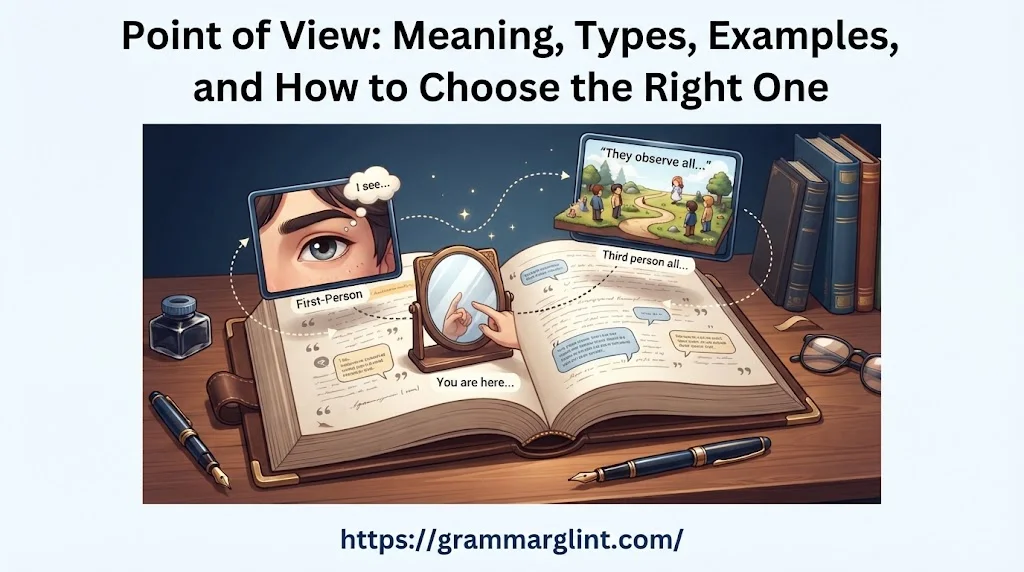
Think of point of view as a camera.
If the camera sits inside one character’s head, readers experience events through that character’s thoughts and senses. If the camera moves freely among several characters, readers gain a much wider view.
That choice changes the story.
Point of View Meaning in Simple Terms
A useful way to remember the concept is:
Point of view = the position or perspective from which something is presented.
For example:
First person: I opened the door and looked outside.
Second person: You open the door and look outside.
Third person: She opened the door and looked outside.
The event remains almost identical. The narrative position changes.
Although perspective, viewpoint, outlook, and standpoint can have similar meanings, they aren’t interchangeable in every context. The exact meaning depends on how you use the word.
Why It Matters in Writing
Point of view isn’t merely a grammatical choice. It controls the reader’s relationship with the information.
Suppose a character walks into a room and finds a broken window.
A first-person narrator might say:
I froze when I saw the broken glass. Someone had been inside.
A third-person limited narrator might write:
Daniel froze when he saw the broken glass. Someone had been inside.
An objective narrator could say:
Daniel stopped at the doorway. Glass covered the floor.
Notice what happens.
The first two versions give the reader access to an interpretation. The objective version gives observable information but doesn’t tell readers what Daniel thinks.
That difference creates different emotional effects.
Read More: Setup vs. Set Up: Which One Is Correct?
Point of View Controls Information
A writer decides not only how to tell a story but also what the reader can know.
This makes point of view especially important for:
- Suspense
- Mystery
- Character development
- Emotional intimacy
- Humor
- Dramatic irony
- Unreliable narration
- Persuasion
- Personal essays
- Memoirs
- Academic writing
- Journalism
- Instructional content
A carefully chosen perspective can make readers feel trapped inside a character’s fear. Another can make them feel like observers watching events unfold from a distance.
A useful metaphor is a window. The writer chooses the window through which the reader sees the story.
Change the window and you change the experience.
The Three Main Types
Most discussions of narrative point of view begin with three major categories:
- First person
- Second person
- Third person
Third person then divides into important subtypes, especially third-person limited, third-person omniscient, and third-person objective.
Here’s the basic comparison:
| Point of View | Common Pronouns | Narrator’s Position | Typical Effect |
| First person | I, me, my, we, our | Inside the story | Intimate and personal |
| Second person | you, your | Addresses the reader directly | Immediate and immersive |
| Third-person limited | he, she, they | Outside the story but close to one character | Focused and intimate |
| Third-person omniscient | he, she, they | Outside the story with broad knowledge | Wide-ranging and flexible |
| Third-person objective | he, she, they | Outside the story and limited to observable information | Detached and observational |
These categories provide a useful framework. Yet good writing often uses them with considerable flexibility.
First-Person Point of View
First-person point of view uses a narrator who speaks from their own position within the story.
The most recognizable pronouns include:
- I
- me
- my
- mine
- we
- us
- our
- ours
For example:
I stepped onto the platform and checked my watch. The train was already leaving.
The narrator experiences the event directly.
First-person narration often creates a strong sense of intimacy because readers receive information through the narrator’s consciousness. The narrator can describe personal thoughts, memories, fears, assumptions, and sensations.
However, first person also creates a natural limitation.
The narrator can’t automatically know everything.
If another character secretly leaves the room, the narrator won’t know why unless someone explains it or the narrator later discovers the reason.
That limitation can become a powerful storytelling tool.
Types of First-Person Narrators
First-person narration doesn’t always mean the narrator is the main character.
A first-person narrator may serve as:
- The protagonist
- A supporting character
- A witness
- An observer
- An unreliable narrator
Consider a detective story narrated by the detective’s assistant. The assistant may describe the detective’s actions while remaining unaware of the detective’s private reasoning.
That distance creates room for mystery.
Advantages of First-Person Point of View
First person works particularly well when you want to create:
- Emotional closeness
- A strong personal voice
- Subjective interpretation
- Immediate reactions
- Confessional storytelling
- Character-driven narratives
It also allows the narrator’s personality to shape the prose.
A nervous narrator may notice tiny threats everywhere. A sarcastic narrator may turn ordinary events into jokes. A grieving narrator may interpret familiar places differently.
The reader doesn’t simply learn what happened. The reader experiences what happened through someone.
Limitations of First-Person Point of View
The biggest limitation is restricted knowledge.
A first-person narrator can’t naturally reveal information they couldn’t reasonably know.
For example:
I didn’t know it then, but Sarah was secretly planning to leave the country.
This can work if the narrator is recounting the story years later and eventually learned the truth. Without that context, however, the sentence creates an information problem.
First-person narration therefore requires careful control of knowledge.
Second-Person Point of View
Second-person point of view speaks directly to the reader or treats “you” as the person experiencing the events.
For example:
You walk into the empty house and hear a noise upstairs.
The reader becomes the implied participant.
Second person appears less frequently in conventional novels than first or third person. However, it has important practical uses.
You’ll often encounter it in:
- Instructions
- Tutorials
- Guides
- Interactive fiction
- Self-help writing
- Advertising
- Games
- Choose-your-own-adventure stories
For example:
You press the reset button and wait ten seconds.
This style works because the writer directly places the reader inside the action.
Why Second Person Feels So Direct
Second person removes some distance between writer and reader.
Compare:
She should back up the files before installing the update.
with:
You should back up your files before installing the update.
The second sentence feels more direct because it addresses the reader personally.
That doesn’t automatically make second person better. It simply creates a different relationship with the audience.
When to Use Second Person
Use second person when the reader needs to do something, imagine something, or identify directly with an experience.
For example:
You open your laptop after a long day and notice three missed deadlines.
That sentence places the reader inside the situation immediately.
However, extended second-person narration can become tiring if the reader doesn’t accept the implied role.
Third-Person Point of View
Third-person point of view tells the story using character names and third-person pronouns such as he, she, and they.
For example:
Marcus entered the café and ordered a coffee.
The narrator isn’t necessarily a character in the story.
Third person gives writers considerable flexibility. It can remain tightly focused on one character or expand to include several characters and events.
The major forms include:
- Third-person limited
- Third-person omniscient
- Third-person objective
These modes can look similar on the surface. Their knowledge and access differ significantly.
Read More: Williams’ or Williams’s? Here’s the Possessive Form
Third-Person Limited Point of View
Third-person limited, sometimes called close third, follows one character’s experience closely while still using third-person grammar.
For example:
Maya stared at the envelope. She wanted to open it, but something about the handwriting made her hesitate.
The narrator uses she rather than I. Yet readers remain close to Maya’s thoughts and feelings.
Third-person limited can create much of the intimacy associated with first person without requiring the narrator to speak as the character.
Why Writers Choose Third-Person Limited
This perspective offers a useful middle ground.
You get:
- Close character access
- Third-person pronouns
- Strong emotional connection
- Controlled information
- Flexibility to shift focus between sections
It also works particularly well for suspense.
If Maya doesn’t know who sent the letter, the reader doesn’t know either.
That shared uncertainty can keep readers turning pages.
Example of Third-Person Limited
Daniel heard footsteps behind him. His shoulders tightened. He wanted to look back, but he was afraid of what he might see.
The reader experiences the scene through Daniel.
The narration doesn’t reveal what the person behind him is thinking. It doesn’t even confirm who the person is.
That restriction creates tension.
Third-Person Omniscient Point of View
Third-person omniscient point of view gives the narrator broad knowledge of the story, including information characters may not possess.
An omniscient narrator can potentially reveal:
- Multiple characters’ thoughts
- Events occurring in different locations
- Past events
- Future consequences
- Background information
- Information unknown to the characters
For example:
Sarah smiled as she entered the room. Across town, Daniel was already packing his bags. Neither knew that their decision would change the family forever.
The narrator knows more than Sarah or Daniel.
That broader knowledge distinguishes omniscient narration from third-person limited narration.
Strengths of Third-Person Omniscient
Omniscient narration works well when a story requires:
- Multiple major characters
- Broad historical context
- Several locations
- Social commentary
- Large-scale events
- Multiple timelines
- Dramatic irony
It can make a story feel expansive.
Instead of looking through one keyhole, readers can see the entire building.
The Main Risk
Too much information can overwhelm readers.
If every character’s thoughts appear within the same scene, the narrative may lose focus. Readers can struggle to understand whose emotional journey matters most.
Omniscience creates freedom, but freedom needs control.
Third-Person Objective Point of View
Third-person objective narration presents events without directly revealing a character’s private thoughts.
It resembles a camera recording what happens.
For example:
James entered the room. He placed the envelope on the table. Sarah looked at it but didn’t touch it.
The narration reports visible actions.
It doesn’t say:
James felt nervous.
Instead, it shows behavior from which readers can infer emotion.
This technique can create a restrained, observational effect.
The approach can be especially effective when a writer wants readers to interpret behavior rather than receive an explanation of every emotion.
Point of View vs. Perspective
These terms overlap, which causes plenty of confusion.
Point of view usually identifies the position or narrative standpoint from which something is presented.
Perspective often refers to the way someone interprets or understands what they see.
A simple distinction helps:
| Term | Basic Idea | Example |
| Point of view | Who presents or experiences the information | The story uses first person |
| Perspective | How that person interprets the information | The narrator sees the event as unfair |
| Viewpoint | The position from which something is considered | The story follows a child’s viewpoint |
| Opinion | A judgment or belief | She thinks the decision was wrong |
In literary analysis, the terms can overlap. In practical writing, context usually makes the intended meaning clear.
Point of View vs. Viewpoint
Viewpoint is very close to point of view.
For example:
From the customer’s point of view, the process is confusing.
From the customer’s viewpoint, the process is confusing.
Both sentences work.
The difference is often one of usage rather than meaning. Point of view is especially common when discussing narrative technique, while viewpoint frequently describes someone’s position or perspective on an issue.
Point of View vs. Voice
Another important distinction involves voice.
Point of view answers:
Who is seeing or telling the story?
Voice answers:
How does the narration sound?
Consider two first-person narrators.
I entered the room. Everything looked ordinary.
I shuffled into that miserable little room, where even the wallpaper seemed determined to insult me.
Both use first-person point of view.
Their voices, however, are completely different.
One sounds neutral. The other sounds sarcastic and opinionated.
So, point of view and voice work together, but they aren’t identical.
How It Changes the Same Story
One event can become several different stories depending on who tells it.
Imagine a student arriving late to class.
First Person
I ran through the hallway, already knowing I’d missed the quiz.
The narrator shares the student’s immediate experience.
Second Person
You race down the hallway, hoping the teacher hasn’t started the quiz.
The reader becomes the participant.
Third-Person Limited
Amir hurried down the hallway. He knew the quiz had already started.
The narration stays close to Amir.
Third-Person Omniscient
Amir hurried toward the classroom, convinced he had missed the quiz. Inside, however, the teacher was still waiting for the students to settle down.
The reader knows something Amir doesn’t know.
Third-Person Objective
Amir ran down the hallway. He stopped outside the classroom, took a breath, and opened the door.
The narration reports what can be observed.
Same event. Different information. Different emotional effect.
That’s the real power of point of view.
How It Affects the Reader
A well-chosen point of view shapes what readers feel and believe.
It Controls Emotional Distance
First person can place readers extremely close to a character.
Third-person objective can create more distance.
Neither is automatically superior.
A horror story might benefit from close first-person narration because fear becomes immediate. A historical account might benefit from a more detached perspective because the writer needs room for context and evidence.
It Controls Suspense
Suspense often depends on information management.
If readers know that someone is hiding behind the door while the protagonist doesn’t, the situation becomes tense.
That’s dramatic irony.
If readers know only what the protagonist knows, they experience uncertainty alongside the character.
Point of view determines which version you get.
It Controls Sympathy
Readers tend to understand characters more deeply when they receive access to their thoughts, fears, motivations, and memories.
A character who seems cruel from the outside may appear completely different once readers understand why they act that way.
This doesn’t mean readers will agree with the character.
Understanding and agreement are two different things.
In Academic Writing
Point of view also matters outside fiction.
Academic writing generally values clarity, precision, and an appropriate relationship between the writer and the evidence. The correct perspective depends on the discipline, assignment, and required style.
For example:
I analyzed the survey responses.
can be perfectly appropriate when the writer actually performed the analysis.
Compare it with:
The researcher analyzed the survey responses.
The first version is direct and transparent. The second creates greater distance.
Neither sentence is automatically better.
The assignment and discipline determine which approach fits.
Point of View in Different Types of Writing
| Writing Type | Common Point of View | Why |
| Memoir | First person | Personal experience |
| Personal essay | First person | Reflection and lived experience |
| Fiction | First or third person | Narrative flexibility |
| Instructions | Second person | Direct guidance |
| Research paper | Discipline-dependent | Precision and transparency |
| News reporting | Usually third person | Reportorial distance |
| Business report | Usually third person or institutional voice | Formal clarity |
| Opinion article | First or third person | Argument and perspective |
There isn’t a single perspective that works everywhere.
Purpose should drive the choice.
How to Choose the Right
Choosing a narrative perspective becomes easier when you ask the right questions.
Start With the Story’s Center
Ask:
Whose experience matters most?
If the story revolves around one character’s emotional journey, first person or third-person limited may work well.
If the story follows several equally important characters, third person may provide more flexibility.
Decide How Much the Reader Should Know
Ask:
Should the reader know more than the characters?
If yes, omniscient narration may work.
If no, limited narration can preserve uncertainty.
For a mystery, restricted information can be extremely valuable.
Consider Emotional Distance
Ask:
Do readers need to feel the character’s emotions directly?
If yes, first person or close third can create intimacy.
If the writing needs a more observational tone, objective third person may work better.
Consider Your Audience
A technical guide that says:
You should restart the device before changing the settings.
feels natural because the reader needs direct instructions.
A research report may require a different rhetorical approach.
Audience and purpose should work together.
A Decision Guide
Use this quick framework:
What are you writing?
|
+—————–+—————–+
| | |
Personal Fiction Instructions
| | |
First person Who leads? Second person
|
+————–+————–+
| |
One focus Several focuses
| |
First or close Third person
third
|
How much does narrator know?
|
+———–+———–+
| |
Limited Broad
| |
Third limited Third omniscient
This isn’t a rigid formula. It’s a practical starting point.
Common Mistakes
Even experienced writers can weaken a piece by shifting perspective without control.
Sudden POV Switching
Consider:
Maria entered the restaurant. She wondered whether Daniel had arrived. Daniel hated waiting for people and had already decided to leave.
The passage begins close to Maria and suddenly enters Daniel’s thoughts.
That shift can feel accidental.
A cleaner approach would establish a deliberate scene change before moving into Daniel’s perspective.
Head-Hopping
Head-hopping occurs when narration jumps rapidly between different characters’ private thoughts without a clear structural reason.
For example:
Sarah worried that Tom was angry. Tom wondered why Sarah looked nervous. Their waiter hoped they wouldn’t start arguing.
Three minds appear almost instantly.
That can work in some forms of omniscient narration. In close third person, however, it can confuse readers.
Confusing the Narrator With the Author
The narrator isn’t necessarily the author.
A fictional narrator can:
- Lie
- Misunderstand events
- Omit information
- Exaggerate
- Misinterpret other characters
- Contradict known facts
This creates the unreliable narrator.
A narrator saying something doesn’t automatically make it true.
Giving the Narrator Impossible Knowledge
A limited narrator shouldn’t suddenly know something they couldn’t possibly know.
For example:
Jake walked past the house. Inside, Mrs. Carter worried that someone had followed him.
If the narration follows Jake closely and has no established omniscient perspective, the sudden access to Mrs. Carter’s thoughts creates a point-of-view problem.
Mixing First and Third Person Without Purpose
Switching from:
I opened the door.
to:
She stepped into the hallway.
without a deliberate structural reason can make readers wonder whether the mistake belongs to the character, narrator, or writer.
Consistency matters.
In Nonfiction
Nonfiction also depends heavily on perspective.
A memoir naturally centers the writer’s experience:
I remember standing outside the hospital that morning.
A historical article may use third person:
The workers arrived at the factory before sunrise.
A personal analysis might use first person:
I argue that the policy created unintended consequences.
The correct choice depends on the relationship between the writer and the subject.
Point of View Doesn’t Automatically Determine Bias
A common misconception is that third person always means objective writing.
It doesn’t.
A third-person narrator can strongly favor one character.
For example:
Robert entered the room, his usual habit of ignoring everyone on display once again.
The narrator uses third person but clearly expresses judgment.
Likewise, first person isn’t automatically unreliable or biased.
Grammar tells you the narrative person. Context reveals the perspective and bias.
In Journalism
Journalistic writing often uses third person because it creates distance between the reporter and the subject.
For example:
The committee approved the proposal on Tuesday.
The sentence focuses on the event.
However, journalistic objectivity isn’t created simply by avoiding “I.” A writer can still select facts, quotations, sources, and framing in ways that influence interpretation.
That makes point of view a useful concept when analyzing news.
Ask:
- Whose voices appear?
- Whose voices are missing?
- What information receives emphasis?
- Which facts appear first?
- What context does the writer provide?
- How does the headline frame the event?
Point of view operates at the level of selection as well as grammar.
Case Study: One Event, Three Perspectives
Imagine a school announces that students must stay after class for an extra hour.
Student’s First-Person Perspective
I couldn’t believe they were making us stay another hour. I had already planned my entire evening around getting home early.
The focus is personal inconvenience.
Principal’s Third-Person Perspective
The principal knew the schedule change would frustrate students, but she believed the additional hour was necessary to prepare them for the examination.
The focus shifts toward institutional reasoning.
Objective Perspective
The principal announced that students would remain at school for an additional hour. Several students complained after the announcement.
This version reports observable events.
None of these accounts automatically tells the complete truth.
Each one highlights a different slice of reality.
That is why point of view matters when readers compare accounts of the same event.
Examples in Literature
Literary works offer countless demonstrations of narrative perspective.
The Great Gatsby uses Nick Carraway as a first-person narrator. His position as both participant and observer shapes how readers understand Gatsby and the surrounding characters.
Moby-Dick famously begins with Ishmael’s first-person narration. His voice and observations become part of the experience of the novel.
Third-person narration offers a different range. Many classic novels use third-person narration to combine external description with access to a character’s thoughts.
The lesson isn’t that one method is better.
The lesson is that narrative form becomes part of meaning.
A Quick Comparison
| Type | Pronouns | Knowledge | Emotional Closeness | Best Suited For |
| First person | I, me, we | Usually limited | High | Memoirs, personal fiction |
| Second person | You, your | Usually directed at reader | Very high | Guides, interactive writing |
| Third limited | He, she, they | Focused | High | Character-driven fiction |
| Third omniscient | He, she, they | Broad | Variable | Large-scale narratives |
| Third objective | He, she, they | Observable facts | Lower | Detached narratives |
FAQs
1. What is point of view?
Point of view is the perspective from which a story is told. It shows who is telling the story and how the reader experiences the events.
2. What are the three main types of point of view?
The three main types are first person, second person, and third person. Each one gives the reader a different way to experience the story.
3. What is first-person point of view?
First person uses words such as “I,” “me,” and “my.” The narrator tells the story from their own perspective.
4. What is second-person point of view?
Second person speaks directly to the reader using “you.” It makes the reader feel more personally involved in the story.
5. What is third-person point of view?
Third person tells a story about other people using words such as “he,” “she,” and “they.” The narrator remains outside the story.
6. Why is point of view important?
Point of view affects how the reader interprets characters, events, and important details. It also controls what information the reader can receive.
7. Can point of view be used in poetry?
Yes. In poetry, point of view can describe the speaker’s viewpoint or perspective. The speaker isn’t necessarily the author.
8. What is the narrator’s role in point of view?
The narrator is the voice that tells the story. The narrator’s position determines what the reader knows about the story and its characters.
9. What happens when point of view goes wrong?
An inconsistent point of view can confuse the reader and weaken trust. It may also damage the suspension of disbelief.
10. How can writers choose the right point of view?
Writers should consider who needs to tell the story and what the reader needs to know. Using common sense and understanding POV rules can make the choice easier.
Conclusion
Point of view gives every story a particular perspective and determines how readers connect with its characters, events, and information. Whether a writer chooses first person, second person, or third person, the choice can strongly shape the reader’s experience.
A clear point of view also helps writers maintain trust and avoid common POV pitfalls. By understanding the narrator, speaker, and amount of available information, writers can create stories and poems that feel natural, focused, and easy to follow.

For Shafiq ur Rehman, writing is an art form and grammar is the toolbox that makes it beautiful. As a dedicated content writer at Grammar Lantern, Shafiq approaches every topic like an architect carefully laying down strong foundations of understanding before adding the finer details. He loves diving into the trickiest grammar points and resurfacing with simple, bite-sized takeaways that anyone can grasp. When he’s not crafting articles, you’ll likely find him strategizing over a game of chess, exploring dusty local bookshops, or quietly jotting down poetic observations in his notebook.
[…] Read More: Point of View: Meaning, Types, and How to Choose the Right One […]