When writing an email or checking formal writing, choosing the right preposition after answer can prevent a common issue. Answer To, For, Or Of the Question? becomes easier when you consider the meaning and context. In standard English usage, answer to normally connects an answer with a question. An answer for can refer to a person, responsibility, or situation, while answer of is less common in this meaning. This distinction helps explain the rules of grammar and makes the correct choice clearer.
In business communication, meetings, project management, scheduling, time management, online booking, and broadcasting, precise language helps prevent misunderstandings. I find that checking the intended meaning first makes it easier to choose between prepositions and maintain consistency in written communication and spoken communication. The same method works when creating content for a calendar or shared calendar.
A useful guide should include practical examples, usage tips, and common mistakes while explaining the exact difference between answer to, answer for, and answer of. With care, the right form can improve professionalism, strengthen formal writing skills, and build a stronger grasp of language. These skills support professional communication, everyday conversation, and other real-world communication.
Quick Answer
The correct phrase for a response to a question is “answer to the question.”
| Expression | Correct for meaning “a response to a question”? | Main use |
| answer to the question | Yes | A response to a question |
| answer for the question | Usually no | Speaking for someone or being responsible |
| answer of the question | No, not in this meaning | Requires a different grammatical relationship |
Here are three quick examples:
- Correct: “What is the answer to the question?”
- Usually incorrect for this meaning: “What is the answer for the question?”
- Not standard for this meaning: “What is the answer of the question?”
There’s another important construction to remember:
I answered the question.
Here, answer is a verb. It doesn’t need to before the direct object the question.
So the easiest rule is:
Noun: an answer to a question
Verb: answer a question
That distinction solves most cases.
Why “Answer To the Question” Is Correct
The phrase “answer to the question” follows a standard English pattern in which to connects something with the thing it addresses, responds to, or corresponds to.
When answer functions as a noun, the question becomes the target or subject of that answer. That’s why English naturally says:
- an answer to a question
- a reply to a question
- a response to a question
- a solution to a problem
For example:
“Her answer to the question was surprisingly detailed.”
The noun answer identifies the response. The prepositional phrase to the question tells you which question that response addresses.
The same structure appears in countless everyday sentences:
- “I don’t know the answer to this question.”
- “He gave a clear answer to my question.”
- “There are several possible answers to the question.”
- “The teacher explained the answer to the problem.”
- “We finally found an answer to the problem.”
Think of to as pointing toward the question. The answer is directed toward it.
A Simple Grammar Pattern
You can remember the structure this way:
answer + to + question
For example:
answer + to + the question
Or:
an answer + to + your question
This pattern works whether the question comes from a teacher, customer, interviewer, colleague, friend, or reader.
“Answer To the Question” Meaning and Usage
“Answer to the question” means the response that addresses a particular question.
The word answer can refer to a piece of information, an explanation, a solution, or a response that resolves what someone asked.
For example:
“The answer to the question is 42.”
Here, answer refers to the information that resolves the question.
In another sentence, the answer might be more complicated:
“Her answer to the interviewer’s question included several examples.”
The phrase doesn’t necessarily mean there’s only one possible answer. It simply identifies the response connected to that question.
In Everyday Conversation
You might use the phrase when discussing something someone has asked:
“I don’t have an answer to your question yet.”
Or:
“That’s an interesting answer to a difficult question.”
The construction sounds completely natural in casual conversation.
In Academic Writing
The phrase also works naturally in formal contexts:
“The answer to this question depends on the context.”
“Students should explain their answer to each question.”
“The study provides an answer to an important research question.”
There’s no need to replace answer to with a more complicated expression simply because the writing is formal.
Read More: Preform or Perform: Which Word Is Correct?
In Professional Communication
You can use it in emails, reports, meetings, and presentations:
“Here is the answer to your question.”
“We have prepared answers to the questions raised during the meeting.”
“The following section provides an answer to the customer’s concern.”
The phrase is versatile because its grammar doesn’t depend on the level of formality.
“Answer For the Question”: When Can It Be Used?
Here’s where things get interesting. Answer for isn’t inherently ungrammatical. The problem occurs when you use it to mean “the answer to the question.”
In standard usage, you normally don’t say:
“I need the answer for the question.”
Instead, say:
“I need the answer to the question.”
The preposition for creates a different relationship.
For example:
“I’ll answer for my colleague.”
This can mean that the speaker will respond on the colleague’s behalf.
Another example is:
“Who will answer for the team?”
Here, the person may be speaking as the team’s representative.
“Answer For” Can Mean Responsibility
The expression answer for can also relate to responsibility or accountability.
Consider:
“He will have to answer for his actions.”
This doesn’t mean that he will provide a response to a question. It means he’ll be held responsible for what he did.
Similarly:
“The manager must answer for the company’s decision.”
The meaning is closer to explain or take responsibility for something.
Compare the Meanings
| Phrase | Meaning |
| answer to a question | Provide a response |
| answer for someone | Speak or respond on someone’s behalf |
| answer for something | Take responsibility or provide an explanation |
This distinction matters because replacing to with for can change the meaning rather than simply create a different spelling preference.
“Answer Of the Question”: Is It Grammatically Correct?
“Answer of the question” isn’t the standard English expression when you mean the response to a question.
For that meaning, use:
the answer to the question
The issue comes from treating of as though it can replace to. English prepositions don’t work that way. You can’t normally swap one for another just because both connect two nouns.
For example:
the answer to the question ✅
the answer of the question ❌ for the intended meaning
However, of can appear around the word answer when it establishes another relationship.
For example:
“The answer of the student surprised the teacher.”
This sentence can be grammatically possible, depending on context and intended meaning. Here, of the student identifies whose answer it is.
Similarly:
- the wording of the question
- the meaning of the question
- the subject of the question
- the author of the answer
These constructions use of for relationships that differ from the relationship between an answer and the question it addresses.
Why “Of” Doesn’t Work Here
If you’re describing a response directed toward a question, English conventionally uses to.
It’s similar to other established combinations:
- solution to a problem
- response to a complaint
- reply to an email
- reaction to an event
- answer to a question
Prepositions are often tied to particular words and meanings. Learning these combinations as natural patterns is much more useful than trying to translate them word-for-word from another language.
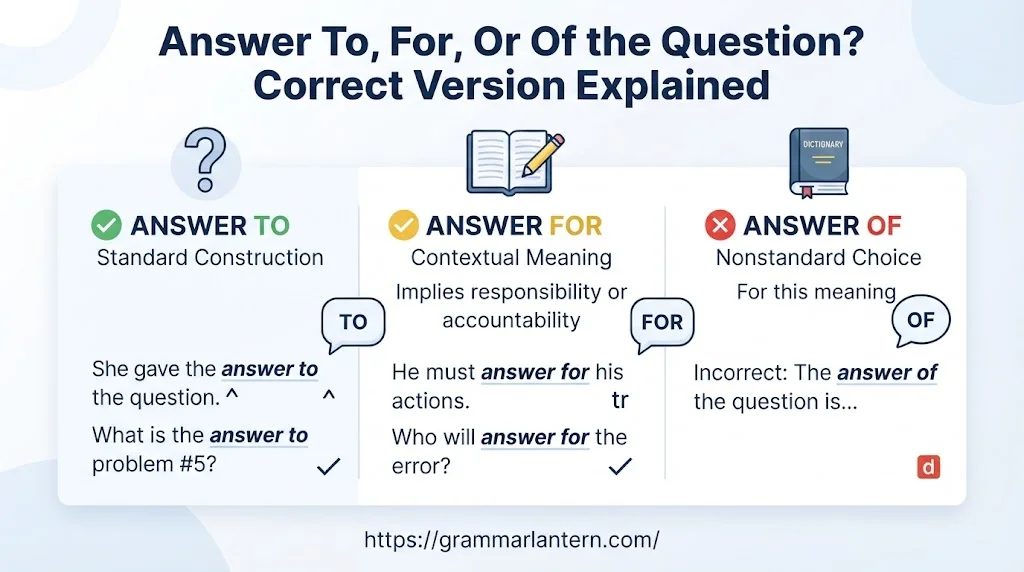
Answer To vs. Answer For vs. Answer Of
The differences become clearer when you place the expressions side by side.
| Expression | What it normally means | Example |
| answer to the question | A response to a question | “I know the answer to the question.” |
| answer for someone | Respond on another person’s behalf | “She answered for her colleague.” |
| answer for something | Accept responsibility or account for something | “He must answer for his decision.” |
| answer of the question | Not the standard construction for a response | Use “answer to the question” instead |
The key isn’t simply memorizing three prepositions. It’s understanding the relationship each one creates.
To connects the answer with the question it addresses.
For can indicate representation or responsibility.
Of commonly indicates possession, association, origin, or another relationship, but it doesn’t normally introduce the question being answered.
Common Examples
Seeing the phrase in different situations makes its usage easier to recognize.
Everyday Examples
“What’s the answer to your question?”
“I don’t know the answer to that question.”
“She gave me a thoughtful answer to my question.”
“There’s no simple answer to this question.”
Notice how naturally to fits each sentence.
School and Exam Examples
“Write your answer to each question clearly.”
“Check your answer to the first question.”
“The teacher discussed the correct answer to the question.”
“Students should provide an answer to every question.”
In educational writing, answer to is especially common because students regularly respond to questions.
Workplace Examples
“We need an answer to the client’s question.”
“I’ll send you the answer to your question this afternoon.”
“The report contains answers to the questions raised by the committee.”
“The support team provided an answer to the customer’s concern.”
These examples show that the construction works naturally in professional communication.
Common Mistakes
The most frequent mistake involves choosing a preposition based on intuition rather than established usage.
“Answer Of the Question”
Incorrect for the intended meaning:
“I know the answer of the question.”
Better:
“I know the answer to the question.”
“Answer For the Question”
Usually incorrect when you mean a response:
“She gave an answer for the question.”
Better:
“She gave an answer to the question.”
However, don’t assume answer for is always wrong. Its meaning changes when for indicates representation or responsibility.
Confusing the Noun and Verb
Compare these sentences:
“I know the answer to the question.”
“I can answer the question.”
The first sentence uses answer as a noun. The second uses answer as a verb.
That’s one of the most useful distinctions in this entire topic.
Answer To the Question vs. Answer the Question
These two structures are both correct, but their grammar differs.
“Answer To the Question”
Here, answer is a noun.
“She gave an answer to the question.”
The noun needs the preposition to to introduce the question being addressed.
“Answer the Question”
Here, answer is a verb.
“She answered the question.”
The question functions as the direct object of the verb answered.
You can think of the difference like this:
| Noun construction | Verb construction |
| an answer to the question | answer the question |
| a reply to the question | reply to the question |
| a response to the question | respond to the question |
This comparison reveals something important. English doesn’t apply one preposition to every related word.
For example, answer as a verb can take a direct object:
“Please answer my question.”
But respond normally takes to:
“Please respond to my question.”
Learning the grammatical pattern of each word prevents many preposition errors.
Answer To the Question vs. Response To the Question
Answer to the question and response to the question are closely related.
An answer usually addresses the information requested by a question. A response can be broader.
For example:
“What time does the store close?”
A direct answer might be:
“It closes at 9 p.m.”
A response could include that information plus additional explanation.
The distinction becomes more noticeable when someone reacts without directly providing the requested information.
For example:
“Why did you leave the meeting?”
Someone might respond:
“I had another appointment.”
That’s a response to the question. Depending on context, it can also serve as an answer.
The important grammatical point remains unchanged:
answer to the question
response to the question
Both use to in their noun forms.
“The Answer to Your Question” vs. “An Answer to Your Question”
The articles the and an can also change the nuance.
“The Answer to Your Question”
Use the when you’re referring to a particular answer.
“The answer to your question is yes.”
The speaker treats the answer as a specific piece of information.
“An Answer to Your Question”
Use an when you’re presenting one possible answer.
“I can offer an answer to your question.”
This wording can suggest that other answers or interpretations may exist.
Consider a question such as:
“Why do people learn another language?”
There might not be one universal answer. You could say:
“There are several answers to this question.”
That sentence is perfectly natural because the plural answers allows multiple possibilities.
Prepositions With “Answer”: A Clear Grammar Guide
The word answer appears in several useful structures. Each one has its own meaning.
Answer To Something
Use to when the noun identifies what the answer addresses.
“This is the answer to the problem.”
“She found an answer to the question.”
“We need an answer to the complaint.”
Answer Someone
Use answer directly when it functions as a verb and takes a person as its object.
“I answered the teacher.”
“She answered her manager.”
This can mean responding to what the person said or asked.
Answer Something
The verb can also take a question or request directly:
“Please answer the question.”
“He answered the email.”
“She answered the phone.”
The exact meaning depends on the object.
Answer For Someone
For can indicate that someone responds on another person’s behalf.
“I’ll answer for him.”
This isn’t equivalent to answer to him.
Answer For Something
This construction can indicate responsibility:
“The director must answer for the decision.”
Again, this has nothing to do with choosing a preposition for answer to the question.
Read More: Setup vs. Set Up: Which One Is Correct?
Formal and Informal Usage
One useful feature of answer to the question is its flexibility.
You don’t need to change the phrase when moving from casual conversation to formal writing.
Informal
“What’s the answer to this question?”
Professional
“Here is the answer to your question.”
Academic
“The findings provide an answer to the central research question.”
Technical
“The equation provides an answer to the stated problem.”
The wording remains stable because answer to is a standard grammatical combination.
A Practical Case Study: Choosing the Right Preposition
Imagine you’re writing an email to a customer.
The customer asks:
“When will my order arrive?”
You want to mention the information you’ve prepared.
You could write:
“Here is the answer to your question.”
That’s the natural choice because you’re providing a response.
Now imagine your colleague asks you to respond on their behalf.
You might say:
“I’ll answer for my colleague.”
The meaning has changed. You’re now acting as the representative.
Finally, imagine a manager wants an explanation for a controversial decision:
“The manager must answer for the decision.”
Here, answer for expresses responsibility.
This simple scenario shows why the prepositions shouldn’t be treated as interchangeable.
How to Remember the Correct Preposition
Here’s the easiest memory trick:
You give an answer to a question.
When answer is a noun and question is the thing being addressed, use to.
You can also remember the pattern through related expressions:
- answer to a question
- response to a question
- reply to a question
- solution to a problem
Then remember that answer for has its own meanings.
For example:
“She answered for her brother.”
That’s about representation.
And:
“He must answer for his actions.”
That’s about responsibility.
The phrase answer of the question doesn’t serve the normal “response to a question” meaning.
Quick Memory Chart
| If you mean… | Use… |
| A response to a question | answer to the question |
| Speaking on someone’s behalf | answer for someone |
| Taking responsibility | answer for something |
| A question being directly acted upon by the verb | answer the question |
FAQs
1. Is “answer to the question” correct?
Yes. Answer to the question is the standard and most natural expression when referring to a response to a question.
2. Should I say “answer for the question”?
Usually, no. Answer for is generally used when referring to a person, responsibility, or something being represented rather than directly responding to a question.
3. Is “answer of the question” grammatically correct?
Answer of the question is generally not the natural choice in standard English. Answer to the question is normally preferred.
4. What does “answer for” mean?
Answer for can mean being responsible for something or speaking on someone else’s behalf. For example, “I cannot answer for my colleague.”
5. Can “answer to” be used with something other than a question?
Yes. Answer to can describe a response to a problem, need, request, or situation. For example, “This may be the answer to our problem.”
6. Why is “answer to” more common?
The preposition to shows that the answer is directed toward a question or issue. This makes the relationship between the question and response clear.
7. Can “answer of” ever be correct?
Yes, but its meaning and structure can differ from answer to. In ordinary writing, however, answer of the question is usually not the expression you want.
8. Which phrase should I use in formal writing?
Use answer to the question when you mean a response to a question. It is clear, natural, and widely accepted.
9. Is “the answer to a question” different from “the answer for someone”?
Yes. The answer to a question refers to a response, while the answer for someone can indicate responsibility or speaking on another person’s behalf.
10. How can I remember the correct expression?
Think of the question as something you respond to. This simple association makes answer to easier to remember and use correctly.
Conclusion
Choosing between answer to, answer for, and answer of becomes much easier when you focus on meaning and context. Answer to is the normal choice when referring directly to a question, while answer for has different meanings related to responsibility or representation. Answer of is uncommon in this particular structure.
A small preposition can change how natural a sentence sounds. By paying attention to context and common English usage, you can make your writing clearer and more professional. Whether you are writing an email, preparing formal content, or speaking in everyday conversation, choosing the appropriate expression helps your message sound confident and natural.

Muhammad Haroon is the voice behind many of the clear, practical grammar guides you’ll find on Grammar Lantern. With a strong background in content writing and a genuine love for the English language, Haroon specializes in breaking down intimidating grammar topics into simple, digestible lessons. His goal is simple: to empower readers to write with confidence and clarity. Whether he’s explaining tricky tenses or demystifying punctuation, Haroon approaches each topic with patience, precision, and a touch of warmth—because he knows that learning grammar is a journey, not a race.



[…] Read More: Answer To, For, Or Of the Question? Correct Version Explained […]